The Complete Jewelry Pouch Size Guide: Standard Dimensions for Every Jewelry Type
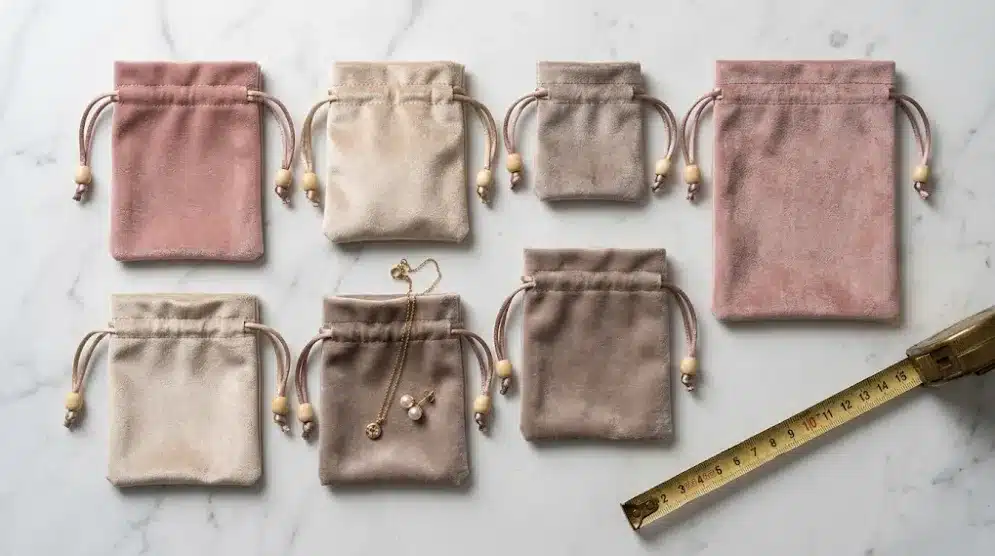
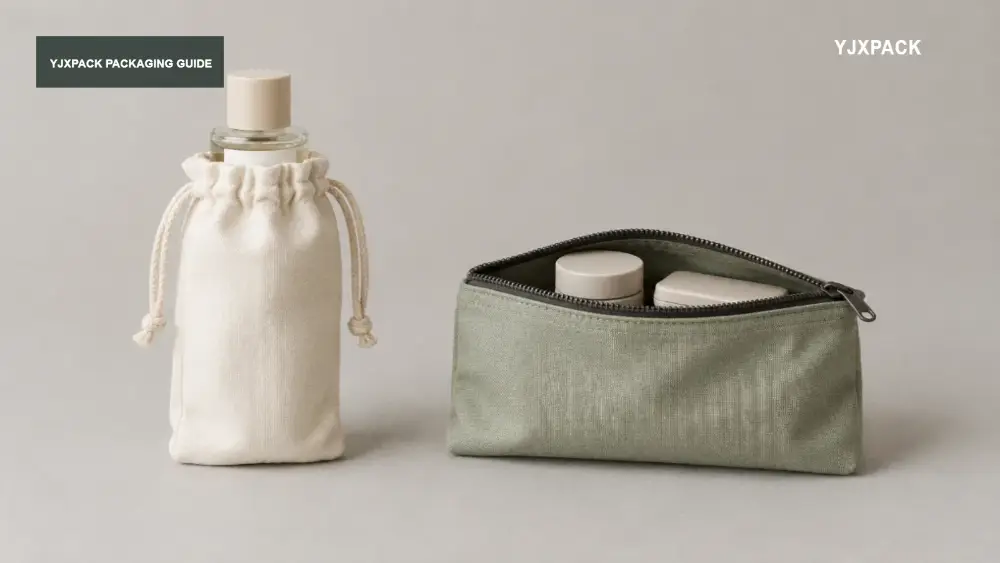
Editorial product photography showing the full range of jewelry pouch sizes used in fabric packaging for brand sourcing.
You’re sourcing jewelry packaging for the first time. As you scroll through a supplier’s catalog, dozens of sizes appear — 7×8 cm, 8×12 cm, 10×15 cm, and more. They all look similar, so you pick a “medium” and move on. Naturally, that feels like the safe choice.
In fact, most new brand owners do exactly this. They guess a pouch size in five minutes and ship the order. However, the wrong size quietly damages your brand. A tight pouch scratches plated rings during transit. Meanwhile, a loose one bounces the piece around and feels cheap when the customer opens the gift.
This article fixes that. In plain English, with no jargon, you’ll learn three things. First, the standard dimensions for every major jewelry type. Second, how to measure your own pieces correctly. Third, when custom sizing is worth the extra cost — and when it isn’t. By the end, you’ll have a complete jewelry pouch size guide you can share with your sourcing team.
1. Why Pouch Sizing Matters More Than You Think
Most buyers treat pouch sizing as a small detail. Yet the size you choose shapes three big parts of your business at once: product safety, brand perception, and shipping cost. Let’s break each one down.
The cost of getting it wrong. A pouch that hugs your jewelry too tightly causes friction. Over a long ocean voyage, that friction creates tiny scratches on plated rings and dulls polished surfaces. As a result, returns go up and your reputation takes a hit. By contrast, a pouch that’s too big lets your piece bounce around, which can bend prongs or tangle delicate chains.
What customers subconsciously notice. Open any luxury jewelry pouch, and you’ll see the piece sits perfectly centered with about a finger’s width of room on each side. That “just right” feel signals craft and care to your customer. Meanwhile, an obviously oversized pouch reads as a bulk buy from a discount supplier. Even if your buyer can’t name the issue, they feel the difference.
The storage and shipping impact. Every extra centimeter of pouch width adds up. Over a 5,000-unit order, oversized jewelry pouches can raise your carton count by 15-20%. That means more pallets, higher freight bills, and more warehouse shelf space. Smart sizing saves real money at scale.
2. Standard Jewelry Pouch Sizes by Product Type
This is the core of the guide — the standard sizes our factory uses most often for each jewelry category. All measurements show both inches and centimeters, since US buyers prefer inches while European buyers prefer cm.
2.1 Ring pouch sizes
Standard: 2.75″ × 3.15″ (7 × 8 cm)
This size fits a single ring or a matched pair perfectly. However, vintage statement rings with raised stones or wide bands need a bigger pouch. For those, step up to 3.15″ × 3.94″ (8 × 10 cm). Engagement rings shipped with a certificate or care card also need the larger size, so the paper doesn’t bend.
2.2 Earring pouch sizes
Standard: 3.15″ × 3.15″ (8 × 8 cm)
Square pouches work beautifully for stud earrings and small hoops. By contrast, drop earrings and chandelier styles need a taller pouch — try 3.15″ × 4.7″ (8 × 12 cm) so the design hangs straight without tangling. Ear cuffs and ear climbers usually fit the standard square size.
2.3 Necklace and pendant pouch sizes
Standard: 3.15″ × 4.7″ (8 × 12 cm)
Most pendants on a 16-18 inch chain fold neatly into this size. For longer chains (20-24 inches), move up to 3.94″ × 5.9″ (10 × 15 cm). Meanwhile, multi-layer necklaces or chunky statement pieces fit best in 4.7″ × 6.7″ (12 × 17 cm), which gives each chain enough room to lie flat without crossing.
2.4 Bracelet pouch sizes
Standard: 3.94″ × 5.9″ (10 × 15 cm)
Chain bracelets and tennis bracelets coil comfortably inside. However, rigid bangles need a different shape — go with 4.7″ × 4.7″ (12 × 12 cm) so the bangle keeps its natural round form. Cuff bracelets need 4.7″ × 5.9″ (12 × 15 cm) since their open shape resists folding.
2.5 Watch pouch sizes
Standard: 4.7″ × 5.9″ (12 × 15 cm)
Women’s dress watches and slim leather-strap watches fit this size. By comparison, men’s sport watches and chronographs need 5.9″ × 7.9″ (15 × 20 cm) to fit the larger case and thicker strap. Always test with your specific watch model before placing a bulk order.
2.6 Jewelry set pouch sizes
Necklace + earring set: 4.7″ × 6.7″ (12 × 17 cm)
Necklace + earring + ring set: 5.9″ × 7.9″ (15 × 20 cm)
Set pouches often include interior dividers or pockets so pieces don’t touch. Therefore, talk to your supplier about velvet jewelry pouches with sewn-in slots, since these protect each piece and look upscale.
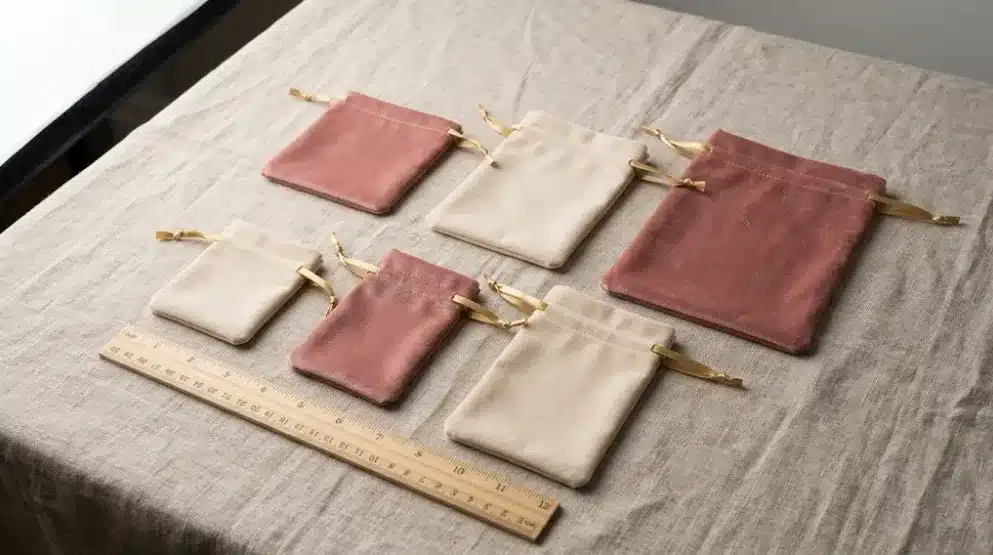
Side-by-side comparison of standard jewelry pouch sizes used for different product types in custom packaging sourcing.
3. The Jewelry Pouch Size Chart — Quick Reference
Save this chart or share it with your sourcing team. These dimensions cover 90% of standard jewelry packaging needs.
| Jewelry Type | Standard Size (inches) | Standard Size (cm) | Best For |
|---|---|---|---|
| Ring | 2.75″ × 3.15″ | 7 × 8 cm | Single rings, ring pairs |
| Statement Ring | 3.15″ × 3.94″ | 8 × 10 cm | Large stones, wide bands |
| Stud Earring | 3.15″ × 3.15″ | 8 × 8 cm | Studs, small hoops |
| Drop Earring | 3.15″ × 4.7″ | 8 × 12 cm | Dangles, chandeliers |
| Pendant Necklace | 3.15″ × 4.7″ | 8 × 12 cm | 16-18″ chains |
| Long Necklace | 3.94″ × 5.9″ | 10 × 15 cm | 20-24″ chains |
| Multi-Layer Necklace | 4.7″ × 6.7″ | 12 × 17 cm | Layered designs |
| Chain Bracelet | 3.94″ × 5.9″ | 10 × 15 cm | Tennis, chain styles |
| Bangle | 4.7″ × 4.7″ | 12 × 12 cm | Rigid bangles |
| Watch (Dress) | 4.7″ × 5.9″ | 12 × 15 cm | Dress, slim watches |
| Sport Watch | 5.9″ × 7.9″ | 15 × 20 cm | Chronographs, sport |
| Jewelry Set | 5.9″ × 7.9″ | 15 × 20 cm | Full sets with pockets |
Complete jewelry pouch size chart — covers 90% of standard sourcing needs
4. How to Measure Your Jewelry for the Right Pouch
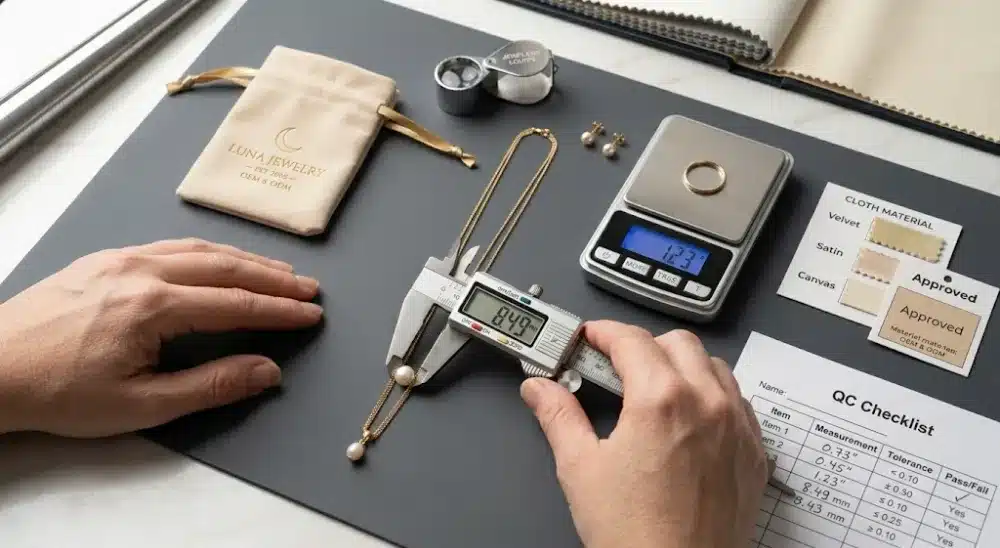
Standard sizes are a starting point, not a final answer. Your specific pieces may need slightly different dimensions. Here’s exactly how to measure jewelry for pouch sourcing.
4.1 Measure each piece correctly
Different jewelry types need different measuring methods. Specifically:
- Rings — measure the widest part of the band, including any stone setting. Then measure the height from base to top of the stone.
- Necklaces — don’t measure the full chain length. Instead, fold the necklace as it would sit in the pouch (usually doubled or coiled) and measure that folded footprint.
- Earrings — lay one earring flat and measure the longest dimension (top of post to bottom of drop).
- Bracelets — for chain bracelets, fold once and measure. Meanwhile, for bangles, measure the outer diameter.
- Watches — measure case diameter first, then measure the full strap when coiled.

4.2 The sizing formula
Once you have your jewelry measurements, use this simple formula:
Recommended pouch size = Largest jewelry dimension + 1.5 cm buffer + 0.5 cm for drawstring channel
For example, if your pendant measures 5 cm when folded, your pouch should be at least 7 cm tall (5 + 1.5 + 0.5 = 7 cm). The buffer matters because it lets the customer slide the piece in and out easily without snagging on the fabric.
4.3 Always order samples first
Before locking in a 5,000-piece production run, order samples in two or three sizes. Test each one with your real product. Furthermore, check how the pouch looks closed, opened, and during a mock unboxing. Spending $30 on samples can save you $5,000 in re-orders.
5. Custom vs. Standard Sizing — When to Choose Each
Both paths have their place. Picking the right one depends on your brand stage, order volume, and product mix.
5.1 When standard sizes work best
Stick with standard sizes when:
- Your product line is small (1-3 SKUs).
- Your MOQ is under 1,000 pieces.
- You need fast delivery (under 3 weeks).
- You’re testing a new product before scaling.
- Budget is tight and you want to minimize tooling fees.
Standard sizes ship faster because suppliers often keep blank stock ready for logo customization only.
5.2 When custom sizes are worth the investment
Custom sizing pays off when:
- Your jewelry has non-standard proportions (oversized statement pieces, long pendants).
- You want a “perfectly fitted” luxury feel.
- Your order quantity is 1,000+ pieces, which spreads custom setup costs across more units.
- You’re building a multi-piece set with specific internal pockets.
- You need a unique pouch shape (wallet-style, envelope, drawstring + flap combo).
At YJXpack, we offer custom sizing starting at MOQ 100 pieces, with sample lead times of 1-3 days. Our team handles design, prototyping, and production in one place — no middleman markup.
6. How Material Choice Affects Sizing
Many buyers don’t realize this — the same jewelry piece needs different pouch sizes depending on the fabric. Material thickness, stretch, and stiffness all change what “the right size” really means.
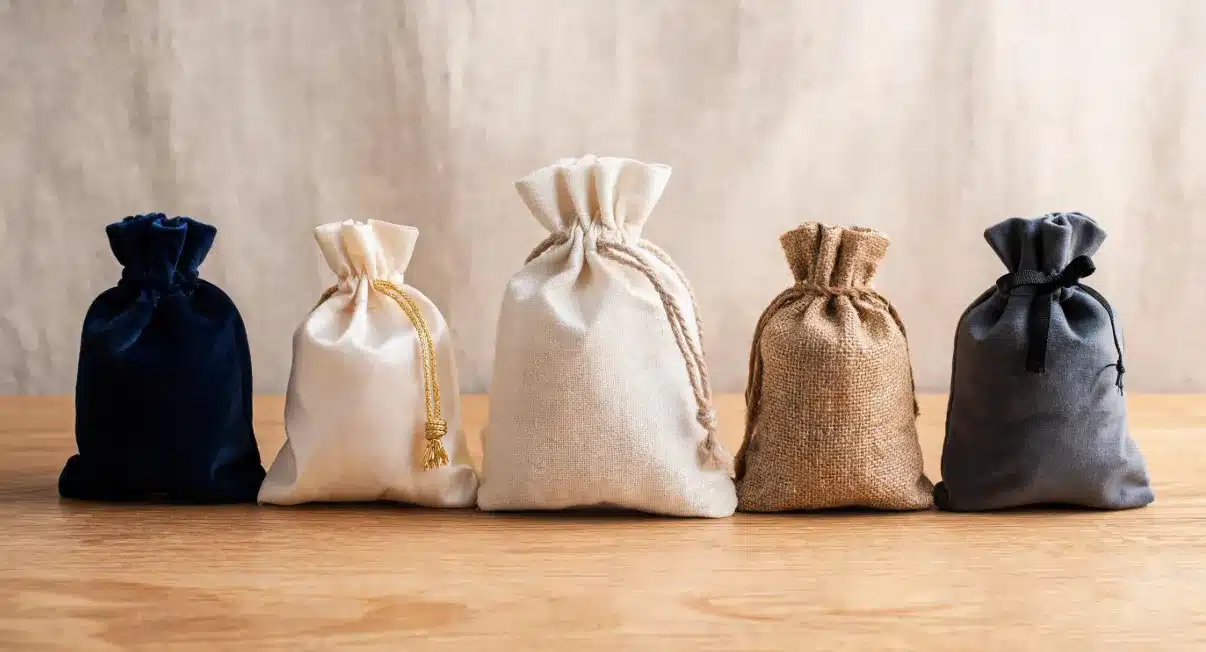
Visual reference for B2B buyers comparing fabric options for custom jewelry pouches.
6.1 Velvet (plush, soft material)
Velvet has noticeable thickness and gives the pouch real structure. As a result, you need to add 5-10% extra interior space compared to thinner fabrics. For instance, a 7 × 8 cm velvet pouch fits the same ring as a 6.5 × 7.5 cm satin pouch.
6.2 Microfiber (soft, suede-like texture)
Microfiber drapes softly and hugs the jewelry shape. Therefore, you can size more snugly without scratching. This material is great when you want a compact, modern look. Browse microfiber jewelry bags for fitted, premium-feel packaging.
6.3 Cotton and canvas
Cotton is medium-thickness and tends to shrink 2-3% after the first wash or steam. So always order pouches slightly larger than your final target. Cotton works well for eco-friendly brands and bohemian aesthetics.
6.4 Satin and silk
Satin is thin and smooth, allowing the tightest fit. However, satin shows wrinkles easily, so leave just enough room that the fabric stays smooth around the jewelry. Satin pouches are popular for wedding favors and luxury gift sets.
7. Size Considerations for Different Use Cases
Where and how your pouch gets used also shapes which size you should pick. The same product type may need different dimensions across different sales channels.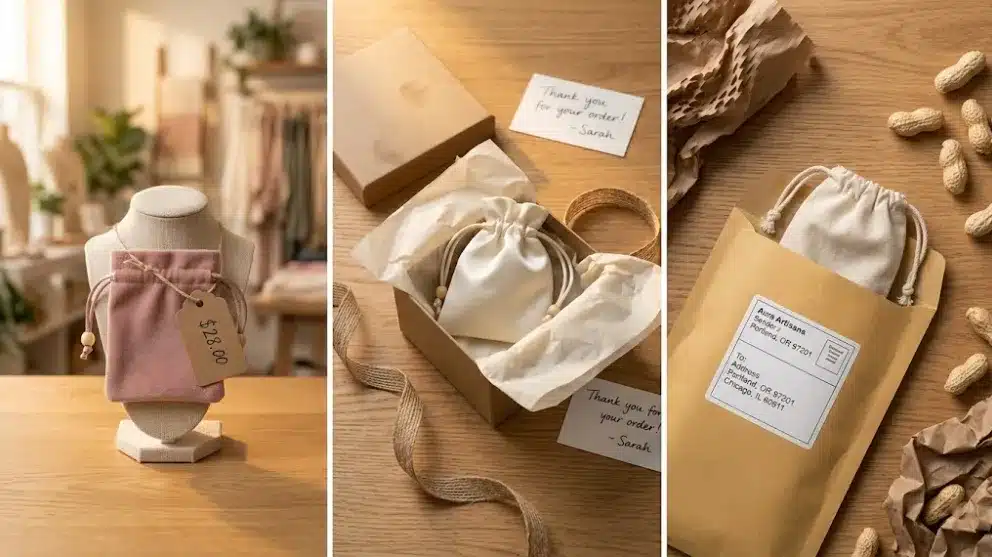
7.1 Retail display pouches
Slightly larger pouches work better in stores. The extra space lets you attach hangtags, care cards, or branded inserts. Plus, a fuller-looking pouch reads as more valuable on a shelf.
7.2 E-commerce shipping pouches
For online orders, smaller is better. Compact pouches lower your shipping weight and fit more easily into mailers. Over thousands of orders, this saves serious money on postage and DIM weight charges.
7.3 Gift packaging pouches
Size up one step for gift-focused brands. The extra room makes the unboxing feel generous and celebratory. Furthermore, tissue paper or a small thank-you card inside boosts perceived value.
7.4 Travel and storage pouches
If you sell jewelry travel pouches as an add-on or premium upgrade, go bigger. Customers want to fit several pieces inside, often with separate inner compartments. Common travel sizes range from 5.9″ × 7.9″ up to 7.9″ × 9.8″ (15 × 20 cm to 20 × 25 cm). For proper jewelry care guidance, see the GIA jewelry care reference.
8. Common Sizing Mistakes — And How to Avoid Them
After 20+ years in fabric packaging, we’ve seen the same handful of sizing errors repeat across new brands. Here are the four most expensive ones — and the fix for each.
| Mistake | Why It Happens | The Fix |
|---|---|---|
| Picking one size for all SKUs | Trying to reduce SKU count and save cost | Use 2-3 sizes based on product mix |
| Skipping samples before bulk order | Time pressure and overconfidence | Always order 2-3 sample sizes first |
| Ignoring fabric thickness | Treating velvet and satin as equal | Add 5-10% size for velvet pouches |
| Forgetting drawstring channel space | Measuring only the jewelry, not the closure | Add 0.5 cm for drawstring at top |
Avoiding these four mistakes saves most brands from costly re-orders
9. FAQs
Q1: What is the most common jewelry pouch size?
The most ordered size across the jewelry industry is 3.15″ × 4.7″ (8 × 12 cm). This size fits pendants, small bracelets, and earring pairs comfortably, which makes it a flexible default for new brands. In fact, many sourcing teams start here when launching their first packaging line, then add a smaller ring pouch and a larger set pouch once their product mix grows.
Q2: Can I order custom-sized jewelry pouches with a low MOQ?
Yes. At YJXpack, custom sizing starts at MOQ 100 pieces, which is unusually low for the industry. Smaller minimums are possible for stock fabric in standard colors. However, fully custom dyeing usually requires 500+ pieces because mills have minimum dye-batch sizes. Sample lead time is 1-3 days, so you can test the size before committing to bulk.
Q3: What’s the difference between a jewelry pouch and a jewelry bag?
A pouch is typically a soft, closable bag with a drawstring or flap, holding 1-3 pieces. By contrast, a jewelry bag is larger, often structured, and designed to carry multiple items or full sets. In practice, pouches are gift-focused — the kind you hand to a customer at point of sale. Bags, meanwhile, lean more travel-focused, with inner compartments and roll-up designs.
Q4: How do I measure a jewelry piece for pouch sizing?
Measure the largest dimension of your jewelry in its packed position — folded for necklaces, coiled for bracelets, flat for earrings. Then add 1.5 cm for breathing room plus 0.5 cm for the drawstring channel. This gives you the minimum interior pouch size. For irregular shapes like cuff bracelets or statement rings, add another 0.5 cm of buffer to be safe.
Q5: What size pouch fits a standard ring box?
To hold a typical 2″ × 2″ ring box, you need a pouch of at least 2.75″ × 3.5″ (7 × 9 cm). Be sure to add extra width for the drawstring closure to function properly. If your ring box is taller (with a hinged lid), step up to 3.15″ × 3.94″ (8 × 10 cm) so the lid doesn’t catch on the fabric when sliding in.
Q6: How much does custom sizing cost extra?
Custom sizing typically adds 10-20% to the per-unit cost compared to standard sizes, depending on order volume. For orders over 1,000 pieces, the cost difference becomes minimal because setup costs spread across more units. Setup fees are usually one-time charges of $50-150, which cover pattern making and the first sample run. In short, custom sizing pays off quickly at higher volumes.
Q7: What’s the smallest jewelry pouch you can produce?
The smallest practical pouch size for production is around 2″ × 2″ (5 × 5 cm). Anything smaller becomes difficult to sew cleanly. Furthermore, customers struggle to open very small pouches because the drawstring channel takes up too much of the opening. For these reasons, most brands stay at 2.75″ × 3.15″ or larger.
Q8: Should I order multiple sizes or stick to one universal size?
For brands with diverse product lines, ordering 2-3 sizes works much better than forcing one universal size. The cost savings of a single size rarely outweigh the brand damage of poor fit. A universal-size approach only makes sense for very narrow product lines — for example, a brand that sells only stud earrings. Otherwise, plan for at least a small, medium, and large pouch in your packaging line.
10. Conclusion — Get Pouch Sizing Right the First Time
Smart jewelry pouch sizing comes down to three steps. First, measure your product correctly using the right method for each jewelry type. Second, add the right buffer — 1.5 cm for breathing room plus 0.5 cm for the drawstring. Third, always test with real samples before placing a bulk order.
Do all three, and pouch sizing stops being a guessing game. Instead, it becomes what it should be: a small but real source of brand quality that your customers feel every time they open a package.
Get a Quote — Custom Jewelry Pouches
YJXpack — Yijiaxin (Shenzhen) Packaging Co., Ltd.
For 20+ years, we’ve supplied custom jewelry pouches and fabric packaging to brand owners, traders, and e-commerce sellers across the US, Europe, and the Middle East. We hold GOTS, OEKO-TEX, GRS, BSCI, ISO 9001, and SABER certifications, and we serve over 8,000 brands worldwide.
Email: info@yjxpack.com
WhatsApp / WeChat: +86 18617112946
Website: www.yjxpack.com
Quote within 3 minutes · 3D mockup in 30 minutes · Sample in 1–3 days · MOQ 100 pieces · GOTS / OEKO-TEX / GRS / BSCI / ISO 9001 certified
Share This Story, Choose Your Platform!