Quick Summary
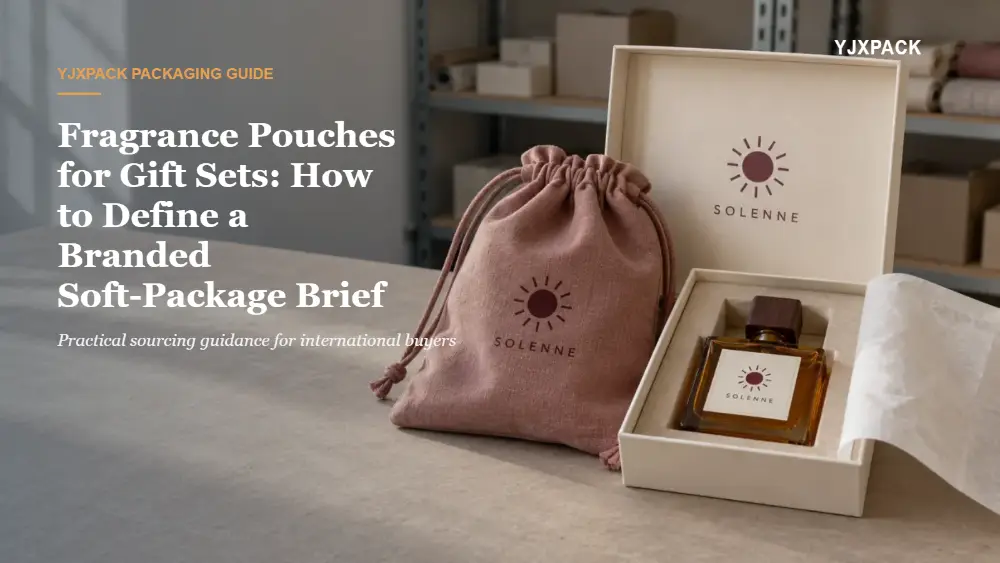
A fragrance pouch is rarely purchased as an isolated bag. In a gift-set project, it sits between the bottle, the inner presentation, the outer carton and the moment the recipient opens the set.
That makes the buying decision more complex than choosing a fabric colour and adding a logo. The pouch may need to hold a bottle securely inside a rigid box, separate a bottle from other gift-set items, create a softer reveal when the box is opened, or become a reusable accessory after the fragrance has been removed.
The useful starting point is this:
Define what the pouch must do in the full gift set before deciding how it should look on its own.
A well-prepared fragrance pouch brief should cover:
- The exact bottle or product set that goes inside
- Whether the pouch is for protection, presentation, reuse or a combination of these roles
- How it relates to the insert, carton, sleeve and other gift-set components
- The material, closure and branding treatment needed for that role
- How the pouch will be packed, transported and presented at unboxing
- Which details must be reviewed on a physical sample before production approval
Define the Role of a Fragrance Pouch in the Gift Set
The same phrase—“fragrance pouch”—can describe several different packaging jobs.
A pouch around a single bottle may provide a soft reveal inside a premium gift box. A pouch holding a travel-size fragrance set may keep several items together. A drawstring pouch may become a reusable storage accessory. A soft bottle bag may also be used as a branded outer layer for a seasonal gift, event set or retail promotion.
Those uses should not be specified in the same way.
| Gift-set role | What the fragrance pouch needs to do | Priority in the brief | Common mistake |
|---|---|---|---|
| Bottle presentation pouch | Create a soft first impression when the box is opened | Material feel, colour, logo scale and bottle fit | Choosing a pouch before confirming the bottle and insert layout |
| Protective soft layer | Reduce direct contact between the bottle and surrounding components | Internal clearance, seam placement and fabric behaviour | Assuming soft fabric alone will solve transport protection |
| Multi-item organiser | Keep a bottle, sample vial, card or accessory together | Compartment logic, closure and item sequence | Using one oversized pouch that lets items move freely |
| Reusable gift accessory | Remain useful after the fragrance is removed | Durable appearance, closure experience and branding restraint | Treating it like a one-time inner wrap |
| Seasonal or promotional bottle bag | Support a campaign, event or limited set | Brand consistency, packing speed and artwork control | Adding complex decoration without defining the required presentation |
Start by identifying the primary role. A pouch can support more than one job, but one role should lead the specification.
For example, if a pouch is mainly an unboxing layer inside a rigid gift box, the outer carton and insert may provide most of the structural support. The pouch can then prioritise texture, colour and controlled fit. If the pouch will be used to carry a bottle after purchase, the project needs a more careful discussion of bottle movement, closure and the interaction between the bottle weight and the fabric construction.
Build the Gift Set Around the Bottle, Not the Pouch Alone
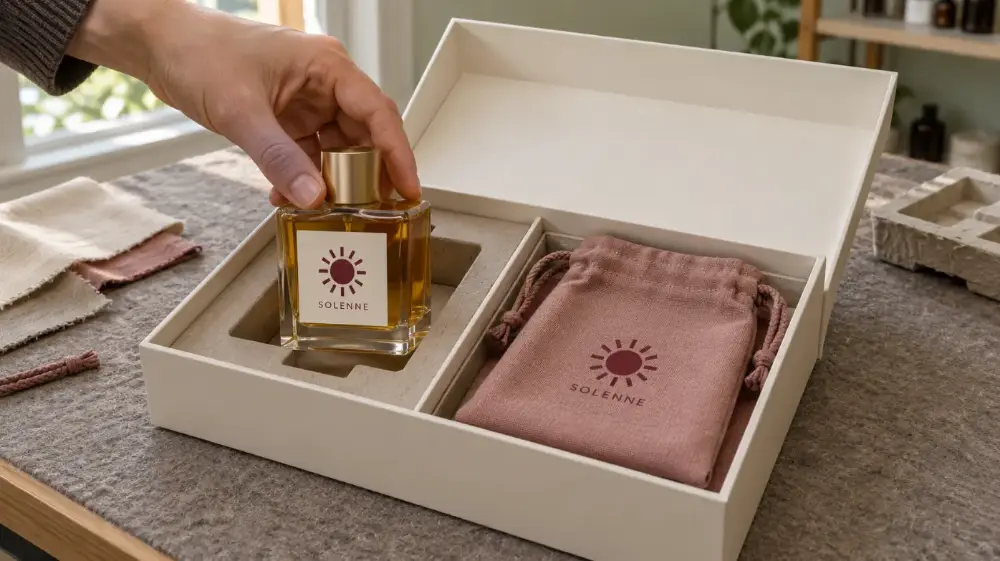
A fragrance pouch should be designed around the actual product configuration. “For perfume bottle” is not enough information for a supplier to recommend a reliable format.
The buyer should provide the product dimensions in the condition in which the set will be packed. This includes the bottle body, cap, spray head, collar, any protective sleeve, and any product that will share the pouch.
| Buyer input | Why it matters | What can go wrong if it is missing |
|---|---|---|
| Bottle height, width and depth | Determines usable internal pouch space | The bottle may sit too tightly, lean awkwardly or move excessively |
| Cap and spray-head profile | Changes the highest and widest points of the product | A pouch that fits the bottle body may catch on the cap |
| Bottle shape | Round, square, oval and irregular bottles behave differently inside soft packaging | The pouch may twist or create uneven pressure points |
| Number of gift-set items | Defines whether the pouch holds one item or an assembled set | Items can collide, scratch or look disorganised |
| Inner-box or insert dimensions | Determines whether the pouch must fold flat, wrap around the item or occupy a fixed cavity | The pouch may create unwanted bulk inside the carton |
| Intended opening sequence | Defines what the recipient sees first | The pouch may hide the hero product or disrupt the gift reveal |
The product should be measured as a three-dimensional object, not only from a front photograph.
For a single fragrance bottle, the pouch should accommodate the bottle in the intended orientation: upright, horizontal or wrapped. For a gift set with a bottle and smaller items, decide whether the pouch holds all components together or only the hero bottle. These are different packaging systems.
A practical rule is:
> If the bottle is secured by an insert, the pouch can focus on presentation. If the pouch is expected to control the bottle itself, fit and closure become more important.
Do not ask a soft pouch to replace a protective insert, carton or transport test plan without first confirming the full packaging route.
Choose a Fragrance Pouch Format for Protection and Presentation
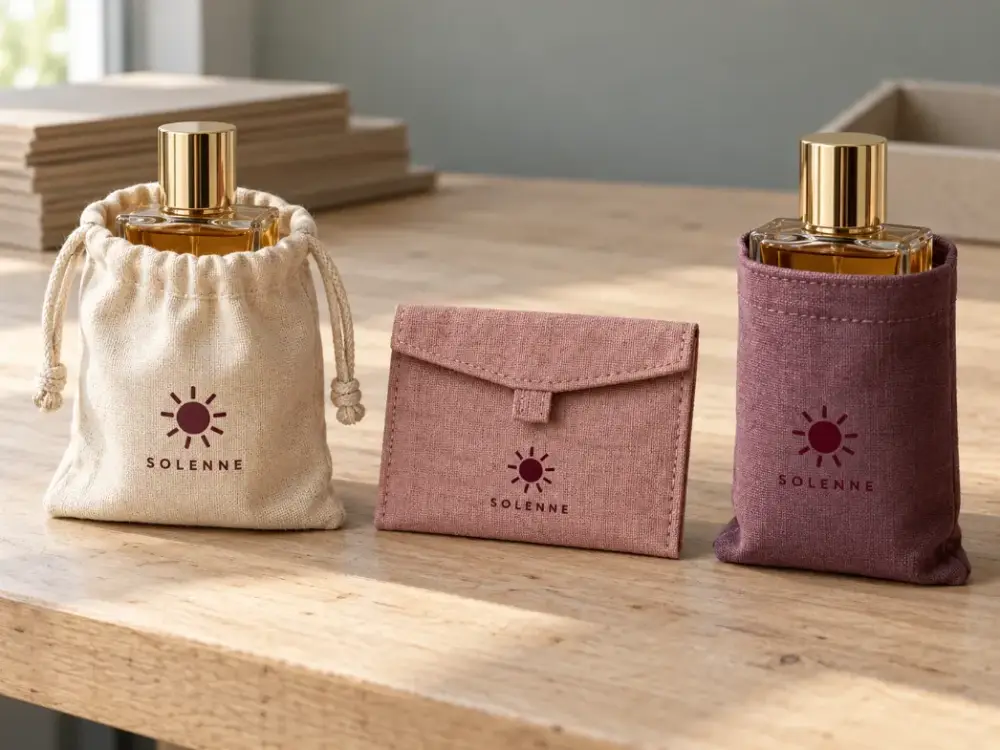
The pouch format should follow the product arrangement and intended use. The most visually appealing option is not always the most suitable one for the gift-set workflow.
| Pouch format | Best suited to | What it contributes | What to confirm during sampling |
|---|---|---|---|
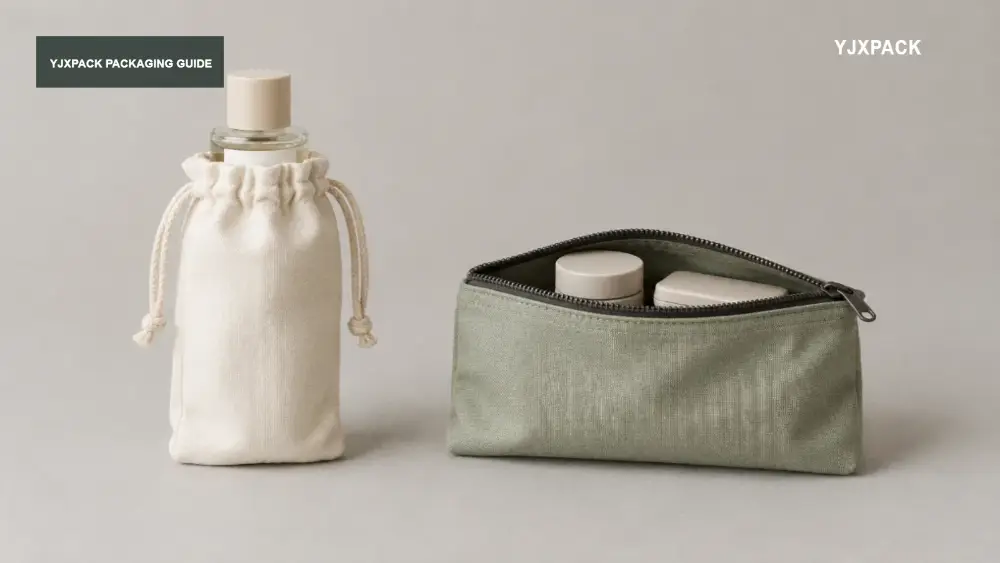
| Drawstring pouch | Single bottle, travel set or reusable gift accessory | Familiar opening experience and flexible fit | Whether the closure gathers evenly and how the bottle sits when closed |
| Envelope pouch with flap | Flat fragrance accessories, discovery cards or slim gift-set components | Controlled front presentation and a cleaner silhouette | Flap overlap, closure alignment and finished edge quality |
| Sleeve-style bottle pouch | A single bottle presented upright or inside a set | A close-fitting, bottle-led appearance | Bottle insertion, top opening and how the sleeve works with the carton |
| Zip pouch | Multi-item travel set or reusable organiser | More contained storage for several small components | Zip placement, opening width and whether hardware suits the intended presentation |
| Fold-over soft wrap | Gift boxes, bottle-and-card combinations or limited editions | A layered unboxing moment with flexible branding area | Fold sequence, fastening method and carton compatibility |
| Multi-pocket pouch | Sets with several small vials, accessories or tools | Separation between components | Pocket dimensions, seam bulk and item removal experience |
A perfume pouch for a small discovery set may benefit from internal separation so that vials or accessories do not collect at the bottom. A custom bottle bag for one hero bottle may need a narrower body and a closure that does not interfere with the cap or neck.
The right choice depends on the product system, not on a generic “luxury” look.
During sample review, place the actual bottle or representative dummy inside the pouch. Open and close it repeatedly. Place it into the intended carton. Remove it as a customer would. Those simple actions often reveal whether the pouch needs a revised opening, a different fold direction or more controlled internal space.
Coordinate Material, Colour and Branding Across the Gift Set
The pouch should belong to the same visual system as the fragrance bottle, carton and printed inserts. It does not need to duplicate every design element.
A coordinated set often uses one or two recognisable brand cues across different materials. For example, the carton may carry the main visual artwork while the pouch uses a quieter colour, texture or simplified mark. This prevents the set from looking over-branded while still feeling connected.
| Gift-set element | Possible role in the visual system | Pouch decision to coordinate |
|---|---|---|
| Bottle | Hero product and strongest visual object | Choose pouch colour and opening style that do not compete with the bottle |
| Rigid carton | Main protection and primary retail surface | Confirm pouch fold size and bulk inside the carton |
| Insert or tray | Product positioning and protection | Confirm whether the pouch wraps the bottle before or after it enters the insert |
| Printed card | Story, scent description or gifting message | Decide whether it sits inside, outside or separately from the pouch |
| Ribbon, seal or sleeve | Secondary gift detail | Avoid duplicating too many closures around the pouch |
| Pouch | Tactile layer and reusable packaging element | Use material, colour and branding that support the set rather than overpower it |
Material should be selected for the desired interaction, not simply for a trend label.
A matte cotton or linen-style surface can support a natural, botanical or craft-led fragrance presentation. A dense smooth fabric can create a more polished appearance. A soft brushed or velvety surface can create a tactile contrast against a rigid carton. Each option may affect print appearance, fold bulk, dust pickup and the way the pouch sits in the final set.
The buyer should define the visible priority:
- Is the bottle meant to be seen immediately?
- Should the pouch create a reveal before the bottle appears?
- Is the pouch intended to be retained and reused?
- Does the set rely on a calm minimal look or a more decorative seasonal presentation?
- Does the logo need to be the main cue, or should colour and material carry the identity?
Avoid asking every component to communicate every brand message. A pouch can be quiet and still feel intentional.
Plan How the Pouch Will Be Packed, Shipped and Unboxed
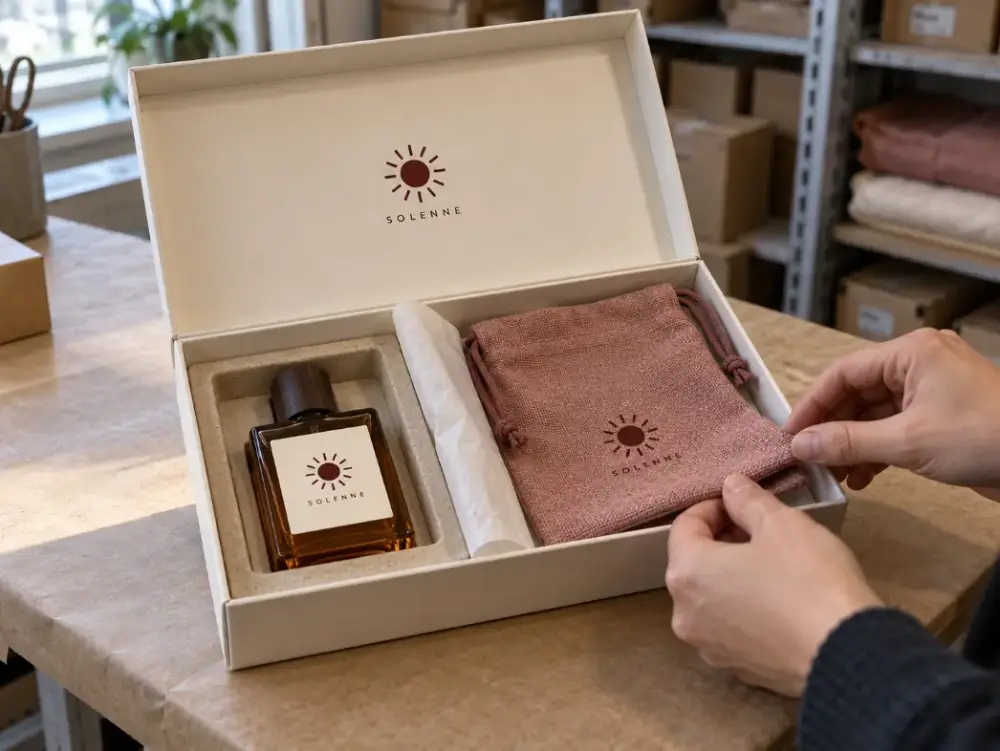
A pouch can look correct as a standalone sample and still create problems once it enters the actual packing process.
The buyer should map the sequence from packing table to customer unboxing.
| Stage | Decision to make | Observable check |
|---|---|---|
| Pouch preparation | Is the pouch packed flat, pre-folded or pre-filled? | Check whether the selected fold creates visible crease lines in the presentation area |
| Product insertion | Does the bottle enter before or after the pouch enters the box? | Check whether the bottle catches on seams, drawstrings or closure edges |
| Inner-box assembly | Does the pouch sit inside an insert, around an insert or independently in the carton? | Check whether the carton closes without compression or loose space |
| Outer packing | Will units be stacked, nested or separated during transport? | Check whether pouches transfer colour, snag or create uneven carton pressure |
| Retail opening | What does the recipient touch and see first? | Open several assembled sets in sequence and review consistency |
| Reuse after gifting | Does the pouch still feel useful after the bottle is removed? | Test whether the closure and format suit a plausible secondary use |
This does not require a complicated packaging engineering exercise for every project. It does require the buyer to stop treating the pouch as an item that appears only at the design stage.
If a pouch must be folded beneath the bottle tray, its fold pattern is part of the specification. If it is wrapped around a bottle, the closing method is part of the specification. If it is packed loose inside a gift box, the visual side that faces upward is part of the specification.
The unboxing sequence should be agreed before final artwork approval, because the chosen front panel may not be the panel visible to the recipient.
Specify the Artwork, Inserts and Gift-Set Components
The artwork brief should identify what belongs on the pouch and what belongs elsewhere in the set.
A pouch is not always the best location for fragrance notes, care instructions, campaign text or a long brand message. Fabric decoration is strongest when it supports simple, durable visual cues. More detailed information may be clearer on a printed card, carton or insert.
| Information or design element | Better location in most gift sets | Why |
|---|---|---|
| Brand icon or simplified logo | Pouch front, woven label or discreet side detail | Supports recognition without turning the pouch into a printed leaflet |
| Full fragrance story | Insert card, carton or booklet | Allows more controlled typography and content |
| Ingredients, regulatory text or required product information | Bottle label, carton or approved printed component | Must follow the relevant market and product requirements |
| Gift message | Card, tag or printed sleeve | Can be changed by campaign, season or recipient |
| Product positioning | Insert, tray or carton structure | Keeps the bottle stable and visually central |
| Reuse cue | Pouch material and format | Can be communicated through the object itself rather than extra text |
For the pouch artwork brief, provide:
- Approved logo artwork in the required file format
- Preferred logo version for the selected material and pouch colour
- Decoration method or acceptable alternatives
- Exact logo position and intended visible panel
- Decoration size relative to the finished pouch
- Colour reference, where colour consistency is required
- Whether one or more gift-set variants use different artwork
- The approved relationship between pouch, card, insert and carton
If the fragrance project will be sold in a specific target market, any required product, safety, labelling or packaging information should be confirmed against current local rules and the customer’s compliance process. It should not be assumed that a soft pouch replaces any required information-bearing component.
Prepare a Fragrance Pouch Brief for Sampling and Quotation
A supplier can only quote and sample efficiently when the buyer describes the complete gift-set use case.
Use the following as a working brief.
| Brief field | Buyer must provide | Why the supplier needs it |
|---|---|---|
| Gift-set purpose | Retail launch, seasonal gift, discovery set, event set or loyalty gift | Establishes the required presentation and likely use cycle |
| Product configuration | Bottle dimensions, cap profile, item count and product orientation | Defines pouch form and usable internal space |
| Pouch role | Presentation layer, organiser, bottle cover or reusable accessory | Determines construction and closure priorities |
| Material direction | Target handle, surface appearance, colour and any known material preference | Helps narrow suitable material and decoration options |
| Branding treatment | Logo file, placement, colours and preferred method | Allows a comparable decoration quotation |
| Set components | Carton, insert, tray, ribbon, card, sleeve or other items | Prevents the pouch being developed in isolation |
| Packing route | Flat-packed, pre-filled, folded, wrapped or inserted into a cavity | Determines fold, bulk and assembly requirements |
| Sample review criteria | Fit, closure, fold, print or embroidery appearance, carton compatibility | Creates a practical approval standard |
| Unknown capability items | [VERIFY WITH YJXPACK] selected pouch format, material, decoration, gift-set assembly and final size capability | Keeps unconfirmed requirements visible before commitment |
A useful sample request is not “Please make a fragrance pouch with logo.”
A more useful request is:
> Please develop a concept sample for one fragrance bottle and gift-set configuration. The pouch should support the selected opening sequence, fit inside the proposed carton system, use the supplied logo artwork in the agreed visible location, and be reviewed with the actual bottle or representative dummy before final specification approval.
That gives both buyer and supplier a clear basis for discussion.
For a project-specific conversation about fragrance pouches, bottle fit, gift-set presentation and sample preparation, contact YJXPACK.
Frequently Asked Questions
What is the difference between a fragrance pouch and a custom bottle bag?
A fragrance pouch may hold a bottle, a discovery set or several gift components. A custom bottle bag is usually more directly shaped around one bottle. The right term matters less than defining the product configuration, pouch role and packing sequence.
Can one pouch hold both a perfume bottle and printed gift-set materials?
It can, but the layout should be tested. A card, vial or accessory may create unwanted movement or pressure against the bottle. Decide whether the items need separate pockets, a tray or a different placement inside the carton.
Should the pouch carry the full fragrance logo and story?
Usually not. A pouch often works best with a simplified brand cue. Detailed fragrance information is generally easier to control on a carton, insert or card.
Is a soft pouch enough to protect a fragrance bottle during transport?
A soft pouch can reduce direct contact with surrounding items, but it should not be assumed to replace a suitable insert, carton or transport-protection system. Review the full packaging configuration with the actual product or representative sample.
What should be approved before placing a fragrance pouch order?
Approve the pouch material and colour, final dimensions, closure, logo method and placement, bottle fit, carton compatibility, packing sequence and the physical sample used as the reference for production.
Share This Story, Choose Your Platform!