You just bought a $200 silver necklace online. The package arrives. You tear open the mailer, excited. Inside, a thin plastic zip bag holds your necklace. It crinkles. It looks cheap. For a moment, you wonder if the jewelry inside is even real.
In fact, this happens every day. Customers love the product. But the packaging tells a different story. So they hesitate to buy again. Plus, they hesitate to share it on Instagram. Worse, eco-conscious shoppers see plastic and quietly walk away. Today, packaging is not just a wrapper. Instead, it’s the first thing your customer touches — and the last thing they remember.
This guide fixes that. First, you’ll learn what “eco-friendly jewelry packaging” really means in 2026 — beyond the buzzwords. Second, you’ll compare the 5 main sustainable materials side by side, with real costs. Third, you’ll decode the certifications that actually matter — GRS, OCS, GOTS, and OEKO-TEX.
By the end, you’ll know more about sustainable jewelry packaging than 95% of brand owners sourcing it today. Plus, you’ll spot greenwashing in seconds.
1. What Does “Eco-Friendly Jewelry Packaging” Really Mean?
Let’s start with the hard truth. The word “eco-friendly” gets used so loosely it almost means nothing now. So before we compare materials, we need a real definition.
Real eco-friendly jewelry packaging works on three levels. First, the raw material. Where did the fiber come from? Is it recycled, organic, or virgin? Second, the production process. How much water and energy did the factory use? Does the dye contain heavy metals? Third, the end of life. What happens to the bag after the customer is done with it? Will it break down, or sit in a landfill for 200 years?
A bag passes only when all three levels check out. Just one is not enough. For example, a cotton bag made with toxic dyes is not eco-friendly. Likewise, a “recycled” bag with a plastic-coated lining is not eco-friendly either.
Importantly, “natural” does not mean “eco.” Cotton is natural. Still, conventional cotton uses huge amounts of water and pesticides. So the word you really want is **verified** — backed by a real certification, not a marketing claim.
In short, eco-friendly jewelry packaging is not a single material. Instead, it’s a complete chain — material, process, and lifecycle — that holds up to outside review.
2. Why Sustainable Packaging Matters in 2026
You may wonder if customers really care. The data is clear: they do.
Recent surveys show that over 70% of US Gen Z and Millennial shoppers say sustainability shapes their buying choices. Moreover, almost half say they’ll pay more for a brand with proven eco values. So sustainable packaging is no longer “nice to have.” It’s a buying factor.
Regulators are pushing in the same direction. In Europe, the new Packaging and Packaging Waste Regulation (PPWR) sets strict reuse and recycling targets. Meanwhile, California’s SB 54 law forces brands to cut single-use plastics by 25% before 2032. As a result, even small US brands that ship overseas now feel the pressure.
For brands, the upside is real. First, eco packaging supports higher prices. Second, it boosts repeat purchases. Third, it earns free press and social shares. Plus, it removes a major reason for customer guilt — which is one of the quiet drivers of returns.
So in 2026, sustainable packaging is not just about saving the planet. It’s also about saving the brand.
3. The 5 Main Eco-Friendly Materials Compared
Now let’s get practical. Below are the five materials most sustainable jewelry brands use today. Each has trade-offs. So pick based on your product, price point, and customer.
| Material | Cost | Look & Feel | Breaks Down? | Best For |
|---|---|---|---|---|
| Recycled Cotton | Low–Medium | Soft, slightly textured | Yes (months) | Mid-range brands, daily reuse |
| Organic Cotton | Medium | Soft, clean white tone | Yes (months) | Premium and clean-beauty brands |
| rPET (Recycled Polyester) | Medium | Smooth, silky, vibrant colors | No (recyclable) | Velvet pouches, bold colors |
| FSC Paper / Kraft | Low | Earthy, raw, minimal | Yes (weeks) | Boxes, inserts, hangtags |
| Hemp / Jute | Medium | Rustic, coarse, natural | Yes (months) | Bohemian, artisan brands |
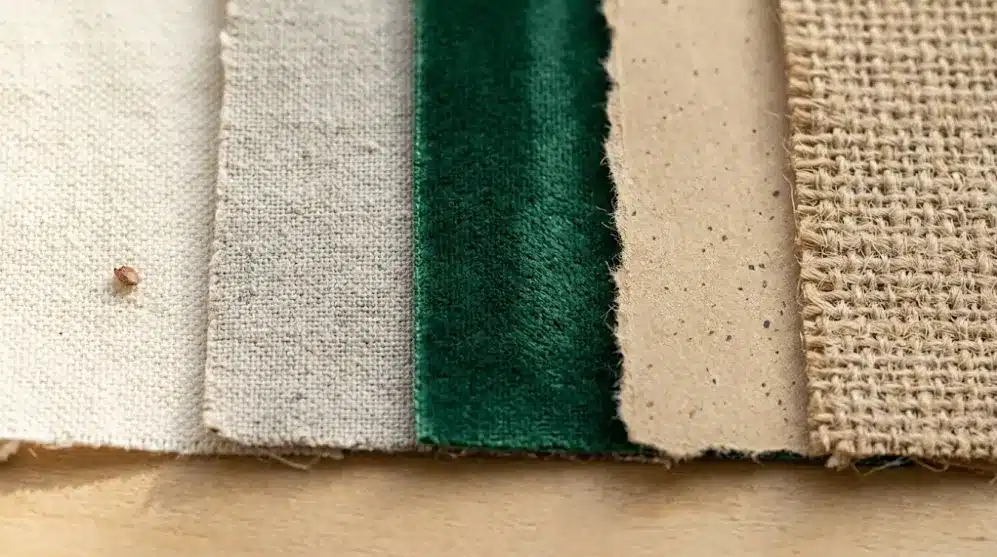
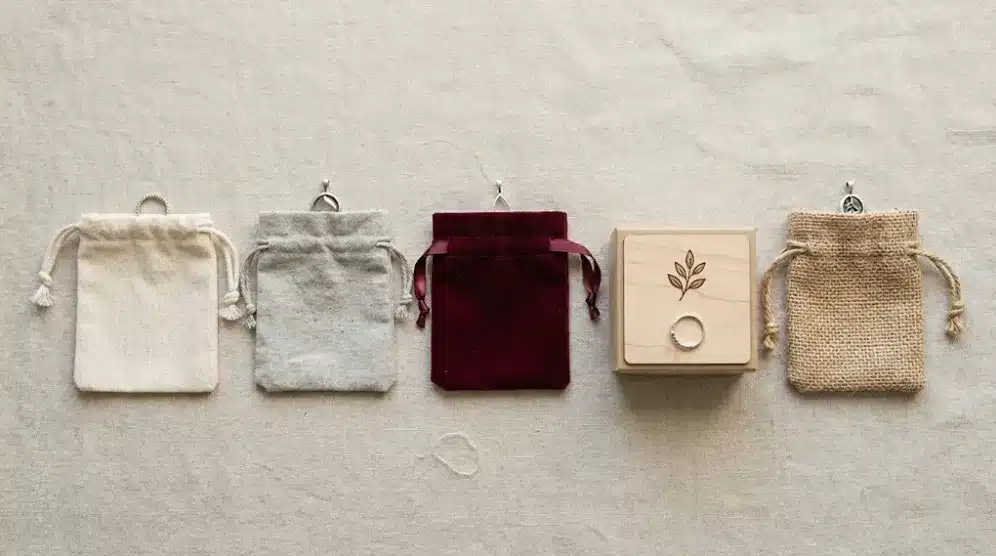
A quick read of the table tells you a lot. Recycled cotton hits the sweet spot for most brands — soft, affordable, and clearly green. Organic cotton, on the other hand, pushes a premium feel for clean-luxury labels. Meanwhile, rPET is the only “plastic” that fits an eco story, because it gives velvet bags new life without virgin oil.
For brands that want a custom organic cotton jewelry pouch, the soft hand-feel and natural cream tone often beat any synthetic option on shelf presence.
So no single material is “best.” Instead, the right one is the one that fits your product, your price, and your customer’s values.
4. Certifications Explained — GRS, OCS, GOTS, OEKO-TEX
Here’s where most brand owners get lost. Acronyms fly. Sales reps name-drop them. But few people can explain what each one actually proves. So let’s clear that up.
GRS (Global Recycled Standard). Run by Textile Exchange, GRS is the gold standard for recycled materials. It checks that the fiber is truly recycled — and tracks it through every step of the supply chain. Plus, it audits social and environmental practices at the factory. If a supplier claims “made from recycled cotton” but has no GRS certificate, ask why. You can verify the standard on the Textile Exchange website.
OCS (Organic Content Standard). Also from Textile Exchange, OCS tracks the flow of organic fiber from farm to finished product. Importantly, it does not audit dyeing or chemical use. So OCS proves “organic content” — but not “organic process.”
GOTS (Global Organic Textile Standard). GOTS is the highest bar for organic textiles. It covers the organic fiber, the dyeing process, the chemicals, the wastewater, and even worker rights. In short, if OCS is the entry level, GOTS is the full package. For the full criteria, see the GOTS official site. For a deeper look at how these two compare, our earlier post on OCS vs GOTS breaks it down further.
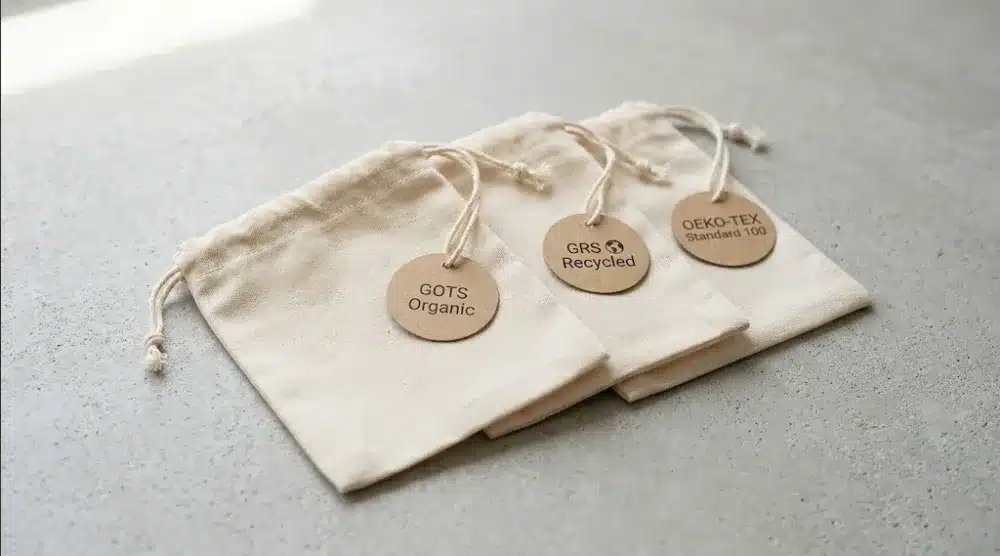
OEKO-TEX Standard 100. This one is different. It does not check whether the material is organic or recycled. Instead, it tests the finished product for harmful chemicals — over 1,000 of them. So OEKO-TEX is the safety net that protects your customer’s skin.
Quick rule of thumb: Use GRS for recycled, GOTS for organic, and OEKO-TEX for skin safety. Stack all three for a truly bulletproof eco claim.
So the next time a supplier shows you a certificate, ask one thing: “What exactly does this prove?” If they can’t answer in one sentence, the claim isn’t solid.
5. How Much Does Eco Packaging Really Cost?
Sustainability sounds expensive. The reality is more nuanced. So let’s look at real numbers.
| Bag Type (5×7 inch, custom logo) | Cost per Bag (MOQ 1,000) | Extra vs. Conventional |
|---|---|---|
| Conventional cotton pouch | $0.45 – $0.65 | Baseline |
| Recycled cotton (GRS) | $0.55 – $0.80 | +15–25% |
| Organic cotton (GOTS) | $0.75 – $1.10 | +40–70% |
| rPET velvet pouch | $0.60 – $0.90 | +20–35% |
As you can see, the gap is smaller than most people think. Recycled cotton with GRS costs only 15–25% more than the standard option. Meanwhile, the perceived value jump is much larger.
Of course, there are hidden costs too. For instance, certified runs may carry an audit fee. Plus, MOQs can rise for niche materials. Still, even at MOQ 100, most factories can offer GRS recycled cotton without a major price jump.
Here’s the smart angle. Many brands pass the extra cost straight to the customer — and the customer pays gladly. Why? Because a $0.30 packaging upgrade often justifies a $5–$10 retail price bump. In short, the math works.
So the real question is not “Can I afford eco packaging?” Instead, it’s “Can I afford not to use it?”
6. Common Greenwashing Traps to Avoid
Not every eco claim is honest. In fact, many are designed to fool busy buyers. So watch for these five red flags.
- “Made from natural materials” — How much? 5% or 95%? Without a percentage, the claim is meaningless.
- “Eco-friendly ink” — Eco by whose standard? Ask for OEKO-TEX or GOTS-approved inks specifically.
- Self-made “Green” labels — A green leaf logo invented by the supplier is not a certification. Real ones come from third-party auditors.
- “Reusable” cotton bag used once — As covered in our deep-dive on plastic vs cotton bag comparison, cotton wins only after many reuses. So a thrown-away cotton bag is the worst case.
- “Recyclable” claim — Recyclable in theory ≠ actually recycled. Less than 9% of plastic ever gets recycled in practice.
So how do you spot real claims? Ask for the certificate number. Cross-check it on the issuing body’s website. If a supplier can’t share a current, valid certificate within 24 hours, the claim is suspect.
Above all, push for specifics. “Recycled” should come with a percentage. “Organic” should come with a certificate. “Biodegradable” should come with a time frame and condition (industrial vs home compost).
7. How to Choose the Right Eco Packaging for Your Brand
So with all this information, how do you actually pick? Here’s a three-step framework that works for almost any jewelry brand.
Step 1 — Define your brand values. Are you “pure nature” (organic cotton, hemp)? Or “circular economy” (recycled cotton, rPET)? Or “minimal waste” (FSC paper, no plastic at all)? Pick one lead value. Then your material choice becomes obvious.
Step 2 — Match your price point. Conventional cotton fits sub-$50 jewelry. Recycled cotton with GRS fits $50–$200. Organic cotton with GOTS fits $200+ and clean-luxury. Meanwhile, rPET velvet works for any price tier — it’s the most flexible eco option.
Step 3 — Pick the right certifications. Selling on Amazon? GRS and OEKO-TEX help you stand out. Selling DTC? GOTS adds the storytelling power your About page needs. Selling wholesale to retailers? Expect them to demand at least one of the four.
For a full range of custom jewelry pouches across these material tiers, you can mix and match based on which product line needs which story.
Naturally, you don’t have to pick just one. Many brands run a “core” line in recycled cotton and a “premium” line in organic cotton. So your packaging mirrors your product tiers.
8. Real Examples — What Sustainable Jewelry Brands Use
Now let’s look at how real brands stack these choices. Three quick patterns we see again and again.
Pattern 1 — DTC Independent Brand ($60–$150 jewelry): Most pick a GOTS-certified organic cotton drawstring pouch with a single-color screen-printed logo. Why? Because the unboxing photos play well on Instagram. Plus, the soft cream color photographs beautifully against jewelry of any metal.
Pattern 2 — Mid-Tier Lifestyle Brand ($150–$400 jewelry): The combination here is usually a GRS recycled cotton outer bag plus an FSC-certified kraft box inside. So the customer gets both a soft pouch and a structured box. Meanwhile, both are certified. Total cost: about $1.20–$1.80 per unit at moderate MOQs.
Pattern 3 — Bridal and Fine Jewelry ($400+): A surprising number of brands now use a recycled velvet pouch made from rPET. Because the look is plush, deep-toned, and luxurious — but the story is still circular. So they get the upscale feel without the virgin polyester guilt.
In each pattern, the brand isn’t just buying a bag. Instead, they’re buying a piece of the customer’s first impression. So the packaging works double duty: protection plus storytelling.

9. Inside YJXpack — Our Sustainable Production Process
To put it in context, here’s what we do at YJXpack so brands can hit these standards without paying enterprise prices.
We hold GOTS, GRS, OEKO-TEX, BSCI, ISO 9001, and SABER certifications — all current, all third-party audited. So when we say “GRS recycled cotton,” we can hand you the certificate number same day. Plus, we’ve served 8,000+ brands worldwide, including more than 50 with active sustainability programs.
On capability, our 4,000+ sqm factory runs 110+ machines with 100+ staff. So we handle MOQs from 100 pieces — which means even early-stage brands can use certified materials. Meanwhile, lead times stay tight: 1–3 days for samples, 5–7 days for bulk.
Above all, we share certificates before any commitment. So you can verify everything before you spend a dollar. To learn more, visit YJXpack or just ask for a sample.
10. Conclusion — From “Looks Green” to “Truly Green”
Let’s go back to where we started. Eco-friendly jewelry packaging is not about choosing the most natural-looking material. Instead, it’s about a complete chain — material, process, and lifecycle — that holds up under outside review.
Fortunately, the logic is simple. First, pick the right material for your brand and price point. Second, verify with real third-party certifications — GRS, OCS, GOTS, or OEKO-TEX. Third, design for reuse and end-of-life, so the bag earns its eco label through real use.
Do all three, and eco packaging stops being a marketing claim. Instead, it becomes a real piece of your brand — one your customers can see, touch, and trust.
11. FAQs
Q1: What’s the difference between recycled cotton and organic cotton?
Recycled cotton reuses old cotton fiber, so it cuts water and energy use. Organic cotton, on the other hand, is grown without pesticides on certified farms. In short, recycled is about giving fiber a second life, while organic is about cleaner farming from the start. Plus, the certifications differ — GRS for recycled, GOTS or OCS for organic.
Q2: Is rPET really eco-friendly?
Yes, in context. rPET takes plastic bottles out of landfills and turns them into soft, velvety fabric. So it gives plastic a second life. However, it’s still plastic — meaning it does not biodegrade. Therefore, treat rPET as “less bad” than virgin polyester, not as a perfect solution.
Q3: How much more does GRS-certified packaging cost?
Typically 15–25% more than conventional packaging. For example, a $0.50 cotton pouch jumps to about $0.60–$0.65 with GRS recycled cotton. Plus, there may be a small audit fee for documentation. Still, the marketing value almost always covers the gap.
Q4: Can I get eco packaging at low MOQ?
Yes. At YJXpack, you can start at MOQ 100 with certified materials. So even early-stage brands don’t need to commit to thousands of units. Of course, MOQs can rise for very specialized materials like hemp blends. Therefore, always check with your supplier first.
Q5: Is biodegradable packaging the same as compostable?
No. Biodegradable just means “breaks down eventually” — which could take years. Compostable, on the other hand, breaks down within a set time in a specific environment (home or industrial compost). So compostable is the stricter, more meaningful claim.
Q6: Which certification is most trusted in the US?
For organic, GOTS is the gold standard. For recycled, GRS leads. Meanwhile, OEKO-TEX is widely trusted for chemical safety across both. So if you stack GOTS or GRS with OEKO-TEX, your eco story holds up to even strict US retailer audits.
Q7: How long does eco-friendly jewelry packaging take to break down?
It depends on the material. Plain cotton breaks down in 1–5 months in compost. FSC paper takes weeks. Hemp and jute take 2–4 months. However, rPET does not biodegrade — instead, it’s recyclable. So check the material before you make any “breaks down” claim.
Get a Quote — Sustainable Jewelry Packaging
YJXpack — Yijiaxin (Shenzhen) Packaging Co., Ltd.
For 20+ years, we’ve made custom eco-friendly jewelry packaging — recycled cotton pouches, organic cotton drawstring bags, rPET velvet pouches, FSC paper boxes, and more — for brand owners, traders, and e-commerce sellers across the US, Europe, and the Middle East. We hold GOTS, GRS, OEKO-TEX, BSCI, ISO 9001, and SABER certifications, and we serve over 8,000 brands worldwide.
Want to see and feel the real thing? Request a free sample pouch — we’ll ship it to your door so you can judge the quality and material before any commitment.
Email: info@yjxpack.com
WhatsApp / WeChat: +86 18617112946
Website: www.yjxpack.com
Free sample shipped to your door · Quote within 3 minutes · 3D mockup in 30 minutes · MOQ 100 pieces · GOTS / GRS / OEKO-TEX / BSCI / ISO 9001 certified
Share This Story, Choose Your Platform!