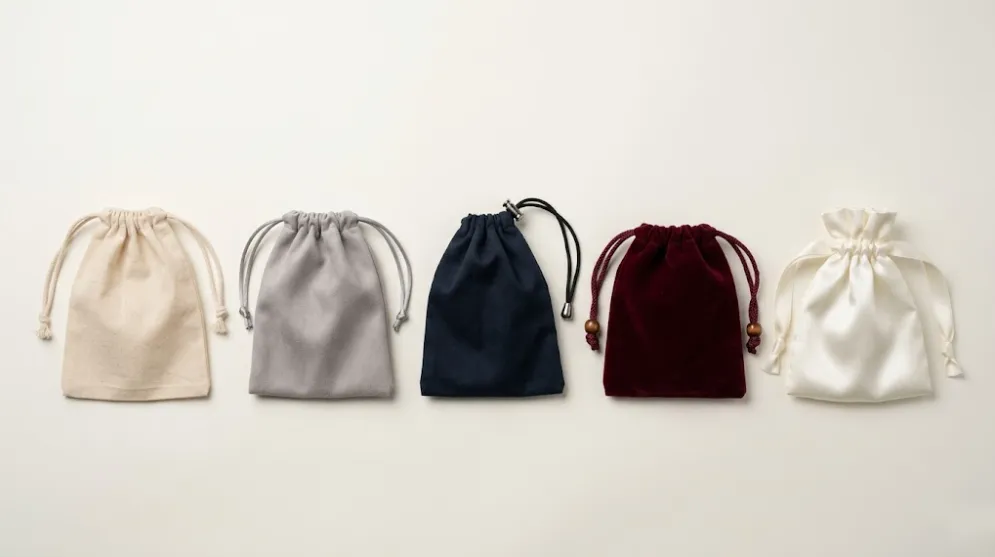
You searched “drawstring pouch” online. Thousands of products popped up — cotton ones, satin ones, velvet ones — and the closure styles vary wildly too. They all look similar in the photos. However, the prices can differ by 3x. Naturally, you wonder which one is actually right for your brand.
In fact, most brand owners treat “drawstring pouch” as one simple product. But it’s not. Behind that single term sit 5+ closure styles, 6+ fabric choices, 6+ cord types, and 5+ logo printing methods. Multiply those together, and you get over 150 possible combinations. So picking blindly often leads to a pouch that looks wrong, feels cheap, or breaks down within months.
This article fixes that. In plain English, with no jargon, you’ll learn three things. First, what a drawstring pouch really is, where it came from, and why brands keep using it. Second, the 5 main closure styles and how to pick one. Third, the full custom production process — from cord type to logo printing — so you can spec your perfect pouch.
By the end, you’ll understand drawstring pouches better than most buyers sourcing fabric packaging today.
1. What Is a Drawstring Pouch? The Simple Definition
A drawstring pouch is a small soft-fabric bag that closes by pulling one or more cords through a channel at the top opening. That’s the whole concept. Pull the cord, and the bag cinches shut. Loosen it, and the bag opens flat. No zippers, no buttons, no clasps — just clean, simple, manual closure.
So what makes it different from other small bags? A zipper pouch uses a hard mechanical closure. A flap pouch uses a magnetic or snap closure. A tote bag stays open. A drawstring pouch, by contrast, sits in a sweet spot — soft enough to feel premium, quick enough to open and close, and cheap enough to mass-produce.
That combination is exactly why jewelry brands, gift brands, and beauty brands love it. The unboxing feels personal. The closure feels handmade. Plus, the soft fabric protects the product better than a stiff box. In short, the drawstring pouch hits a balance no other small bag matches.
2. A Quick History — Where Drawstring Pouches Came From
The drawstring pouch isn’t new. In fact, it’s one of the oldest forms of personal carry ever invented. Archaeologists have found drawstring bags in ancient Egyptian tombs, Roman ruins, and Tang dynasty Chinese textiles. So the basic design has stayed nearly unchanged for over 3,000 years.
In medieval Europe, drawstring pouches served as the everyday money bag — sewn from leather, linen, or wool and worn at the belt. By the 17th century, aristocrats had upgraded the design with silk and velvet, using them specifically for jewelry storage. For deeper context on textile history, the Victoria & Albert Museum archives show how drawstring designs evolved across centuries.
The Victorian era cemented the drawstring pouch as the standard jewelry packaging format. Plus, the rise of department stores in the 1800s normalized “the velvet drawstring jewelry bag” as the universal symbol of luxury. Then, in the modern DTC era, the format came roaring back. Brands like Mejuri, Catbird, and AUrate built their entire packaging identity around clean, well-made drawstring pouches.
The lesson is clear. This isn’t a trendy product. It’s a timeless format that keeps reinventing itself.
3. The 5 Main Closure Styles — and How to Pick One
This is where most buyers get tripped up. “Drawstring pouch” sounds like one thing, but there are five distinct closure styles. Each one signals something different about your brand. So let’s break them down.
3.1 Single drawstring
One cord runs through a single channel at the top. Pull the cord, and the bag closes. This is the cheapest and fastest closure to produce. However, single drawstrings can slip open on their own, especially with heavier jewelry inside. Best for lightweight gift packaging and low-cost promotional items.
3.2 Double drawstring (opposing pull)
Two cords run through the channel from opposite sides. Pull both, and the bag closes tightly and symmetrically. This is the industry-standard closure for jewelry pouches because it locks securely and looks balanced from any angle. Slightly higher cost, but worth it for any serious brand.
3.3 Drawstring with cord stopper
A spring-loaded plastic or metal stopper sits on the cord. Slide it down, and the closure locks at any tightness. This is the most secure option. Plus, the stopper adds a small functional design element. Most common in outdoor, sport, men’s, and travel-focused packaging.
3.4 Drawstring with knot or bead end
The cord ends finish with a hand-tied knot, wooden bead, or metal cap. These add visual character and brand identity. However, they slow production and raise costs. Best for premium, wedding, and gift packaging where every detail matters.
3.5 Ribbon drawstring
A wide satin ribbon replaces the standard cord. The visual effect is dramatic — soft, flowing, and gift-like. However, ribbons wear out faster than cords and can fray with heavy use. Reserved for wedding favors, holiday limited editions, and high-touch luxury packaging.
Quick comparison of all 5 closure styles:
| Closure Style | Cost | Visual Appeal | Security | Best For |
|---|---|---|---|---|
| Single drawstring | $ | Simple | Low | Promo gifts, lightweight items |
| Double drawstring | $$ | Balanced, clean | Medium-High | Jewelry (industry standard) |
| Cord stopper | $$$ | Functional | High | Travel, sport, men’s |
| Knot / bead end | $$$ | Premium, crafted | Medium | Premium gifts, weddings |
| Ribbon drawstring | $$ | Luxe, gift-like | Low | Weddings, holiday favors |
For most jewelry brands, the double drawstring is the default choice. So if you’re unsure, start there — it’s the industry standard for good reason.

4. Common Materials for Drawstring Pouches
The fabric you choose shapes everything — visual feel, cost, durability, and brand voice. Here are the six main materials used in custom drawstring pouches.
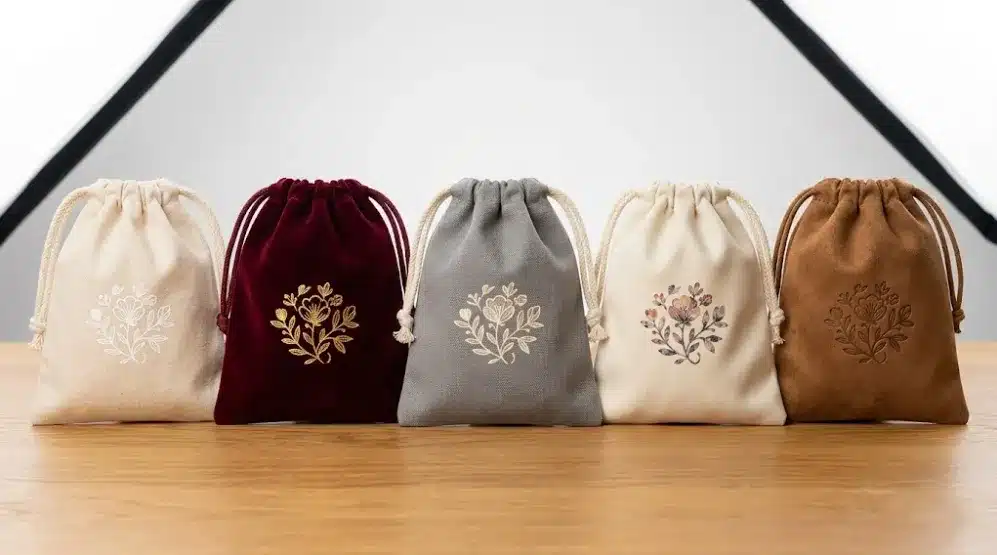
- Velvet drawstring bag — plush, light-catching, classic luxury feel. Best for premium and traditional jewelry brands. $0.50-$1.20/pc.
- Microfiber drawstring pouch — soft, lightweight, scratch-resistant. Best for modern DTC brands. $0.35-$0.80/pc.
- Satin drawstring pouches — smooth, shiny, gift-like. Best for weddings and seasonal gifts. $0.30-$0.70/pc.
- Cotton drawstring pouches — natural, breathable, eco-friendly. Best for sustainable brands. $0.25-$0.60/pc.
- Suede drawstring pouch — grainy, vintage-luxury feel. Best for men’s and heritage brands. $0.80-$2.50/pc.
- Organza drawstring pouch — sheer, lightweight, romantic. Best for wedding favors and sample bags. $0.15-$0.40/pc.
Each material has its sweet spot — there’s no universal “best.” For a full side-by-side comparison with star ratings and price tiers, see our deep-dive guide to jewelry pouch material comparison.
5. Drawstring Cord Types — Often Overlooked, But Critical
Here’s the detail most articles skip — and most buyers ignore. The cord material alone shapes about 30% of how your drawstring pouch feels and looks. So picking the right cord matters almost as much as picking the right fabric.
5.1 Cotton cord
Soft, natural, slightly textured. Cotton cord pairs beautifully with cotton, canvas, and organic fabrics. It’s also the most popular all-around choice because it’s affordable and works with almost any pouch style.
5.2 Satin cord
Smooth, shiny, light-catching. Satin cord adds gift-like elegance and pairs especially well with satin and velvet pouches. However, it can fray at the cut ends, so quality finishing matters.
5.3 Polyester cord
Strong, cheap, and consistent in color. Polyester is the workhorse cord for high-volume orders. Plus, it resists fading better than natural fibers. Common in promotional and budget packaging.
5.4 Jute or hemp cord
Rough, rustic, and unmistakably natural. Jute cord signals “eco” instantly. Best paired with cotton, canvas, or organic fabric pouches for bohemian or sustainable brand stories.
5.5 Leather cord
Premium, distinctive, and built to last. Leather cord adds masculine and heritage character. Best for men’s jewelry, watch pouches, and luxury vintage-styled packaging. Costs significantly more than fabric cords.
5.6 Elastic cord
Stretchy and self-tightening. Elastic cord is rare in jewelry pouches but useful for specific functional designs like hair tie storage or makeup brush bags.
The big mistake brands make is matching a premium fabric with a cheap cord. Specifically, putting a $0.10 polyester cord on a $1.00 velvet pouch instantly drops the perceived value. So always spec the cord with the same care as the fabric.

6. Logo Printing Methods on Drawstring Pouches
Your logo is what turns a generic drawstring pouch into branded packaging. However, not every printing method works on every fabric. So here are the 5 main techniques, ranked by use case.
6.1 Silk screen printing
The industry workhorse. Silk screen presses ink directly onto fabric through a mesh stencil. It’s cheap, fast, and produces vivid solid colors. However, it struggles with gradients, multiple colors, and fine detail. Best for cotton, satin, and microfiber.
6.2 Hot stamping (foil printing)
A heated die presses metallic foil (gold, silver, rose gold, copper) onto the fabric. The result is a shimmering metallic logo that signals premium instantly. Best for velvet, satin, and suede. However, hot stamping doesn’t work for highly detailed logos with thin lines.
6.3 Embroidery
Stitched logos using colored thread. Embroidery creates a textured, three-dimensional logo that lasts as long as the pouch itself. It’s the most premium look. However, it costs the most and has higher MOQs. Best for cotton canvas and velvet.
6.4 Heat transfer printing
A printed film gets pressed onto fabric with heat. Heat transfer handles complex colorful designs that silk screen can’t. So it’s the go-to for multi-color logos and photographic prints. However, the print can crack or peel over years of heavy use.
6.5 Debossing
A heated die presses the logo design into the fabric, creating a recessed impression without ink or foil. The result is subtle, refined, and tactile. Best for suede and leather pouches where you want a low-key luxury feel.
Quick comparison of all 5 logo printing methods:
| Method | Cost | Visual Effect | Durability | Best Materials |
|---|---|---|---|---|
| Silk screen | $ | Vivid, flat | High | Cotton, satin, microfiber |
| Hot stamping | $$ | Metallic, premium | High | Velvet, satin, suede |
| Embroidery | $$$ | 3D, crafted | Very high | Cotton canvas, velvet |
| Heat transfer | $$ | Full-color, detailed | Medium | Microfiber, polyester |
| Debossing | $$$ | Subtle, tactile | Very high | Suede, leather |
The right choice depends on three factors: your fabric, your brand voice, and your budget. For premium brands, hot stamping on velvet remains the gold-standard combination.
7. The Custom Drawstring Pouch Production Process — Step by Step
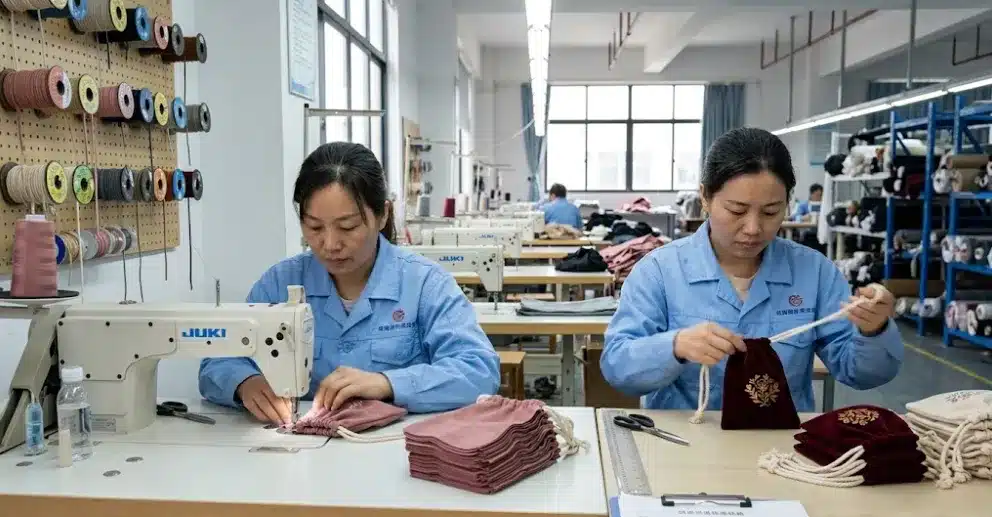
Wondering what actually happens after you place an order? Here’s the full 8-step production process at YJXpack.
7.1 Inquiry and spec confirmation
You send your requirements — size, fabric, color, closure style, logo, quantity. Your account manager confirms feasibility and quotes within 3 minutes.
7.2 3D mockup design
Our design team creates a 3D digital mockup so you can see exactly how your pouch will look before production starts. Turnaround: 30 minutes.
7.3 Sampling
Once you approve the mockup, we produce a physical sample. Lead time is 1-3 days. Then we ship it for your hands-on evaluation.
7.4 Sample approval
You inspect the sample, request any tweaks, and sign off. Most projects need 1 round of revisions; some need 2-3.
7.5 Bulk production
Once approved, bulk production runs in 5-7 days for orders up to 5,000 pieces. Larger orders take proportionally longer.
7.6 Quality inspection
Every piece goes through 100% manual quality inspection following AQL 2.5 standards. Defects get pulled before packing.
7.7 Packaging and shipping
Pouches are individually bagged or bulk-packed based on your preference. We offer DDP shipping, sea freight, and air freight.
7.8 After-sales support
We respond to any post-delivery questions within 1 hour. If anything doesn’t match the approved sample, we replace it at no cost.
8. Top Use Cases — Where Drawstring Pouches Win
Drawstring pouches show up across dozens of industries. Here are the 8 highest-volume use cases.
- Jewelry packaging — the #1 use case. Rings, necklaces, earrings, bracelets all live in drawstring pouches.
- Wedding favors — small satin or organza pouches filled with almonds, candy, or seeds.
- Beauty sample bags — cosmetic brands ship lipstick or fragrance samples in branded microfiber pouches.
- Sachet and aromatherapy bags — cotton or linen pouches filled with dried lavender, herbs, or essential oils.
- Watch and accessory packaging — suede or velvet pouches for individual watches, sunglasses, or hair clips.
- E-commerce gift packaging — DTC brands use branded pouches as inserts inside shipping boxes to lift the unboxing.
- Travel storage — premium hotels and luxury brands offer drawstring shoe bags, jewelry travel cases, and amenity pouches.
- Branded promotional gifts — corporate gift programs use logo-printed cotton pouches as eco-friendly swag.
If your product is small, soft, or giftable, there’s probably a drawstring pouch format that fits.
9. How to Choose the Right Drawstring Pouch for Your Brand — 4 Questions
Picking the right drawstring pouch can feel overwhelming. So narrow it down by answering these four questions in order.
9.1 What’s your product?
The product inside dictates protection needs. Plated jewelry needs cushioning fabric (microfiber, velvet). Wedding almonds need lightweight fabric (organza, satin). Watches need structured fabric (suede, velvet). Start here.
9.2 What’s your customer expectation?
Your customer’s perceived value determines packaging tier. Specifically, packaging cost should track to 5-10% of product price for sustainable margins. So a $30 necklace should ship in a $0.50 pouch, not a $1.50 one.
9.3 What’s your brand voice?
Modern brands lean toward microfiber in neutral colors with silk screen logos. Heritage brands choose velvet with hot stamping. Eco brands pick cotton with embroidery. Pick the combination that matches the rest of your brand.
9.4 What’s your order volume?
Embroidery and debossing have higher MOQs (usually 500+ pieces). Silk screen and hot stamping work at 100 MOQ. So if you’re testing small batches, plan your logo method accordingly.
10. Conclusion — A Small Bag, A Big Brand Decision
A drawstring pouch looks simple. But behind that simple form sit hundreds of possible combinations — 5 closures × 6 fabrics × 6 cord types × 5 logo methods. Each combination signals something different to your customer.
Fortunately, the logic is simple. First, pick the fabric that matches your product and price tier. Second, pick the closure that matches your security and aesthetic needs. Third, pick the logo method that matches your fabric and brand voice. Then always request a physical sample before placing a bulk order.
Do all three, and the drawstring pouch stops being a generic accessory. Instead, it becomes a quiet but powerful brand asset that customers feel every time they open your package.
11. FAQs
Q1: What’s the difference between a drawstring pouch and a regular pouch?
A drawstring pouch closes by pulling one or more cords through a top channel. A regular pouch usually closes with a zipper, snap, magnetic flap, or no closure at all. Specifically, drawstring closures feel softer and more handmade, while zipper closures feel more functional and secure. For jewelry and gift packaging, drawstring wins on emotional warmth.
Q2: What’s the most popular drawstring closure style for jewelry?
Double drawstring (opposing pull) is the industry standard for jewelry pouches. It closes tightly, looks balanced from any angle, and costs only slightly more than single drawstring. About 70% of all jewelry pouch orders at YJXpack use this closure style. So if you’re unsure, start there.
Q3: Can I print my logo on any drawstring pouch material?
Yes, but the method matters. Silk screen works on almost any fabric. Hot stamping works best on velvet, satin, and suede. Embroidery works on cotton canvas and velvet. Heat transfer works on microfiber and polyester. So pick your fabric first, then match the logo method that performs best on it.
Q4: What’s the MOQ for custom drawstring pouches?
At YJXpack, custom drawstring pouches start at MOQ 100 pieces. That’s unusually low for the industry. Sample lead time is 1-3 days. However, fully custom dyeing or embroidery may require 500+ pieces because mills have minimum batch sizes. So plan accordingly if you want a unique color.
Q5: How long does it take to produce custom drawstring pouches?
From order confirmation to ready-to-ship, the typical timeline is 7-10 days for orders up to 5,000 pieces. Specifically, sampling takes 1-3 days, sample approval takes 1-2 days, and bulk production takes 5-7 days. Larger orders or complex customization can extend this to 15-20 days. We also offer rush production for urgent orders.
Q6: Are drawstring pouches eco-friendly?
It depends on the material. Organic cotton (GOTS certified) and recycled cotton are the most eco-friendly options. Recycled microfiber (GRS certified) is also a strong choice. By contrast, standard velvet, polyester, and synthetic suede rank lower. So if sustainability matters, spec the material carefully — the “drawstring pouch” format itself is neutral.
Q7: What’s the price range for a custom drawstring pouch?
Custom drawstring pouches typically run $0.25-$2.50 per piece, depending on material, size, closure style, and logo method. Cotton pouches with silk screen logos sit at the low end. Premium velvet pouches with hot stamping or embroidery sit at the high end. Volume discounts kick in at 500+ pieces.
Get a Quote — Custom Drawstring Pouches
YJXpack — Yijiaxin (Shenzhen) Packaging Co., Ltd.
For 20+ years, we’ve made custom drawstring pouches in every material — velvet, microfiber, satin, cotton, suede, and organza — for brand owners, traders, and e-commerce sellers across the US, Europe, and the Middle East. We offer 5 closure styles, 6 cord materials, and 5 logo printing methods. Plus, we hold GOTS, GRS, OEKO-TEX, BSCI, ISO 9001, and SABER certifications. We serve over 8,000 brands worldwide.
Want to see and feel the real thing? Request a free sample pouch — we’ll ship it to your door so you can judge the quality before any commitment.
Email: info@yjxpack.com
WhatsApp / WeChat: +86 18617112946
Website: www.yjxpack.com
Free sample shipped to your door · Quote within 3 minutes · 3D mockup in 30 minutes · MOQ 100 pieces · GOTS / GRS / OEKO-TEX / BSCI / ISO 9001 certified
Share This Story, Choose Your Platform!