Most brands want eco-friendly packaging. Not all of them know what that actually means, though. Terms like OEKO-TEX, GRS, and organic cotton get used everywhere — and they don’t all mean the same thing. Yet the differences matter a lot once you start sourcing.
In short: eco friendly packaging for fabric pouches comes in three main types: chemically safe fabrics (OEKO-TEX), recycled materials (GRS), and certified natural fibers (organic cotton / GOTS). At YJXpack, we produce pouches across all three certification tracks for brands worldwide. This guide explains each one clearly, compares them side by side, and gives you a decision framework so you can pick the right option without guesswork.
1. The Quick Answer — Eco Friendly Packaging Certifications at a Glance
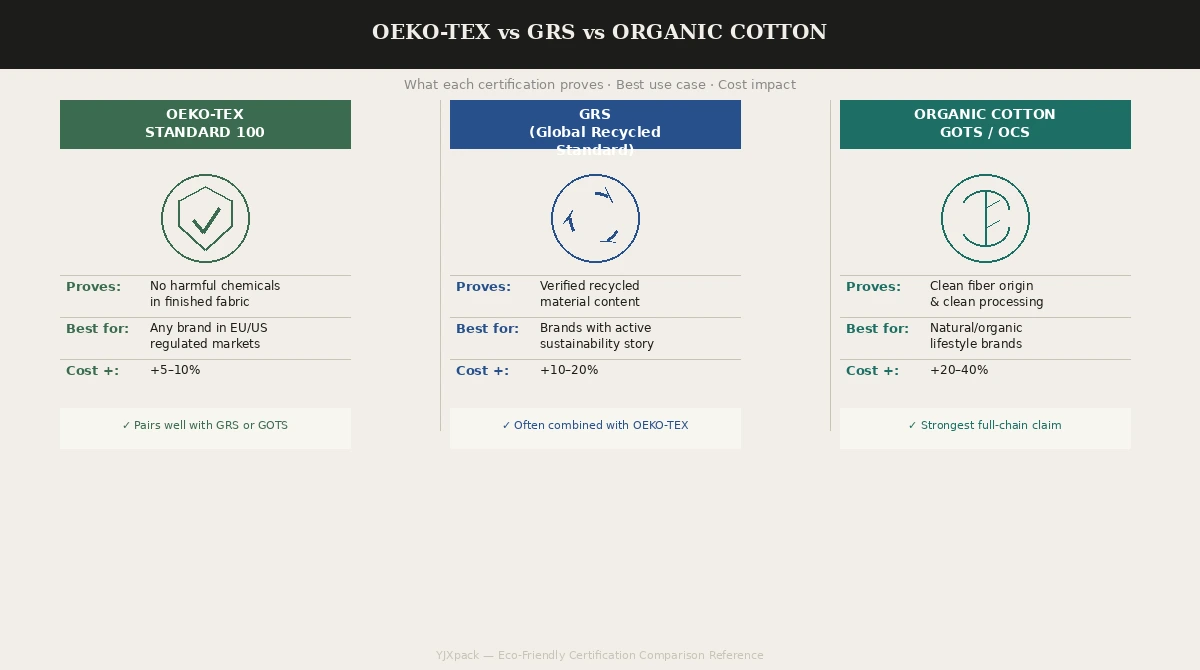
If you need the short version, here it is. First, OEKO-TEX proves the fabric has no harmful chemicals. Second, GRS proves the material was made from recycled content. Third, organic cotton or GOTS proves the fiber was grown and processed without synthetic pesticides.
| Certification | What It Proves | Best For | Cost Impact |
|---|---|---|---|
| OEKO-TEX Standard 100 | No harmful chemicals in fabric | Any brand entering EU/US markets | Low (+5-10%) |
| GRS | Recycled material content verified | Brands with sustainability story | Mid (+10-20%) |
| Organic Cotton / GOTS | Natural fiber, clean process | Premium natural lifestyle brands | High (+20-40%) |
Of course, one certification doesn’t cancel out another. Many brands layer two or more together. But first, let’s look at what each one actually covers before you decide which combination makes sense.
2. What Does “Eco-Friendly” Actually Mean for a Fabric Pouch?
“Eco-friendly” is one of the most overused words in packaging. Without a certification behind it, it’s just marketing language. So the first question to ask any supplier is simple: which sustainable packaging certification do you actually hold, and can I verify it?
A fabric pouch can be eco-friendly in three different ways. It might be made from fabric that contains no toxic dyes or chemicals. Alternatively, it might use recycled fiber that diverts waste from landfill. Or it might be made from natural fiber grown without synthetic inputs. Each path solves a different environmental problem.
The mistake most brands make is treating these as interchangeable. They aren’t. A recycled polyester pouch with GRS certification is eco-friendly in the waste-reduction sense. However, it may still use chemical dyes that OEKO-TEX would flag. Meanwhile, an organic cotton pouch might have a clean fiber origin but still carry a higher carbon footprint from shipping than a locally recycled alternative.
Understanding which problem you’re actually solving helps you pick the right certification — and the right answer to give your customers when they ask.
3. What Is OEKO-TEX Certification?
OEKO-TEX Standard 100 is the most widely recognized textile safety certification in the world. Specifically, it tests finished fabric for over 100 harmful substances, including heavy metals, formaldehyde, pesticide residues, and banned dyes. Every component of the certified product gets tested, not just the outer fabric.
An OEKO-TEX certified pouch tells your customer that what they’re touching has been independently verified as safe. This matters especially for brands selling into the EU and US, where chemical safety scrutiny has increased significantly in recent years.
OEKO-TEX does not certify production processes or labor practices. It also does not verify whether the fiber is organic or recycled. Instead, it focuses entirely on the question: is this safe for human contact?
The cost premium for OEKO-TEX certified fabric is relatively modest, typically 5-10% above standard fabric. The certification renews annually and must be maintained across the supply chain. For most brands entering regulated markets, therefore, OEKO-TEX is the minimum credible eco claim to make.
4. What Is GRS (Global Recycled Standard)?
GRS certification, managed by Textile Exchange, verifies that a product contains a minimum percentage of recycled material. The standard applies to recycled polyester, recycled cotton, recycled nylon, and other reclaimed fibers. It also covers chain-of-custody documentation, which means you can trace the recycled material back through the supply chain.
A GRS recycled fabric bag makes a strong sustainability story because the claim is independently verified rather than self-declared. Brands in beauty, retail gifting, and outdoor products increasingly require GRS from their packaging suppliers as part of their own ESG reporting.
One important note: GRS certification does not mean the fabric is chemical-free. Recycled polyester, for example, can still contain residual substances from its previous life cycle. Many brands pair GRS with OEKO-TEX to cover both the recycled content claim and the chemical safety claim simultaneously.
The cost premium for GRS fabric typically runs 10-20% above conventional alternatives, depending on the recycled content percentage and fiber type.
5. What Is Organic Cotton? OCS vs GOTS Explained
Organic cotton comes from plants grown without synthetic pesticides, herbicides, or GMO seeds. However, “organic” on a label alone tells you very little. The certification behind it matters more than the word itself.
OCS (Organic Content Standard) verifies only that the fiber content is organic. It traces the cotton from farm to final product but does not cover the processing stage, meaning the dyeing and finishing steps can still use conventional chemicals.
GOTS (Global Organic Textile Standard) is the more rigorous option. It covers both the organic fiber origin and the entire processing chain, including dye chemistry, wastewater treatment, and social compliance at the factory. An organic cotton pouch with GOTS certification gives your customers the full picture, from farm to finished product.
At YJXpack, we hold GOTS certification alongside OEKO-TEX and GRS. That combination lets brands choose whichever claim fits their product and market, without switching suppliers or renegotiating contracts.
6. OEKO-TEX vs GRS vs Organic Cotton: How Eco Friendly Packaging Options Compare
Now that we’ve covered what each certification covers individually, it helps to see them side by side. This is where eco friendly packaging decisions usually get made for real.
OEKO-TEX and organic cotton (GOTS) both address chemical safety, but from different directions. OEKO-TEX tests the finished fabric and verifies that harmful residues are below threshold levels. GOTS, by contrast, controls the inputs at source so that harmful chemicals never enter the process in the first place. Both are credible. GOTS is the stronger claim, but it carries a significantly higher cost.
GRS and OEKO-TEX operate independently of each other and can be combined. A recycled polyester pouch with both GRS and OEKO-TEX certification covers the recycled content story and the chemical safety story simultaneously. This combination is increasingly common among brands with formal sustainability commitments.
Organic cotton and GRS address different environmental problems entirely. Organic cotton reduces agricultural chemical use and supports soil health. GRS, by contrast, reduces material waste and landfill contribution. Some brands source organic recycled cotton, which qualifies for both OCS and GRS, but this material costs significantly more than either alone.
7. Which Certification Fits Your Brand?
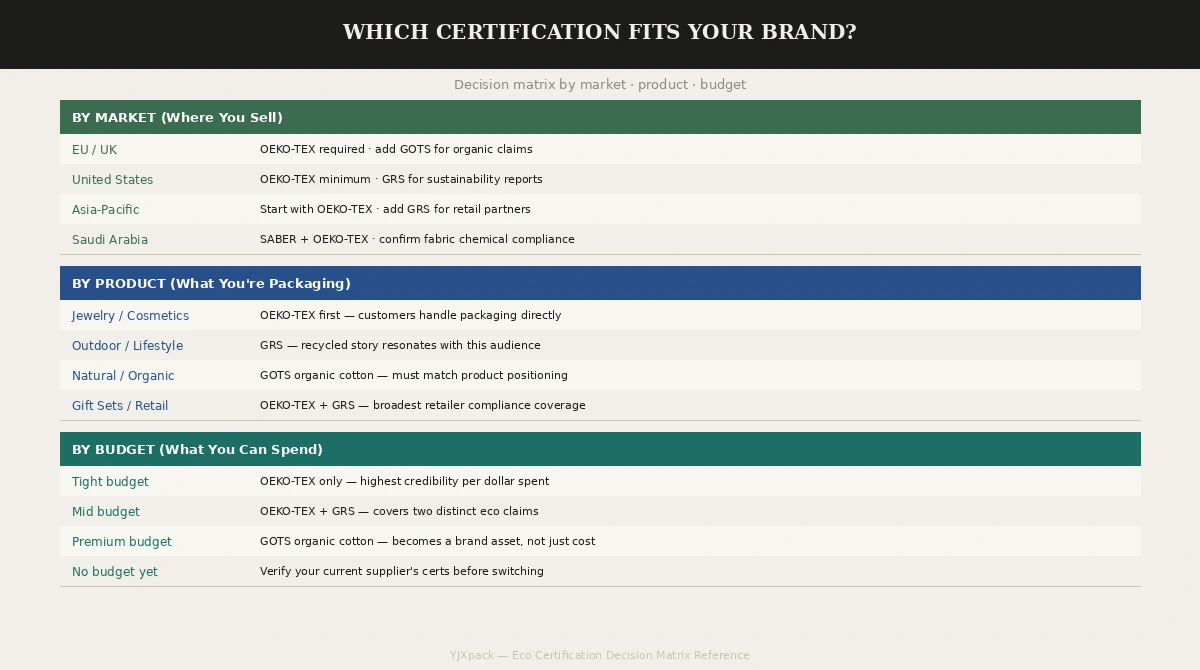
The right choice depends on your market, your product, and your budget. Here’s how to think through each dimension.
By Market (Where You’re Selling)
Brands selling into the EU need at minimum OEKO-TEX, since EU textile regulations increasingly require chemical safety documentation. Brands selling into the US have more flexibility but face growing retailer-driven ESG requirements. Brands in Asia-Pacific markets often start with OEKO-TEX and add GRS as a secondary claim for sustainability-forward retail partners.
By Product (What You’re Packaging)
Jewelry and cosmetics brands benefit most from OEKO-TEX, since their customers interact closely with the packaging. Outdoor and lifestyle brands often prioritize GRS because the recycled materials story resonates with their audience. Natural and organic product brands almost always need organic cotton with GOTS or OCS, since their packaging must match their product’s positioning.
By Budget (What You Can Spend on Packaging)
Start with OEKO-TEX if budget is a constraint. It delivers the highest credibility per dollar spent and satisfies most retailer compliance requirements. Add GRS as a second layer if you’re scaling and your customers actively ask about recycled content. Consider full GOTS organic cotton when your brand’s identity is built around natural and organic, since the certification then becomes a brand asset rather than just a compliance cost.
8. What to Ask Your Factory Before Ordering
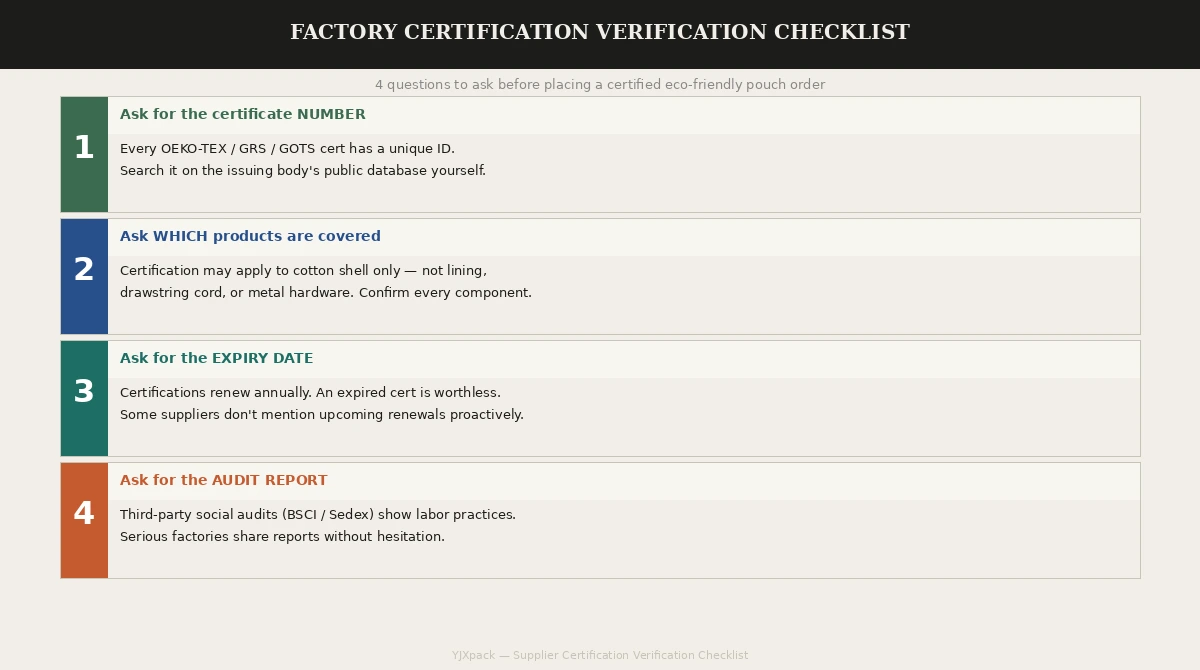
Certifications are only as reliable as the factory holding them. So before placing an order, ask these specific questions rather than accepting a general claim of “eco-friendly.”
First, ask for the certification number, not just the name. Every OEKO-TEX, GRS, and GOTS certificate has a unique number you can verify on the issuing body’s public database. A supplier who hesitates to provide this is worth treating with caution.
Second, ask which specific products in their range carry each certification. A factory might hold OEKO-TEX for their cotton fabrics but not for their lining materials or drawstring cords. Get confirmation that the certification applies to every component of your finished pouch, not just the outer shell.
Third, ask for the certificate expiry date. Certifications renew annually. An expired certificate is meaningless, and suppliers don’t always proactively flag when a renewal is pending.
Finally, ask whether they can share the audit report. Third-party social compliance audits like BSCI or Sedex are often part of a broader sustainable packaging certification package. At YJXpack, we maintain current certifications across OEKO-TEX, GRS, GOTS, BSCI, and ISO 9001, and share documentation on request without delay.
9. Common Myths About Eco-Friendly Packaging
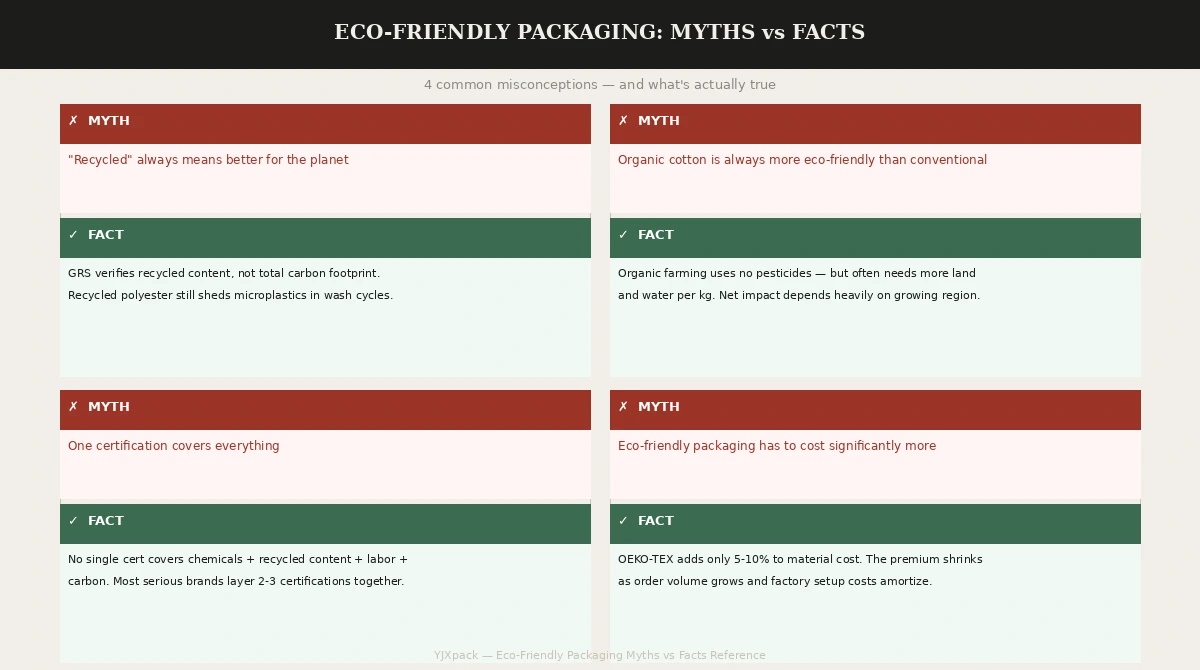
A few persistent misconceptions make this topic harder than it needs to be. Here are the ones we hear most often.
Myth 1: “Recycled” Always Means Better for the Planet
Recycled materials reduce waste, but they don’t automatically reduce carbon footprint. Recycled polyester requires energy-intensive processing and still sheds microplastics in wash cycles. GRS certification verifies the recycled content claim but doesn’t address these downstream impacts. It’s a real sustainability improvement, but not a complete solution.
Myth 2: Organic Cotton Is Always More Eco-Friendly Than Conventional Cotton
Organic cotton uses no synthetic pesticides, which is a genuine environmental benefit. However, organic cotton farming typically uses more land and more water per kilogram of fiber than conventional cotton. The net environmental impact depends heavily on where and how it’s grown. GOTS certification gives you the best available assurance, but it doesn’t resolve this underlying tradeoff.
Myth 3: One Certification Covers Everything
No single certification covers chemical safety, fiber origin, recycled content, labor practices, and carbon footprint all at once. OEKO-TEX covers chemicals. GRS covers recycled content. GOTS covers organic fiber and processing. BSCI covers labor. Brands serious about sustainability usually hold two or three of these simultaneously.
Myth 4: Eco-Friendly Packaging Has to Cost Significantly More
OEKO-TEX certified fabric adds roughly 5-10% to material cost, which is a very manageable premium. The bigger cost driver is usually the certification fee that your supplier pays annually. A factory that spreads that fixed cost across large production volumes passes on a much smaller per-unit premium than one running small batches. At YJXpack, our certified velvet pouches and cotton bags carry OEKO-TEX certification as standard, without significant price separation from non-certified alternatives.
10. Conclusion — The Right Eco Friendly Packaging Choice for Your Brand
Eco friendly packaging is not a single choice. Instead, it’s a stack of verified claims, each one addressing a different environmental impact. OEKO-TEX handles chemical safety. GRS handles recycled content. Organic cotton with GOTS handles fiber origin and processing.
Start with the certification that matters most to your market and your customers. Then add layers as your brand and budget grow. The most important step, in fact, is moving from unverified claims to independently certified ones. That shift is what separates real eco friendly packaging from packaging that just looks the part.
11. FAQs
Q1: Is OEKO-TEX the same as organic certification?
No, they cover different things. OEKO-TEX verifies the finished fabric is free of harmful chemicals. Organic certification like GOTS verifies the fiber was grown without synthetic pesticides and processed with clean chemistry. A product can hold both, one, or neither.
Q2: Generally, do I need GRS certification if I’m already using organic cotton?
Generally, no — unless you’re specifically claiming recycled content. GRS applies to recycled materials. Organic cotton is a virgin natural fiber, not recycled. They address different environmental claims and don’t substitute for each other.
Q3: Most retailers require which certification minimum for eco-friendly pouches?
Most major retailers entering the EU market require at minimum OEKO-TEX Standard 100 for textile products. Some additionally require GOTS or GRS as part of their supplier sustainability programs. Requirements vary by retailer and market.
Q4: About how much does it add to pouch cost if I choose GOTS organic cotton?
About 20-40% more than standard cotton is typical, depending on color, fabric weight, and order volume. OEKO-TEX adds far less, usually 5-10%. GRS recycled fabric sits in between at roughly 10-20% above conventional alternatives.
Q5: No certification yet — where should I start?
Start with OEKO-TEX Standard 100. It’s the most widely recognized, the most affordable upgrade, and satisfies the most common retailer and market requirements. From there, add GRS or GOTS based on your brand’s specific story.
Q6: Can I verify a factory’s certification myself before ordering?
Yes. Every OEKO-TEX certificate has a unique ID searchable at oeko-tex.com. GRS certificates are verifiable through Textile Exchange. GOTS certificates are searchable at the GOTS public database. Always verify before placing a first order.
Q7: Usually, how long does it take to get certified eco-friendly pouches made?
Usually, lead time is similar to standard pouches — 5-7 days for bulk once a sample is approved, assuming the factory already holds the relevant certifications. The certification is on the factory and material, not the finished order, so there’s no extra approval time once you’re working with a certified supplier.
Get a Quote — Certified Eco-Friendly Pouches
YJXpack — Yijiaxin (Shenzhen) Packaging Co., Ltd.
For 20+ years, we’ve produced custom fabric pouches certified under OEKO-TEX, GRS, GOTS, and BSCI for brands worldwide. Not sure which certification fits your market? Tell us where you’re selling and who your buyers are, and we’ll recommend the right combination.
Want proof before you commit? Request a free certified sample pouch — we’ll ship it with full certification documentation attached so you can share it with your buyer or retail partner.
Email: info@yjxpack.com
WhatsApp / WeChat: +86 18617112946
Website: www.yjxpack.com
Free sample shipped to your door · Quote within 3 minutes · MOQ 100 pieces · OEKO-TEX / GRS / GOTS / BSCI / ISO 9001 certified
Share This Story, Choose Your Platform!