A hotel laundry bag is often treated as a small amenity item. That is exactly why branding decisions are frequently made too late.
A logo may be added after the bag size, material and drawstring have already been chosen. The result can look acceptable in a flat approval photo but feel wrong in the guest room: too promotional for a premium wardrobe, too delicate for a high-turnover program, or too costly for an item that will be replenished frequently.
The better question is not, “How large should the logo be?”
> What job should this branded laundry bag perform in the hotel program?
For some properties, the bag is a simple guest-use item that needs to be easy to identify and economical to replenish. For others, it is part of a premium in-room presentation. For a laundry operator or resort group, the mark may also help distinguish property, room category or service workflow.
That service role should determine the decoration method, placement and artwork brief.
Start With the Service Life of the Bag
Before comparing print methods, define whether the bag is primarily a replenishment item, a reusable in-room accessory, an operations tool, or a branded retail-style item.
| Program situation | What the bag needs to do | Branding priority | Usually unsuitable approach |
|---|---|---|---|
| High-turnover guest room replenishment | Give guests a clear place for laundry and support regular replacement | Simple identification, controlled cost, consistent appearance | Overly detailed artwork or premium decoration with no service purpose |
| Reusable premium room or resort program | Remain in the room presentation over repeated guest stays | Material feel, restrained branding, long-term appearance | Large promotional print that dominates the room setting |
| Laundry collection or back-of-house program | Support property identification and handling workflow | Functional mark, property code or colour logic | Treating the bag like a luxury guest amenity |
| Boutique hotel, villa or gift program | Extend the property’s brand experience beyond a basic utility item | Tactile detail, presentation, branded finish | Choosing the cheapest decoration route without reviewing the guest experience |
| Multi-property hotel group | Keep branding consistent while allowing property variation | Artwork system, colour control, approval process | Treating every property version as an unrelated artwork project |
This distinction matters because a hotel may use the same phrase—“laundry bags with logo”—for completely different products.
A single-colour mark on a lightweight guest laundry bag can be the right decision for a large replenishment program. That same treatment may feel underdeveloped in a boutique resort wardrobe where the bag is intended to remain visible beside robes, slippers and amenities.
The bag’s service life sets the branding ceiling. A short-life, high-volume item normally needs a decoration route that is simple to approve and repeat. A reusable item gives the buyer more reason to consider texture, label construction or embroidery.
Choose the Logo Method Based on the Job, Not the Artwork Alone
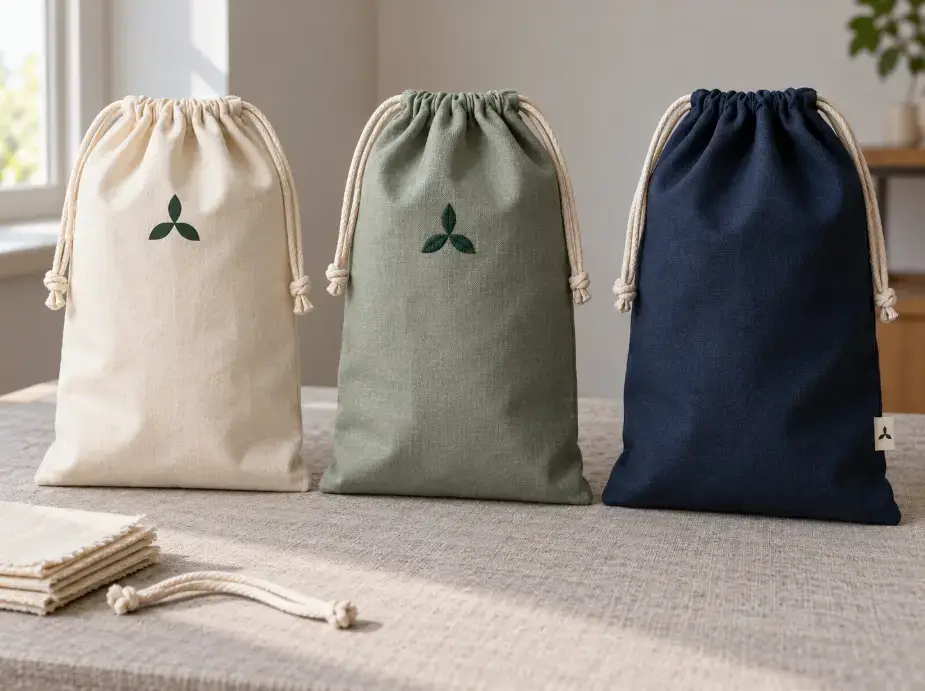
The same logo can be reproduced through screen printing, transfer decoration, embroidery or a woven label. Those are not interchangeable choices.
| Decoration route | Best fit | What it adds | What the buyer must watch |
|---|---|---|---|
| Single-colour screen print | Simple hotel mark, short name or icon on cotton or non-woven bags | Direct, efficient brand recognition | Print area, edge sharpness, ink coverage and fabric texture |
| Multi-colour screen print | Brand marks with defined spot colours and clear colour blocks | More faithful brand colour separation | Each additional colour increases artwork and production coordination |
| Transfer decoration | Artwork with fine detail, tonal changes or small colour elements | Can reproduce more visual detail than a simple solid-colour print | Surface compatibility, placement on flexible fabric and sample appearance |
| Embroidery | Reusable premium bags in stable woven fabric | Texture, depth and a more tactile finish | Small text, fine lines, dense stitch areas and backing on the reverse side |
| Woven label | A refined, long-term brand identifier near a seam or edge | A quiet premium cue without a large front graphic | Label size, seam placement, fold direction and whether it remains visible when stored |
The practical rule is simple:
- Use screen printing when the brand needs to be recognised quickly and the artwork is simple.
- Consider embroidery or woven labels when the bag itself is intended to feel like a durable part of the room experience.
- Consider transfer decoration only when artwork detail genuinely needs it; it should not be selected merely because a logo file contains more colours.
A premium logo treatment is not automatically a premium guest experience. If the bag is lightweight, folded into a drawer and routinely replenished, a subtle woven label or oversized embroidery can add cost without improving the service moment.
Treat the Artwork Brief as a Procurement Document
A logo file alone is not an adequate brief for custom laundry bags.
The purchasing team should define the mark in the context of the selected bag—not as an isolated graphic. A useful artwork brief answers five questions:
- Which logo version is approved for this program?
- Is the mark one solid colour, multiple spot colours, or a detailed graphic?
- Where is the logo placed when the bag is hanging, folded and stored?
- Does the hotel need one standard version or several property-specific versions?
- What is the approved reference for colour, size and appearance?
This becomes especially important for hotel groups.
For example, a group may have three property marks and offer four bag colours across its portfolio. That does not necessarily create twelve different products, but it does create an approval matrix of up to twelve logo-and-background combinations. Some combinations may need a different ink colour, a simplified artwork version or a different placement rule.
That is where many “small” logo projects become slow.
A buyer can avoid this by defining a brand system early:
| Brief item | Example decision to make |
|---|---|
| Primary mark | Use the icon only, not the full hotel name |
| Artwork version | Use a one-colour version for replenishment bags |
| Bag colour | Ivory bag with dark green mark; navy bag with light neutral mark |
| Placement | Centred upper front, below the drawstring channel |
| Property variation | Hotel name changes, icon and placement remain fixed |
| Approval reference | Signed physical sample plus approved artwork file |
| Reorder rule | Reorders follow the signed sample unless a revised artwork is approved |
The point is not to create paperwork. It is to stop every reorder from becoming a new branding discussion.
Placement Should Follow How the Bag Is Actually Used
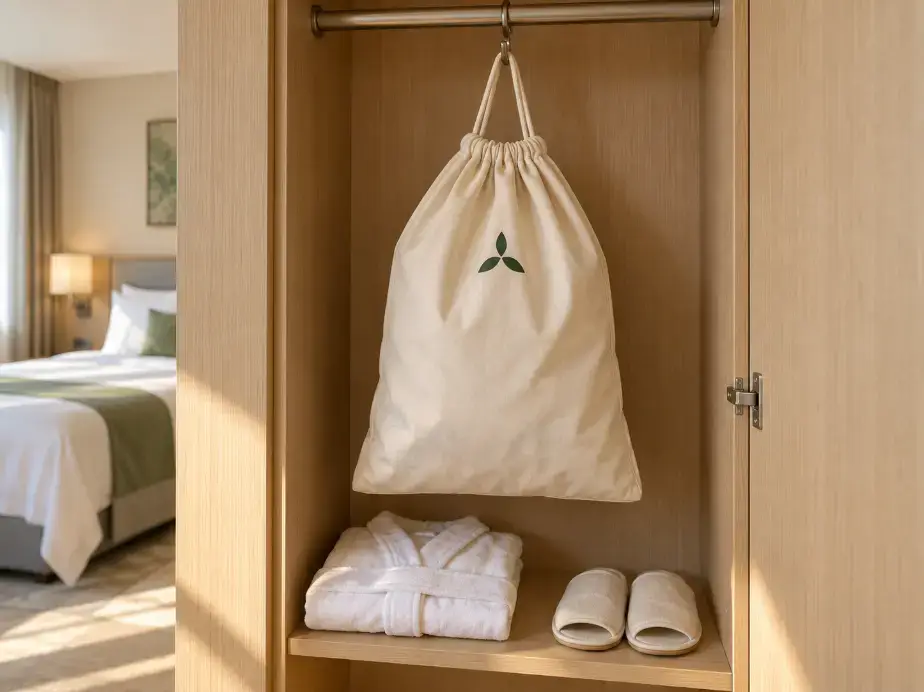
Logo placement is often approved while the bag lies flat on a table. Guests do not experience it that way.
A hotel laundry bag may be hung inside a wardrobe, folded into a drawer, placed beside robes, carried to a collection point or stored with other amenities. The most attractive placement on a flat sample can disappear when the drawstrings are pulled or the bag is folded.
Instead of asking whether the logo is “visible enough,” ask one operational question:
> At the moment the guest or staff member needs to recognise the bag, which panel of the bag is actually facing them?
For a hanging wardrobe bag, the front upper panel may be the natural choice. For a bag that is commonly folded and placed in a drawer, the visible fold face may matter more. For a back-of-house collection bag, a practical property identifier may be more useful than a decorative front-centre mark.
Avoid placing a key mark:
- Directly across a drawstring channel
- Too close to a side seam or folded gusset
- In an area likely to crease sharply when the bag is stored
- Where a filled bag will distort the artwork
- Where it competes with necessary guest-use information
A well-placed small mark often feels more intentional than a large front graphic. The goal is not maximum logo area. It is a bag that still looks considered when used as intended.
Understand What Actually Changes the Quote
Hotel buyers often ask for a price “with logo.” That phrase leaves out the variables that make one quoted decoration route different from another.
| Quote driver | Why it affects the project |
|---|---|
| Number of print colours | More colour separation can require more artwork preparation and production steps |
| Decoration area | A small chest-size icon is not the same project as a large front-panel graphic |
| Decoration method | Screen print, transfer, embroidery and woven labels use different materials and processes |
| Number of logo locations | Front-only, front-and-back, or bag plus label are separate decoration requirements |
| Bag material and colour | Fabric texture and background colour affect how an artwork version should be prepared |
| Property-specific versions | Different hotel names, colourways or language versions expand approval and artwork control |
| Folding and packing requirement | If a logo must remain visible in presentation packaging, folding direction becomes part of the specification |
| Reorder governance | A clear signed sample and artwork reference reduce avoidable variation on later orders |
This does not mean every program needs a complex specification. It means the buyer should decide what matters before comparing quotations.
A low-cost quote can be appropriate for a simple guest-use bag. A higher-cost route may also be appropriate when the bag is part of a premium room identity. The mistake is comparing the two as though they solve the same problem.
Use the Sample Review to Test the Real Guest Experience
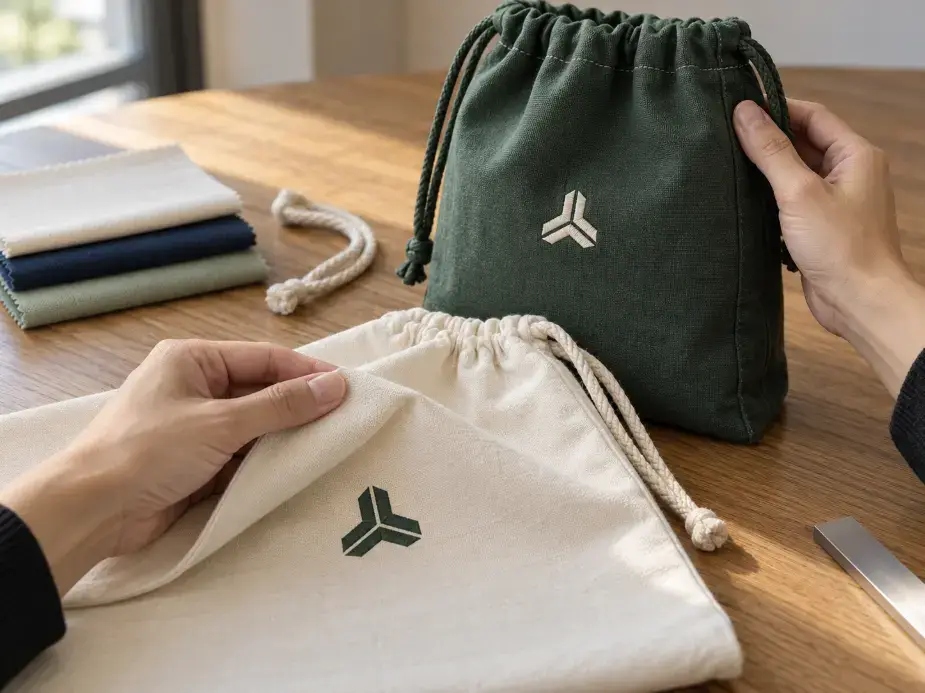
The first sample should not be approved only because the logo looks correct under office lighting.
Review it in the situations the program will actually create:
- Hang the bag in a representative wardrobe or guest-room setting.
- Pull the drawstrings fully closed and check how the front panel behaves.
- Fold the bag as it will be packed or displayed.
- Place typical guest laundry inside it and review whether the mark distorts.
- Compare the selected logo colour against the approved artwork reference and bag colour.
- Check the reverse side of embroidery or added labels for comfort, bulk and construction quality.
- Confirm that any washability, rubbing resistance or repeated-use requirement is defined in the project specification and assessed on the agreed sample.
The sample is where branding becomes a product decision. It should answer not only “Does the logo look right?” but also “Does this bag still feel appropriate once it enters the hotel service flow?”
Build a Short RFQ That Prevents Rework
A practical RFQ for laundry bags with logo should include:
- Intended program: replenishment, reusable guest room, back-of-house or retail-style use
- Bag material, colour, target size and closure type
- Selected logo method or acceptable alternatives
- Artwork file and approved colour reference
- Logo size and exact placement
- Number of logo locations
- Property-specific artwork versions, if any
- Folding, packing and display requirements
- Required sample review points
- Reorder reference: approved artwork version and signed sample
That is enough to start a meaningful supplier discussion. It gives the supplier a way to recommend alternatives while keeping the original procurement objective intact.
If you are planning custom hotel laundry bags with logo, the useful starting point is not “Which print looks best?” It is “What role should the bag play in this hotel program, and what branding method supports that role without adding unnecessary complexity?”
For a project-specific discussion of bag format, decoration options and sample approval points, contact YJXPACK.
Frequently Asked Questions
Is screen printing always the lowest-cost option for hotel laundry bags?
Not always. It can be a practical route for simple artwork, but the final comparison depends on colour count, print coverage, fabric, quantity, placement and the required presentation. Compare like-for-like specifications rather than choosing a method by name alone.
Is embroidery suitable for every laundry bag?
No. Embroidery is usually better suited to stable woven materials and reusable, premium-positioned bags. Fine text, dense artwork and lightweight fabric should be reviewed on a physical sample before approval.
Should a hotel place its full logo on every laundry bag?
Not necessarily. A simplified icon, monogram or woven label may suit the bag and room setting better than a full logo lock-up. The choice should match the bag’s role and the hotel’s brand system.
What should be approved before a reorder?
Keep the final artwork version, colour reference, logo size, placement instruction, bag material and signed sample together as the reorder reference. This reduces the chance that a later order is treated as a new branding project.
Share This Story, Choose Your Platform!