Custom amenity bags are often treated as a simple packaging item. For hotels, resorts, spas, airlines and corporate gift programs, they are usually part of a larger guest experience.
The bag needs to hold the intended contents, present the brand appropriately, support staff packing and remain practical when the guest opens and reuses it. A pouch that looks attractive when empty may become difficult to pack when filled. A fabric that feels premium may still be unsuitable if the opening is too narrow, the lining reduces usable capacity or the closure does not work smoothly with the contents.
This guide explains how to specify custom amenity bags according to the actual kit, guest-use scenario and purchasing process. It covers capacity, shape, material, lining, closure, logo placement, RFQ preparation and sample review.
The key principle is simple: start with the contents and the way the kit will be used. Choose the bag construction after those requirements are clear.
What Are Custom Amenity Bags for Hospitality Kits?
A custom amenity bag is a fabric pouch or soft bag designed to hold a planned group of guest-use products. The contents may include toiletries, sleep accessories, wellness items, small textiles, travel products or corporate gifts.
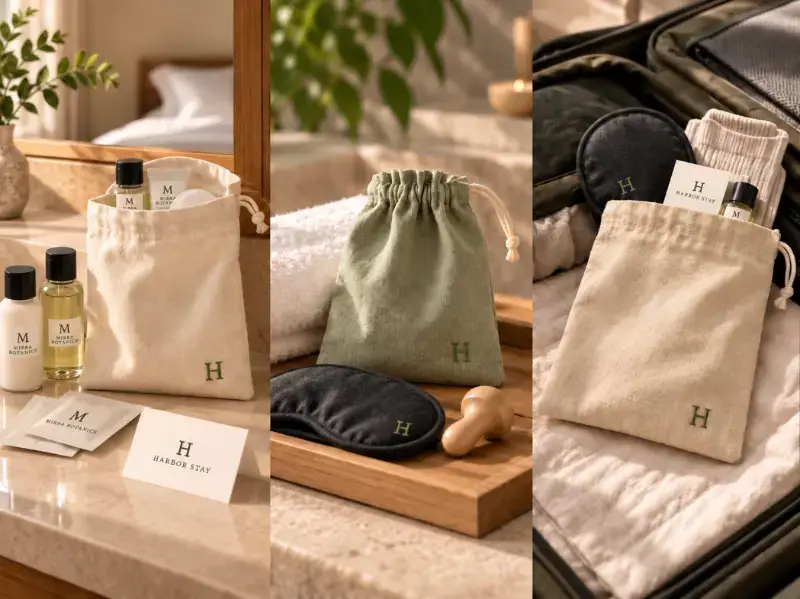
A hotel amenity bag may be placed on a guest-room vanity, inside a welcome tray, next to a folded towel or within a larger arrival package. A spa may use a soft fabric pouch for a towel, eye mask and personal-care items. An airline or travel program may prefer a compact custom toiletry bag that can be placed inside luggage or a seat-back kit.
The bag can serve several purposes at the same time:
- Organize a group of small products
- Improve the first presentation of the kit
- Give hotel staff a defined packing format
- Provide a reusable item for the guest
- Create a visible surface for brand presentation
- Keep different kit versions visually consistent
However, not every hospitality bag should use the same structure. A pouch for small sachets and a pouch for bottles may look similar in a catalogue but require different opening sizes, side depth, lining and closure details.
The following three project types illustrate the difference.
Scenario 1: Small hotel toiletry kit
A hotel may provide several small bottles, sachets and a printed welcome card. The main priorities are usually:
- Easy insertion of small items
- A clean presentation on a vanity or tray
- A compact profile during room setup
- A front panel that remains visible
- A closure that staff can operate quickly
A flat pouch may work when the contents are thin. If the bottles create depth, a gusseted format may be more practical.
Scenario 2: Spa or wellness welcome kit
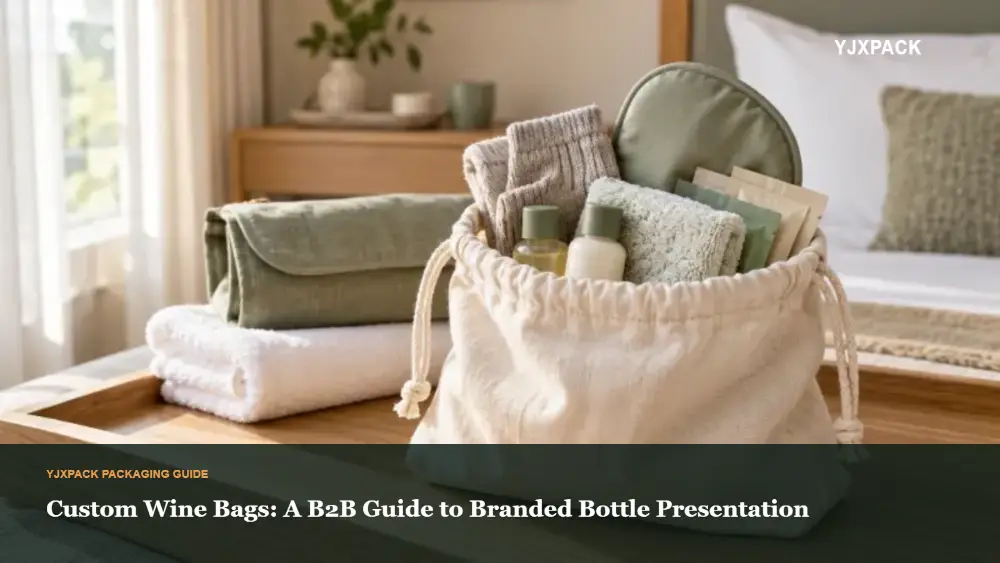
A spa kit may contain a folded towel, sleep mask, socks, sachets or wellness accessories. The bag may need to feel softer and more gift-oriented.
The priorities may include:
- A wider opening
- Flexible volume
- Soft hand feel
- Comfortable drawstring or fold-over access
- A presentation that works on a tray or shelf
This type of kit may not need the same structure as a bottle-based toiletry pouch.
Scenario 3: Corporate travel or VIP gift kit
A corporate travel kit may combine travel accessories, small textiles, a card and personal-care items. The buyer may care more about reuse, organization and brand visibility.
The priorities may include:
- More controlled capacity
- A stable front panel
- A closure that keeps mixed items together
- A visible but restrained logo
- Consistent construction across several colorways
These scenarios show why the intended use should be confirmed before selecting a bag style.
The term `hotel laundry bags` describes a different packaging and handling requirement. Laundry bags may have different capacity, privacy, closure and durability expectations. They should not automatically be used as a reference for hospitality amenity bags unless the contents and handling process are genuinely similar.
Start With the Kit Contents and Guest-Use Scenario
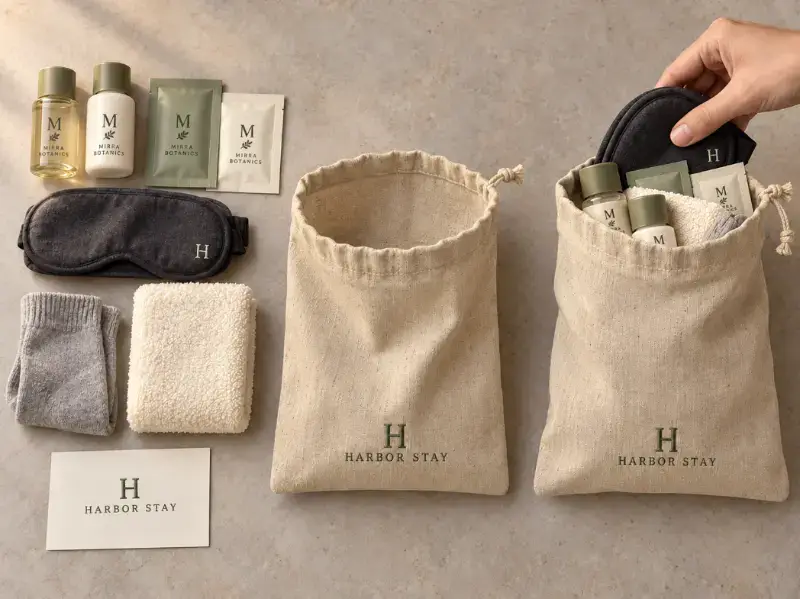
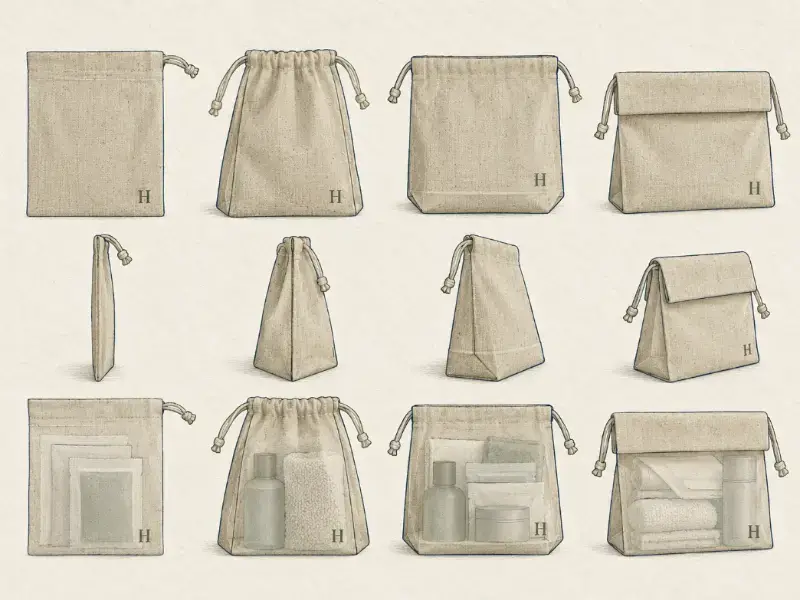
The safest way to specify a custom amenity bag is to begin with the actual contents. Do not start with a preferred fabric pouch and assume that every kit can fit inside it.
Prepare a content list that includes:
- Item name
- Quantity
- Approximate size and shape
- Whether the item is flexible, rigid, liquid-filled or fragile
- Whether the item needs to remain upright
- Whether the guest removes one item at a time
- Whether the bag will be reused after the stay
- Whether hotel staff will assemble the kit manually
If possible, prepare physical samples or dummy items. A filled pouch often behaves differently from a digital drawing or an empty sample.
| Kit contents | Likely construction direction | Main risk | What to confirm before quotation |
|---|---|---|---|
| Sachets, cards and flat accessories | Flat pouch or envelope format | Contents may slide or become difficult to retrieve | Opening size, internal space and front-panel visibility |
| Small bottles and tubes | Gusseted or deeper pouch | Contents may pull against seams or make the opening too narrow | Filled depth, opening clearance and base shape |
| Folded towel, socks and sleep mask | Soft drawstring or flexible pouch | Bag may collapse or become overfilled | Fabric flexibility, opening width and gathered appearance |
| Mixed toiletries and accessories | Gusseted or lightly structured pouch | Different shapes may create uneven pressure | Internal space, lining and closure behavior |
| Corporate gift items | Structured or stable-front pouch | Branding may disappear when contents are inserted | Front-panel area, shape retention and logo placement |
| Compact travel kit | Flat or low-profile pouch | Added lining or hardware may create unnecessary bulk | Folding, storage and filled thickness |
Review the contents in three states:
- Empty state: shows the natural shape, folding behavior and storage profile.
- Partially filled state: shows whether the opening and brand area remain usable.
- Fully filled state: shows the practical capacity, seam tension and closure behavior.
This three-state review is especially important for drawstring bags. When the pouch is empty, the fabric may look wide and smooth. When filled, the upper section may gather tightly and reduce the visible logo area.
Use the guest journey as a design test
The bag should also be reviewed through the guest journey:
- How does the guest first see it?
- Can the guest understand how it opens?
- Can the guest remove one item without emptying everything?
- Does the bag remain attractive after opening?
- Can it be reused for travel or storage?
- Does the closure become frustrating after repeated use?
A hotel staff member may also have a different workflow:
- Does the bag stay open while being packed?
- Can staff insert all contents quickly?
- Does the closure require two hands?
- Can filled bags be stacked without collapsing?
- Does the final appearance remain consistent from room to room?
These questions are more useful than choosing a pouch from a photograph alone.
How to Choose Capacity, Shape, and Opening Size
Capacity should be evaluated using the filled bag, not only the flat dimensions. Fabric thickness, lining, seams, gussets, closure channels and fold-over sections all affect usable space.
Flat pouches
A flat pouch has limited depth and usually works best for thin or flexible contents. It can be easy to store and may create a clean front-facing presentation.
The main risk is overloading. Bottles or bulky items may cause the front panel to bulge and may place pressure on the side seams. If a flat format is being considered for mixed contents, test it with the actual items before confirming the construction.
Gusseted pouches
A gusseted pouch has additional side or bottom panels that create depth. It can be more suitable for bottles, folded textiles or mixed amenity kits.
The gusset should not be judged separately from the opening. A bag may have enough theoretical volume but still be difficult to use if the opening does not allow the contents to pass through comfortably.
Structured-bottom pouches
A structured-bottom pouch may stand more easily on a vanity, counter or tray. This can help the kit look organized during presentation.
The trade-off is added construction complexity. The buyer should confirm whether the base needs reinforcement, how the pouch will be folded during shipment and whether the structured format creates unwanted bulk.
Fold-over formats
A fold-over pouch can create a clean, compact appearance and a defined front surface for branding. It may suit flatter contents or gift-oriented presentation.
The main risk is that the flap may no longer sit neatly when the pouch is overfilled. Review the filled thickness and flap alignment before confirming the final shape.
| Format | Best suited to | Less suitable for | Sample review focus |
|---|---|---|---|
| Flat pouch | Sachets, cards, masks and thin accessories | Multiple bottles or bulky mixed contents | Flat profile, opening clearance and front-panel shape |
| Gusseted pouch | Bottles, folded textiles and mixed kits | Projects requiring the smallest possible empty profile | Side depth, bottom construction and filled stability |
| Structured-bottom pouch | Vanity, shelf or tray presentation | Extremely compact folding and shipping | Upright posture, base reinforcement and folding |
| Fold-over pouch | Flat gifts and controlled front presentation | Irregular or overfilled contents | Flap alignment, filled thickness and closure behavior |
| Soft drawstring pouch | Flexible gifts, textiles and reusable kits | Contents that need a rigid upright position | Opening width, cord movement and gathering |
Do not confirm a universal size too early
A hospitality program may have several kit versions. One version may contain only toiletries, while another includes a towel and travel accessories. Using one universal bag can create either wasted space or an overfilled appearance.
A better approach is to define a small family of related formats:
- Compact format for light contents
- Medium format for mixed guest-use items
- Larger format for textiles or gift sets
The formats can share the same fabric direction, cord, lining or branding treatment while using different proportions.
Material, Lining, and Hand-Feel Options for Hospitality Kits
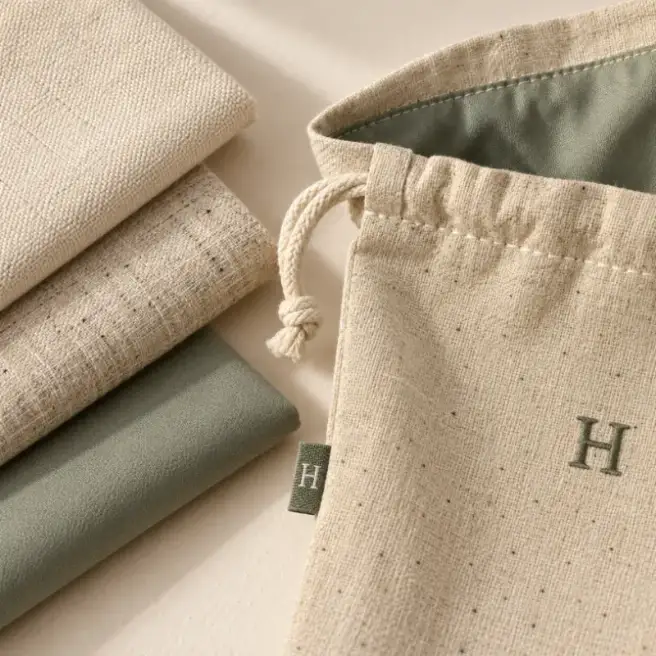
Material affects more than appearance. It changes the way the pouch folds, gathers, holds its shape, receives a logo and feels in the guest’s hand.
Possible material directions include cotton, canvas, linen-look fabric, microfiber, velvet or satin-like surfaces. These are starting directions rather than guaranteed performance categories.
| Material direction | Possible visual role | Construction consideration | Buyer question |
|---|---|---|---|
| Cotton or canvas | Natural, practical and approachable | May require the right weight to avoid looking too limp | Does the fabric hold the intended shape when filled? |
| Linen-look fabric | Relaxed and hospitality-oriented | Surface irregularity may affect small artwork | Will the texture support the chosen branding method? |
| Microfiber | Smooth and lightweight | May create a different hand feel from woven fabrics | Does the surface feel appropriate for the guest experience? |
| Velvet or satin-like surface | Gift-oriented and visually distinctive | May show compression or light variation | Does the surface remain consistent in different lighting? |
| Lined construction | Cleaner interior and more finished presentation | Adds thickness and sewing steps | Does the lining reduce usable capacity? |
The buyer should inspect:
- Fabric thickness
- Surface texture
- Opacity
- Color consistency
- Hand feel
- Edge behavior
- Seam appearance
- Drawstring-channel construction
- Lining attachment
- Visible creasing after packing
- Compatibility with printing, embroidery or labels
A lining can improve the interior appearance, but it may also make the pouch heavier or reduce the usable space. A heavier outer material may make the pouch feel more substantial, but it may not fold as efficiently during packing.
Do not assume that a fabric is waterproof, stain-resistant, hygienic or protective without project-specific evidence. Those claims should only be used if the supplier can provide the appropriate confirmation or testing.
Review material in the intended environment
A fabric that looks attractive under studio lighting may appear different in a hotel bathroom, a spa treatment room or a retail display. Request material swatches and review them under lighting that resembles the intended use.
Also compare the fabric when it is:
- Flat
- Gathered
- Folded
- Filled
- Printed or embroidered
- Placed beside the kit contents
This helps the buyer judge whether the material supports the complete presentation rather than only the empty product photograph.
Choosing the Right Closure for Custom Amenity Bags
The closure affects guest access, containment, packing speed and the visual personality of the kit.
Drawstring closure
A drawstring creates a flexible and soft presentation. It may work well for textile-based kits, reusable pouches and gift-style packaging.
The buyer should inspect the channel, cord thickness, cord exit, knot treatment and how the opening behaves when the pouch is filled. The gathered area may also reduce the visible front surface for branding.
Zipper closure
A zipper creates a more controlled opening and may help contain smaller items. It can suit a travel-oriented custom toiletry bag, but the zipper tape, puller, alignment and seam finishing should be reviewed.
The buyer should also test whether the zipper catches fabric, whether the pouch folds comfortably when closed and whether the puller creates unnecessary visual weight.
Fold-over closure
A fold-over flap can produce a clean and quiet presentation. It may suit flat contents, gift kits or projects that need a defined front panel.
The buyer should check whether the flap remains aligned after filling and whether the contents push against the fold.
| Closure | Guest experience | Packing workflow | Main risk |
|---|---|---|---|
| Drawstring | Soft and quick to open | Easy to close after inserting flexible contents | Gathering can reduce opening and logo visibility |
| Zipper | Controlled and contained | Requires accurate alignment during packing | Zipper can add bulk or create sewing issues |
| Fold-over flap | Clean and gift-oriented | Works best with flatter contents | Flap may not close neatly when overfilled |
The “best” closure depends on the content set. A drawstring is not automatically better for a gift kit, and a zipper is not automatically better for a travel kit. The actual packing and guest-use sequence should determine the decision.
Logo Placement and Brand Presentation
Logo placement should be planned on the filled pouch. A logo that looks centered on a flat artwork template may shift or distort when the fabric gathers, folds or expands.
Review the following locations:
| Branding location | Possible advantage | Possible issue |
|---|---|---|
| Center front panel | Easy to see in a display setting | May distort when the pouch is filled |
| Lower front panel | May remain below the gathered area | Can become hidden if the pouch collapses |
| Side panel | More subtle and less promotional | Less visible from the front |
| Fold-over flap | Provides a defined surface | Flap position may change after filling |
| Interior label | Creates a quiet brand detail | Not visible during first presentation |
The artwork should be evaluated at the actual size. A logo that works on a large rigid box may not remain clear on a small gathered fabric pouch.
Decoration options may include print, embroidery, woven labels, patches or other methods subject to material and artwork review. The final method should be tested on the selected fabric rather than assumed from a reference image.
If final brand artwork is not available, use a blank panel or a non-text placeholder during concept development. Do not rely on an AI-generated readable logo for final production artwork.
What to Include in a Custom Amenity Bag RFQ
A useful RFQ should explain the complete kit, not only the desired bag appearance.
| RFQ category | Information to send | Why it matters |
|---|---|---|
| Intended use | Hotel room, spa, airline, travel or corporate gift | Establishes the guest and staff context |
| Contents | Item list, quantity, shape and approximate size | Determines capacity and opening requirements |
| Filled arrangement | Photo or sketch of how items should sit inside | Helps review practical fit |
| Bag format | Flat, gusseted, structured, drawstring, zipper or flap | Gives the supplier a clear starting direction |
| Material | Fabric family, color and texture reference | Supports material and hand-feel review |
| Lining | Unlined, partially lined or fully lined | Affects capacity and construction |
| Closure | Preferred closure and operation requirement | Connects the bag to the packing workflow |
| Branding | Artwork, placement, size and decoration preference | Supports logo feasibility review |
| Packing | Filled or empty shipment, folding and individual packaging | Affects final presentation and logistics |
| Quantity | Expected order quantity or range | Required for commercial evaluation |
| Destination | Delivery country or region | Needed for quotation preparation |
| Approval | Sample, material swatch, artwork proof or pre-production review | Defines the approval stages |
A practical supplier information pack
For a more efficient quotation discussion, prepare these items together:
- A short description of the hospitality program
- Photos of the intended contents
- A filled mock-up or physical dummy set
- Preferred fabric and color references
- Closure preference
- Logo artwork or a blank branding-area instruction
- Target packing method
- Expected order quantity
- Delivery destination
- Questions that require supplier confirmation
Do not assume MOQ, lead time, price, capacity, certification or production capability. These details should remain pending until they are confirmed for the specific project.
For hotel amenity bag projects, confirm available materials, sampling, decoration methods, commercial terms and project capability directly with YJXPACK.
How to Review Samples Before Bulk Production
A sample review should test appearance, use and production consistency. It should not stop at checking whether the empty pouch looks attractive.
| Review area | What to inspect | Decision question |
|---|---|---|
| Filled capacity | All intended items inside the pouch | Does the kit fit without excessive compression? |
| Opening | Insertion and removal of the actual contents | Can staff and guests use the opening comfortably? |
| Closure | Operation while empty and filled | Does the closure work without catching or pulling? |
| Shape | Standing, folding and laying flat | Does the pouch present correctly in the intended setting? |
| Seams | Corners, channels, edges and bottom construction | Are the visible construction details consistent? |
| Fabric | Texture, weight, color and hand feel | Does the material match the approved direction? |
| Lining | Interior appearance and attachment | Does the lining add value without reducing usability? |
| Logo | Size, placement and visibility when filled | Is the brand mark still clear in the real presentation state? |
| Packing | Folding, stacking and individual presentation | Can the finished bags be packed as planned? |
| Replenishment | Repeated staff handling | Is the kit practical for the intended workflow? |
A useful sample review should include the actual people who will make or approve the decision:
- Packaging or procurement
- Brand or marketing
- Hotel operations
- Housekeeping or replenishment staff
- Supplier or production contact
If different departments approve different parts of the project, record the decisions separately. For example, marketing may approve the logo appearance while operations identifies that the opening is too narrow for packing.
Before bulk production, confirm the approved material, color, construction, closure, artwork, dimensions, packing method and unresolved project details.
Frequently Asked Questions About Custom Amenity Bags
What is the difference between a custom amenity bag and a custom toiletry bag?
A custom toiletry bag usually focuses on bottles, sachets and personal-care products. A custom amenity bag can hold a broader hospitality kit that may include toiletries, textiles, sleep accessories, wellness products or gifts.
The final construction should follow the contents rather than the product name.
Should I choose a flat pouch or a gusseted pouch?
Choose a flat pouch when the contents are thin, flexible and easy to insert through a relatively narrow opening. Consider a gusseted pouch when the kit includes bottles, folded textiles or mixed items that need more depth.
The filled sample should control the final decision.
Can a soft amenity bag hold bottles?
It may be suitable for some bottle-based kits, but the result depends on the bottle shape, number of items, fabric, lining, opening and closure. Test the actual contents before confirming the final format.
Which closure is best for hospitality kits?
Drawstrings can work well for soft, reusable and gift-oriented kits. Zippers can provide more controlled access. Fold-over closures can create a clean presentation for flatter contents.
The correct choice depends on the packing process and guest-use scenario.
Can a logo be applied to a gathered drawstring bag?
It may be possible, but the gathered fabric can distort the logo area. A lower front panel, side panel, flap or interior label may provide a more stable surface.
The placement and decoration method should be checked on the filled sample.
What should I send when requesting a quotation?
Send the intended application, content list, filled arrangement, fabric direction, color, closure, logo artwork, packing requirements, quantity and destination. Reference images and physical samples can make the discussion more precise.
Are hotel laundry bags the same as custom amenity bags?
No. Hotel laundry bags usually serve a different collection, containment and handling purpose. Their material, closure, capacity and privacy requirements may not match a guest amenity kit.
Use them as a reference only when the actual contents and handling conditions are comparable.
Can YJXPACK produce hotel amenity kit bags?
Project capability, available materials, sampling, MOQ, lead time, production capacity and commercial terms should be confirmed directly with YJXPACK for the specific project.
Final Takeaway
The right custom amenity bag is selected by connecting the contents, guest experience, staff workflow and brand presentation.
Start with the actual kit contents. Compare flat, gusseted, structured and fold-over formats using a filled dummy set. Review fabric, lining and closure together. Plan the logo on the filled pouch rather than the empty artwork template. Then prepare an RFQ that gives the supplier enough information to evaluate the complete project.
A structured sample review can identify problems before bulk production, especially around opening size, filled capacity, closure operation, seam tension and logo visibility.
To request the next step, prepare your kit contents, filled arrangement, material direction and logo artwork, then use the Get a Quote process to confirm project-specific capability and commercial details with YJXPACK.
Share This Story, Choose Your Platform!