Quick Summary
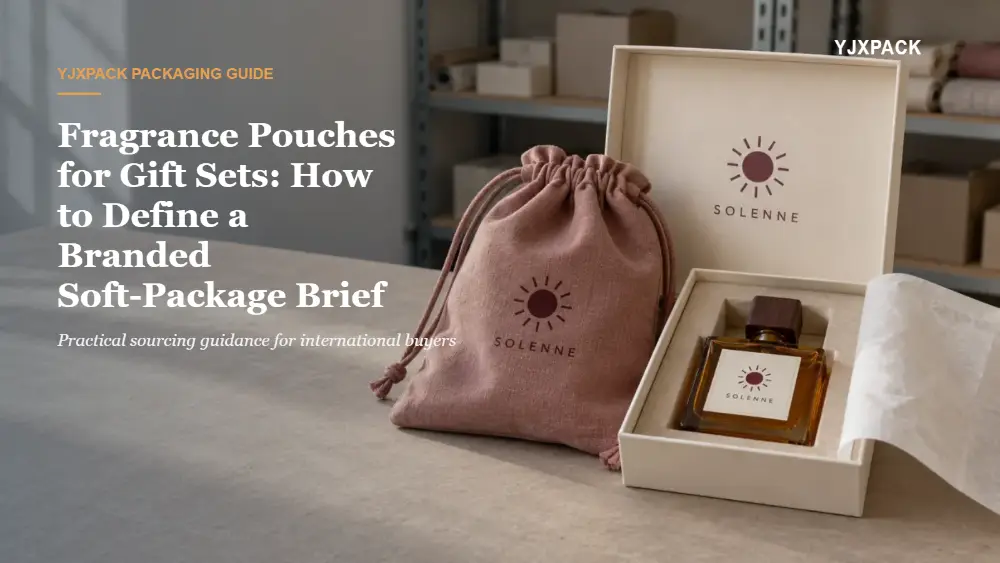
A perfume pouch is more than a soft container placed around a fragrance bottle. For a fragrance brand, it can become part of the product experience: the first tactile layer the customer touches, the detail that makes a gift set feel complete, or the reusable item that keeps the brand present after the bottle has been opened.
The most effective perfume pouch programs begin with the fragrance itself rather than with a generic bag size. Bottle proportions, cap shape, label position, material mood, gift-box structure, and the intended unboxing sequence all influence the final pouch design.
A well-planned perfume pouch should:
- Fit the fragrance bottle without looking loose or overly compressed.
- Make the bottle easier to present, carry, or gift.
- Support the visual language of the fragrance brand.
- Work naturally with the bottle label, box, tissue, card, and other packaging elements.
- Feel intentional when the customer opens it and useful after the first purchase.
- Use fabric, color, closure, and logo placement as part of one coordinated design.
This guide focuses on perfume packaging pouch applications for fragrance brands, gift programs, seasonal editions, discovery sets, and premium retail presentation. It is not a guide to generic cosmetic bags. The most suitable material, construction, and decoration should be confirmed against the actual bottle and packaging concept.
Why Is a Perfume Pouch Different From a Generic Cosmetic Pouch?
A generic cosmetic pouch is usually designed to hold several loose products. It may prioritize capacity, a wide opening, internal organization, and easy access. A perfume pouch has a different visual and functional relationship with its contents.
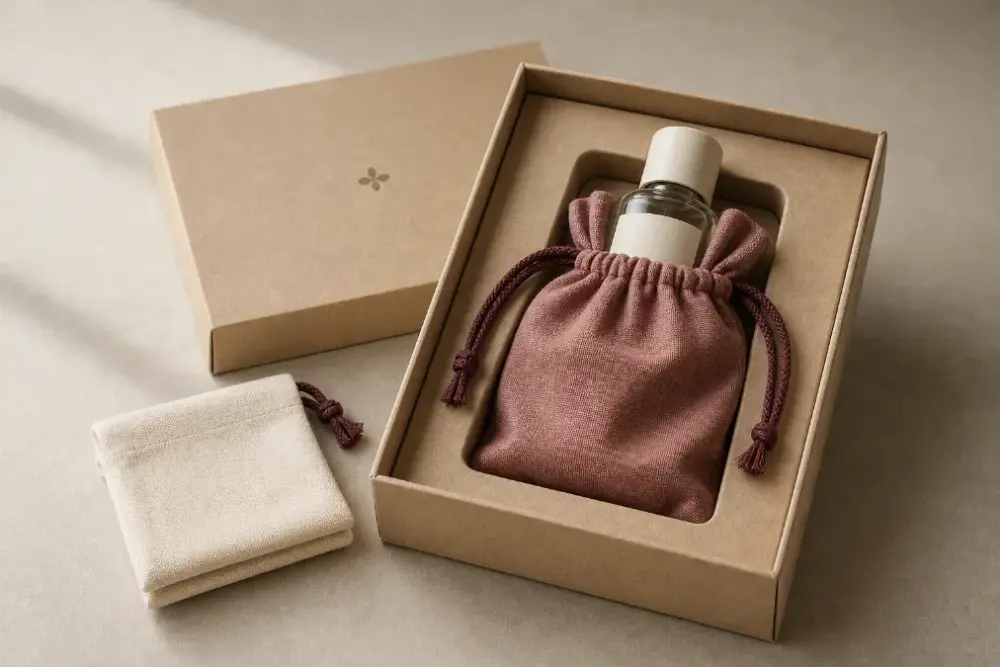
The fragrance bottle is usually the hero object. The pouch must frame it, soften it, or make its presentation more distinctive without hiding the product completely. In many cases, the customer sees the pouch and bottle together before using either one. That means the pouch becomes part of the brand’s first impression.
The difference can be seen in five areas.
1. The bottle has a defined visual identity
Perfume bottles often have distinctive shoulders, caps, labels, bases, and silhouettes. A pouch that is too loose can make the bottle look unimportant. A pouch that is too tight can hide the bottle shape or make insertion difficult.
2. The opening affects the presentation
A drawstring opening can frame the neck and cap while allowing the body of the bottle to remain visible. A shorter pouch can create a sleeve-like effect. A taller pouch can provide a more enclosed and gift-oriented presentation.
3. The fabric is part of the brand mood
A textured cotton-like pouch communicates something different from a smooth satin-like pouch. A brushed surface may feel quiet and contemporary, while a richer pile can create a more ceremonial gift impression.
4. The logo competes with the bottle label
The pouch logo should not automatically be placed in the largest possible area. The brand may want the pouch mark to support the bottle label, create a secondary signature, or remain deliberately subtle.
5. The pouch may have a second life
A customer may keep the pouch for travel, jewelry, keepsakes, or small personal items. This possibility changes how the closure, size, handfeel, and visual identity should be considered.
| Packaging type | Primary role | Typical design priority |
|---|---|---|
| Generic cosmetic pouch | Hold several loose items | Capacity and access |
| Perfume pouch | Frame or accompany one fragrance bottle | Proportion and presentation |
| Fragrance gift pouch | Add a tactile layer to a gift | Material mood and opening sequence |
| Discovery-set pouch | Carry several small fragrance items | Internal arrangement and compact format |
| Limited-edition pouch | Extend the campaign or collection | Distinctive color, artwork, and reuse |
This distinction matters when preparing a custom cosmetic pouch brief for a fragrance project. If the buyer describes the item only as a cosmetic pouch, the result may be designed around general storage instead of bottle presentation.
How Can a Perfume Pouch Extend the Fragrance Unboxing Experience?
The best perfume packaging pouch does not appear as an unrelated accessory. It should have a clear role in the order in which the customer discovers the product.
A simple unboxing sequence might begin with the outer shipping package, continue to a rigid gift box, reveal the fabric pouch, and finally present the fragrance bottle. In another program, the pouch may be the first object the customer sees, with the bottle partially visible through the gathered opening. In a retail environment, the pouch may be handed over separately and become part of the customer’s memory of the purchase.
Before choosing the pouch format, the brand should describe the intended sequence:
- What does the customer see first?
- Is the pouch opened before or after the box?
- Is the bottle already inside the pouch?
- Should the cap remain visible?
- Does the pouch need to stand independently?
- Will the customer keep and reuse the pouch?
These questions are more useful than starting with a generic request such as “make a small luxury bag.”
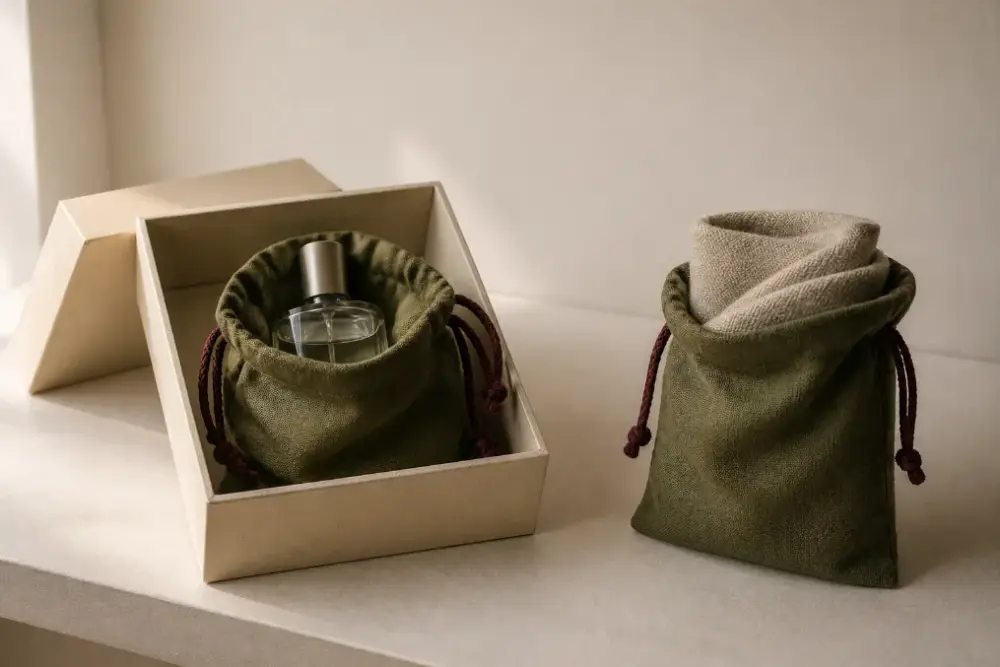
For example, a fragrance brand launching a limited-edition gift set may want the pouch to create anticipation. The bottle can be partially concealed, with the cap and upper shoulder visible above the gathered edge. The customer then loosens the cord and removes the bottle. This makes the pouch part of the ritual rather than a disposable outer layer.
A retail fragrance program may need a different approach. The pouch can be shorter and more open, allowing the bottle label and cap to remain visible. The fabric may be selected to complement the bottle rather than cover it. If the pouch is handed over outside a rigid box, the logo and front panel need to work from a wider viewing distance.
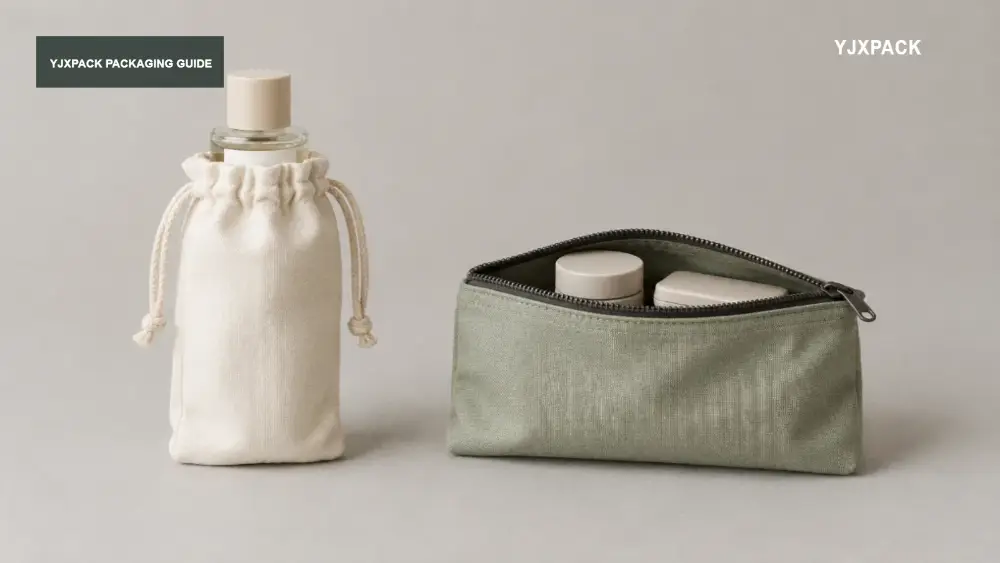
A discovery kit may use a compact pouch to hold several sample vials or small bottles. In that case, the pouch should not be treated as a miniature version of a full-size perfume bag. The opening, internal movement, and arrangement of the smaller items may require a separate format.
The pouch can also introduce contrast. A dark glass bottle may be placed in a pale tactile pouch. A transparent or lightly colored bottle may work with a deeper fabric tone. A simple bottle may benefit from a more expressive pouch surface, while an ornate bottle may need a quieter textile so the overall package does not become visually crowded.
The key is to decide what the pouch is doing emotionally and visually:
- Is it creating softness around a rigid bottle?
- Is it slowing down the unboxing moment?
- Is it making a gift set feel more complete?
- Is it helping the customer carry the product?
- Is it extending the brand into the customer’s daily life?
The answer should guide the shape, opening, material, decoration, and relationship with the box.
Which Bottle Details Should Shape the Pouch Design?
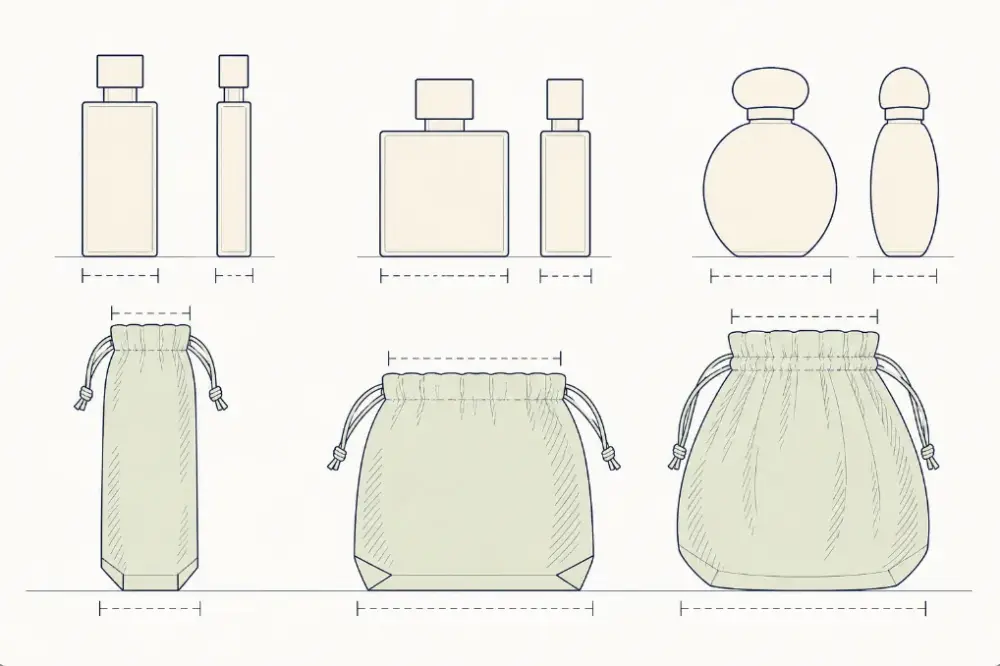
A perfume pouch should be developed around the real bottle, not only around a product photograph. Photographs can hide the widest point, cap overhang, base shape, or changes in depth.
The bottle’s silhouette should be reviewed from the front, side, and top. A square bottle may look narrow from the front but require more internal width than expected. A rounded shoulder may catch against the gathered opening. A large cap may need additional clearance even if the glass body is compact.
The following bottle details can affect the pouch:
- Total height with the cap installed.
- Maximum width and depth.
- Shape of the shoulder and neck.
- Cap diameter and overhang.
- Base shape and stability.
- Label position and preferred viewing direction.
- Whether the bottle must remain upright.
- Whether the bottle is packed alone or with accessories.
- Whether the bottle needs to be visible above the pouch opening.
The pouch should also be evaluated in three states:
- Empty and laid flat.
- Filled with the bottle but not fully closed.
- Filled and gathered in the intended presentation position.
A flat pouch may appear correctly proportioned, but gathering changes the front panel. It can pull the logo upward, create folds across the label area, or reduce the visible opening. These changes are normal characteristics of soft packaging, but they should be planned rather than discovered after production.
For a bottle with a large cap, the opening may need to remain more open or the pouch may need a slightly wider upper section. For a bottle with a heavy base, the lower construction should be reviewed so that the pouch does not collapse or tilt. For a wide square bottle, a flat rectangular pouch may create tension at the side seams unless the width and depth are planned together.
A pouch can be visually close-fitting without being dimensionally tight. The buyer may want the fabric to follow the bottle shape while still leaving enough room for smooth insertion and removal. The correct balance depends on the fabric thickness, lining, closure, and intended use.
| Bottle characteristic | Possible pouch direction | Visual issue to watch |
|---|---|---|
| Tall narrow body | Taller vertical pouch with controlled opening | Excessive side movement |
| Wide square body | Wider pouch with stable bottom | Side seam tension |
| Large decorative cap | More generous opening and upper clearance | Cap catching during insertion |
| Rounded shoulder | Soft upper shape or wider mouth | Fabric gathering over the shoulder |
| Heavy glass base | Reinforced bottom construction | Pouch leaning or collapsing |
| Visible front label | Controlled front panel and logo position | Pouch folds covering the label |
This is also where the bottle label and pouch logo should be considered together. If the bottle label is the primary brand signature, the pouch logo can be smaller or placed lower. If the pouch is expected to stand alone after gifting, the fabric logo may need to carry more of the brand identity.
A supplier should receive the most reliable bottle information available: a physical reference, dimensional drawing, verified measurements, or a clear specification sheet. If the bottle is still being finalized, the pouch should remain adjustable until the key dimensions are confirmed.
How Do Fabric, Color, and Finish Set the Brand Mood?
The fabric often communicates the fragrance brand’s personality before the customer reads any words.
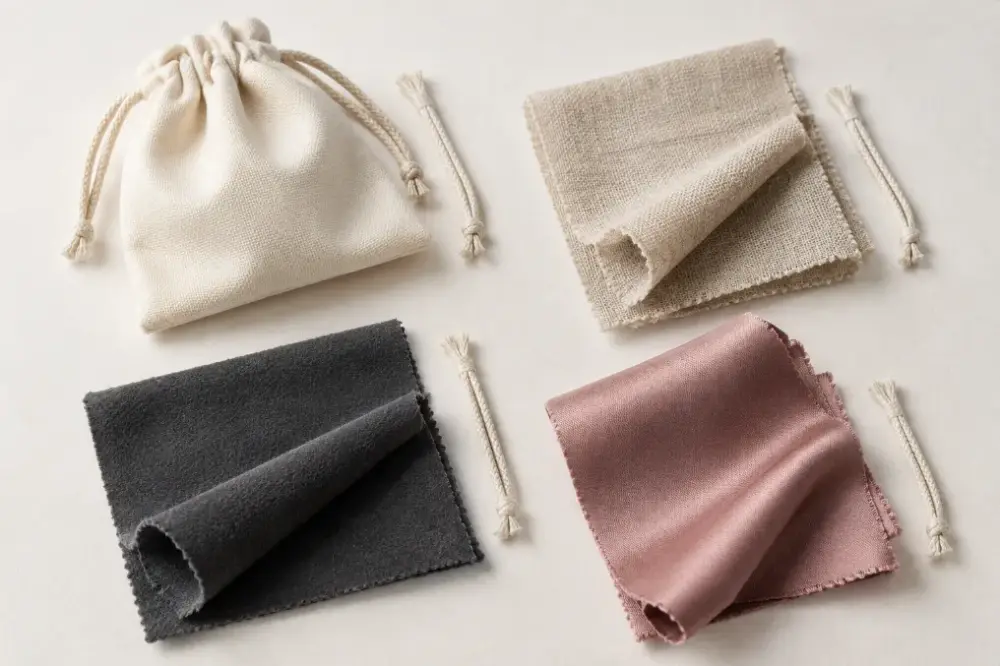
A natural, visible weave may support a botanical, artisanal, or understated fragrance concept. A smoother surface may feel more polished and contemporary. A brushed or soft-touch fabric can make the pouch feel intimate and tactile. A richer pile or deeper color may support a ceremonial gift program or seasonal launch.
The most appropriate perfume pouch material depends on the visual direction, touch experience, decoration method, and relationship with the bottle. There is no universal material that is automatically premium for every fragrance program.
| Material direction | Brand mood it may support | Design consideration |
|---|---|---|
| Cotton-like fabric | Natural, calm, approachable | Visible weave and logo contrast |
| Linen-like fabric | Artisanal, botanical, relaxed | Texture and edge finishing |
| Satin-like fabric | Polished, elegant, gift-oriented | Reflection and logo registration |
| Brushed microfiber-like fabric | Soft, quiet, contemporary | Surface uniformity and color depth |
| Velvet-like fabric | Rich, ceremonial, seasonal | Pile direction and crushing |
| Blended or recycled fabric | Material-conscious, modern | Exact fiber and surface consistency |
Color should be considered alongside the bottle, not selected in isolation. A pale pouch can make a dark bottle appear more graphic. A deep pouch can create stronger contrast with a light bottle but may compete with a dark label. A muted accent color may connect the pouch to a box insert, ribbon, tissue, or campaign card without repeating every element.
The finish also changes the customer’s perception:
- Matte surfaces can feel calm and understated.
- Soft shine can make the packaging feel more gift-oriented.
- Visible texture can create a handmade or material-led impression.
- A clean flat surface can support a minimalist visual system.
- Contrasting cords can make the opening more visible.
- Tonal cords can make the pouch feel quieter and more refined.
Logo treatment should follow the material. A small mark may disappear on a highly textured surface. A large mark may feel too promotional on a soft neutral pouch. A simple abstract emblem can sometimes work better than a long wordmark, especially when the gathered area reduces the available flat surface.
The buyer should review the fabric in natural and artificial light if the project will be displayed in both retail and indoor gift environments. The same surface can appear matte in one setting and reflective in another. A sample swatch should also be gathered or folded because the final pouch will not remain completely flat.
The important goal is not to make the pouch look expensive in isolation. It is to make the pouch feel consistent with the fragrance story.
Where Does a Perfume Pouch Add Value in Gift Sets and Limited Editions?
A perfume pouch is especially useful when the fragrance is sold as more than a single bottle.
In a gift set, the pouch can separate the bottle from other objects, create a softer opening moment, or give the customer a reusable item after the rigid packaging has been discarded. In a limited edition, it can carry a seasonal color, artist-inspired pattern, or restrained campaign mark without changing the bottle itself.
The pouch may be used in several gift formats:
- One bottle inside one pouch.
- One pouch beside the bottle inside a box.
- A pouch containing a bottle and a small card.
- A larger pouch for a discovery collection.
- Several matching pouches for a fragrance wardrobe.
- A seasonal pouch used as a reusable gift wrap.
The correct format depends on how the customer interacts with the set. If the pouch is placed inside a fitted box, its external size and gathered volume matter. If it is handed over separately, the front view and handle or cord behavior become more important. If it holds more than one small item, the internal arrangement should be considered instead of simply enlarging a single-bottle pouch.
A limited edition also creates an opportunity to change the material mood without changing the core construction. The same basic pouch shape may be adapted through:
- A seasonal fabric color.
- A contrasting cord.
- A limited artwork placement.
- A different texture or surface finish.
- A coordinated box insert.
- A small abstract emblem or pattern.
However, the design should remain recognizable as part of the brand system. Too many changes at once can make the pouch look like a separate promotional item.
A useful application matrix is:
| Program | Pouch role | Recommended design emphasis |
|---|---|---|
| Core fragrance line | Consistent secondary packaging | Repeatable shape, restrained branding |
| Holiday gift set | Unboxing and gifting detail | Richer handfeel, gift-box coordination |
| Discovery collection | Compact multi-item carrier | Opening, organization, and easy handling |
| Limited edition | Campaign extension | Color, artwork, and controlled variation |
| Retail-only presentation | Product framing | Bottle visibility and logo hierarchy |
| Post-purchase reuse | Long-term brand reminder | Useful size, comfortable closure, durable feel |
The pouch should add a reason for the customer to keep it. That reason may be practical, tactile, emotional, or visual. A pouch that is attractive but difficult to use is unlikely to create lasting value.
How Can a Brand Make the Pouch Feel Reusable Rather Than Promotional?
The difference between a reusable pouch and a promotional giveaway is often found in proportion and restraint.
A promotional item may focus heavily on a large logo, bright contrast, or campaign message. A reusable pouch usually needs a more balanced relationship between identity and everyday usefulness. The customer should be able to imagine using it after the fragrance has been removed.
Useful reuse scenarios can include:
- Carrying travel-size fragrance items.
- Storing jewelry or small personal objects.
- Protecting a keepsake.
- Organizing accessories inside luggage.
- Holding a small gift for another person.
The pouch does not need to mention these uses with printed text. Its size, closure, handfeel, and finish can communicate them naturally.
A reusable design should avoid unnecessary details that limit the pouch to one campaign. A small abstract mark may age better than a large event date. A neutral color may work beyond one season. A comfortable opening may be more valuable than a decorative element that makes the pouch difficult to close.
The logo should also be placed where it remains visible without taking over the entire front panel. The buyer can compare:
- A centered front mark.
- A lower front mark that remains visible when gathered.
- A small side mark.
- A tonal mark that is visible at close range.
- A fabric label or patch for a softer branded effect.
The correct choice depends on the brand’s personality and the pouch’s expected second life. A niche fragrance brand may prefer a subtle mark that feels like a design detail. A corporate gifting program may need clearer identification. A limited edition may use a visual emblem while keeping the wording minimal.
This is also where the complete packaging system matters. If the box already carries the campaign name, the pouch may not need to repeat it. If the pouch will travel independently, a more recognizable mark may be useful. The final decision should consider both the moment of gifting and the period after unboxing.
For a custom perfume pouch project, the brief should describe the intended reuse, not only the first packaging moment. That helps the supplier understand why the pouch must have a particular size, closure, surface, or logo position.
Frequently Asked Questions
Is a perfume pouch the same as a fragrance pouch?
The terms are often used similarly, but a perfume pouch usually refers specifically to a soft bag designed around a perfume or fragrance bottle. A fragrance pouch may also describe a broader format for discovery sets, sample vials, or fragrance accessories. The final specification should be based on the actual contents and presentation sequence.
Can a perfume pouch replace a rigid fragrance box?
Not always. A pouch can add tactile presentation and reuse value, but it does not automatically provide the same structure or protection as a rigid box. The right solution may be a pouch alone, a pouch inside a box, or a pouch placed beside the bottle within a larger gift set.
Is a custom cosmetic pouch suitable for perfume packaging?
Sometimes, but not by default. A general cosmetic pouch may be too wide, too deep, or too open for a single fragrance bottle. If the pouch is intended to hold a bottle, its dimensions, opening, and internal behavior should be designed around the bottle rather than copied from a general cosmetic format.
Should the perfume bottle remain visible inside the pouch?
That depends on the intended experience. A partially visible bottle can support retail presentation and recognition. A more enclosed pouch can create a slower gift-opening moment. The bottle height, cap shape, logo position, and gift-box arrangement should guide the decision.
What should a fragrance brand confirm before production?
The brand should confirm the bottle reference, pouch dimensions, fabric direction, color, closure, logo artwork, gift-box relationship, and sample expectations. Any protection or handling requirement should be described separately and verified for the final configuration.
Share This Story, Choose Your Platform!