Cotton vs Linen vs Muslin: Which Fabric Is Best for Pouches?
Cotton vs Linen vs Muslin: The Quick Answer
If you’re comparing cotton vs linen vs muslin for pouch packaging, here’s the short version before we get into the details.
Cotton vs linen vs muslin comes down to one simple tradeoff: durability and cost versus texture and looks. It’s sturdy, affordable, and easy to print on, which makes cotton the default choice for most brands. Linen looks more upscale and textured, but it costs more and wrinkles easily. Muslin is the lightest and cheapest of the three, though it’s also the least durable over repeated use.
So which one wins? Honestly, it depends on what you’re packing and how much you want to spend per unit. A jeweler shipping delicate rings has different needs than a candle brand doing a one-time gift box drop. Keep reading, and we’ll break down exactly where each fabric shines.
All three fabrics show up constantly in packaging, yet buyers often pick one out of habit rather than fit. That’s an easy trap to fall into, especially when a supplier’s catalog photo makes every option look equally polished. In reality, the right choice comes down to a handful of practical questions: how the pouch will be used, how often it gets handled, and what kind of first impression it needs to make.
02 cotton vs linen vs muslin fabric closeup
Cotton vs Linen: What Makes These Three Fabrics Different (Weave, Weight, Texture)
All three fabrics come from plant fibers, yet they feel completely different in your hand. The difference comes down to weave and weight.
Cotton uses a tight, even weave, which gives it a smooth surface and real structure. Because the fibers pack closely together, cotton fabric holds its shape well and resists stretching out of size.
Linen comes from flax fibers instead of cotton bolls, and the weave tends to be looser and slightly irregular. That’s actually part of the appeal — linen has a natural, slightly rustic texture that reads as premium rather than sloppy. Plus, linen fibers are naturally stronger than cotton fibers, strand for strand.
Muslin is technically a type of cotton, but it’s woven much more loosely and left mostly unfinished. The result is a thin, breathable, almost gauze-like fabric. It’s soft right out of the box, with none of the stiffness you sometimes get from new cotton canvas.
Weight matters just as much as weave. Fabric weight is usually measured in GSM, or grams per square meter, and this number affects everything from opacity to how the pouch holds its shape. A light 100 GSM cotton feels almost paper-thin, while a heavy 300+ GSM canvas stands up on its own even when empty. Linen typically falls in a similar mid-to-heavy range, while muslin usually sits at the lighter end, often under 150 GSM.
Color behavior also differs across the three. Cotton takes dye evenly and holds bright, saturated colors well over time. Linen tends to mute colors slightly, giving even bold dye lots a softer, more heathered look. Muslin, because it’s so lightweight, often looks best left undyed or in pale natural tones, since heavier dye can make the thin fabric feel stiff.
Cotton Pouches: Pros & Cons
Cotton is the fabric most brands reach for first, and there’s a good reason why.
Pros: Cotton is durable, machine washable, and holds screen printing or embroidery cleanly. As a cotton pouch fabric goes, it also comes in a huge range of weights, from lightweight muslin-adjacent cotton to heavy canvas that feels almost rigid. Our cotton bag collection covers most of that range in standard sizes.
Cons: Cotton isn’t especially fancy on its own. Compared to velvet or satin, it reads as more practical than premium, so brands chasing a luxury unboxing moment sometimes look elsewhere. It can also shrink slightly after washing if it isn’t pre-shrunk during manufacturing.
Overall, cotton is the safe middle ground — not the cheapest, not the fanciest, but reliable across almost every use case. It’s also the easiest fabric to source consistently, since cotton supply chains are more established and predictable than linen or specialty muslin weaves. For a first order, or for a brand still testing which packaging style resonates with customers, cotton is usually the lowest-risk starting point.

03 cotton vs linen vs muslin pouch lineup
Linen Pouches: Pros & Cons
Linen brings texture and a certain earthy elegance that cotton just doesn’t have. A linen drawstring bag tends to stand out on a shelf next to plainer cotton or muslin options.
Pros: Linen looks naturally upscale, even without added branding. The slightly nubby texture photographs beautifully for product shots, and the fabric is genuinely strong — stronger than cotton, fiber for fiber. It also gets softer with each wash, which some brands treat as a feature rather than a flaw.
Cons: Linen wrinkles fast and doesn’t bounce back the way cotton does. It also tends to cost more per yard, since flax fiber production is slower and less mechanized than cotton farming. For brands watching unit cost closely, that price gap matters.
Linen works best when the “imperfect, natural” look actually fits the brand story — think artisanal candles, handmade jewelry, or eco-focused packaging. It also tends to age gracefully, developing a softer hand-feel over months of use rather than looking worn out. Brands selling higher-priced products sometimes find that the extra cost of linen pays for itself through the perceived value it adds at unboxing.
Muslin Pouches: Pros & Cons
Muslin is the lightweight option, and it shows in both the price and the feel. A muslin pouch works best when cost matters more than long-term wear.
Pros: Muslin is inexpensive, breathable, and soft from the very first use. It’s a popular pick for sachets, small favor bags, and any situation where the pouch is more of a nice touch than a long-term storage solution. Since the weave is so open, muslin also lets scent through, which is handy for dried herb or soap sachets.
Cons: The loose weave that makes muslin soft also makes it the least durable of the three fabrics. It snags easily, and it isn’t the best choice for anything with sharp edges or repeated handling. Muslin also shows dirt and staining faster than tighter-woven cotton.
If your pouch is a one-time-use touch rather than something customers keep and reuse, muslin usually gets the job done for less money.
What About Cotton-Linen Blends?
Some suppliers offer a blended fabric that mixes cotton and linen fibers together, and it’s worth a quick mention since it splits the difference between the two.
A typical blend runs somewhere around 55% linen and 45% cotton, though ratios vary by mill. The cotton content adds structure and keeps the price a bit lower than pure linen, while the linen content still gives the fabric that slightly textured, natural look. Wrinkling improves too, since cotton fibers help the blend bounce back into shape more than pure linen ever does on its own.
The tradeoff is that blends rarely excel at any one thing. A blend won’t feel quite as crisp as pure cotton, and it won’t have the same rustic texture as pure linen. Still, for brands that want a middle-ground look without a middle-ground price jump all the way up to full linen, a blend can be a reasonable compromise worth sampling.
If you’re unsure which direction to go, ask your supplier for swatches of all four options — cotton, linen, muslin, and a cotton-linen blend — side by side. Seeing and touching the actual fabric tells you more in thirty seconds than any spec sheet can.

04 cotton vs linen vs muslin cost comparison
Durability & Washability Compared
Numbers make this easier than adjectives, so here’s a direct comparison across the three fabrics. When it comes to cotton vs linen specifically, both fabrics score close together on durability, while muslin trails behind on almost every metric.
| Feature | Cotton | Linen | Muslin |
|---|---|---|---|
| Durability (repeated use) | High | High | Low to moderate |
| Machine washable | Yes | Yes, but wrinkles | Yes, but fragile |
| Wrinkle resistance | Moderate | Low | Low |
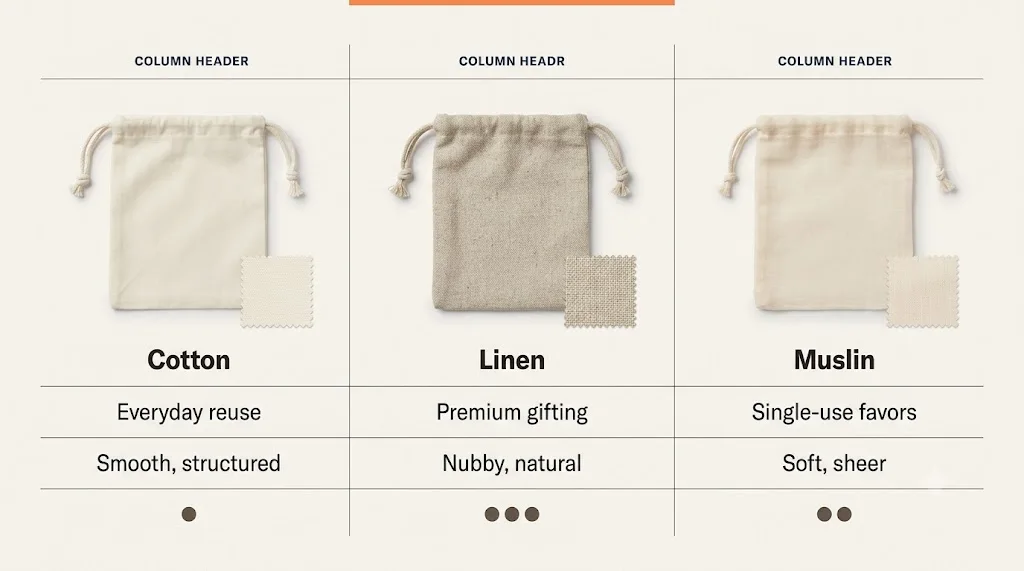
| Texture | Smooth, even | Nubby, natural | Soft, sheer |
| Print quality | Excellent | Good, texture shows through | Fair, light prints only |
If you need a pouch that survives shipping, reuse, and the occasional wash, cotton and linen both outperform muslin by a wide margin. Muslin still has its place, though, especially for single-use packaging where longevity isn’t really the point.
Cost Comparison — Which Fabric Is Cheapest at Scale
Price per unit shifts quite a bit depending on order volume, but the general ranking between cotton vs linen vs muslin stays fairly consistent.
Muslin is almost always the cheapest of the three, since the loose weave uses less raw fiber and processing time. Cotton sits in the middle, with plenty of price variation depending on weight and finish. Linen tends to land at the top of the range, mainly because flax processing is more labor-intensive than cotton ginning.
That said, bulk order size changes the math more than fabric choice alone. A 5,000-unit cotton order can easily beat a 500-unit linen order on a per-piece basis, even though linen is the pricier raw material. So if budget is tight, it’s worth asking your supplier for volume-based quotes across all three fabrics before locking in a decision.
Printing and finishing add another layer to the cost picture. Screen printing on cotton is usually the most affordable customization option, since the smooth surface takes ink cleanly with minimal waste. Embroidery costs more regardless of fabric, but it holds up noticeably better on cotton and linen than on muslin, where the loose weave can let stitching pull through over time. If your order includes custom branding, it’s worth pricing the fabric and the decoration together rather than treating them as separate line items — sometimes a slightly pricier fabric actually saves money once printing costs are factored in.

05 cotton vs linen vs muslin swatch selection
Best Use Cases for Each Fabric
Matching fabric to product type saves headaches down the line, so here’s a quick rundown by category.
Jewelry — cotton and linen both work well here, especially for pieces without sharp edges. For anything delicate, pair the pouch with a rigid box for shipping. Our full jewelry bags catalog includes cotton, linen-look, and blended options.
Gifts and favors — muslin shines here, since cost matters more than long-term durability for a one-time favor bag at a wedding or event.
Retail add-ons — cotton is the practical default, holding up to handling on a shelf and taking branding cleanly.
Small sachets — muslin’s breathable weave makes it ideal for anything scent-related, like dried lavender or soap samples. Check out our sachet bags if that’s your use case.
Eco-conscious branding — linen and organic cotton both signal sustainability well, especially when backed by a real certification rather than just marketing language. Textile-focused shoppers increasingly check for third-party proof, and a supplier that can point to a real audit trail from a group like Textile Exchange builds more trust than a bag simply labeled “eco-friendly.”
Subscription boxes and repeat unboxing — cotton tends to win here too, since it survives the wear of repeated shipping better than muslin and costs less than linen at volume. Brands sending a pouch every month need something that still looks presentable after a rough trip through a delivery van.
How to Choose Between Cotton vs Linen for Your Brand
Start with how the pouch will actually be used. There’s no single best pouch fabric for every situation, so this step matters more than any other. If customers will reuse it — for storage, travel, or as a small everyday bag — cotton or linen both hold up better than muslin over time.
Next, think about your visual brand. Cotton reads clean and neutral, which works for almost any aesthetic. Linen leans more rustic and artisanal, so it fits brands already leaning into a natural or handmade feel. If your branding already uses warm, earthy tones, linen usually matches better than crisp white cotton.
Then factor in budget per unit, especially at scale. Cotton offers the best balance of cost and durability for most order sizes, while linen adds noticeable cost for a texture upgrade that may or may not matter to your specific customer base.
Finally, don’t skip the safety and sustainability checks if they matter to your buyers. Fabric tested under OEKO-TEX standards confirms there’s nothing harmful in the dye or finishing process, and organic options certified by GOTS back up any eco-friendly claims with real documentation instead of just a green label.
Once you’ve settled on a fabric, request swatches and a small sample run before committing to full production. Color, weight, and hand-feel all vary more between suppliers than most buyers expect. It’s also worth asking how the supplier sources raw fiber, since traceability has become a bigger factor for retailers who need to answer sustainability questions from their own customers. When you’re ready to move forward, yjxpack.com can walk you through fabric options, minimums, and lead times for your specific order.
Common Questions Buyers Get Wrong
A few misconceptions come up again and again when brands are sourcing pouches, so let’s clear them up here.
“Linen and cotton are basically the same thing.” Not quite. They come from completely different plants — cotton from the cotton boll, linen from flax stems — and that difference shows up in strength, texture, and price.
“Muslin is just cheap cotton.” Muslin is technically a cotton weave, but calling it “cheap cotton” undersells what it’s good at. The open weave is a deliberate design choice for breathability, not a shortcut.
“Heavier fabric always means better quality.” Not necessarily. A heavy, stiff cotton canvas might be overkill for a small ring pouch, while a lighter weight often drapes and photographs better for the same product. Match the weight to the job, not the other way around.
“Natural fabrics don’t need care instructions.” They do. Linen especially benefits from gentle washing and air drying, since high heat can shrink or damage the fibers over time. If your pouches are meant to be reused, a simple care note goes a long way toward keeping customers happy.
“All suppliers measure fabric weight the same way.” Not always. Some list GSM, others list ounces per yard, and a few round loosely rather than testing precisely. If durability matters for your order, ask for the actual GSM figure rather than trusting a vague label like “heavyweight” on a product listing.
FAQs
Is cotton or linen better for pouches?
Cotton is usually the better all-around choice for durability, cost, and print quality. Linen offers a more premium, textured look, but it costs more and wrinkles faster, so the right choice depends on your brand and budget.
Is muslin cheaper than cotton?
Yes, muslin is typically the cheapest of the three fabrics, since its loose weave uses less raw material and processing. It’s not as durable as standard cotton, though, so it works best for single-use or lightweight packaging.
Can you wash a linen pouch?
Yes, linen pouches are machine washable, but they wrinkle easily and shrink slightly with high heat. Gentle washing and air drying keep the fabric in better shape over time.
Which fabric is best for jewelry pouches?
Cotton and linen both work well for jewelry, since they’re sturdy enough to protect small items during shipping and storage. Muslin is better suited to lighter items or one-time gift packaging rather than long-term jewelry storage.
Does linen or cotton print better for custom logos?
Cotton generally holds screen printing and embroidery more cleanly, since its tighter weave gives ink and thread a smoother, more even surface. Linen’s texture can make finer print details look slightly less crisp.
Share This Story, Choose Your Platform!