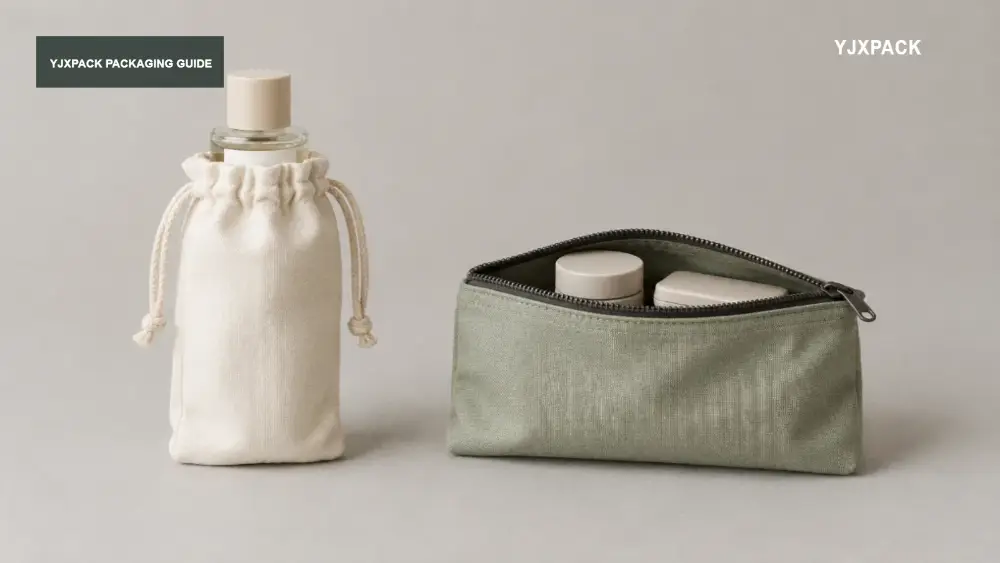
A phone pouch looks like the easiest item on a device accessory packaging list. It is a sewn bag with a closure. The difficulty starts when you try to write the specification: the pouch has to fit a phone in a case, protect a screen from abrasion, hold up in retail handling, carry a logo that reads clearly at a small size, and still meet a unit cost that works for an accessory that may retail well below the device itself.
This guide explains selection logic — how to weigh size, protection, material and accessory mix before you commit to a specification. Availability, construction options, artwork limits, MOQ, sampling, pricing and documentation must be confirmed against your final brief during quotation.
Everything below is organized around the buying decisions themselves: what to fix before quoting, what to test on a sample, and what to put in the request so the answer comes back usable.
Quick Summary
- Decide the pouch’s job first. A pouch that ships inside a retail box is a different product from one sold as a standalone accessory.
- Fit is a case question, not a phone question. A pouch sized to a bare handset will fail for buyers who use protective cases.
- Protection is a layering decision: shell fabric, lining, closure and seam construction each handle a different risk.
- Closure choice drives both presentation and use. Drawstring, zipper, flap and snap formats signal different things to a customer.
- Logo methods are material-dependent. Confirm the method on the actual fabric, not on a paper swatch.
- A complete RFQ shortens the sampling loop more than any other single step.
What to Decide Before Requesting a Quote
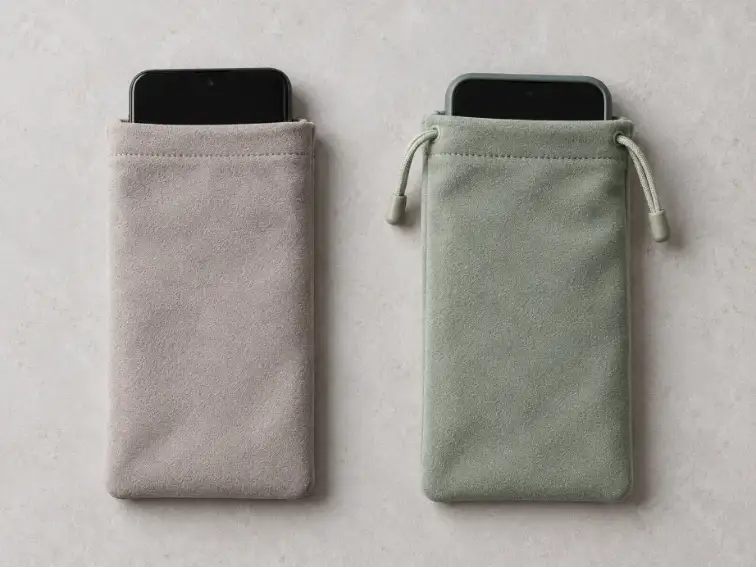
Three decisions determine almost every downstream choice: what the pouch protects, where it is used, and how it is displayed.
The job the pouch performs. Phone pouches in the device accessory market usually fall into one of a few roles. A protective sleeve travels with the phone — in a bag, a pocket or a carry case. A retail presentation pouch holds the phone or an accessory during unboxing, then often gets reused or discarded. A bundled accessory pouch organizes cables, adapters or earbuds that ship with a device or a case. An event or promotional pouch is given away with a brand mark and judged mostly on how it looks in the hand.
Each role changes the specification. A sleeve prioritizes abrasion resistance and closure security. A presentation pouch prioritizes surface finish and how the fabric photographs. A bundled pouch prioritizes internal organization and low unit cost. A promotional pouch prioritizes logo area and a shape that reads well in a photo.
Where the phone lives before the pouch. If the pouch must accept a phone inside a protective case, that changes the internal dimensions, and often the closure type. A slim drawstring pouch that works for a bare handset may not close over a thick rugged case. Decide this early, because it is a frequent reason a first sample needs revision.
Whether the pouch is sold or given. A pouch sold as a product carries more weight with a customer than a pouch included free with a case. Sold pouches justify stronger materials, a real closure and better finishing. Bundled pouches usually justify a tighter cost target and simpler construction.
Write these three answers down before you talk to any supplier. They will shape your questions for the rest of the sourcing process.
Define the Requirements for a Custom Phone Pouch
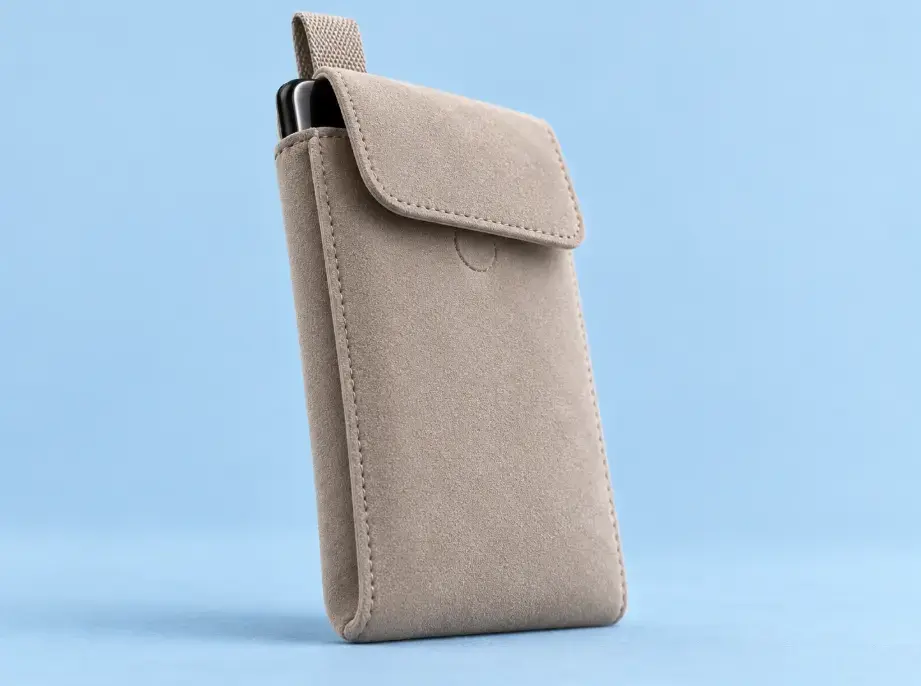
A requirement list for a phone pouch is short but specific. Suppliers quote faster and more accurately when the list separates fixed requirements from open items.
Fixed requirements are the things you will not change:
- The device and case the pouch must accept, with the maximum external thickness.
- Whether any accessory travels with the phone in the same pouch.
- The role of the pouch: sleeve, presentation, bundle organizer or promotional item.
- The market and channel it ships into, which can affect labeling and documentation expectations.
- Your target unit cost range and annual or seasonal volume.
Open items are the things you want the supplier to advise on:
- Fabric options that meet your protection and finish goals at your cost target.
- Closure formats that fit the pouch’s opening size and use pattern.
- Lining options, if the pouch touches a screen or a polished surface.
- Logo methods that hold up on the chosen fabric.
- Construction details such as binding, piping, gussets or a padded panel.
Keeping these separate prevents a common problem: the supplier answers the open questions with their default option, and you mistake a default for a recommendation.
One more requirement is easy to forget. If the pouch holds a phone with a cable, the cable needs a defined place to sit. A pouch with no internal separation lets a connector press against a screen. A simple internal elastic loop, a divider panel or a flat pocket solves this, but only if you ask for it.
Material, Construction, and Protection Needs
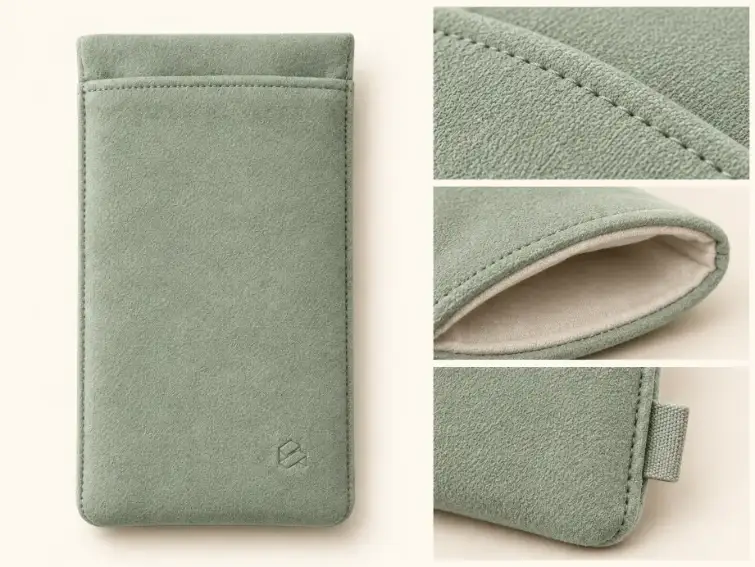
Protection in a soft pouch comes from layers, not from a single heavy fabric. Think of the pouch as a small system, where each layer handles one risk.
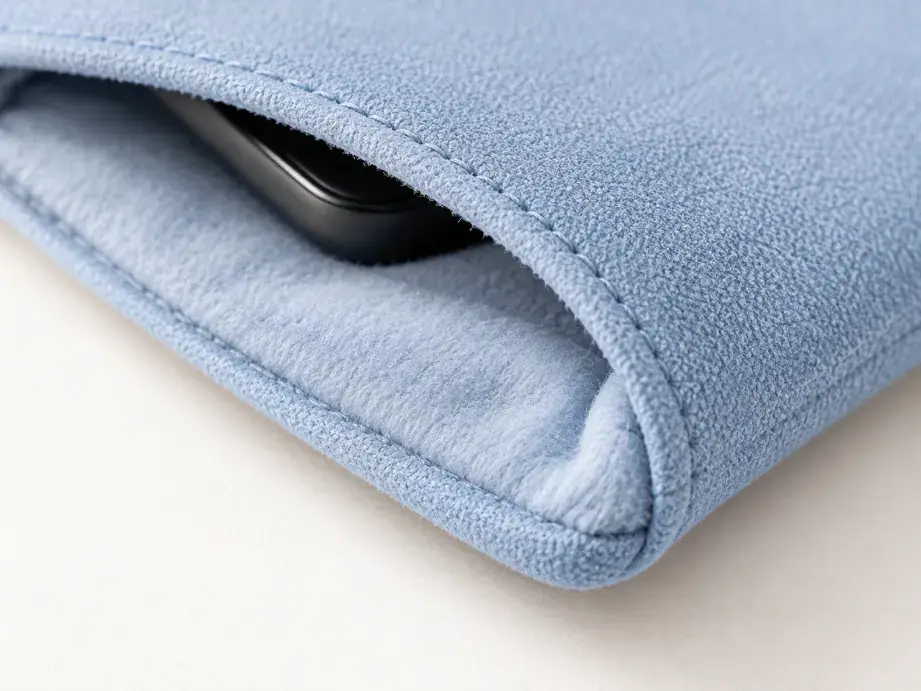
Shell fabric carries the load in everyday use. Common options include woven cotton and canvas, polyester and nylon, non-woven fabric, and microfiber. A denser weave resists abrasion and pilling better than a loose one, but denser fabric also feels stiffer and costs more per unit. Microfiber gives a smooth, soft hand feel and is often chosen where the pouch touches a screen or a lens. For deeper material comparisons, [what is a microfiber bag](/what-is-a-microfiber-bag-uses-for-jewelry-eyewear-and-electronics/) covers the fabric’s uses in electronics contexts.
Lining is the layer that touches the device. If the pouch holds a bare phone or a polished accessory, a soft lining reduces the chance of fine scratches during transport. Confirm the lining construction on the sample, not from a swatch photo; a lining can differ from a visual swatch unless it is stated in the written specification.
Padding matters only if the pouch needs to absorb impact. A thin foam layer or a quilted panel changes the pouch’s outline and its fold behavior near the closure. It also raises unit cost and shipping volume, so add it only if the use case justifies it.
Seams and edges decide how long the pouch survives. Raw internal seams can fray and leave loose threads inside the pouch. Bound or folded seams cost slightly more and look cleaner, especially when the pouch is opened in front of a customer.
Closure security is a protection feature, not just a design choice. A drawstring can help retain a phone, but the result depends on the opening, cord tension and the device’s fit inside the pouch. A flap with a snap or hook-and-loop closure can suit quick-access formats, subject to fastening placement and expected handling. A zipper can provide more defined containment, but it adds hardware, cost and a possible scratch risk if its teeth or slider sit close to the device.
Moisture and dust are worth naming explicitly. Most fabric pouches are not waterproof. If the device or accessory needs water resistance, that is a different specification conversation, and any claim about it must be supported by the supplier.
A simple protection test you can run on the sample
You do not need a laboratory to catch the most common failures. Once you have a sample, put the actual device and case inside it and:
- Close the pouch fully and shake it gently, then check whether the device shifted position.
- Run a finger along the inside of every seam to feel for loose threads or a rough edge.
- Open and close the closure repeatedly to check whether the fabric drags, the cord frays or the mechanism loosens.
- Fold or pack the pouch the way it will ship, then reopen it and look for creasing that would look bad in retail.
These checks are not a substitute for supplier testing or documentation. They simply catch problems early, before a production run commits to a construction.
Size, Closure, and Presentation Choices
Size and closure are the two decisions that most often need to be reworked after a first sample. Getting them clear before sampling saves a round.
Size starts from the device plus its case, plus any accessory stored with it. Add enough allowance for the fabric’s thickness and the closure’s take-up, because a drawstring or a flap uses some of the opening when it closes. A pouch measured only to the device will feel tight and close poorly. The internal measurement is what matters; the external measurement is what shows in your product listing, and the two are not the same number.
Closure format shapes both use and image:
| Closure | Best suited to | Watch for |
|---|---|---|
| Drawstring | Soft, packable pouches; promotional items; low cost per unit | Cord wear, and opening size that limits access |
| Zipper | Secure travel sleeves; pouches that hold loose accessories | Hardware cost, weight, and teeth near the device |
| Flap with snap | Retail presentation; quick access | Snap strength and possible fabric marking |
| Flap with hook-and-loop | Low-cost quick-access designs | Noise when opened, and lint build-up over time |
Presentation is about how the pouch reads when it is picked up. A structured pouch with a gusset stands upright and looks more like a product. A flat pouch folds down and looks more like packaging. Neither is better in every case: an upright pouch photographs well on a retail shelf, while a flat pouch takes less space in a shipping carton and often costs less to freight.
Shape also affects perceived quality. A rounded bottom, a piping detail along the edge or a shaped flap each add a finishing step and a corresponding cost. Confirm which of these are structural requirements and which are optional before you ask for a quotation, so the pricing reflects your real intent.
Which Logo Method Works on Phone Pouch Fabrics?
The right logo method depends on two things: the fabric and the artwork. Choose a method for the fabric first, then adjust the artwork to suit it. A method that works perfectly on a flat cotton panel can behave very differently on a stretchy knit, a pile fabric or a coated surface.
Screen printing deposits ink through a mesh screen. It works well on flat woven fabrics and holds a solid color with clean edges, making it a good fit for a compact logo or a short wordmark. It suits designs with a limited number of colors. Fine detail and small lettering are harder to reproduce reliably.
Heat transfer prints artwork onto a carrier film and presses it onto the fabric. It can carry more colors and finer gradients than screen printing, which helps when a phone pouch needs a detailed mark. Bond strength depends on the fabric surface and the pressing parameters, so confirm it on the actual shell fabric.
Embroidery stitches the design into the fabric. It gives a raised, durable mark that suits canvas, twill and heavier wovens. Very fine text, thin lines and small enclosed shapes can close up in stitching, so artwork usually needs simplifying. On a small phone pouch, embroidery also adds weight and can stiffen the panel.
Hot stamping (foil) presses a metallic or colored foil into the surface. It suits certain fabrics — particularly pile and coated surfaces — and produces a reflective mark that reads as premium. It is less suitable for artwork with fine detail.
Two practical rules reduce rework:
- Approve the logo on the actual fabric, at the actual size, on the actual pouch. A paper proof does not show how pile, weave or coating changes edge quality.
- Ask what the minimum stroke width and minimum text size are for the chosen method on the chosen fabric, and simplify the artwork to fit inside those limits.
Logo placement is worth fixing in the brief too: centered on the front panel, offset to a corner, on the flap, or printed on the drawstring cord or a woven label. Each option has a different visible area, and the artwork often needs adjusting to fill it properly.
How Do Phone Pouch, Cable Pouch, and Earbuds Pouch Requirements Differ?
Brands that sell device accessories rarely buy one pouch. They usually need a small family: a custom phone pouch, a custom cable pouch, and a custom earbuds pouch that share a visual identity but serve different jobs. Treating them as one specification is a common mistake.
Phone pouches are driven by fit and screen safety. Internal dimensions must clear the case, and the lining and closure must not press against the display.
Custom cable pouches are driven by organization. Cables coil, tangle and have rigid connectors. A pouch with a flat profile and an internal elastic loop or a divider keeps a connector away from the cable and makes the pouch easier to close. Size is usually driven by the cable’s coiled diameter, not its length.
Custom earbuds pouches are driven by small-part protection. Charging cases are glossy and scratch-prone, and they are small enough to be lost inside an oversized pouch. A snug internal dimension matters more here than in the other two formats, and a soft lining earns its cost.
Custom electronics pouch formats extend the same logic to power banks, adapters and small accessories. The heavier the item, the more the seam and closure construction matter, because a heavy object pulls on a drawstring channel or a snap.
A consistent family has real advantages: one shell fabric, one color reference, one logo method and one construction standard across formats simplifies the specification and the approval process. Confirm with the supplier whether the same construction standard can be applied across all the sizes in the family, since a small panel and a large panel do not always accept the same finishing details.
What to Include in Your RFQ
A complete RFQ is the single highest-leverage document in a packaging order. It removes assumptions and gives the supplier enough to quote against your real requirement instead of their default product.
Include the following:
- Purpose and use. What the pouch holds, where it is used, and whether it is sold or bundled.
- Internal dimensions for each pouch in the family, derived from the device or accessory with its case or cover, plus the allowance you want for fabric thickness and closure take-up. State which measurement is internal and which is external.
- Material direction. The shell fabric family you are considering, and whether you need a lining or padding. If you have a preference for recycled or certified fabric, say so and ask what documentation the supplier can provide.
- Closure format and any hardware requirements.
- Color reference. Give a physical color standard or a defined color reference and ask how the supplier matches it on the chosen fabric. Fabric dye lots and fabric type both affect how closely a color can be matched, so treat the standard as a target to confirm on a sample.
- Logo method, artwork and placement. Include the artwork file, the intended size and the placement. Ask for the method’s limits on that fabric.
- Quantity by size, plus your expected annual volume if you plan repeat orders.
- Packaging and shipping expectations. How individual pouches are packed, whether they need polybags or hang tags, and the destination.
- Compliance and documentation needs. State clearly what you require, and ask the supplier to confirm what they can actually provide. Do not assume certifications exist; verify them as part of supplier review. If factory social-compliance audits are part of your process, [how to verify a BSCI-compliant packaging factory](/how-to-verify-a-bsci-compliant-packaging-factory-in-china/) explains what to check.
- Sample requirements. What you need to see, and which details must be approved before production.
If you write a brief regularly, a standardized format saves time on every subsequent project.
Sample Review and Quality Checks
A sample is a decision tool. Review it against the requirement list, not against your impression of it, and record what you approve so a later reorder does not drift.
Review the sample against these points:
- Does the device, in its case, go in and come out without force?
- Does the closure close fully and stay closed when the pouch is handled?
- Are the internal seams clean, with no loose threads or raw edges touching the device?
- Does the logo sit at the intended size and position, and are the edges clean on that fabric?
- Does the shade of the fabric match the approved standard under daylight, not only under indoor lighting?
- Does the pouch keep its shape after being folded and packed the way it will ship?
Separate what you can verify yourself from what the supplier must document. You can judge fit, closure behavior, finish quality, color under neutral light and logo appearance. You cannot verify material composition, fiber content, recycled content or certification status by looking at a pouch. Those require the supplier to provide supporting documents, and they should be requested as part of the quotation, not assumed.
Approve by writing it down. A signed-off sample plus a short written specification sheet — dimensions, fabric, lining, closure, hardware, color reference, logo method and placement, packing method — is what prevents a reorder from quietly changing. Keep that record with the purchase order. If nothing else survives from the sampling stage, keep this.
Plan for the production-versus-sample gap. A hand-made sample and a production run are not made the same way. Small differences in fabric tension, cutting or pressing can shift how a pouch looks in volume. Ask how the supplier controls that gap, and decide in advance which details are acceptable variation and which are not.
When Should You Move to a Second Supplier?
Move to a second supplier when a specific, repeatable failure appears — not when the first sample feels slightly off. A pouch that closes awkwardly once may simply be a sample artifact. The same closure failing on two samples, or a supplier who cannot explain how they will control it, is a different signal.
Three situations justify a second quote:
- A capability gap. The supplier cannot execute a requirement that matters — the logo method on your chosen fabric, the lining, or the internal divider the pouch needs.
- A documentation gap. You need material or compliance documentation and the supplier cannot provide it, or answers vaguely when asked directly.
- A specification gap. The quote comes back with substitutions you did not approve — a different lining, a different closure, a different fabric weight — and the supplier treats them as equivalent.
Before switching, send your written specification to the second supplier and ask the same questions. Quotes are only comparable when the brief behind them is identical. If the two quotes describe different products, the price difference tells you nothing.
There is a simpler case for a second supplier too: continuity. If your product line depends on a single pouch size shipping every quarter, a second qualified source reduces the risk of a disruption you cannot control.
Next Step
The fastest path from idea to a usable quote is a single page of decisions: what the pouch holds and where it is used, the internal dimensions with the case allowance, the material and closure direction, the logo method and placement, quantities by size, and the documentation you need.
Send that page to YJXPACK with your artwork, and ask for a sample that reflects the actual fabric, closure and construction you intend to order — then approve it in writing. If you would like help structuring the brief before you request pricing, contact YJXPACK and describe the pouch family you are sourcing; the more of these decisions you settle up front, the fewer sampling rounds you will need.
Frequently Asked Questions
Should a phone pouch be sized to the bare phone or to the phone in a case?
Size it to the phone in its case, and state that assumption in your brief. Buyers who use protective cases are common, and a pouch that only fits a bare handset will feel tight and close poorly for them. Give the supplier the maximum external thickness you need to accommodate, not a single device model number.
Is a zipper always the most protective closure?
No. A zipper can provide more defined containment, but it also adds hardware, weight and cost, and its teeth or slider need to be kept away from the device. For a soft sleeve or a bundled accessory pouch, a drawstring or flap may be suitable when it matches the actual handling pattern. Choose the closure for the use pattern, then confirm it on the sample.
Can one shell fabric and logo method cover a whole accessory family?
Often, yes — and keeping one fabric, one color reference and one logo method across a custom phone pouch, custom cable pouch and custom earbuds pouch simplifies approval and reordering. The limit is construction: small panels do not always accept the same finishing details as large ones, so confirm the shared standard with the supplier across every size in the family.
What documentation should I ask for with the quote?
Ask for whatever your market and channel require, then ask the supplier to confirm what they can actually provide — do not assume a certificate or test report exists because the pouch looks right. Common requests include material composition, recycled or organic content claims, and social-compliance audit documentation. Treat each as an item to verify during supplier review.
How do I keep a reorder consistent with the first order?
Approve a physical sample, then record a short specification sheet beside it: internal and external dimensions, shell fabric, lining, closure, hardware, color reference, logo method and placement, and packing method. Reference that sheet on the purchase order. Most reorder drift comes from a spoken detail that was never written down.
Share This Story, Choose Your Platform!