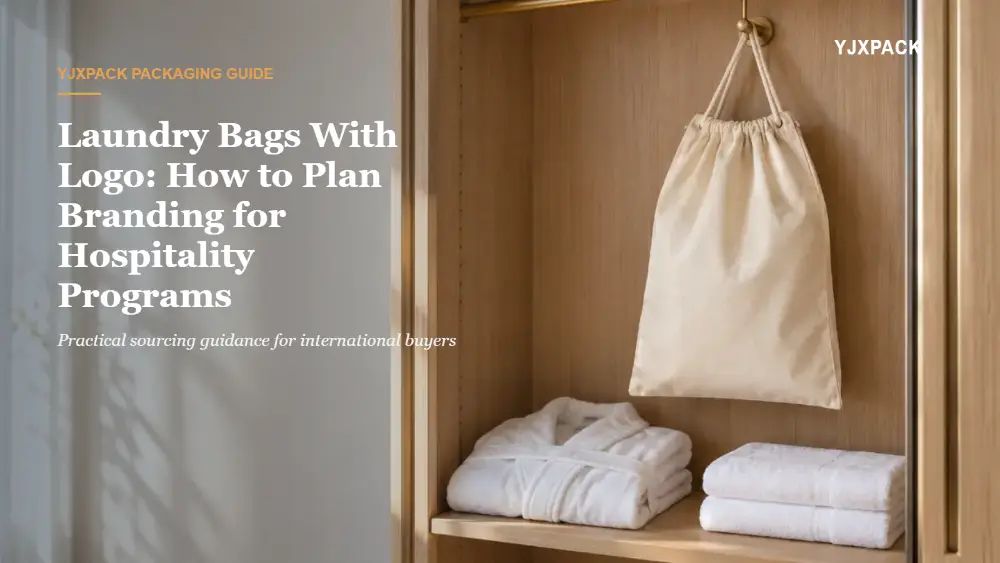
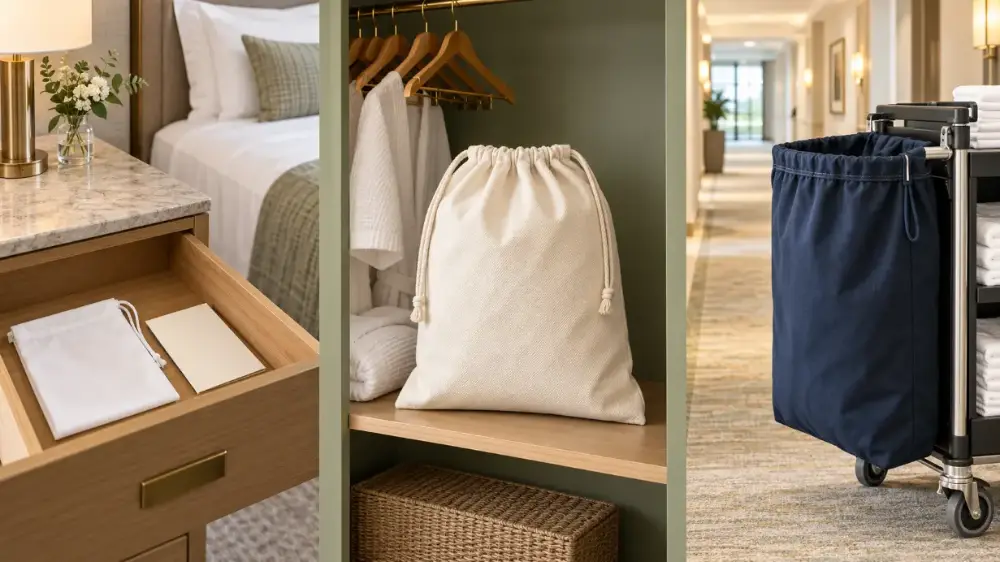
A hotel laundry bag is not just a small branded guest-room item. It sits between the guest, housekeeping, the laundry desk and the return-delivery process. That means a bag can look well designed but still fail operationally: the guest does not know what to write on it, the room number is missing, the drawstring is difficult to close, the bag is too small for the intended service, or the laundry list becomes separated from the garments.
For hotel procurement teams, the useful question is not “Which laundry bag looks best?” It is:
Which bag format supports our guest laundry flow, room presentation, replenishment model and brand standard without creating unnecessary handling problems?
This guide gives practical market benchmarks for hotel laundry bags, including material ranges, size formats, information layouts and sample-review points. These are starting points for a brief and quotation—not universal requirements. Final dimensions, material, construction and inspection criteria should be confirmed through the approved sample and purchase specification.
What Should a Hotel Decide Before Sourcing Laundry Bags?
The first decision is the program type. “Hotel laundry bag” can mean several very different products, and they should not all be quoted from the same basic brief.
| Program type | Typical location | Primary purpose | Procurement priority | Common mistake |
|---|---|---|---|---|
| Guest-room laundry collection bag | Wardrobe, drawer, bathroom or luggage area | Guest places garments inside for collection | Identification, instruction layout, room presentation | Treating it as a logo bag only |
| Guest laundry bag with service list | Guest room, concierge or housekeeping pickup point | Bag travels with an itemised laundry list | Bag/list attachment method, room details, return flow | Bag and list separate during collection |
| Lightweight replenishment bag | Standard rooms, serviced apartments, budget accommodation | Simple guest supply item | Folded size, cost control, print clarity, replenishment packing | Choosing a material without defining the handling cycle |
| Premium branded reusable bag | Resort, boutique hotel, spa, VIP or retail program | Guest-use accessory or elevated room amenity | Fabric hand feel, construction, logo treatment, presentation | Calling it “reusable” without a defined care and approval process |
| Back-of-house linen or staff bag | Housekeeping trolley, laundry room or service corridor | Internal collection and sorting | Capacity, closure, identification, operational handling | Using guest-room visual requirements for a back-of-house product |
A guest-room bag and a back-of-house bag may both use a drawstring, but their briefs should be different. The first must look appropriate in a room and help a guest understand the service. The second may need a more functional format, different size logic and a clearer identification method.
Before asking for quotations, define these five points:
1. What will the guest place inside the bag?
A few garments for same-day service need a different format from a larger collection bag.
2. Where will the bag be placed?
A bag displayed in a wardrobe can be folded differently from one hung beside a laundry list or placed in an amenity drawer.
3. How will the bag be identified?
Decide whether the guest writes directly on the bag, completes a separate laundry list, uses a room-number panel, or follows another property-specific process.
4. How will housekeeping collect it?
Confirm whether bags are collected from the room, handed to concierge, picked up after a guest call, or linked to a door-hanger request.
5. Will the item be replenished, reused or sold?
This affects material, construction, packing and the level of visual finish expected.
Which Material and GSM Range Fits the Program?
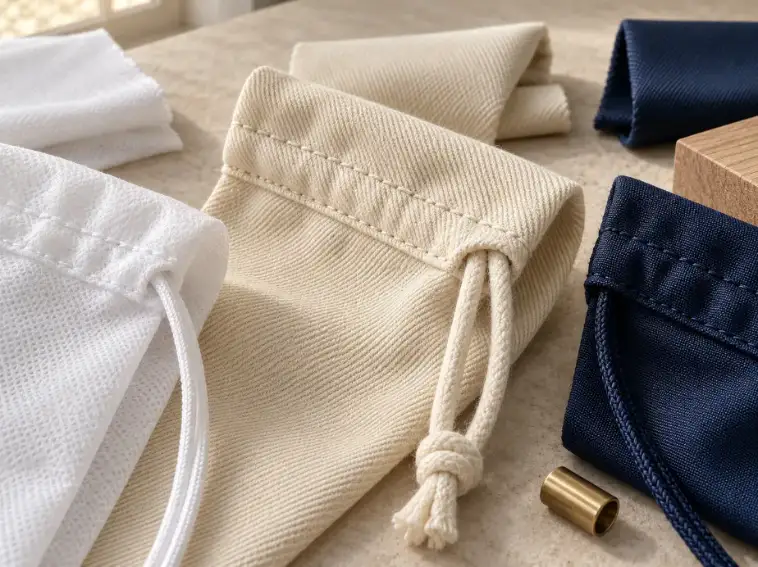
Material selection should start with the program, not with a generic claim such as “more durable” or “more eco-friendly.” In the visible hospitality supply market, non-woven guest bags are commonly offered around the lighter 45–80 GSM range, while cotton hotel laundry bag programs may be offered from approximately 120 GSM upward into heavier fabric options.
The table below gives a practical quotation framework.
| Material direction | Common market reference range | Suitable project direction | What the buyer should specify | What not to assume |
|---|---|---|---|---|
| PP non-woven, lightweight | Approx. 45–60 GSM | Basic guest-room supply, high-volume replenishment | Bag size, colour, print area, drawstring channel, folding method | A GSM number alone does not define seam strength or carrying suitability |
| PP non-woven, enhanced presentation | Approx. 50–80 GSM | Branded hotel amenity or guest laundry bag | Surface feel, logo treatment, rope or cord style, stitching detail | “Premium” does not automatically mean suitable for repeated washing |
| Cotton or cotton blend | Approx. 120–245 GSM visible in market offers | Boutique hotels, resort programs, reusable or retail-oriented formats | Fabric weight, weave, natural or dyed colour, shrinkage expectation, logo process | Cotton does not automatically make a bag washable or suitable for every service cycle |
| Polyester or synthetic fabric | Defined by the specific construction rather than GSM alone | Smooth surface, colour consistency, some repeated-handling concepts | Fabric type, lining, print method, closure and intended handling | Synthetic fabric is not automatically waterproof, stain-proof or more durable |
| Mesh or open-weave construction | Product-specific | Internal sorting or selected laundry operations | Mesh opening, closure, identification method and intended use | It may not give the guest-room presentation or privacy needed for guest clothing |
A useful procurement rule is to define fabric weight and construction together. For example, “50 GSM non-woven” is not yet a full brief. Add the bag dimensions, seam method, drawstring material, print coverage and expected use. A small lightweight guest bag and a larger collection bag may use similar material names but need very different construction decisions.
A practical material-selection shortcut
| If your program prioritises… | Start the discussion with… | Then confirm on the sample… |
|---|---|---|
| Low folded volume and routine room replenishment | Lightweight non-woven format | Print clarity, cord movement, seam appearance and bag opening |
| Natural textile appearance | Cotton or cotton-blend direction | Fabric hand feel, logo contrast, shrinkage expectation and fold presentation |
| A more substantial branded guest accessory | Higher-weight cotton, lined fabric or a structured pouch concept | Shape retention, closure feel, logo method and packing presentation |
| Internal laundry sorting | Operational textile or mesh format | Closure security, identification and handling process |
| Hotel-group consistency across properties | One controlled material and artwork system | Colour reference, logo placement, carton marking and replenishment specification |
What Size Format Should You Use?
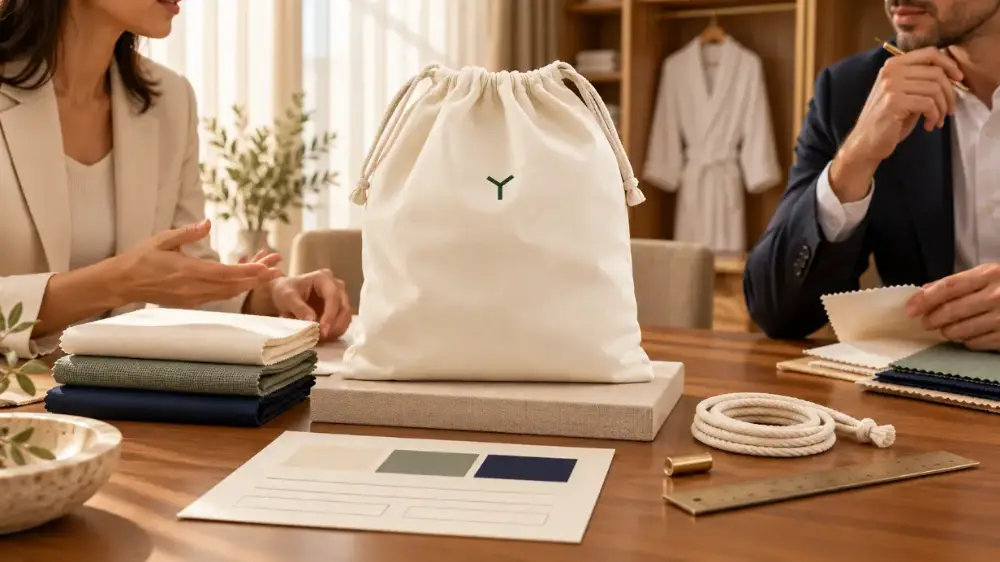
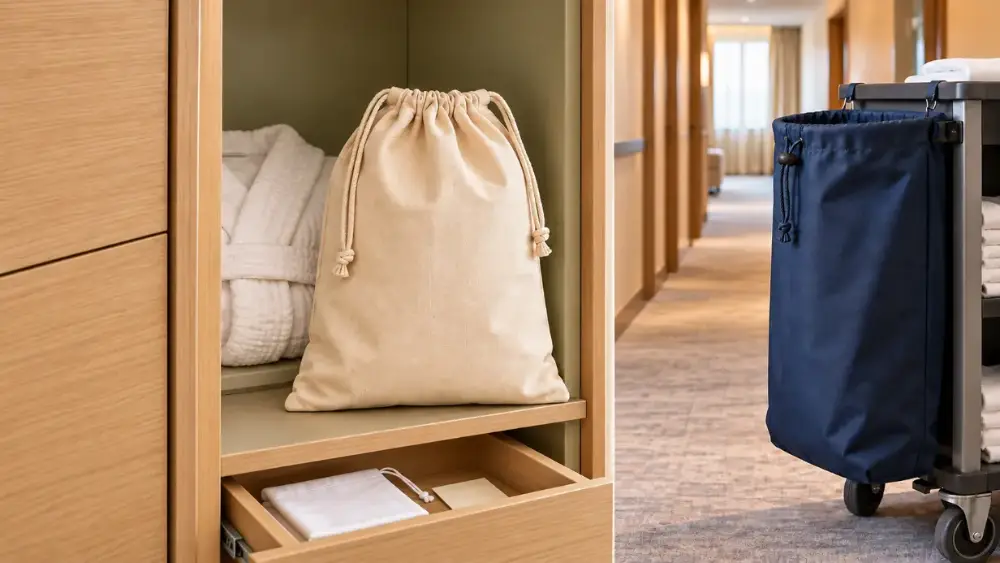
There is no universal hotel laundry bag size. Market examples range from roughly 400 × 500 mm for simple guest amenity-style laundry bags to formats such as 18 × 19 inches plus a 4-inch gusset, 14 × 24 inches or 18 × 24 inches in other laundry-bag categories.
The important point is not to copy a size from a catalogue. It is to connect size to the intended contents and service flow.
| Format reference | Approximate use direction | Why a hotel may choose it | Specification questions to answer |
|---|---|---|---|
| 400 × 500 mm flat bag | Compact guest-room collection or amenity-style format | Easy to fold and place with a laundry list | Is the opening wide enough? Does it accommodate the expected garment mix? |
| 14 × 24 in flat format | Narrower guest garment collection format | Can suit a simple vertical room display | Does it look too narrow when filled? Where will the instruction panel sit? |
| 18 × 19 in + gusset | More volume through side or bottom depth | Helps when the bag needs additional usable space | Is the gusset required for presentation, volume or both? |
| 18 × 24 in | Larger soft-bag reference | Common benchmark for a more substantial collection format | Is the bag still appropriate for in-room display and folding? |
| Custom dimensions | Hotel-specific room or service flow | Fits a defined wardrobe, drawer or amenity tray | What is the finished width, height, gusset and tolerance? |
When comparing dimensions, ask suppliers to state the finished size, not only the cut size. A drawstring channel, seam allowance and gusset can all change the usable interior space and the visual proportions of the finished bag.
Size brief checklist
| Field | Example of a useful brief | Weak version |
|---|---|---|
| Finished dimensions | “Finished size: 400 mm W × 500 mm H, flat bag” | “Medium laundry bag” |
| Gusset | “No gusset” or “100 mm side gusset” | “Should hold more clothes” |
| Opening | “Drawstring channel across top opening” | “Easy to close” |
| Intended contents | “Guest garments for standard laundry service” | “Laundry” |
| Room placement | “Folded beside service list in wardrobe drawer” | “For hotel room” |
| Packing | “Individually folded; 100 pieces per inner pack” | “Bulk packed” |
Why the Information Panel Matters More Than the Logo
For guest laundry service, the bag is part of an identification process. The hotel needs to decide what information travels with the garments from the room to collection, processing and return.
A guest laundry bag should be designed around the property’s actual workflow.
| Information element | Why it matters | Where it can appear | Procurement decision |
|---|---|---|---|
| Guest name | Helps link the bag to the guest record | Printed write-in panel or separate list | Is handwriting required directly on the bag? |
| Room number | Supports collection and return routing | Printed field or laundry list | Must it remain visible after the bag is closed? |
| Date | Helps identify collection timing | Bag or service form | Is it necessary for the property’s process? |
| Service type | Distinguishes laundry, pressing, dry cleaning or express service | Laundry list or instruction card | Should it be printed on the bag or handled separately? |
| Itemised garment list | Supports pricing and item control | Separate list, attached card or pocket | How will it remain connected to the bag? |
| Hotel logo | Supports brand consistency | Front panel, label or repeat pattern | What size and position leave room for operating information? |
| Guest instruction | Explains use, collection timing and restrictions | Main print panel or separate insert | Which languages and approved wording are required? |
A common design error is to use the entire front panel for a large hotel crest, then add the practical information in small type at the bottom. For a guest-room laundry bag, the service instruction and identification area often need more attention than decorative coverage.
Recommended panel hierarchy
- Hotel logo or property name
- Clear “Laundry Service” or equivalent guest-facing heading
- Identification fields: guest name, room number and date if used
- Guest action: where to place the bag, collection timing or contact method
- Laundry list instruction: attached, enclosed or available through concierge
- Fine-print terms or restrictions, only where approved by the hotel
For multilingual properties, avoid shrinking all languages into one crowded panel. Decide whether the hotel needs bilingual printing, a separate laundry list, a QR-supported service instruction or different artwork by market.
Which Closure and Construction Details Should Be Specified?
A drawstring bag is often the default starting point, but it is not a complete specification. Two drawstring bags can differ significantly in guest experience and appearance.
| Component | Choices to define | Why it affects the program |
|---|---|---|
| Top closure | Open top, drawstring, rope drawstring, zipper, flap | Changes guest usability, appearance and collection process |
| Cord material | Cotton cord, polyester cord, ribbon or another agreed option | Changes visual style, feel and knot behaviour |
| Cord thickness | Project-specific measurement | Affects perceived quality and movement through the channel |
| Drawstring channel | Single channel, folded channel, reinforced channel | Affects appearance and how the bag closes |
| Seam construction | Side seam, bottom seam, overlock or another agreed construction | Determines what inspectors should review visually |
| Gusset | Flat, side gusset, bottom gusset | Changes usable volume and bag shape |
| Lining | Unlined or lined | Changes feel, cost, construction and printing logic |
| Hanging feature | None, loop, hook-compatible feature | Must match the room presentation and service process |
For a guest-room program, the sample review should include a simple use test:
- Can a guest open the bag without pulling the cord out?
- Can the bag be closed without an awkward knot?
- Does the printed instruction remain visible when the bag is partly filled?
- Does the bag still look tidy when folded for room setup?
- Does the chosen cord style match the hotel’s visual level?
- Does the bag fit its intended wardrobe, drawer or amenity position?
These are not laboratory performance claims. They are practical approval checks that can prevent a visually attractive but inconvenient bag from moving into production.
How Should Hotels Specify Laundry Bags With Logo?
A logo method should be selected after the hotel confirms the material, artwork detail, print size, placement and intended visual effect. “Add logo” is not enough for a quotation.
| Decoration route | Often considered when… | Buyer should provide | Sample approval focus |
|---|---|---|---|
| One-colour screen print | Artwork is simple and the material surface suits printing | Vector logo, Pantone reference if needed, print size and position | Edge clarity, ink coverage and colour appearance |
| Multi-colour print | The logo uses several approved colours | Final artwork, colour references and clear-space rules | Registration, colour consistency and small-detail legibility |
| Heat transfer or film | Artwork detail or colour complexity requires evaluation | Artwork file, material sample direction and placement | Adhesion and visual result on the selected fabric |
| Embroidery | A textile, tactile or premium presentation is intended | Simplified artwork and thread-colour direction | Stitch density, backing visibility and fabric distortion |
| Woven label | The brand mark should appear as a sewn-in element | Label artwork, size, fold type and sewn position | Label edge finish and attachment position |
| Foil, debossing or other special finish | Material and style support a decorative effect | Material choice, artwork and sample expectation | Whether the finish is visually suitable on the actual fabric |
For hotel groups, use an artwork-control table rather than approving a logo only by email.
| Artwork control item | What to record |
|---|---|
| Artwork file name and version | Prevents outdated logo files entering production |
| Logo width and placement | Prevents visual inconsistency between orders |
| Colour reference | Defines the approved colour target where applicable |
| Print side | Front only, back only or both sides |
| Information panel layout | Confirms room number, date and service instructions |
| Language version | Prevents unapproved wording from appearing in guest rooms |
| Approved sample date | Creates a reference for later replenishment orders |
What Should Be Included in a Hotel Laundry Bag RFQ?
A quote request should let every supplier price the same project. If suppliers receive only a reference image and a logo, their quotations may refer to different materials, dimensions and construction assumptions.
Use this RFQ structure:
| RFQ field | Information to provide |
|---|---|
| Project name | Hotel name, property group or guest-room program name |
| Product use | Guest laundry collection, dry-cleaning service, retail accessory or internal handling |
| Finished size | Width × height, gusset if required |
| Material direction | Non-woven, cotton, cotton blend, polyester or another preferred option |
| Material weight | Target GSM range if already decided |
| Construction | Flat bag, gusseted bag, lined or unlined, seam requirement |
| Closure | Drawstring, cord type, cord colour and channel style |
| Branding | Logo file, position, print method if known and colour reference |
| Guest information | Name, room number, date, service instruction and required languages |
| Packing | Folded format, individual packing, inner-pack quantity, carton requirement |
| Quantity | First order quantity and expected repeat-order approach if known |
| Destination | Delivery country, port or warehouse location |
| Sample requirement | Plain sample, printed sample, pre-production sample or another agreed step |
| Inspection requirement | Visual criteria, dimension tolerance and any AQL or third-party inspection requirement |
Copyable RFQ starter text
> Product: Custom hotel guest laundry bag
> Intended use: In-room guest laundry collection
> Finished size: [width] × [height], [flat / gusseted]
> Material: [material] at approximately [GSM]
> Closure: [drawstring / rope drawstring / other]
> Logo: [front / back] placement, artwork attached
> Guest information: [room number / guest name / date / service instruction]
> Languages: [language version]
> Packing: [folded / individually packed / inner-pack quantity]
> Order quantity: [quantity]
> Destination: [country or port]
> Sample requirement: [plain / printed / pre-production]
> Please quote material options separately where relevant.
How Should You Review Samples and Inspection Criteria?
The sample should be reviewed in the same way the property expects to use it. A flat photo is not enough.
| Review area | What to check | Example of a meaningful rejection point |
|---|---|---|
| Dimensions | Finished width, height and gusset | Bag does not fit the intended room setup |
| Material | Weight, hand feel, opacity and surface | Fabric appearance does not match the approved direction |
| Logo | Position, size, colour and artwork accuracy | Logo is off-centre or key detail is unreadable |
| Guest information panel | Room-number field, date field and language copy | Guest cannot easily identify where to write |
| Drawstring | Cord length, movement and channel finish | Cord catches, pulls out or does not close smoothly |
| Seams | Visual consistency, thread ends and shaping | Uneven seam or visible loose thread on guest-facing side |
| Folding and packing | Room-ready folded presentation | Bag creases hide the instruction panel |
| Replenishment | Inner-pack and carton identification | Hotel team cannot distinguish versions or language variants |
If a buyer requests AQL inspection, it is useful to define the defect categories before production:
| Defect category | Typical examples for a guest laundry bag |
|---|---|
| Critical | Incorrect hotel artwork, wrong language, missing required warning or information |
| Major | Wrong dimensions beyond agreed tolerance, unusable drawstring, missing logo, incorrect material |
| Minor | Small loose thread, slight print variation within approved tolerance, minor fold inconsistency |
ISO 2859-1 provides an AQL-based sampling framework, but it does not impose one universal acceptance level for all hotel laundry bag orders. AQL level, inspection level, lot size and defect definitions should be agreed in the purchase specification. If a buyer uses values such as AQL 2.5 for major defects and AQL 4.0 for minor defects as a commercial starting point, those values should be written clearly into the project requirement rather than assumed.
What Should You Do Before Placing the Order?
Before confirming bulk production, make sure the hotel has approved all of the following:
- Finished bag size and whether a gusset is required
- Material type and target weight range
- Drawstring style, cord colour and closure operation
- Logo file, position, colour reference and decoration method
- Guest identification fields and service wording
- Language versions and laundry-list relationship
- Room presentation and folding method
- Packing and replenishment labels
- Sample approval standard and inspection requirements
- Final purchase-order quantity and delivery destination
The most effective hotel laundry bag is not the one with the most decoration. It is the one that makes the guest laundry process clear, fits the room program, protects the hotel’s brand consistency and gives the purchasing team a repeatable specification for future orders.
To discuss a custom hotel laundry bag project, share your intended use, target material, finished dimensions, artwork and quantity through YJXPACK’s contact page. Final specifications should be confirmed through the approved sample and written project requirement.
Frequently Asked Questions
What GSM should a hotel laundry bag use?
For lightweight non-woven hotel guest bags, market offers commonly sit around the 45–80 GSM range. Cotton hotel laundry bag projects may use substantially heavier fabric options, including 120 GSM and above. The right choice depends on the bag size, intended handling, room presentation and approved sample.
What is a common hotel laundry bag size?
There is no single standard size. Market examples include approximately 400 × 500 mm guest-room formats, 14 × 24 inch flat bags, 18 × 19 inch bags with a gusset and 18 × 24 inch formats. Select the final dimensions according to the expected contents and service process.
Should a hotel laundry bag include a room-number field?
If the bag moves through a guest laundry collection process, a room-number field is often useful. Many hotel guest laundry bag formats also include guest name and date fields. The hotel should decide whether these details are printed on the bag, recorded on a separate laundry list or both.
Can hotel laundry bags include a custom logo?
Yes. Hotels can specify a printed logo, woven label, embroidery or another decoration route depending on the material, artwork and intended appearance. Confirm the method on a physical sample before bulk production.
What should be checked before approving a hotel laundry bag sample?
Check finished dimensions, material appearance, logo accuracy, guest information layout, drawstring movement, seam finish, room presentation, folding method and packing. If the hotel has a defined service workflow, test the bag together with the laundry list and collection process.
Is AQL inspection suitable for hotel laundry bags?
AQL sampling can be used when agreed by the buyer and supplier. The purchase specification should define the inspection level, AQL values, lot size and the difference between critical, major and minor defects.
Share This Story, Choose Your Platform!