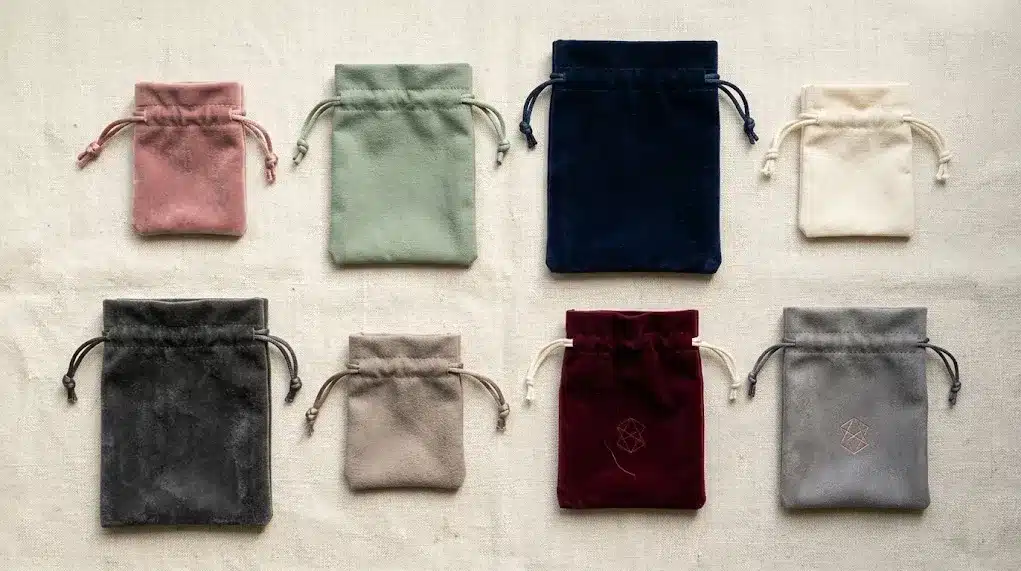
You order 1,000 custom velvet pouches. They arrive on time. Then you open the box — and your statement necklace doesn’t fit. Or worse, your dainty ring rattles around inside a pouch that’s way too big. Suddenly, your “premium” packaging looks cheap.
In fact, this happens more than you think. Across new B2B packaging orders, roughly 1 in 3 brand owners report a sizing mismatch on their first run. So the cost isn’t just the pouch — it’s the reorder, the delay, and the brand impression.
This guide fixes that. First, you’ll get the universal formula to measure any piece of jewelry. Second, you’ll see standard jewelry pouch size charts for every category — rings, necklaces, bracelets, earrings, and watches. Third, you’ll learn the 5 most common sizing mistakes and how to dodge them.
By the end, you’ll size your pouches like a sourcing pro — and never reorder because of a half-inch mistake again.
1. Why Pouch Size Matters More Than You Think
Pouch size feels like a small detail. However, it touches almost every part of your business.
Get it wrong, and three things break at once. First, your shipping costs jump — oversized pouches mean bigger mailers and more dim weight. Second, your customer experience suffers — a loose necklace tangles, and a tight ring leaves scratch marks. Third, your brand looks careless — and that’s the cost you can’t measure.
Of course, get it right and the math flips. Tight, well-fitted pouches feel premium. They photograph better, ship cheaper, and customers reuse them. So one size decision affects unit cost, reorder rate, and review scores — all at once.
So before we touch any chart, remember this: the right pouch size is the cheapest brand upgrade you’ll ever make.
2. The Universal Measuring Formula (Use This Today)
Here’s the secret most size charts skip. You don’t need to memorize 50 dimensions. Instead, you need one simple formula.
Pouch height = same as width (or slightly taller for drawstring)
That’s it. Now let’s apply it to three real examples.
Example 1 — A simple gold ring. Longest dimension: about 0.8 inch. Add a 1.2 inch buffer for drawstring room. Pouch size: 2×2.5 inch. Done.
Example 2 — A pendant necklace (16 inch chain). Here’s the trick: don’t measure the chain stretched out. Instead, fold the necklace twice. The folded length becomes your longest dimension. For a 16 inch chain, the folded bundle is about 4 inch. Add buffer → pouch size 4×6 inch.
Example 3 — A pair of stud earrings. Longest dimension: about 1 inch. Pouch size: 2.5×3 inch. Why the extra height? Because two earrings need room to sit side by side, not stacked.
So now you have a method. Furthermore, the charts below are just shortcuts for when you don’t want to do the math.
3. Standard Pouch Sizes for Rings
Rings are the easiest category. They’re small, similar in size, and forgiving. Still, three sizes cover 95% of cases.
| Pouch Size | Best For | Common Use |
|---|---|---|
| 2×2.5 inch | Plain bands, dainty rings | DTC brands, sample kits |
| 2.5×3 inch | Engagement rings, gemstone rings | Most common — the “default” |
| 3×3 inch | Statement rings, ring sets | Premium / chunky designs |
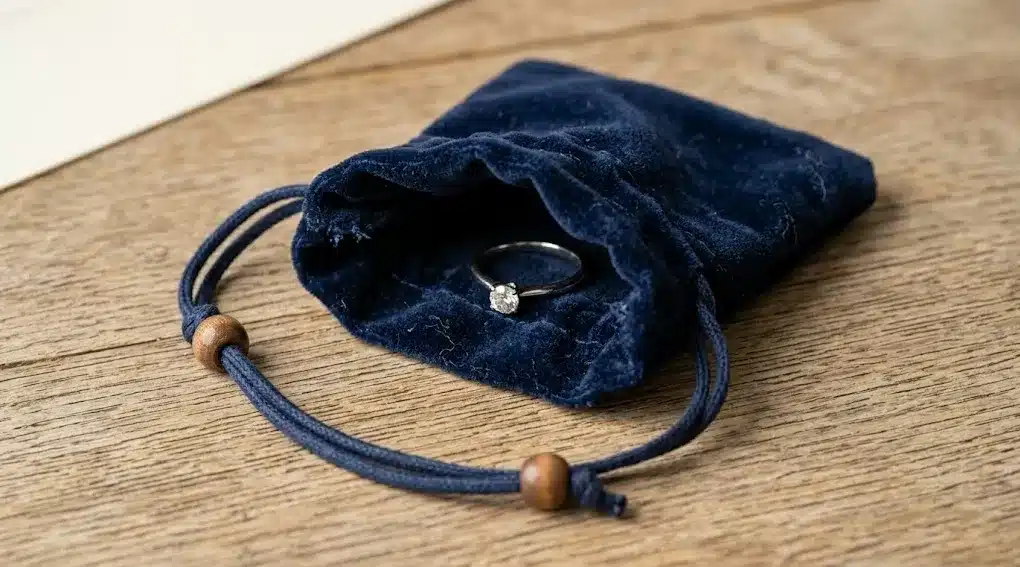
Real example. A boutique engagement-ring brand we work with uses 2.5×3 inch velvet jewelry pouches in deep navy. The fit is snug, the drawstring closes flush, and the ring sits centered. Cost per pouch at MOQ 500: about $0.85 with single-color logo.
Avoid going too small. A pouch that fits the ring but not your fingers makes unboxing awkward. So always test with adult-sized hands before you commit.
4. Standard Pouch Sizes for Necklaces
Necklaces are the trickiest category. The reason? Chain length varies a lot — chokers, pendants, long chains, lariats. So one size definitely won’t fit all.
Here’s the working chart, sorted by chain length.
| Necklace Type | Chain Length | Recommended Pouch |
|---|---|---|
| Choker | 14–16 inch | 3×4 inch |
| Pendant / Standard | 16–18 inch | 4×6 inch |
| Matinee | 20–24 inch | 5×7 inch |
| Long / Opera | 28–36 inch | 6×8 inch or padded card insert |
Pro tip. For longer chains, don’t just go bigger. Instead, add a small foam or paper card inside the pouch — wrap the chain around it. As a result, no tangles, no scratched pendants, and the pouch stays slim for shipping.
Plus, many premium brands now use 4×6 inch as their “house size” across all necklace SKUs. So why? It works for 80% of pieces, simplifies inventory, and customers reuse a 4×6 pouch easily.
5. Standard Pouch Sizes for Bracelets, Earrings & Watches
Three categories, three quick tables. Let’s go through them fast.
5.1 Bracelets
Most bracelets coil into a tight circle. Therefore, you don’t need a long pouch — you need a square one.
| Bracelet Type | Recommended Pouch |
|---|---|
| Tennis / chain bracelet | 3×4 inch |
| Bangle (rigid) | 4×4 inch (square) |
| Cuff (wide) | 4×5 inch |
5.2 Earrings
Earrings need height more than width. The reason? Two pieces, sitting side by side, plus drawstring room.
| Earring Type | Recommended Pouch |
|---|---|
| Studs / huggies | 2×3 inch |
| Drop earrings | 2.5×3.5 inch |
| Statement / chandelier | 3×4 inch |
5.3 Watches
Watches deserve their own size. Specifically, they’re bulkier and heavier than other jewelry.
| Watch Type | Recommended Pouch |
|---|---|
| Slim dress watch | 4×5 inch |
| Standard watch | 4×6 inch |
| Chunky / sport watch | 5×7 inch |
For watches, also consider material weight. Specifically, soft velvet or microfiber protects the case from scratches better than rough canvas.
6. The Master Size Chart (Save This)
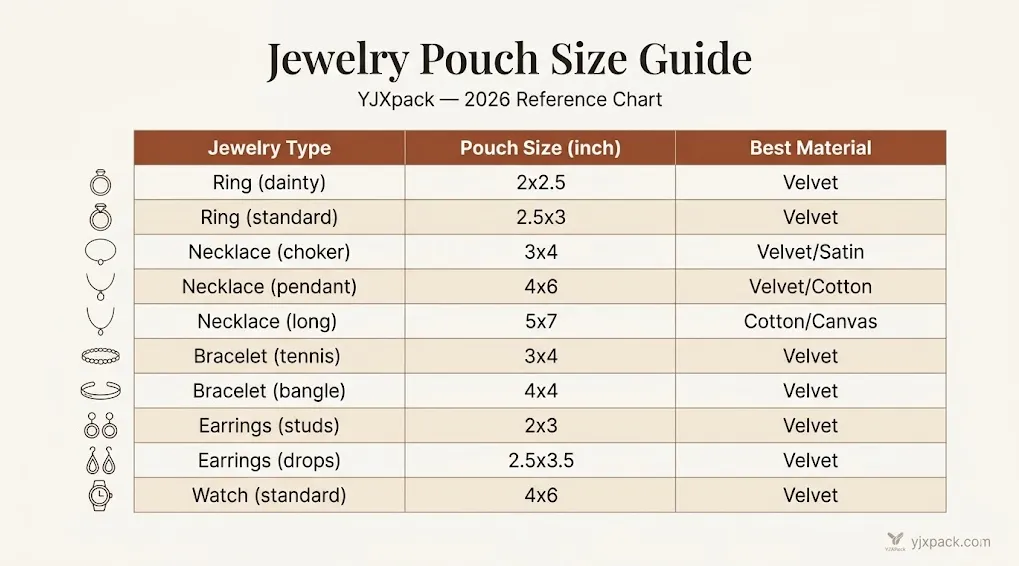
Want one chart to bookmark? Here it is — every jewelry type, every recommended size, in one place.
| Jewelry Type | Pouch Size (inch) | Best Material |
|---|---|---|
| Ring (dainty) | 2×2.5 | Velvet, microfiber |
| Ring (standard) | 2.5×3 | Velvet, suede |
| Necklace (choker) | 3×4 | Velvet, satin |
| Necklace (pendant) | 4×6 | Velvet, cotton |
| Necklace (long) | 5×7 | Cotton, canvas |
| Bracelet (tennis) | 3×4 | Velvet, satin |
| Bracelet (bangle) | 4×4 | Velvet, microfiber |
| Earrings (studs) | 2×3 | Velvet, organza |
| Earrings (drops) | 2.5×3.5 | Velvet, microfiber |
| Watch (standard) | 4×6 | Velvet, microfiber |
Screenshot this. Save it. Send it to whoever orders your packaging.
7. 5 Common Sizing Mistakes (And How to Avoid Them)
Charts only help if you don’t trip on the basics. So here are the five mistakes we see most often — and how to skip them.
7.1 Forgetting About Accessories
Your necklace ships with a small care card. Your ring comes with a polishing cloth. Of course, those go in the pouch too. So always size for the jewelry plus the accessories — not just the jewelry alone.
7.2 Eyeballing From Photos
Product photos lie. Specifically, a pendant on a model looks one size; the real piece can be 30% smaller or larger. Therefore, measure the actual piece with a ruler. Never trust the photo.
7.3 Skipping the Drawstring Buffer
A drawstring eats about 0.5 inch at the top of the pouch. So if your jewelry is 4 inch long, a 4×4 pouch leaves zero closing room. Add the buffer — every time.
7.4 Using One Size for Your Whole Catalog
This is the tempting shortcut. Of course, one SKU is cheaper to order. However, a 4×6 pouch holding a tiny stud earring looks lazy. So instead, group your catalog into 2-3 size tiers — small / medium / large — and order each.
7.5 Ignoring How Material Affects Fit
Heavier fabrics (canvas, thick cotton) take up more internal space than thin satin or microfiber. As a result, a “4×6 canvas pouch” holds less than a “4×6 satin pouch.” Always ask your supplier for the internal dimensions, not just the cut size.
8. How to Order Custom Sizes (Step-by-Step)
Found a size that’s not on any standard chart? No problem. Most factories — including YJXpack — make custom sizes from MOQ 100. Here’s the 4-step process.
Step 1. Measure. Use the universal formula from section 2. Write down width × height in inches AND centimeters.
Step 2. Pick material. Match the material to the jewelry. Small + delicate → velvet or microfiber. Large + casual → cotton or canvas. Need a refresher? See our velvet vs microfiber comparison.
Step 3. Set quantity. Most factories quote MOQ 1,000. However, our custom jewelry pouches start at MOQ 100 — useful when you’re still testing a SKU.
Step 4. Approve a sample. Always sample before bulk. Put your actual jewelry inside. Close the drawstring. Then ship it to yourself. If it survives the mailer and looks right when you open it — approve. If not, adjust by 0.25 inch and re-sample.
A tight feedback loop here saves you thousands later.
9. Material × Size: Pairing Guide
Size and material are not separate decisions. In fact, they work together. Here’s a quick pairing rule.
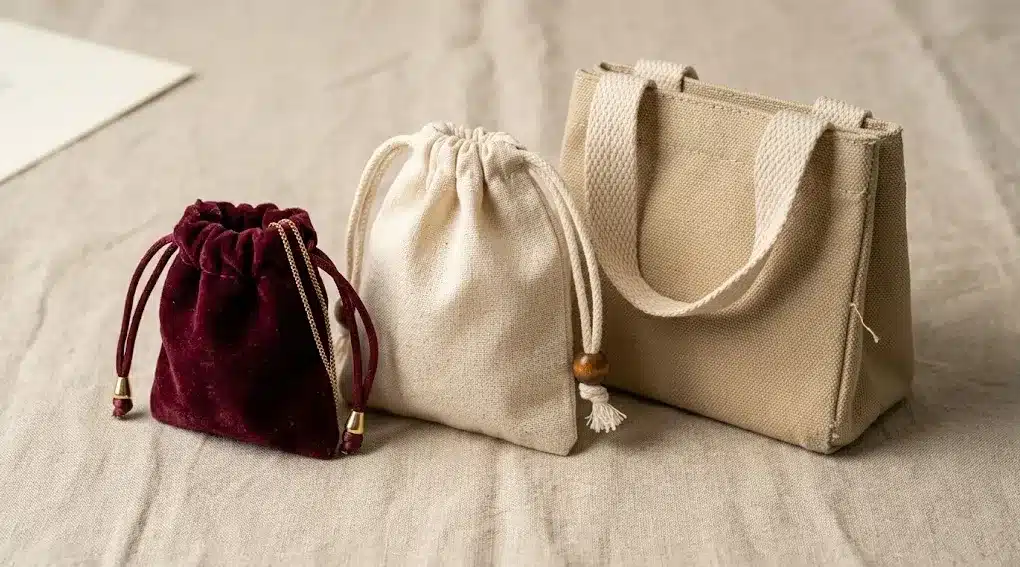
- Small pouches (2–3 inch) — Use thin, soft fabrics. Velvet, microfiber, satin. They drape close to the jewelry and feel premium at small scale.
- Medium pouches (4–6 inch) — Most materials work. Velvet for premium, cotton jewelry pouches for natural / eco brands, organza for transparency and gifting.
- Large pouches (7+ inch) — Skip thin fabrics. Use cotton, canvas, or thick velvet. Otherwise, the pouch sags and the jewelry shifts inside.
Also, remember GSM. A 200gsm cotton pouch feels structured. A 120gsm cotton pouch feels flimsy. Therefore, always ask your supplier for the GSM, not just the material name. For care details on the jewelry itself, the GIA jewelry care guide is a trusted reference.
10. Conclusion — Get the Size Right the First Time
Pouch sizing isn’t hard. It just needs a method.
Fortunately, the logic is simple. First, measure the actual jewelry with a ruler — never estimate from photos. Second, check the chart and apply the +0.5 to 1 inch buffer rule. Third, sample before you commit to bulk.
Do all three, and pouch sizing stops being a guess. Instead, it becomes a five-minute decision — and your packaging arrives fitting perfectly the first time.
11. FAQs
Q1: What is the most common jewelry pouch size?
4×6 inch is the most common jewelry pouch size. Specifically, it fits 80% of necklaces, watches, and bracelets. Therefore, many DTC brands use 4×6 as their “house size” across the whole catalog. For rings and earrings, drop down to 2.5×3 inch.
Q2: How do I measure my jewelry for the right pouch size?
Use the universal formula. First, find the longest dimension of the jewelry (fold necklaces twice before measuring). Then, add 0.5 to 1 inch of buffer for the drawstring. That’s your pouch width. Height is usually the same or slightly taller.
Q3: Is a 4×6 pouch big enough for a necklace?
Yes, for most necklaces under 18 inches. However, for chains 20 inch or longer, go up to 5×7 inch. For very long chains (28+ inch), use 6×8 or add a paper card insert so the chain wraps neatly without tangling.
Q4: Can I order custom pouch sizes below 1,000 pieces?
Yes, with the right factory. Most suppliers set MOQ at 1,000. However, some — including YJXpack — accept custom sizes from MOQ 100. So this is useful when you’re testing a new SKU or building a sample kit. Of course, per-unit cost is higher at low MOQ.
Q5: Does pouch material affect the size I need?
Yes — and most buyers miss this. Thicker fabrics like canvas eat up internal space. As a result, a “4×6 canvas pouch” holds less than a “4×6 satin pouch.” So always ask your supplier for the internal dimensions, not just the cut size of the fabric.
Q6: What size pouch fits a ring box inside?
For a standard 2×2 inch ring box, use a 3×4 inch pouch. For a larger 2.5×2.5 inch box, go with 4×5. The trick is to add at least 1 inch on each side. Otherwise, the box won’t slide in smoothly, and the drawstring won’t fully close.
Q7: Are jewelry pouch sizes the same in inches and centimeters?
No, and this trips up a lot of buyers. A “4×6” can mean 4×6 inches OR 4×6 cm depending on the supplier. The difference is huge — 4×6 inch equals about 10×15 cm. Therefore, always confirm the unit in writing before approving.
Get a Quote — Custom Jewelry Pouches in Any Size
YJXpack — Yijiaxin (Shenzhen) Packaging Co., Ltd.
For 20+ years, we’ve made custom jewelry pouches — velvet, microfiber, cotton, canvas, satin, organza — for brand owners, traders, and e-commerce sellers across the US, Europe, and the Middle East. We hold GOTS, GRS, OEKO-TEX, BSCI, ISO 9001, and SABER certifications, and we serve over 8,000 brands worldwide.
Want to see and feel the real thing? Request a free sample pouch in any of our standard sizes — we’ll ship it to your door so you can judge the fit and quality before any commitment.
Email: info@yjxpack.com
WhatsApp / WeChat: +86 18617112946
Website: www.yjxpack.com
Free sample shipped to your door · Quote within 3 minutes · 3D mockup in 30 minutes · Sample in 1–3 days · MOQ 100 pieces · GOTS / GRS / OEKO-TEX / BSCI / ISO 9001 certified
Share This Story, Choose Your Platform!