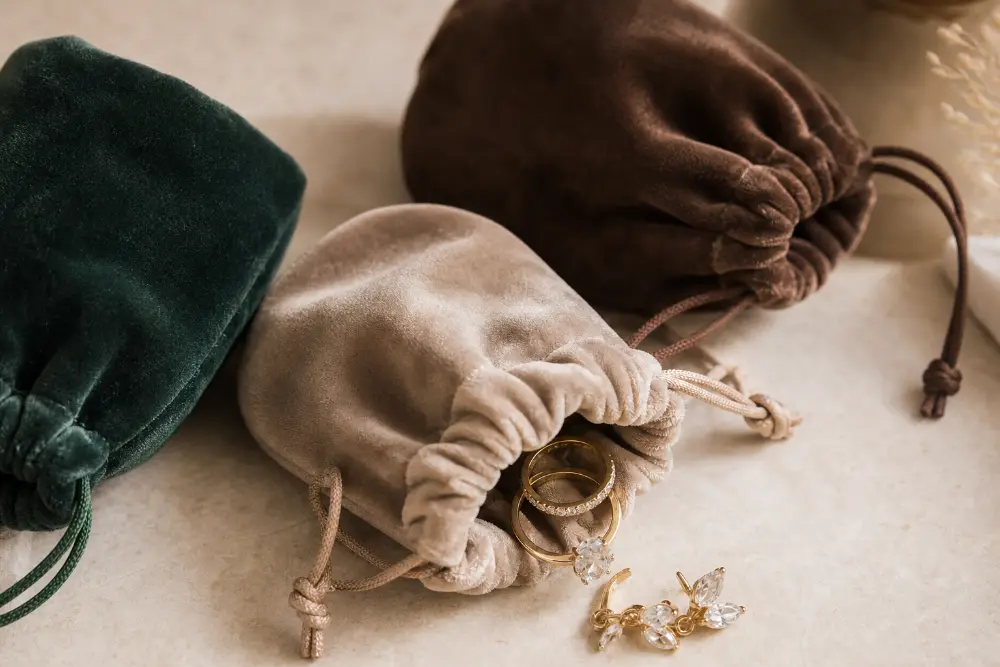
A customer may touch a pouch before seeing the ring, necklace, or earrings inside. That first contact can influence how considered, gift-ready, and consistent the presentation feels. Velvet jewelry packaging can add a soft surface and visible texture, but it will not fit every jewelry line or packing process. Before selecting it, buyers should review the fabric appearance, pouch construction, product fit, handling needs, and sample approval steps.
Quick Summary
- Velvet has a raised surface, often called pile, that can create a soft tactile feel and a visually textured presentation.
- Proper pouch dimensions matter as much as the fabric. Too much empty space can allow items to move, while an overly tight pouch can slow packing or strain the closure.
- Velvet may make lint, dust, and directional shading more noticeable than some smoother materials.
- Buyers should review the actual fabric, color, logo method, dimensions, closure, and jewelry fit on a physical sample before approving production.
- Compare velvet with other pouch materials based on the jewelry type, outer packaging, customer use, and the desired presentation rather than appearance alone.
1. A Softer Contact Layer for Jewelry
Jewelry can contact packaging during packing, shipping, display, and customer use. A velvet pouch adds a textile layer between the item and harder surfaces such as rigid boxes, trays, or countertops. When the pouch fits the item appropriately, it can help limit unnecessary contact with rougher packaging components.
However, velvet does not remove all scratch or tangling risk. Pieces inside the same pouch can still touch each other. Clasps may catch chains, and some stones, coatings, or plated finishes may need separate protection. Multi-piece sets may require cards, dividers, inserts, or individual pouches to keep items apart.
Pouch size has a major effect on the result. A pouch that is too large may let a ring, pendant, or pair of earrings shift during handling. A pouch that is too small can make packing difficult and may put pressure on seams or closures. Buyers can use this jewelry pouch size guide for rings, necklaces, bracelets and more as a starting point when preparing a size brief.
2. A Tactile Presentation for Gift-Oriented Jewelry
Velvet has a raised surface known as pile. When the pile moves in different directions, light can reflect differently across the fabric. This effect may give the pouch more visible depth than a flat textile and create a distinct feel when customers handle it.
That presentation can suit gift sets, boutique displays, seasonal collections, and jewelry associated with special occasions. A velvet pouch may also add a soft layer to an unboxing sequence when it sits inside a rigid box.
Fabric alone does not determine the finished appearance. Color accuracy, stitching, closure details, logo application, and jewelry fit all contribute to the final result. A poorly sized pouch can feel less considered than a correctly fitted pouch made from a simpler material.
Buyers who need to compare pile, fabric composition, and common terminology can review this guide to velvet types used in jewelry packaging before requesting fabric swatches or samples.
3. Color Depth and Brand Contrast
Velvet can make some dark or saturated colors appear visually deep because the pile catches light from different directions. Black, navy, burgundy, and green are often considered for jewelry pouches because they can create contrast around metal and gemstones.
Color appearance can vary more than a digital mockup suggests. Fiber type, pile direction, lighting conditions, dyeing variation, and screen calibration can affect how a pouch looks. A shade that appears even on a monitor may look lighter, darker, or directionally shaded when handled.
Request a physical swatch or pouch sample in the intended fabric and color whenever possible. A Pantone reference can establish a useful color target, but buyers should not expect a textured fabric to look identical under every light source. This Pantone color matching guide for custom fabric pouches outlines factors to review when assessing fabric color.
4. Flexible Pouch Formats for Different Jewelry Types
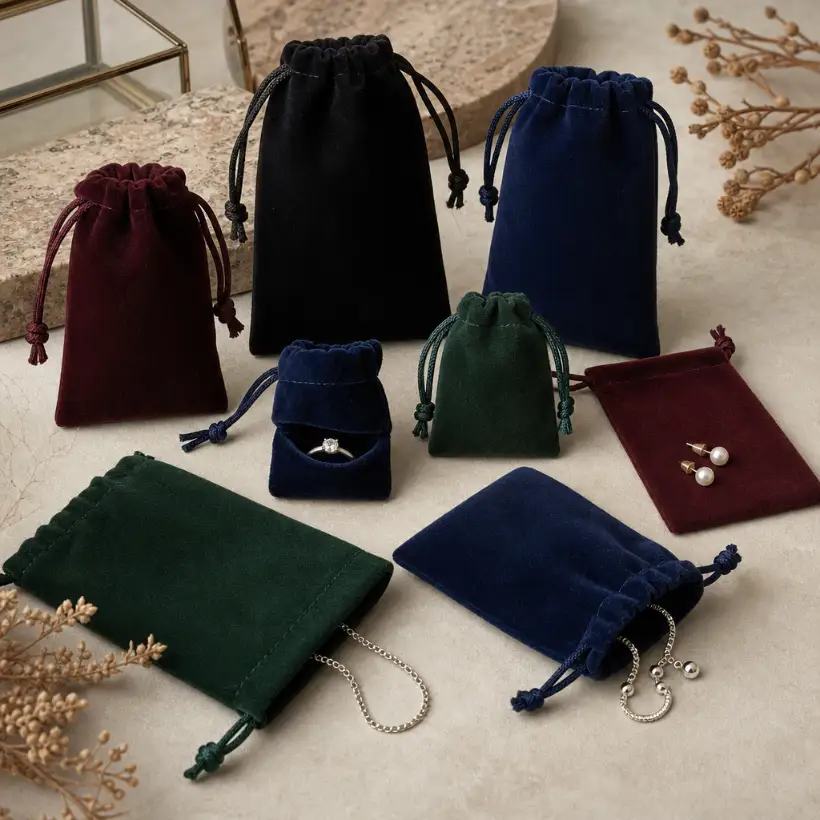
Velvet can be used in drawstring, flap, zipper, flat, or more structured pouch designs. The appropriate format depends on the jewelry shape, how the item will be packed, whether it includes a display card, and whether customers may keep the pouch for later storage.
| Jewelry Type | Pouch Format to Consider | Buyer Consideration |
|---|---|---|
| Rings | Small drawstring pouch | Keep the pouch compact enough to reduce excess movement. |
| Stud earrings | Small pouch with a card or divider | A card or divider can help keep the pair together. |
| Necklaces and chains | Flat or longer pouch | Allow room for the chain and clasp without forcing tight bends. |
| Bracelets | Medium drawstring or flap pouch | Check the opening size as well as the internal dimensions. |
| Multi-item gift sets | Larger pouch with inserts or separate compartments | Separate pieces where practical to limit item-to-item contact. |
This table provides a planning reference rather than a fixed specification. Measure the actual jewelry, including clasps, charms, tags, display cards, and any protective components. Buyers can also explore personalized velvet pouch options for logos, sizes, colors, and closures while preparing a request for quotation.
5. Potential for Customer Reuse
A pouch may remain useful after the original sale. Some customers may use a velvet pouch for travel, drawer storage, or separating a small item from other jewelry. When the pouch carries a logo, continued use may provide additional brand visibility.
Reuse should not be treated as a guaranteed result. Some customers may keep the pouch, while others may discard it after unboxing. Instead, assess whether the construction supports practical use after purchase:
- Is the pouch a useful size for travel or drawer storage?
- Is the closure easy to open and close?
- Can the pouch separate one item from other jewelry during storage?
- Is the logo visible without taking attention away from the product?
- Does the pouch continue to look suitable after normal handling?
These questions help a buyer decide whether the pouch should function only as presentation packaging or also as a storage accessory.
6. Compatibility With Boxes, Cards, and Gift Packaging
Velvet can work as an outer pouch, an inner component inside a box, or part of a gift set that includes cards, tissue, or inserts. Its soft surface can contrast with a rigid box, while a printed card can carry care instructions, product details, or other required information.
A layered packaging setup needs physical testing before approval. The pouch should fit inside the outer box without excessive compression. The jewelry should fit inside the pouch without creating an oversized bundle. If the set includes a card insert, check whether its edges affect the fabric or make the pouch difficult to close.
When preparing a request for YJXPACK, provide product measurements, packaging drawings when available, and a clear explanation of how the final set will be packed. This information helps the buyer and supplier identify questions about dimensions, closure style, logo placement, and box compatibility before sample approval.
7. Velvet Compared With Other Soft Pouch Materials
Velvet is one option among several soft packaging materials. Microfiber, suede-like fabrics, satin, cotton, and organza can suit different presentation and packing needs. Buyers should compare materials based on customer experience, product protection needs, logo requirements, packing workflow, and outer packaging format.
Velvet and Microfiber Compared
| Factor | Velvet | Microfiber |
|---|---|---|
| Surface feel | Often soft and pile-based | Often smooth and soft, depending on construction |
| Visual effect | May show directional shading | Often appears more visually even, depending on fabric |
| Lint and dust visibility | Lint or dust may be more visible | Visibility varies by color and surface finish |
| Bulk | Construction may add thickness | Lighter constructions may be available |
| Logo review | Test carefully because pile can affect detail | Test carefully, especially with fine artwork |
| Common buying consideration | Tactile and gift-focused presentation | A smoother surface or lighter pouch program |
Neither material is automatically the right choice for every project. A lighter fabric may suit a mailing-focused program, while velvet may suit a product where tactile presentation is central to the customer experience. For a meaningful comparison, request samples in the same pouch size, similar color family, logo artwork, and closure style.
How to Source Custom Velvet Jewelry Pouches Carefully

A clear brief can reduce avoidable revisions. Before requesting a quotation or sample, define the product, pouch construction, visual requirements, and approval process.
Build a Complete Request
Include the following information in the request:
- Jewelry type and approximate product dimensions
- Pouch length, width, and any gusset requirement
- Desired fabric type or a reference sample
- Color target and a physical reference when available
- Closure style, such as drawstring, flap, or zipper
- Logo artwork, placement, size, and preferred decoration method
- Whether the pouch will sit inside an outer box
- Any insert, card, or divider that must fit inside
Send the same complete brief to YJXPACK that you would use for any supplier comparison. Clear specifications make it easier to identify open questions before the sample stage.
Review Logo Methods on the Actual Fabric
A raised pile can affect logo sharpness and coverage. A logo method that looks clear on smooth cotton, paper, or a digital proof may look different on velvet. Fine lines, small text, and large solid artwork need particularly careful review.
Do not approve a logo from digital artwork alone. Review it on the intended fabric, color, and pouch construction. Check it at normal viewing distance, then inspect the edges, placement, and readability more closely. If a logo, insert, or card includes jewelry-related product, origin, material, or quality statements, make sure those statements are accurate. The U.S. Federal Trade Commission’s Jewelry Guides provide a relevant reference for businesses making jewelry-related representations.
Use a Sample Approval Checklist
A physical sample gives buyers an opportunity to check practical details before moving forward. Use a written checklist so feedback remains specific and easy to track.
1. Does the jewelry fit without excessive empty space or pressure?
2. Does the pouch open and close smoothly?
3. Does the fabric color reasonably match the approved reference under suitable lighting?
4. Does the pile look reasonably even across visible areas?
5. Is the logo correctly placed and easy to read?
6. Are seams, corners, drawstrings, and closures neat and functional?
7. Does the pouch fit into the intended outer box or mailing package?
8. Does the complete presentation match the intended customer experience?
Document approved measurements, artwork version, color reference, fabric choice, and construction details. This record can reduce confusion during a reorder or when adding another pouch size to a collection.
When Velvet May Not Be the Right Choice
Velvet may be less suitable when a buyer needs the lightest possible package, expects frequent exposure to dust, or wants a very flat and uniform printed surface. It may also be unnecessary for basic packaging where a simpler material better matches the product and customer expectations.
Start with the item and the customer journey. Consider whether the jewelry is commonly gifted, whether it needs a separate storage layer, whether the pouch will travel inside a box, and whether a pile-based texture supports the brand presentation. YJXPACK can review the submitted pouch brief with the buyer, while the buyer should confirm the available material, construction, decoration, and sampling options for the specific project.
Frequently Asked Questions
Does velvet packaging prevent jewelry from scratching?
Velvet can provide a softer contact surface than hard packaging materials, but it cannot remove all scratch risk. Use suitable pouch sizing and separate pieces when needed.
Is velvet suitable for necklaces?
It can be suitable when the pouch has enough length and width for the chain and clasp. A flat format, card, or insert may help manage tangling depending on the necklace design.
Can a logo be added to a velvet pouch?
A logo may be possible, but buyers should test the selected logo method on the intended fabric and color. Velvet pile can affect fine detail, coverage, and edge definition.
What should buyers check on a velvet pouch sample?
Check jewelry fit, color, pile appearance, seams, closure function, logo placement, and compatibility with any outer box, card, or insert.
Is velvet better than microfiber for jewelry packaging?
The suitable choice depends on the intended use. Velvet may suit tactile, gift-focused presentation, while microfiber may suit projects that prioritize a smoother surface or lighter construction.
Share This Story, Choose Your Platform!