The pouch gets all the attention. But the cord is what your customer’s fingers touch first — and the detail that quietly separates a $0.50 pouch from a $1.20 one. So while most brands obsess over fabric and logo, the drawstring quietly tells its own story about quality. Plus, a cheap cord on a beautiful pouch downgrades the whole package in a single touch.
This guide is practical and fast. In about 5 minutes, you’ll know exactly how to specify a drawstring cord like someone who’s done it a hundred times — cord material, thickness, aglet finish, and closure method. Plus, you’ll walk away with a spec cheat sheet you can copy straight into your next supplier inquiry.
Here’s what you’ll learn: the 3 parts of a drawstring you’re actually specifying, how to choose cord material and thickness, the hidden aglet detail that signals quality, and which closure method fits your use case. Let’s get into it.
What You’ll Need Before You Start
Before you spec a cord, have these four things ready:
- Your pouch material — already decided (cotton, velvet, microfiber, etc.)
- Your brand color — ideally a Pantone number, not just “navy”
- Your budget tier — cords range from $0.02 to $0.30+ per pouch
- Your use case — single-use gifting vs. daily reuse changes everything
Got those? Good. Now let’s build your cord spec, one decision at a time.
Cord Anatomy — The 3 Parts You’re Actually Specifying
Most brands think a drawstring is one thing. It’s actually three — and each one is independently customizable. So when you understand the parts, you control the result.
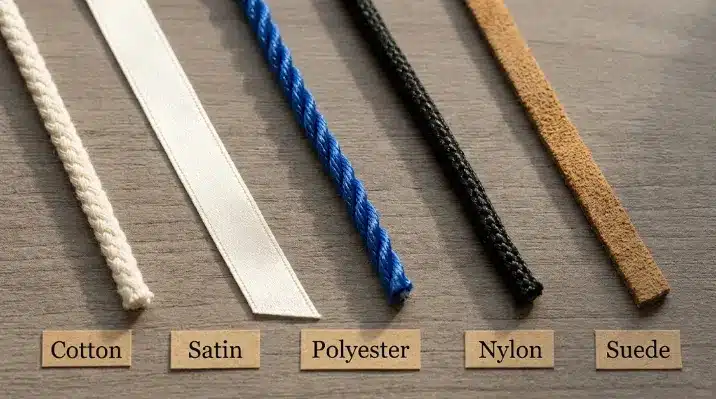
1. The cord (the body). This is the string itself — its material and thickness. Cotton, satin, polyester, nylon, or suede. The cord body is what your customer’s fingers feel and what carries most of the visual weight.
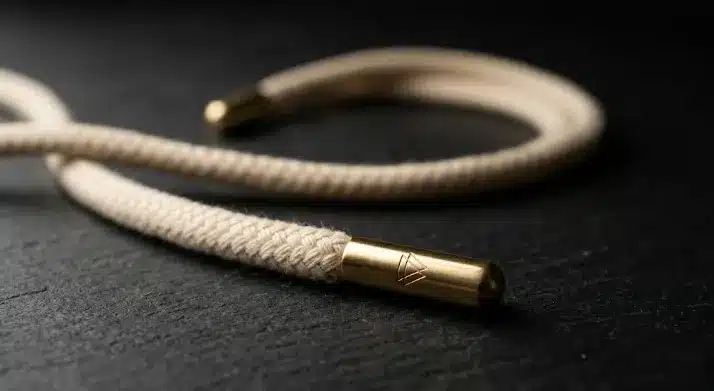
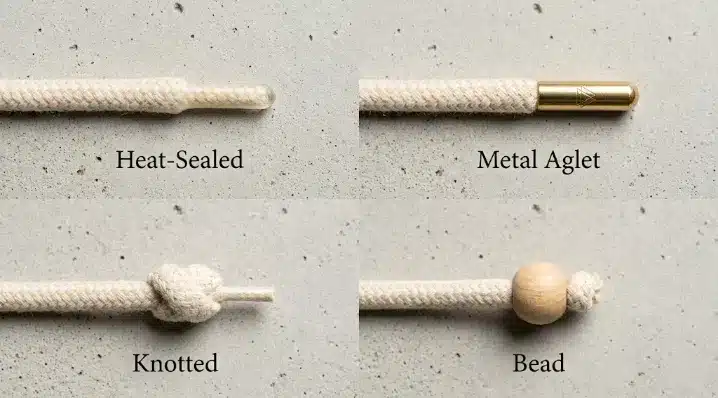
2. The aglet (the tip). This is the finished end of the cord — heat-sealed plastic, a metal cap, a knot, or a decorative bead. Most brands never think about it. So it’s the single most overlooked customization point in the entire pouch.
3. The closure mechanism (how it cinches). Single drawstring, double drawstring, ribbon tie, or a cord lock. This determines how the pouch opens, closes, and holds shut.
Here’s the thing most suppliers won’t point out: you can customize all three separately. So you’re not just picking “a cord” — you’re making three small decisions that together signal either “premium” or “afterthought.” A premium drawstring cord on a premium pouch completes the impression. A cheap one breaks it.
In short, the next three steps walk you through each decision in order. Get all three right, and your packaging feels considered down to the smallest detail.
Step 1 — Choose Your Cord Material
The cord material sets the tone. So match it to your pouch and your brand, not just to the lowest price. Here are the five main options.
Cotton cord. Soft, matte, natural, and eco-friendly. So it pairs perfectly with cotton or canvas pouches and sustainability-focused brands. Plus, it takes a knotted finish beautifully. Cost: low-to-mid. Best for: organic, artisan, and clean-luxury brands.
Satin ribbon. Smooth, lustrous, and elegant. So it reads as gift-ready and ceremonial. Plus, it ties into a clean bow. However, it frays if cut poorly and snags easily. Cost: low-to-mid. Best for: wedding favors, gift packaging, bridal.
Polyester cord. Durable, vivid in color, and economical — the industry workhorse. So it’s the default for most jewelry pouches. Plus, it holds Pantone color well and resists basic wear. Cost: low. Best for: classic premium and high-volume orders.
Nylon cord. Strong, slightly glossy, and water-resistant. So it handles frequent opening and closing without fraying. Plus, it’s ideal for pouches customers reuse daily. Cost: mid. Best for: everyday-wear jewelry, men’s accessories.
Suede or leather cord. Textured, substantial, and distinctly premium. So it signals luxury the moment it’s touched. Plus, it pairs naturally with suede and microfiber pouches. Cost: high. Best for: high-end and heritage positioning.
Here’s the quick pairing rule. Cotton pouch → cotton cord. Velvet pouch → satin ribbon or polyester cord. Microfiber pouch → suede cord or matte polyester. Kraft or canvas → cotton or thick polyester. So when in doubt, match the cord’s character to the pouch’s character. For exact color consistency across production runs, specify a Pantone color matching number for the cord — not just a color name. And if you’re working with a cotton drawstring pouch, a matching cotton cord keeps the whole piece cohesive.
In short, the right pouch cord material makes the pouch feel complete. The wrong one makes it feel cheap.
Step 2 — Pick Cord Thickness & Length
Thickness and length seem like minor details. But get them wrong, and the pouch either won’t close properly or looks visibly cheap. So here’s how to spec both.
Thickness. Three practical tiers:
- Thin (1–2mm): Delicate and refined. Best for small pouches (rings, earrings) and minimalist brands.
- Medium (3–4mm): The universal default. Works for most jewelry pouch sizes and reads as balanced.
- Thick (5mm+): Bold and substantial. Best for larger pouches, canvas bags, and brands wanting a chunky, statement feel.
Length. Use this simple formula: pouch width × 2.5, plus 4–6cm for knotting. So a 10cm-wide pouch needs roughly 29–31cm of cord per side. This gives enough to cinch fully and tie comfortably.
Here’s what goes wrong when you don’t calculate it:
- Right length: Cinches fully, ties easily, hangs neatly.
- Too short: Won’t tie, pouch gapes open, looks unfinished.
- Too long: Dangles awkwardly, tangles, reads as cheap and sloppy.
So always confirm both thickness and length on your spec sheet — and ask the factory to show them on the physical sample before bulk. In short, these two numbers are small, but they’re the difference between a pouch that feels finished and one that feels improvised.
Step 3 — The Hidden Detail: Aglet Customization
Here’s the detail almost no brand thinks about — and the one that separates truly considered packaging from the rest. The aglet is the finished tip of the cord. So most pouches use the cheapest option and never look back. That’s your opportunity.
Four ways to finish a cord end:
Heat-sealed. The cheapest method — the cord end is melted to prevent fraying. So it’s functional but plasticky, and on a premium pouch it reads as an afterthought. Fine for budget packaging, wrong for anything aspiring to luxury.
Metal aglet. A small metal cap crimped onto the cord end. So it instantly elevates perceived quality — and here’s the key part: it can be engraved or stamped with your logo. Plus, the moment a customer’s fingers touch a small branded metal tip, perceived value jumps. This is the single most underused branding touchpoint in jewelry packaging.
Knotted. A clean hand-tied knot at the cord end. So it gives a handcrafted, artisanal feel — perfect for cotton cords and sustainable brands. Plus, it costs almost nothing and signals care.
Bead or tassel. A decorative bead, wooden ball, or small tassel. So it adds personality — ideal for bohemian, artisan, or gift-focused brands.
The cost reality: a custom metal aglet adds roughly $0.05–$0.15 per pouch. So for a $150 piece of jewelry, that’s a rounding error — but the perceived-quality lift is disproportionate. Plus, an engraved metal aglet works as a second logo placement most competitors completely ignore. For more on logo placement options across your packaging, see our logo printing techniques guide.
In short, the aglet is a quality signal hiding in plain sight. So while your competitors heat-seal their cords and move on, a branded metal drawstring aglet quietly tells your customer that you thought about every detail.
Step 4 — Choose Your Closure Method
Finally, decide how the pouch actually closes. The closure method affects both function and look. So match it to how your customer will use the pouch.
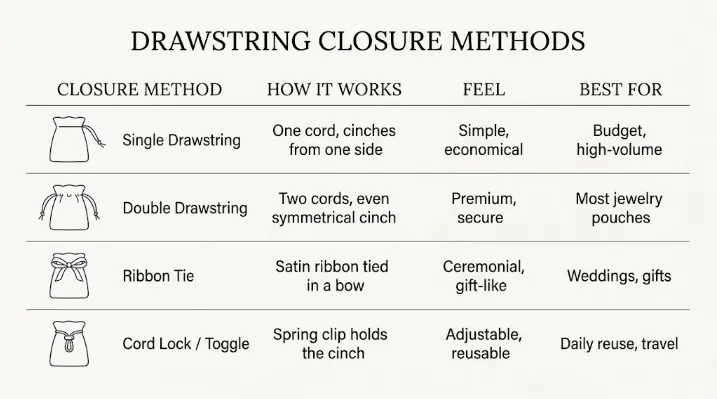
Single drawstring. One cord runs through the channel and cinches from one side. So it’s simple and economical. However, it can pull the pouch opening to one side. Best for: budget-conscious, high-volume orders.
Double drawstring. Two cords run through from opposite sides and pull against each other. So the opening cinches evenly and symmetrically — and it holds shut more securely. Plus, it looks more premium. Best for: most jewelry pouches where presentation matters.
Ribbon tie. A satin ribbon that ties into a bow. So it’s the most gift-forward closure. Plus, it creates a ceremonial unwrapping moment. Best for: wedding favors, holiday gifts, bridal.
Cord lock / toggle. A small spring-loaded clip that holds the cinch in place. So it’s adjustable and reusable without re-tying. Best for: pouches customers open and close frequently, travel-focused jewelry.
Here’s the quick decision guide:
- Want symmetry and a premium look? → Double drawstring.
- Lowest cost, simple function? → Single drawstring.
- Gift or ceremonial feel? → Ribbon tie.
- Frequent reuse? → Cord lock / toggle.
So most premium jewelry brands land on double drawstring for the even, secure, polished result. In short, the closure is the last 10% of the cord decision — but it’s the part the customer interacts with every single time they open the pouch. A well-executed custom drawstring closure makes that interaction feel effortless.
Common Cord Mistakes to Avoid
Even experienced brands make these. So scan the list before you finalize your spec:
- ❌ The cord is cheaper than the pouch. A premium pouch with a plasticky cord downgrades the entire package in one touch.
- ❌ The cord is too short to tie. Always apply the width × 2.5 + knotting formula.
- ❌ The aglet cracks or frays. Cheap heat-sealing splits over time — spec a proper finish.
- ❌ The cord color clashes with the pouch. Either match tone-on-tone or choose a deliberate contrast — never an accidental mismatch.
- ❌ You forgot the aglet can carry your logo. A metal tip is a free second branding placement most brands waste.
So a 30-second review against this list saves you from the most common (and most visible) cord errors.
Quick Reference — Cord Spec Cheat Sheet
Screenshot this. The table below maps common use cases to the cord spec that fits — so you can copy it straight into your next supplier inquiry.
| Use Case | Cord Material | Thickness | Aglet | Closure |
|---|---|---|---|---|
| Classic premium jewelry | Polyester | 3–4mm | Metal (engraved) | Double drawstring |
| Sustainable / artisan | Cotton | 3–4mm | Knotted | Double drawstring |
| Wedding / gift favor | Satin ribbon | Ribbon | Sealed end | Ribbon tie |
| Everyday / men’s jewelry | Nylon | 3–4mm | Metal | Cord lock |
| High-end / heritage | Suede / leather | 2–3mm | Metal (engraved) | Double drawstring |
| Budget / high-volume | Polyester | 2–3mm | Heat-sealed | Single drawstring |
So find your use case, read across, and you have a complete cord spec ready to send. For the full range of pouches these cords pair with, browse our custom jewelry pouches.
How YJXpack Handles Cord Customization
To turn this into a finished product, here’s how we handle cord customization at YJXpack.
We stock all five cord materials — cotton, satin ribbon, polyester, nylon, and suede/leather — so you can match the cord to your pouch without sourcing separately. Plus, we offer custom metal aglets that can be engraved or stamped with your logo, turning the cord tip into a second branding placement. So your packaging carries your mark in two places, not one.
For color, we offer Pantone-matched cords — so your drawstring matches your brand color exactly, not “close enough.” Plus, all four closure methods (single, double, ribbon tie, cord lock) are available across our pouch range. MOQ starts at 100 pieces, and cord customization adds no minimum-order penalty.
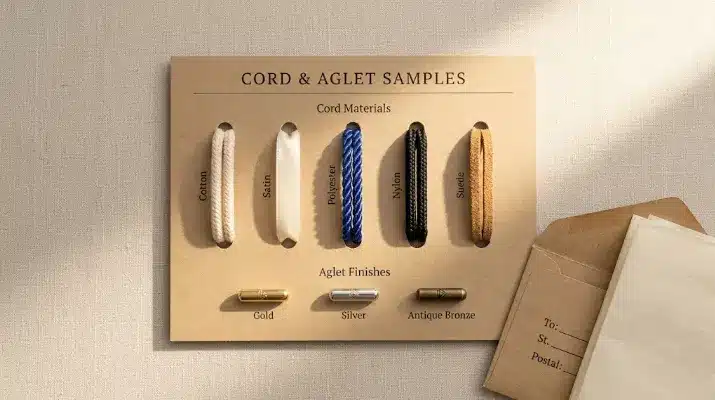
Before you commit, we send a free cord and aglet sample card — physical samples of each material and finish — so you can feel the difference rather than guess from a screen. To start, visit YJXpack and request a cord sample card.
What to Do Tomorrow
Here’s your one action: pull out your most recent pouch sample and pinch the cord between your fingers. Compare it to the pouch fabric. If the cord feels cheaper than the pouch — plasticky, thin, or flimsy — you’ve just found the first thing to upgrade. So spec a better cord on your next order, add a branded metal aglet, and watch how much more “finished” the whole package feels. It’s the smallest change with one of the largest perceived-value returns in all of packaging.
FAQs
Q1: What’s the most popular drawstring cord material?
Polyester cord is the most common — it’s durable, economical, holds color well, and suits most jewelry pouches. Cotton cord is the top choice for sustainable and artisan brands. So polyester wins on volume and value, while cotton wins on natural-fiber appeal. The right one depends on your pouch material and brand positioning.
Q2: Can I put my logo on the cord or aglet?
Yes. A metal aglet (the cord tip) can be engraved or stamped with your logo — one of the most underused branding placements in packaging. Plus, some cords can be printed with a repeating wordmark. So the drawstring can carry your brand in addition to the pouch itself, at a cost of roughly $0.05–$0.15 per pouch for a custom metal aglet.
Q3: Single vs double drawstring — which is better?
Double drawstring is better for most jewelry pouches — it cinches evenly from both sides, holds shut more securely, and looks more premium. Single drawstring is cheaper and simpler but can pull the opening to one side. So choose double for presentation-focused brands, single for budget or high-volume orders.
Q4: What cord length do I need for my pouch size?
Use this formula: pouch width × 2.5, plus 4–6cm for knotting. So a 10cm-wide pouch needs roughly 29–31cm of cord per side. Too short and it won’t tie; too long and it dangles awkwardly. Always confirm the length on a physical sample before approving bulk production.
Q5: Do metal aglets cost a lot more?
No. A custom metal aglet adds roughly $0.05–$0.15 per pouch. So for any jewelry above $50 retail, it’s a negligible cost with a disproportionate lift in perceived quality. Plus, an engraved metal aglet doubles as a second logo placement — making it one of the highest-ROI small upgrades in packaging.
Q6: Can the cord color match my brand color exactly?
Yes, with Pantone matching. Specify a Pantone number rather than a color name, and the cord can be dyed to match your brand color precisely. So your drawstring coordinates exactly with your pouch and brand identity. Standard stock colors carry no extra fee; custom Pantone dyeing may add a small one-time setup cost.
Feel the Difference — Get a Free Cord & Aglet Sample Card
YJXpack — Yijiaxin (Shenzhen) Packaging Co., Ltd.
For 20+ years, we’ve made custom jewelry pouches — with fully customizable cords, aglets, and closures — for 8,000+ brands worldwide. We stock five cord materials, offer engraved metal aglets, Pantone-matched cords, and all four closure methods. Plus, we hold GOTS, GRS, OEKO-TEX, BSCI, ISO 9001, and SABER certifications, all third-party verified.
Want to feel the difference a good cord makes? Request our free cord and aglet sample card — physical samples of every cord material and finish, shipped to your door. Plus, a free 3D mockup showing your logo on a custom metal aglet within 30 minutes.
Email: info@yjxpack.com
WhatsApp / WeChat: +86 18617112946
Website: www.yjxpack.com
Free cord & aglet sample card · Engraved metal aglets available · Pantone-matched cords · MOQ 100 pieces · GOTS / GRS / OEKO-TEX / BSCI / ISO 9001 certified
Share This Story, Choose Your Platform!