You just got two freight quotes for 10,000 cotton pouches. Air freight: $4,800. Sea freight LCL: $580. That’s an 8x price difference for the exact same shipment. So which one wins?
It depends. The wrong answer can either burn your cash flow (paying $4,800 when you didn’t need to) or kill a product launch (waiting 6 weeks when you had 7 days). For fabric pouches specifically — a category that’s notoriously low-density and high-volume — the packaging shipping cost calculation has quirks that most general freight guides miss.
Here’s the problem with most online freight articles. They focus on heavy industrial goods. Plus, they skip how lightweight fabric packaging gets billed (volumetric weight, anyone?). And worst of all, they don’t give you real 2026 sea freight vs air freight numbers — just generic ranges from 2019.
This article fixes that. In plain English, you’ll learn three things. First, real 2026 packaging shipping cost numbers across sea and air freight from China. Second, why fabric pouches have unique freight economics — and the 500kg break-even rule. Third, a real case study comparing $4,800 air freight vs $580 sea freight for 10,000 actual pouches.
By the end, you’ll know exactly which freight method matches your next order.
1. Packaging Shipping Cost — The 1-Minute Quick Answer
Let’s skip ahead. Here’s the bottom line.
For fabric pouches shipped from China to the US in 2026, packaging shipping cost ranges from $0.05 per pouch (sea FCL at scale) to $0.50+ per pouch (air express small batch). As a result, freight can be either a rounding error or your single biggest cost line — depending on choices.
Naturally, the right choice depends on order size and urgency. Here’s the fast-look table.
| Method | Cost Range (2026) | Transit Time | Best For |
|---|---|---|---|
| Air Express (DHL/FedEx) | $6-9 per kg | 3-5 days | Urgent samples, <200kg |
| Standard Air Freight | $4-7 per kg | 7-14 days | Medium urgency, 200-500kg |
| Sea LCL (Less than Container Load) | $95-130 per CBM | 30-45 days | Small-mid orders, <15 CBM |
| Sea FCL 20′ Container | $1,500-5,200 total | 25-40 days | 15-28 CBM volume |
| Sea FCL 40′ Container | $2,000-6,100 total | 25-40 days | 32-58 CBM volume |
That’s the fast version. Now let’s break it down properly.
2. Quick Decision Matrix — Sea vs Air at a Glance
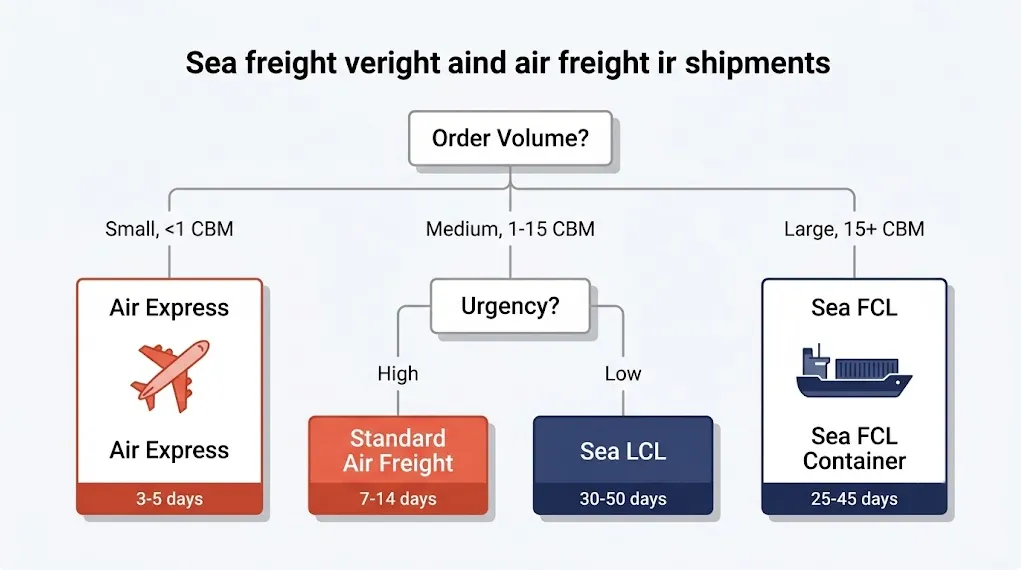
Three variables decide it: volume, weight, and urgency. So here’s the matrix.
| Order Volume | Order Weight | Urgency | Recommended |
|---|---|---|---|
| Less than 0.5 CBM | <20 kg | High (need in 7 days) | Air Express (DHL/FedEx) |
| 0.5-2 CBM | 20-100 kg | Medium | Standard Air Freight |
| 2-15 CBM | 100-500 kg | Low-Medium | Sea LCL |
| 15-28 CBM | 500-3,000 kg | Low | Sea FCL 20′ Container |
| 32-58 CBM | 3,000-8,000 kg | Low | Sea FCL 40′ Container |
Three quick rules from this matrix.
First, fabric pouches are almost always volume-driven, not weight-driven. Specifically, 10,000 cotton pouches typically weigh 200-400 kg but occupy 2-4 CBM. As a result, the dimension matters more than the scale.
Second, urgency overrides everything below 200 kg. So if your sample run needs to land in 5 days, air express wins regardless of cost math. By contrast, for any planned production order with 30+ days lead time, sea freight almost always saves money.
Third, container loads only matter above ~3,000 kg or 15 CBM. Below that, LCL (Less than Container Load) is the realistic sea freight option — you share container space with other shippers. For early-stage brands shipping packaging from China for the first time, or ordering custom packaging samples or first production batches, LCL is the default.
3. Sea Freight Deep Dive — LCL vs FCL Explained
Sea freight isn’t one product — it’s two. So understand both.
LCL (Less than Container Load). Your goods share a container with other shippers. You pay per CBM (cubic meter). Specifically, 2026 rates from major China ports to US West Coast run $95-130 per CBM. East Coast adds $20-40 per CBM for the Panama Canal route.
FCL (Full Container Load). You book the entire container. You pay a flat fee regardless of how full you fill it. Naturally, this only makes sense once you have 15+ CBM of cargo.
| Container Type | Capacity | 2026 Rate (China-US West) | Best Fit |
|---|---|---|---|
| 20′ Standard | ~28 CBM / ~21,000 kg | $1,500-3,200 | 15-28 CBM cargo |
| 40′ Standard | ~58 CBM / ~26,500 kg | $2,000-4,800 | 32-58 CBM cargo |
| 40′ High Cube | ~65 CBM / ~26,500 kg | $2,200-5,200 | 40-65 CBM (taller items) |
| 20′ to US East Coast | ~28 CBM | $3,500-5,200 | East Coast destinations |
| 40′ to US East Coast | ~58 CBM | $4,000-6,100 | East Coast destinations |
Three insights here.
First, LCL vs FCL break-even is around 15 CBM. Specifically, 15 CBM × $110/CBM = $1,650 LCL — which approaches the 20′ FCL minimum of $1,500. By contrast, below 15 CBM, LCL is cheaper. Above 15 CBM, book FCL.
Second, freight cost per CBM is the actual unit price. Always quote in CBM, not weight. As a result, fabric pouches benefit from this — they’re light per CBM compared to dense goods like metal hardware.
Third, container rates spike seasonally. Pre-Black Friday (August-October) and Pre-Chinese New Year (December-January) see 30-60% premium pricing. So book early or plan production around these windows.
4. Air Freight Deep Dive — Standard vs Express vs Charter
Air freight is also three different products. So pick the right one.
| Type | Provider Examples | 2026 Rate | Transit Time |
|---|---|---|---|
| Air Express (Door-to-Door) | DHL, FedEx, UPS | $6-9 per kg | 3-5 days |
| Standard Air Freight | Airline cargo (booked via forwarder) | $4-7 per kg | 7-14 days |
| Air Charter (rare) | Dedicated cargo plane | $50,000+ flat | 2-3 days |
| Air to East Coast | DHL/FedEx (default) | $7-10 per kg | 3-6 days |
| Air to West Coast | DHL/FedEx (default) | $6-9 per kg | 3-5 days |
Three things to understand about air freight cost from China.
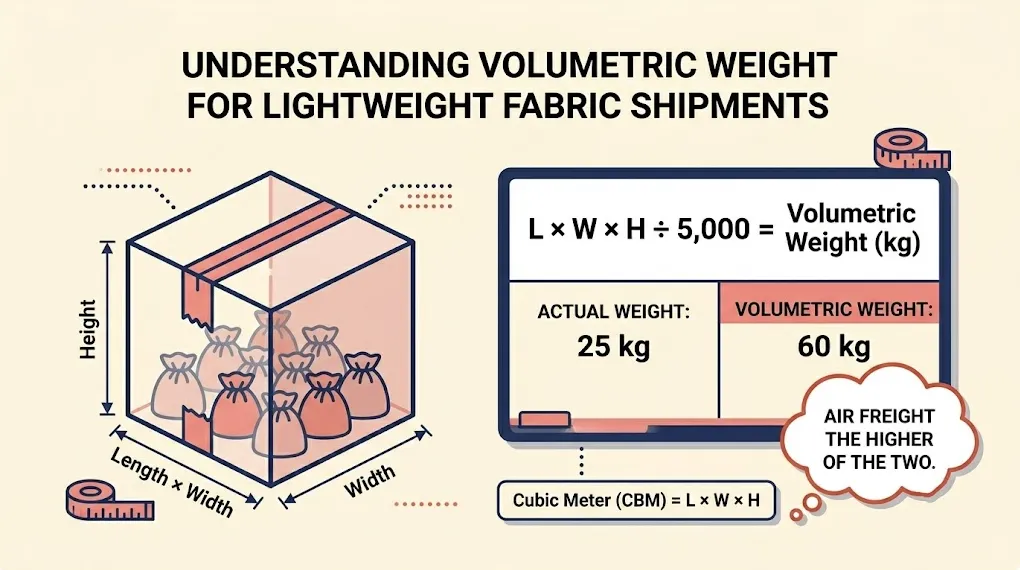
First, air freight bills volumetric weight, not actual weight. Specifically, the formula is: length × width × height (cm) ÷ 5,000 = volumetric weight in kg. As a result, fabric pouches in big boxes can get charged based on box volume — not pouch weight. This catches first-time importers off guard.
Second, express is door-to-door but premium-priced. DHL/FedEx pick up at the factory, clear customs automatically, and deliver to your warehouse — all included. By contrast, standard air freight requires you to handle US-side customs clearance and last-mile delivery separately.
Third, charter flights only make sense above ~3 tons. For typical fabric pouch orders (200-500 kg total), charter is irrelevant. Naturally, most B2B pouch buyers will use either DHL Express or standard air freight depending on quantity.
5. Real 2026 Packaging Shipping Cost Numbers
Let’s get specific. Here are real 2026 rates for typical fabric pouch shipments.
| Shipment Profile | Air Express | Standard Air | Sea LCL | Sea FCL 20′ |
|---|---|---|---|---|
| 500 pouches (10 kg, 0.3 CBM) | $60-90 | $40-70 | $30-50 | N/A |
| 2,000 pouches (40 kg, 1 CBM) | $240-360 | $160-280 | $95-130 | N/A |
| 5,000 pouches (100 kg, 2.5 CBM) | $600-900 | $400-700 | $240-325 | N/A |
| 10,000 pouches (200 kg, 5 CBM) | $1,200-1,800 | $800-1,400 | $475-650 | $1,500-3,200 |
| 25,000 pouches (500 kg, 12 CBM) | $3,000-4,500 | $2,000-3,500 | $1,140-1,560 | $1,500-3,200 |
| 50,000 pouches (1,000 kg, 24 CBM) | $6,000-9,000 | $4,000-7,000 | $2,280-3,120 | $1,500-3,200 |
Three key observations.
First, sea freight savings start small but compound fast. Specifically, at 500 pouches, sea LCL saves ~$30 vs air express. By contrast, at 25,000 pouches, sea LCL saves ~$3,000 vs air express. So scale amplifies the freight savings dramatically.
Second, sea FCL becomes competitive at 25,000+ pouches. At 25,000 pouches (12 CBM), sea LCL and FCL prices converge. Above 25,000 pouches, FCL becomes the cheapest option per piece.
Third, these are FOB-equivalent rates. Add 10-30% for hidden cost items (next section). Plus add Section 301 tariffs for fabric pouches (HS Code 6307.90.98) at 7.5-25% depending on US trade policy at time of import. So always check current tariff rates before quoting.
6. Transit Time Truth — From Pickup to Delivery
Posted transit times are misleading. So here’s the real timeline.
| Stage | Air Express | Standard Air | Sea LCL | Sea FCL |
|---|---|---|---|---|
| Booking + factory pickup | 1-2 days | 2-3 days | 3-5 days | 2-4 days |
| Origin port handling | 0-1 day | 1-2 days | 3-7 days | 2-5 days |
| Transit (port-to-port) | 1-2 days | 3-5 days | 18-28 days | 15-25 days |
| Destination port handling | 0-1 day | 2-4 days | 4-7 days | 3-5 days |
| Customs clearance | Included | 1-3 days | 2-5 days | 2-5 days |
| Last-mile delivery | Included | 1-3 days | 1-3 days | 1-3 days |
| Total realistic | 3-7 days | 10-20 days | 30-50 days | 25-45 days |
Three timing realities.
First, sea LCL has hidden delays. Specifically, LCL containers must wait until they’re full enough to ship — adding 2-7 days. By contrast, FCL ships on the next available vessel.
Second, customs clearance is buyer-controlled. Plus delays here are the #1 cause of late delivery complaints. So have your customs documents (commercial invoice, packing list, HS codes) ready before shipment leaves China.
Third, last-mile delivery varies by destination. Major US ports (LA, Long Beach, NY) move cargo fast. By contrast, inland destinations (Chicago, Denver, Dallas) add 3-7 days for trucking.
7. Hidden Packaging Shipping Cost Items
The headline freight rate is rarely the final number. Here’s what’s actually included — and what isn’t.
| Cost Item | Typical Amount | Who Pays? |
|---|---|---|
| Origin port handling charges (CFS) | $80-150 flat | Usually included in LCL/FCL |
| Destination port handling (THC) | $200-400 flat | Buyer (unless DDP) |
| Customs clearance fee | $80-200 flat | Buyer or DDP |
| Import duties / Section 301 tariffs | 7.5-25% of cargo value | Buyer always |
| Customs bond (US imports) | $50-150 per shipment | Buyer |
| Demurrage / detention | $100-300 per day if delayed | Buyer |
| Cargo insurance | 0.3-0.5% of cargo value | Optional but recommended |
| Last-mile trucking | $200-500 per shipment | Buyer (unless DDP) |
Three rules to budget by.
First, total landed cost is typically 25-40% higher than freight quote. Specifically, the freight quote is just port-to-port. Plus add customs, duties, last-mile, and any insurance. As a result, a $580 sea LCL quote often lands as $800-950 actual paid.
Second, HS Code matters enormously. For fabric pouches, the typical US HS Code is 6307.90.98 (other made-up textile articles). Different HS codes carry different tariff rates. So always verify your HS classification with a customs broker.
Third, demurrage is the most painful hidden cost. If you’re slow to pick up cargo at the port, fees compound daily. Naturally, factor in 1-2 days of buffer for customs review and inspection holds. For more on cost transparency, see our logo printing cost comparison covering total landed-cost calculations.
8. The 500kg Break-Even Rule for Fabric Pouches
Here’s a useful rule of thumb. So memorize this.
The 500kg break-even rule: For fabric pouch shipments under 500 kg, air freight is usually competitive or cheaper than sea LCL after factoring in hidden costs. Above 500 kg, sea freight wins decisively.
Why? Two reasons.
First, sea LCL has fixed minimum charges. Specifically, regardless of whether you ship 100 kg or 400 kg, you pay $80-150 in origin port handling, $200-400 in destination handling, plus $80-200 customs. As a result, those fixed costs amortize poorly across small shipments.
Second, air freight scales linearly. $6/kg is $6/kg whether you ship 50 kg or 500 kg. By contrast, the savings only compound once you’re above the sea freight fixed-cost threshold.
For typical jewelry pouches at 20-40 grams each, 500 kg equals roughly 12,500-25,000 pieces. So orders below this size should usually go by air. Above this, sea freight starts winning.
One caveat. The 500kg break-even rule assumes you have 30+ days of timeline flexibility. If you need delivery in 10 days, air freight wins regardless of size. As a result, plan production timelines with freight choice in mind — see our MOQ packaging guide covering production-to-shipping timelines.
9. Incoterms 101 — DDP vs FOB vs EXW Quick Guide
Incoterms decide who pays what and when. So understand the five you’ll actually see.
| Incoterm | Seller Responsibility Ends At | Buyer Pays For | Best For |
|---|---|---|---|
| EXW (Ex Works) | Factory door | Everything from factory onward | Buyers with own freight contracts |
| FOB (Free On Board) | Loaded on ship at origin port | Sea freight + destination + customs | Most B2B sea freight orders |
| CIF (Cost, Insurance, Freight) | Destination port (covered) | Destination handling + customs + delivery | Buyers wanting insurance bundled |
| DDP (Delivered Duty Paid) | Buyer’s door (everything paid) | Nothing | Buyers new to importing |
| DAP (Delivered At Place) | Buyer’s address (no customs) | Import duties + customs clearance | Buyers with brokers |
Three things to know.
First, EXW shifts all complexity to the buyer. Specifically, you arrange the freight, customs, duties, everything. As a result, only experienced importers should use EXW. For first-time importers, this is the wrong choice.
Second, FOB is the most common B2B Incoterm. The seller handles getting goods onto the ship. The buyer takes over from there. Naturally, this gives you control over freight choice but requires you to know what you’re doing.
Third, DDP is the easiest for new importers. The seller handles everything — freight, customs, duties, delivery. Plus you just receive the goods at your door, no surprises. By contrast, the unit price will be 8-15% higher because DDP includes the seller’s freight markup.
For more on Incoterms, the official ICC Incoterms rules provide the authoritative definitions. We typically offer FOB and DDP options for international fabric pouch orders.
10. Real Case Study — 10,000 Fabric Pouches Shipping Comparison
Let’s run an actual example. Same shipment, two freight choices.
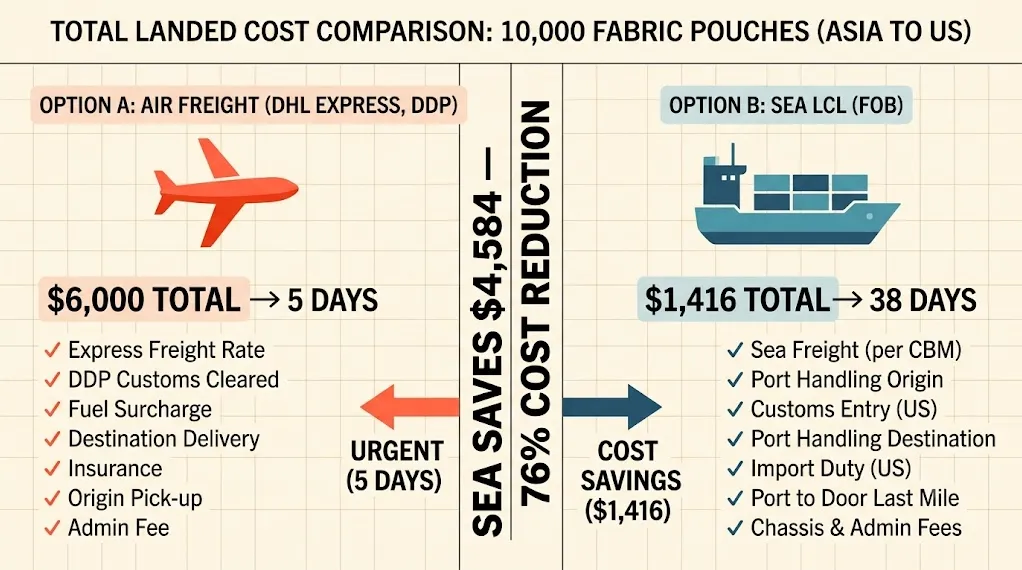
The shipment: 10,000 natural cotton drawstring pouches, 12cm × 18cm, ~25 grams each. Total weight: 250 kg. Total volume: 4.8 CBM (packed efficiently). Origin: Shenzhen. Destination: Los Angeles.
Option A: Air Freight (DHL Express, DDP)
– Air freight rate: $7.50/kg
– Air freight cost: 250 kg × $7.50 = $1,875
– Volumetric weight check: 4.8 CBM × 167 = 800 kg volumetric (volumetric weight applies — billed at higher of actual or volumetric)
– Actual billed weight: 800 kg
– Adjusted cost: 800 kg × $7.50 = $6,000
– Plus DDP markup (customs, duties, last-mile): bundled
– Total: $6,000
– Transit time: 5 days
Option B: Sea LCL (FOB, buyer handles customs)
– Sea LCL rate: $110/CBM
– Sea freight cost: 4.8 CBM × $110 = $528
– Destination port handling (THC): $300
– Customs clearance: $150
– Import duty (HS 6307.90.98, ~7.5% on $2,500 cargo value): $188
– Last-mile trucking to LA warehouse: $250
– Total: $1,416
– Transit time: 38 days
The math: Sea freight saves $4,584 — a 76% cost reduction. By contrast, air freight gets delivery 33 days sooner.
So which is right? Depends on your context.
For a planned production launch with 60+ days runway, sea freight is the obvious winner. By contrast, if you’re restocking a viral SKU and lose $200 of sales per day waiting, air freight pays for itself in 23 days of avoided stockout.
For most cotton tote bag and satin pouch orders, we recommend sea LCL for any quantity above 5,000 pieces when timeline allows.
11. 5 Common Freight Mistakes Brands Make
After 20 years of B2B exports, the same five freight mistakes show up repeatedly. So avoid these.
Mistake 1: Choosing freight method before knowing total volume. Specifically, freight choice depends on CBM and weight together. Plus changing freight method late adds cost. So finalize order specs first, calculate volume, then choose freight.
Mistake 2: Ignoring volumetric weight on air freight. Fabric pouches in cardboard boxes often hit volumetric weight thresholds. As a result, the $4/kg quote becomes effective $12/kg billable. So always ask your freight forwarder for both actual and volumetric quotes.
Mistake 3: Forgetting Section 301 tariffs. US import tariffs on Chinese-origin textile pouches (HS 6307.90.98) currently run 7.5-25%. By contrast, many freight quotes exclude this. So always add tariff lines to your landed-cost spreadsheet.
Mistake 4: Booking sea freight too late before Chinese New Year. December-January sees massive shipping backlogs. Specifically, Chinese factories work overtime and freight slots get scarce. So book sea freight 60+ days before Chinese New Year if production timing is flexible.
Mistake 5: Using DDP without comparing it to FOB+self. DDP simplifies imports but includes 8-15% freight markup. As a result, experienced importers save by using FOB and managing customs themselves. Naturally, new importers benefit from DDP’s simplicity — but always run the numbers.
Packaging shipping cost decisions get smoother once these five mistakes are avoided.
12. Conclusion — Packaging Shipping Cost Decision Test
Skip the long analysis. Instead, use this 60-second test.
Ask yourself four quick questions:
1. Is your order under 200 kg or 1 CBM total volume? → Air express usually wins.
2. Is your order over 500 kg or 5 CBM? → Sea freight (LCL or FCL) is much cheaper.
3. Do you need delivery within 14 days? → Air freight, regardless of cost.
4. Are you new to importing? → Choose DDP terms for simplicity (higher unit price, zero surprises).
If you answer these four before placing any order, your packaging shipping cost projections become accurate instead of optimistic.
That’s it. Sixty seconds. Real answer.
13. FAQs
Q1: How long does sea freight from China to the US really take?
For sea LCL, plan 30-50 days door-to-door including customs. For sea FCL, plan 25-45 days. Specifically, this includes booking time, port handling, ocean transit, US customs clearance, and last-mile delivery. By contrast, “port-to-port transit” alone is just 15-28 days — the rest is logistics overhead.
Q2: What’s the cheapest way to ship 1,000 fabric pouches from China?
For 1,000 pouches (typically ~20 kg, ~0.5 CBM), the cheapest option is sea LCL at $50-70 plus hidden costs (~$300-500 total landed). However, this takes 35-45 days. By contrast, air freight runs $120-180 freight and arrives in 7-14 days. So sea wins on cost but air may win on speed.
Q3: Does DHL include customs clearance?
For DHL Express on standard imports, yes — customs clearance is included in the door-to-door service. Specifically, DHL handles basic clearance and standard duties. However, complex imports (high-value, certified products, or specific HS codes) may need separate broker handling. So always confirm with DHL for orders over $2,500.
Q4: What’s the HS Code for fabric pouches?
The most common HS Code for fabric pouches imported to the US is 6307.90.98 (other made-up textile articles). Specifically, current Section 301 tariffs add 7.5-25% to this code for Chinese-origin goods. As a result, always verify your specific HS code with a licensed customs broker before importing.
Q5: Why does the same shipment cost different amounts in different seasons?
Three reasons. First, peak season (August-October for Black Friday, December-January pre-Chinese New Year) sees 30-60% price spikes. Plus container availability tightens. And last-mile capacity gets booked solid. So timing your import around off-peak windows saves real money.
Q6: Should I use a freight forwarder or book direct with carriers?
For first-time importers, use a freight forwarder. Specifically, they handle bookings, documentation, customs, and problem-solving for a markup of 5-15%. As a result, the time saved usually beats the cost. By contrast, experienced importers with 20+ shipments per year often save by booking direct with carriers.
Q7: Can I switch from sea to air freight if my order is delayed in production?
Sometimes, but it’s expensive. Air freight will get your goods there faster, but the cost premium can be 5-10x for the same shipment. Specifically, a $580 sea shipment becomes a $4,500-5,500 air shipment. So have realistic production timelines locked before committing to delivery dates.
Get a Quote — DDP One-Stop Service to Your Door
YJXpack — Yijiaxin (Shenzhen) Packaging Co., Ltd.
For 20+ years, we’ve shipped custom fabric pouches to brands across the US, Europe, and the Middle East. Our DDP one-stop service handles factory pickup, sea/air freight, customs clearance, import duties, and last-mile delivery — all for one transparent price quoted upfront. We hold GOTS, GRS, OEKO-TEX, BSCI, ISO 9001, and SABER certifications, and we serve over 8,000 brands worldwide.
Want one number instead of ten? Send us your order quantity, destination city, and target delivery date. We’ll respond with three transparent options — air, sea LCL, and sea FCL — with full landed-cost breakdowns. No hidden surprises.
Email: info@yjxpack.com
WhatsApp / WeChat: +86 18617112946
Website: www.yjxpack.com
DDP one-stop service · 3 freight options per quote · Transparent landed-cost breakdown · MOQ 100 pieces · GOTS / GRS / OEKO-TEX / BSCI / ISO 9001 certified
Share This Story, Choose Your Platform!