You’ve spent two weeks finding the perfect pouch supplier. The fabric is right. Plus, the logo method works. And the price per piece is competitive. Then they say it: “MOQ is 5,000 pieces.”
You’re launching a new SKU. You wanted 500 for a market test. Now you’re looking at $4,000+ of inventory that might not sell. Or starting over with another supplier.
This is the most common conversation in custom packaging procurement. And it’s almost always negotiable — if you know how. Here’s the problem with most online MOQ guides. They explain why suppliers set MOQs (which is interesting), but they don’t teach you how to actually negotiate one down (which is what you actually need).
This article fixes that. In plain English, you’ll learn three things. First, what MOQ packaging really means and how suppliers calculate it. Second, real benchmark MOQs by pouch category — so you know what’s negotiable vs hard. Third, seven specific negotiation scripts you can use this week to lower your next MOQ.
By the end, you’ll never accept a quoted MOQ at face value again.
1. MOQ Packaging — The 1-Minute Quick Answer
Let’s skip ahead. Here’s the bottom line.
MOQ packaging stands for “minimum order quantity” — the smallest order a factory will accept from you. Most fabric pouch suppliers quote MOQ between 100 and 5,000 pieces. As a result, the right MOQ for your brand depends on order frequency, design complexity, and how well you negotiate.
Naturally, the answer depends on your pouch type and order context. Here’s the fast-look table.
| Pouch Type | Typical MOQ | Negotiable Down To |
|---|---|---|
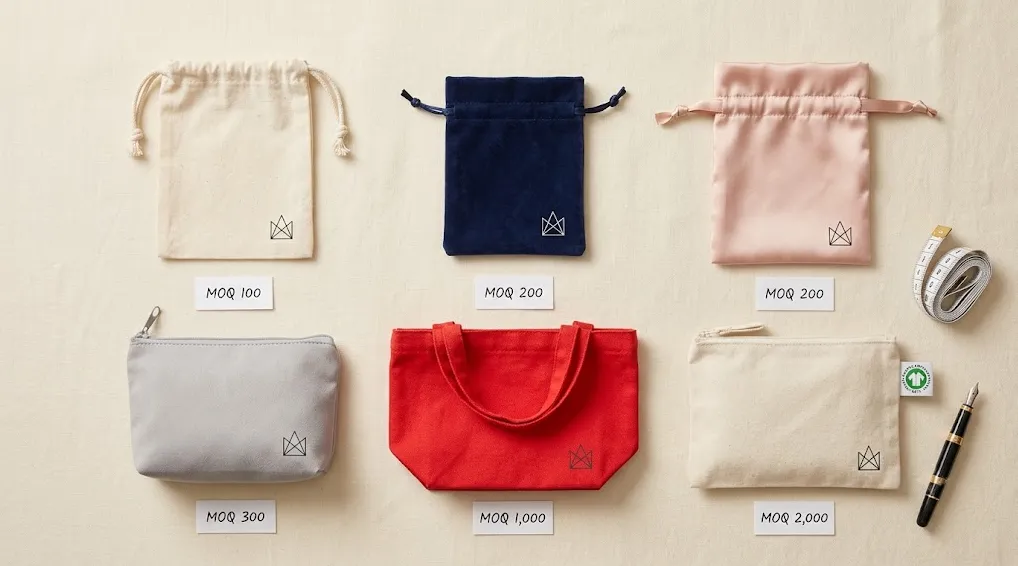
| Standard cotton drawstring | 500-1,000 pcs | 100-300 pcs |
| Custom-printed cotton tote | 1,000-2,000 pcs | 300-500 pcs |
| Velvet jewelry pouch | 500-1,000 pcs | 200-300 pcs |
| Microfiber cosmetic pouch | 1,000-3,000 pcs | 300-500 pcs |
| Polyester satin gift pouch | 500-1,000 pcs | 200-400 pcs |
| Specialty/Premium fabric | 3,000-5,000 pcs | 500-1,000 pcs |
That’s the fast version. Now let’s break it down properly.
2. What Is MOQ? (Minimum Order Quantity Explained)
MOQ stands for “minimum order quantity.” It’s the smallest production run a factory is willing to make for you in a single order. Below that threshold, the factory either refuses the order or charges sample-level prices (often 5-10x higher per piece).
Three details matter for B2B packaging buyers.
First, MOQ is per SKU, not per total order. So if you want 5 designs with MOQ 500, that’s 2,500 pieces total — not 500 pieces split across 5 designs. Naturally, this catches many small brands off guard.
Second, MOQ usually excludes samples. Sample runs (5-30 pieces) are priced separately at premium rates ($15-50 per piece). As a result, sampling is never “low MOQ” — it’s a different category of order entirely.
Third, minimum order quantity packaging requirements vary widely. A standard cotton tote might have MOQ 500. A custom-dyed velvet pouch with metallic foil might have MOQ 3,000. Specifically, the more customization, the higher the practical MOQ.
So when a supplier says “MOQ 1,000,” ask three follow-up questions. First, is that per SKU or total? Second, what’s the unit price at 1,000 vs at 2,000? Third, what’s the rock-bottom production minimum if pricing flexes upward?
The answers reveal whether MOQ is a genuine production constraint or a sales policy choice. By contrast, accepting the headline number without questioning is how brands end up with too much inventory or no supplier at all.
3. Why MOQ Packaging Standards Exist — The Real Cost Math
MOQ isn’t a supplier conspiracy. It’s a real cost equation. So let’s break the math.
| Cost Component | Fixed? | Per-Piece Impact at 200 vs 2,000 |
|---|---|---|
| Machine setup time (2-3 hours) | Fixed | $1.50 vs $0.15 |
| Material waste (10-20% loss) | Semi-fixed | $0.40 vs $0.05 |
| Color/dye batch minimum | Fixed below 500 pcs | $0.80 vs $0.10 |
| QC inspection time | Per-piece | $0.05 vs $0.05 |
| Logo setup (screen/die/digitizing) | Fixed | $0.50 vs $0.05 |
| Order processing/admin | Fixed | $0.30 vs $0.03 |
Three insights from this math.
First, setup costs dominate small orders. Specifically, 80% of the per-piece cost difference between 200 and 2,000 pieces comes from setup amortization, not material costs. So MOQ exists because below a threshold, the supplier loses money even at premium prices.
Second, dye batch minimums are the real bottleneck. A typical fabric dye batch produces 500-1,000 meters of fabric. As a result, ordering less means the factory either wastes leftover fabric or carries it as inventory — both costly.
Third, MOQ varies by complexity, not just quantity. A 500-piece order of a stocked color cotton bag has minimal extra cost. By contrast, a 500-piece order requiring custom Pantone dye, custom size, custom logo, and custom packaging tag has 5+ separate setup costs that don’t amortize.
So MOQ packaging negotiations work best when you understand which costs are truly fixed (hard to negotiate) vs which are policy choices (negotiable). For more on this trade-off, see our logo printing cost comparison covering setup fees in detail.
4. MOQ Packaging by Pouch Category — Industry Standards
Different pouch categories have different real-world MOQ baselines. Here’s the honest breakdown.
| Pouch Category | Standard MOQ | Best Case | Why |
|---|---|---|---|
| Cotton drawstring (stock color) | 500 pcs | 100 pcs | Fabric is stocked; only printing varies |
| Custom cotton tote | 1,000 pcs | 300 pcs | Cutting, sewing, printing all needed |
| Velvet jewelry pouch | 500 pcs | 200 pcs | Velvet rolls are pre-dyed in standard colors |
| Microfiber pouch | 1,000-3,000 pcs | 300 pcs | Higher fabric MOQ from mills |
| Polyester satin pouch | 500-1,000 pcs | 200 pcs | Pre-dyed satin widely available |
| Custom-dyed cotton (Pantone) | 2,000-3,000 pcs | 1,000 pcs | Dye batch minimum is real constraint |
| Organic / certified fabric (GOTS, GRS) | 2,000+ pcs | 500 pcs | Certified mills have higher fabric MOQ |
| Specialty fabric (linen, hemp) | 1,000-2,000 pcs | 500 pcs | Limited fabric supply |
Three patterns emerge.
First, stocked color fabrics have lowest MOQ. Specifically, cotton drawstring pouches in natural cream, black, or navy can drop to 100-200 pieces. As a result, this is the easiest entry point for small brands launching jewelry pouches or test SKUs.
Second, custom-dyed fabric has the highest hard MOQ. Below 500-1,000 pieces of custom-Pantone cotton, the dye batch is uneconomic. By contrast, a custom-printed logo on stocked-color fabric is far more flexible.
Third, certified fabric (GOTS, GRS, OEKO-TEX) MOQs are real. Certified mills run smaller production runs and require minimum commitments. So if you need GOTS organic cotton, expect MOQ 2,000+ as a real constraint, not negotiable down to 100. This is one area where MOQ packaging discussions hit a hard ceiling — certification economics are non-negotiable.
For specific product lines, we generally accept MOQ 100 on stocked-color cotton tote bags with screen-printed logos. By contrast, custom-fabric cosmetic pouches typically need 500+ for cost-effective production.
5. 7 Real Scripts to Negotiate MOQ Down
This is the section nobody else writes. Here are seven actual negotiation scripts that work — tested across hundreds of B2B procurement conversations.
Script 1: The Bundle Approach
When to use: You want multiple SKUs but the supplier’s MOQ is per-SKU.
What to say: “I see your MOQ is 1,000 per SKU. We have 3 designs we want to launch together. Can we combine these at 400 pieces each — 1,200 total — to share setup and meet your bulk threshold?”
Why it works: Factories care about total production efficiency, not always per-SKU minimums. Bundling shares setup overhead across designs.
Script 2: The Future Commitment
When to use: You’re testing the market but plan to scale.
What to say: “We’re willing to sign a letter of intent for 5,000 pieces over the next 3 quarters. Can you start us at 500 pieces this month so we can prove the SKU before committing fully?”
Why it works: Suppliers love predictable demand. A signed forecast commitment is worth real money to their planning team.
Script 3: The Sample-to-Order Conversion
When to use: You need real production quality but small quantity.
What to say: “Instead of a 30-piece sample run at sample pricing, can we do a 300-piece market test at production pricing? If sell-through is good within 60 days, we’ll convert to a 2,000-piece commitment.”
Why it works: Splits the difference between sampling (too small) and full production (too risky). Factories appreciate the path to scale.
Script 4: The Existing-Stock Approach
When to use: Your design needs are flexible.
What to say: “Do you have any in-stock standard pouches I can customize with just a printed logo? I’m flexible on exact size if it means we can do 200 pieces from your existing inventory.”
Why it works: Bypasses fabric MOQ entirely. The supplier already has the fabric — you’re just adding decoration. DTF printing pairs perfectly with this approach for full-color logos on small runs.
Script 5: The Pay-More-Per-Piece Approach
When to use: Cost-per-piece matters less than getting started.
What to say: “If your standard MOQ pricing is $0.80 at 1,000 pieces, what would the unit price be for 200 pieces? We’re willing to pay a 50-80% premium per piece in exchange for the lower commitment.”
Why it works: Many suppliers can produce small runs profitably with higher unit pricing — they just don’t advertise this option.
Script 6: The Off-Season Production Approach
When to use: Timing is flexible.
What to say: “We’re not in a rush. If you can fit this into your low-season production schedule (typically February-March or August), can you accept 300 pieces? Filling production gaps is valuable for you, and patience is valuable for us.”
Why it works: Suppliers lose money on idle machines. A flexible buyer offering MOQ relief during slow months is a win-win.
Script 7: The Pre-Existing Tooling Approach
When to use: Your design is simple enough to match existing setups.
What to say: “Do you have any screens, dies, or templates from past orders that could match our needs? Even a small modification would save weeks of setup, and we could meet a smaller MOQ in exchange.”
Why it works: Existing tooling eliminates the largest fixed cost. Factories with library tooling often accept lower MOQ for orders that fit.
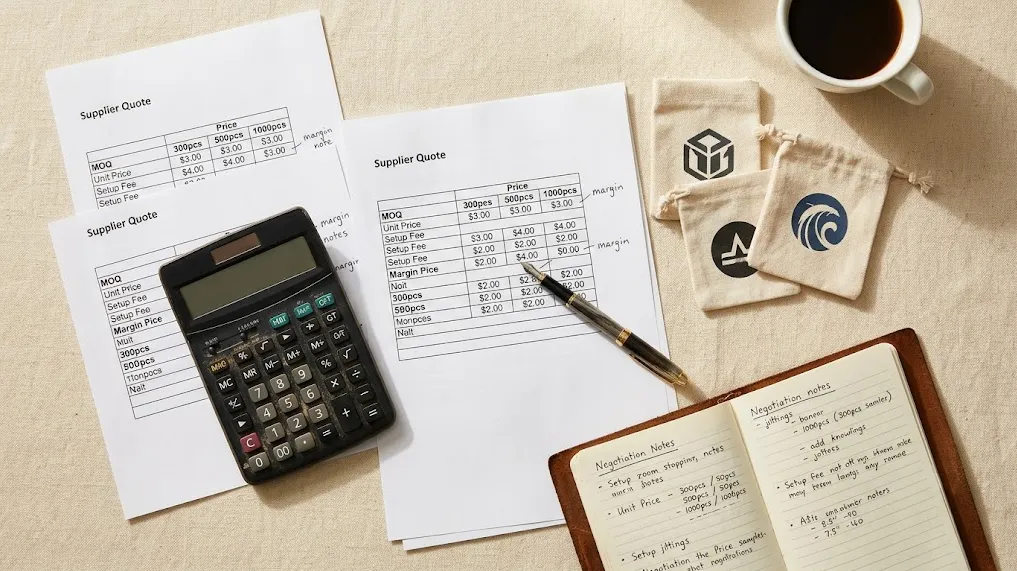
So these seven scripts together cover almost every low MOQ custom packaging negotiation scenario. Pick the script that matches your actual leverage. By contrast, just asking “can you lower the MOQ?” without offering anything in return rarely works.
6. MOQ Packaging Risks — Hidden Costs of Going Too Low
Lower MOQ sounds great. But pushing too low has hidden costs. So watch for these.
| Risk | What Actually Happens | How to Avoid |
|---|---|---|
| Per-piece price doubles or triples | Supplier amortizes fixed costs over fewer units | Calculate total cost, not unit price |
| Sloppier QC | Smaller runs get less factory floor attention | Request additional QC photos before shipping |
| Color/dye batch variation | Custom small batches less consistent | Use stocked colors or accept dE 3-4 tolerance |
| Longer wait for setup turn | Factory prioritizes large orders | Pay rush fee or accept longer lead time |
| Re-order surprise pricing | “Promotional” first-order MOQ pricing won’t repeat | Lock formula and pricing in writing |
| Lower-tier supplier match | Premium factories refuse small orders | Accept tier match, not name match |
Two truths emerge.
First, MOQ below 200 pieces almost always trades quality or price somewhere. Specifically, sub-200 piece runs often go to second-tier subcontractors. So if brand consistency matters, weigh the savings against the risk.
Second, the “we’ll do 100 pieces just this once” deal usually ends badly. Either the supplier ghosts you on the next order, or the second order’s pricing is dramatically higher. By contrast, building from MOQ 300-500 with a steady partner usually outperforms chasing the absolute lowest first-order MOQ.
So negotiate MOQ aggressively — but with clear eyes about what you might give up.
7. MOQ Math — When Higher Quantity Saves Money
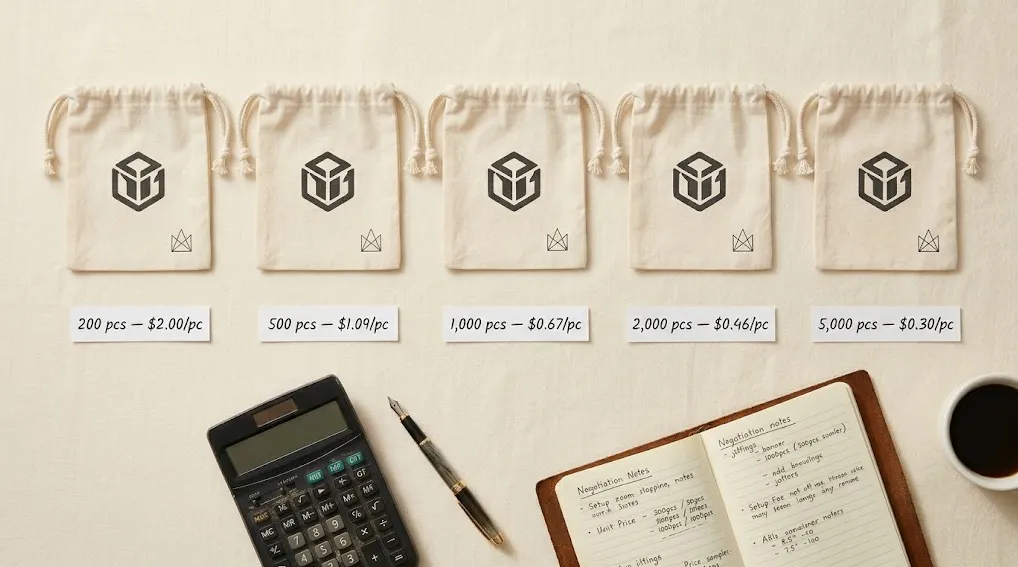
Sometimes the smart move is going up in MOQ, not down. So let’s run the numbers.
| Order Size | Unit Price | Setup | Total Cost | Per-Piece Total |
|---|---|---|---|---|
| 200 pcs | $1.40 | $120 | $400 | $2.00 |
| 500 pcs | $0.85 | $120 | $543 | $1.09 |
| 1,000 pcs | $0.55 | $120 | $670 | $0.67 |
| 2,000 pcs | $0.40 | $120 | $920 | $0.46 |
| 5,000 pcs | $0.28 | $120 | $1,520 | $0.30 |
Three takeaways.
First, going from 200 to 500 pieces saves 45% per piece. That’s a massive jump for a relatively small inventory commitment. So if you can sell 500 pieces within 12 months, ordering 500 is usually smarter than ordering 200.
Second, the curve flattens above 1,000 pieces. Going from 1,000 to 5,000 saves about 55% per piece, but at 5x the inventory commitment. By contrast, going from 200 to 1,000 saves 67% per piece at only 5x the commitment. So the sweet spot is usually 500-1,500 pieces.
Third, cash flow vs cost-per-piece is the real trade-off. A 200-piece order ties up $400. A 2,000-piece order ties up $920. Naturally, if your sell-through is reliable, the 2,000-piece order has 78% lower per-piece cost — which compounds when you re-order.
One quick rule. If your sell-through rate is 50+ pieces per month, ordering at MOQ 500 (10-month inventory) makes financial sense. By contrast, if sell-through is 10 pieces per month, MOQ 100-200 protects cash flow even at higher per-piece cost. So MOQ packaging decisions are as much about cash flow as they are about unit price.
8. Sample Orders vs Production MOQ — The Workflow
Samples and production are different categories of order. So understand the workflow.
Step 1: Send specs to MOQ pouch supplier. Include pouch type, fabric, dimensions, color (Pantone if relevant), logo design, and logo method. Naturally, our Pantone color matching guide covers how to specify color precisely.
Step 2: Request sample. Most suppliers charge $15-50 per sample for custom specs. Stock items may be free. Sample lead time is typically 3-7 days.
Step 3: Approve sample or iterate. Inspect the sample for fabric quality, color match, logo accuracy, stitching, dimensions. Plus take photos under daylight for record. Request a re-do if anything is off.
Step 4: Negotiate production MOQ. With approved sample in hand, negotiate the production order — use the scripts from Section 5.
Step 5: Place production order. Sign a written PO covering quantity, unit price, total cost, payment terms, lead time, shipping terms (FOB, CIF, DDP), and quality acceptance criteria.
Step 6: Pre-production approval. For larger orders, request a “pre-production sample” — one piece from the actual production run before the rest is made. This catches issues at the lowest cost moment.
Step 7: Production + QC + shipping. Production typically takes 5-15 days for runs of 500-5,000 pieces. Add 3-7 days for QC and another 7-30 days for international shipping.
So the entire sample-to-shipping timeline is usually 30-50 days for a first-time order. By contrast, repeat orders skip sampling and run 15-30 days.
9. 5 Common MOQ Mistakes Brands Make
After 20 years of B2B sourcing conversations, the same five mistakes show up repeatedly. So avoid these.
Mistake 1: Accepting the first quoted MOQ. First quotes are typically 30-50% higher than what suppliers will accept. Specifically, with a single counter-offer using Script 2 or Script 5, most quotes drop meaningfully.
Mistake 2: Negotiating MOQ before specs are locked. Suppliers can’t quote accurate MOQ without final fabric, dimensions, color, and logo. So lock specs first, then negotiate MOQ — not the other way around.
Mistake 3: Pushing MOQ way below the real production minimum. Asking for 50 pieces when realistic minimum is 300 wastes everyone’s time. Plus it signals you’re a small fish — and suppliers prioritize larger relationships. So know what’s reasonable to ask for.
Mistake 4: Not committing to future volume in exchange for lower first MOQ. Future-volume commitments are the single biggest lever to negotiate packaging MOQ down. By contrast, asking for low MOQ with no future commitment leaves nothing on the table for the supplier.
Mistake 5: Switching suppliers every order to chase lowest MOQ. Building a relationship with one good supplier almost always beats chasing 5% savings across 5 suppliers. As a result, the lowest MOQ tomorrow comes from the supplier who knows you today.
MOQ negotiations get dramatically more productive once these five mistakes are avoided.
10. Conclusion — MOQ Packaging Decision Test
Skip the long analysis. Instead, use this 60-second test.
Ask yourself four quick questions:
1. Is your annual SKU volume above 1,500 pieces? → Order at MOQ 500-1,000 from the start.
2. Is your annual SKU volume 200-1,500 pieces? → Negotiate MOQ down to 300-500 using Scripts 1, 2, 5.
3. Is your annual SKU volume under 200 pieces? → Switch to stocked-color products or DTF small runs.
4. Are you launching multiple SKUs simultaneously? → Use Script 1 (bundle) to share setup costs.
If you answer these four before any supplier call, your MOQ packaging negotiation moves from generic begging to specific, leverage-based asks. That’s the difference between getting “no” and getting a real conversation.
That’s it. Sixty seconds. Real answer.
11. FAQs
Q1: What’s a reasonable MOQ to ask for custom packaging?
It depends on the pouch type. For stocked-color cotton pouches with screen-printed logos, 100-300 pieces is reasonable. For custom-dyed or specialty fabrics, expect 500-1,000 minimum. Specifically, MOQ for small business orders works best at 300-500 pieces — low enough to test markets, high enough to amortize setup.
Q2: Can a small business negotiate MOQ with overseas suppliers?
Yes, regularly. The seven scripts in Section 5 work across markets. By contrast, the key is having something to offer in return — future volume commitment, flexible timing, accepting standard sizes, or paying higher unit price. So always come prepared with leverage, not just asks.
Q3: Why is custom packaging MOQ usually higher than retail product MOQ?
Because packaging has more setup steps. Specifically, fabric dye batches, logo screens, custom dies, and color matching all have fixed minimums independent of order size. As a result, packaging MOQ reflects these setup constraints — not just supplier policy.
Q4: What’s the cheapest way to test a packaging design without committing to full MOQ?
Three options. First, order a 5-10 piece sample at sample pricing ($15-50/piece). Second, order MOQ 100-200 of an in-stock pouch with just custom logo printing. Third, use DTF printing on a small run of stocked-color pouches. So test in this order: sample → small custom logo → full custom.
Q5: Will a supplier refuse my order if I push MOQ too low?
Yes, this happens regularly. Specifically, premium factories with full order books refuse small orders. By contrast, mid-tier factories often negotiate. So if you’re getting consistent “no” from large suppliers, consider mid-tier alternatives — quality is often comparable.
Q6: Should I order at MOQ or above it?
It depends on sell-through rate. If you can sell the MOQ within 6-12 months, order at MOQ — per-piece cost is much lower. By contrast, if sell-through is uncertain, order at MOQ even if you’d rather order less — the alternative (no supplier) is worse. Then prove sell-through and re-order at lower MOQ next time.
Q7: How long does MOQ negotiation typically take?
For a single round of negotiation, 1-2 days. For complex multi-SKU bundle deals, 1-2 weeks of back-and-forth. So budget your timeline accordingly. By contrast, just accepting the first quote takes minutes — but costs you per piece for every order going forward.
Get a Quote — Low MOQ Custom Packaging
YJXpack — Yijiaxin (Shenzhen) Packaging Co., Ltd.
For 20+ years, we’ve supported brands at every scale — from 100-piece launch tests to 50,000-piece annual programs. Our MOQ baseline is 100 pieces for stocked-color cotton pouches, 300-500 for custom designs, and 1,000+ for custom-dyed fabric. We hold GOTS, GRS, OEKO-TEX, BSCI, ISO 9001, and SABER certifications, and we serve over 8,000 brands worldwide.
Want to test our flexibility? Send us your design specs and target quantity. We’ll respond within 3 minutes with a realistic MOQ quote plus 2-3 alternative configurations to help you find the right balance of quantity, unit price, and lead time.
Email: info@yjxpack.com
WhatsApp / WeChat: +86 18617112946
Website: www.yjxpack.com
MOQ 100 pieces on stocked-color cotton · 3 alternative MOQ tiers per quote · Free sample on first orders · 3D mockup in 30 minutes · GOTS / GRS / OEKO-TEX / BSCI / ISO 9001 certified
Share This Story, Choose Your Platform!