Walk into any jewelry trade show and you will hear buyers use “satin” and “silk” as if they mean the same thing. They do not — and confusing the two before you place a bulk order can leave you with pouches that do not match your intended shelf presentation, budget, or sustainability requirements. This guide gives brand owners, traders, and e-commerce sellers a practical framework for comparing these two fabric categories across the decisions that affect a purchase order: fiber content, hand feel, construction, size, logo methods, cost, sampling, and quality control.
Quick Summary
- “Satin” describes a weave structure, not a fiber; many satin jewelry pouches are woven from polyester rather than silk.
- True silk satin is made with a natural protein fiber and usually carries a higher unit cost; confirm fiber content in writing before sampling.
- Logo method compatibility differs between polyester satin and silk satin; confirm the method with your supplier before approving a decoration approach.
- Pouch size, closure style, and lining interact with material choice and affect the final per-unit cost.
- Request a pre-production sample and a written specification sheet before approving bulk production.
What “Satin” and “Silk” Mean in a Pouch Specification
The word “satin” refers to a weave structure, not a raw material. In a satin weave, warp threads float over multiple weft threads before interlacing, which places most of the fiber surface on the face of the fabric. The result is a smooth, lustrous front and a duller back. That structure can be achieved with polyester, nylon, acetate, or natural silk — which is why a supplier quoting a “satin pouch” has not yet identified the fabric’s fiber content.
“Silk,” by contrast, refers to a specific natural protein fiber produced by silkworms. When buyers ask for a “silk jewelry pouch,” they may mean either a pouch woven from genuine silk fiber or a pouch with a silk-like appearance made from a synthetic alternative. The U.S. FTC’s business guidance on textile labeling requires accurate fiber-content disclosure on consumer products sold in the United States, so the distinction can affect labeling as well as appearance.
For sourcing purposes, treat every supplier quote as incomplete until you receive a written fiber-content declaration. A pouch described as “silk-like satin” may be polyester, but buyers should confirm rather than assume. For a pouch described as “100% silk,” request a written declaration and ask what supporting documentation or testing information is available. When working with a supplier like YJXPACK, include the required fabric composition in your initial inquiry rather than waiting until samples arrive.
How Material Choice Affects Hand Feel, Sheen and Protection
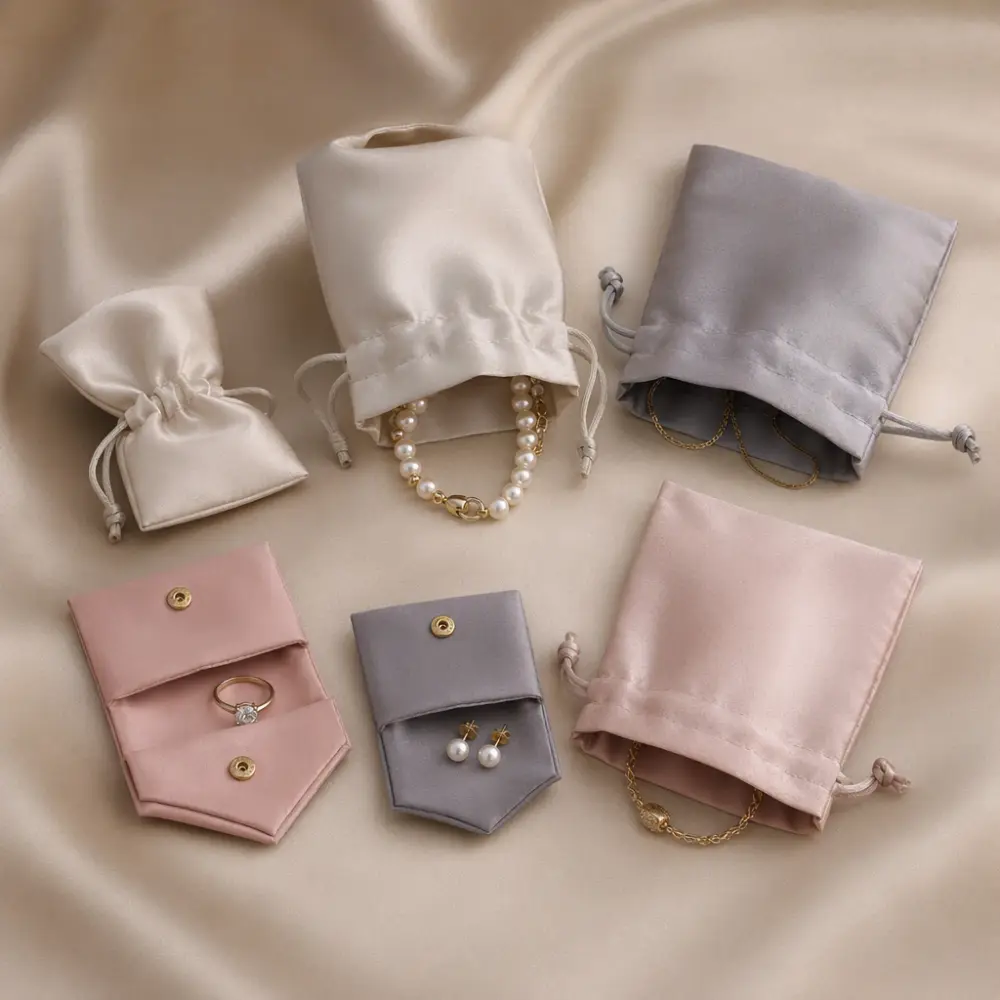
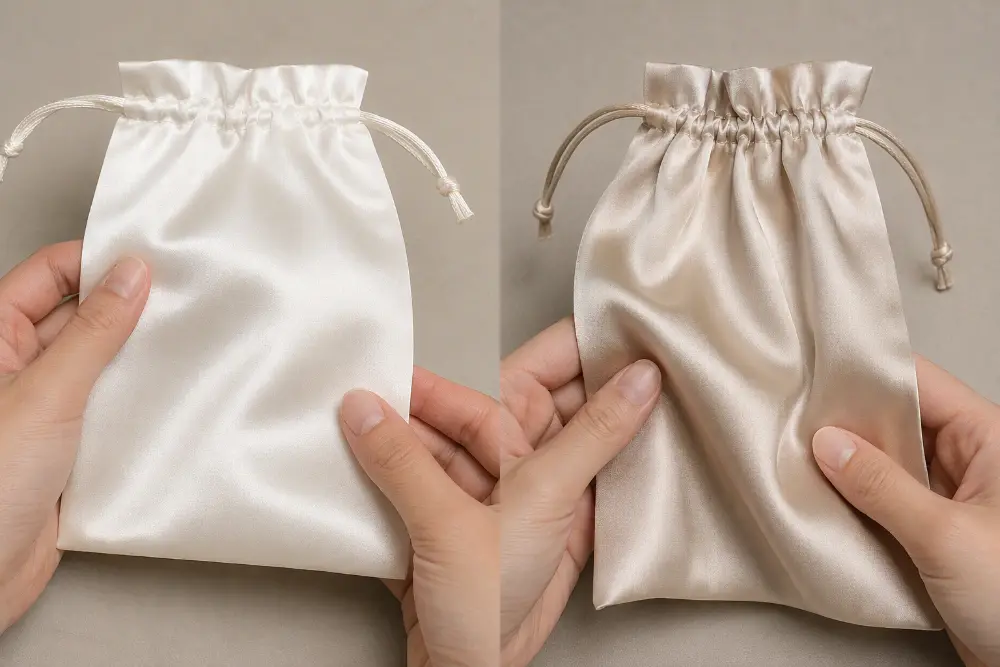
Polyester satin and genuine silk satin can appear similar in product photographs. A physical sample helps buyers compare the differences that may affect their packaging specification.
Polyester satin commonly has a cool, smooth hand feel and a uniform sheen. Its appearance can vary with fabric weight, weave density, color, and lighting. It generally resists moisture and can support a broad range of dyed colors. For jewelry protection, buyers should evaluate whether a tightly woven polyester satin lining provides sufficient separation from metal surfaces and gemstones for their specific product.
Genuine silk satin commonly has a warmer, softer hand feel and more variation in sheen as the fabric moves under light. Silk is a protein fiber and may generate less static than some synthetic fabrics. It is also more sensitive to moisture, heat, and abrasion than polyester, which can affect production handling and end-customer care instructions. The Textile Exchange provides information on responsible-material standards that may be relevant when a brand needs to document its sourcing requirements.
The table below summarizes differences a buyer can compare before requesting samples.
| Property | Polyester Satin | Genuine Silk Satin |
|---|---|---|
| Fiber origin | Synthetic, commonly petroleum-based | Natural silkworm protein fiber |
| Hand feel | Often cool and smooth | Often warm, soft, and fluid |
| Sheen character | Often bright and uniform | Often subtle and angle-dependent |
| Moisture behavior | Generally moisture resistant | Absorbs moisture more readily |
| Static behavior | Can develop static | May generate less static |
| Color range | Broad; consistency depends on dyeing and production controls | Broad; dye behavior can differ by silk type and process |
| Typical unit cost | Usually lower | Usually higher |
| Fiber-content verification | Written declaration; laboratory testing where needed | Written declaration; laboratory testing where needed |
| Sustainability documentation | Verify recycled-content claims and documentation with the supplier | Verify material-origin and related documentation with the supplier |
For branded jewelry pouches where cost, color consistency, and repeatability are key purchase criteria, polyester satin may be suitable. Genuine silk satin may be considered when natural fiber content is a stated requirement or when the packaging specification calls for silk’s particular hand feel and drape. [VERIFY WITH YJXPACK] on current availability of genuine silk satin and polyester satin options for your target specification.
Which Sizes and Constructions Fit Different Jewelry
A satin or silk jewelry pouch that is the wrong size can create avoidable packaging problems. A ring pouch that is too large may allow the piece to move during handling, while a necklace pouch that is too narrow can force the chain into a tight fold.
The construction — drawstring, flap, envelope, or zippered — also interacts with the fabric. Satin and silk fabrics can be slippery, so a drawstring closure should use a cord that can cinch and release reliably. A flap closure on a satin pouch may need a snap, magnetic closure, or ribbon tie to remain closed. For more detail on how closure style affects the sourcing decision, see Drawstring vs. Flap Jewelry Pouches: How to Choose the Right Custom Format for Your Brand.
The table below gives practical size starting points by jewelry type. Confirm exact dimensions against your actual product before finalizing a specification.
| Jewelry Type | Suggested Pouch Size (W × H) | Construction Notes |
|---|---|---|
| Ring (single) | 6 × 8 cm | Small drawstring; confirm depth if replacing a ring box |
| Stud earrings (pair) | 7 × 9 cm | Drawstring or small flap; consider protection for earring posts |
| Drop / dangle earrings | 9 × 12 cm | Drawstring can help avoid bending hooks in a tight flap closure |
| Pendant necklace | 10 × 14 cm | Drawstring with a wide opening; check chain length against pouch height |
| Chain necklace (16–18 in) | 12 × 16 cm | A wider pouch can reduce tight folding; assess lining weight |
| Bracelet / bangle | 10 × 12 cm | Confirm that the flat width accommodates the bangle diameter |
| Multi-piece set | 14 × 18 cm or custom | Confirm whether a compartmented or single-cavity design is needed |
Logo Methods and Customization Choices to Compare
The fabric surface affects which logo methods are technically viable. Satin and silk surfaces are smooth and have little texture, which can support some methods while requiring additional process control for others.
Hot stamping, also called foil stamping, can be used on polyester satin to apply a metallic or colored foil logo. The heat and pressure required for foil stamping on genuine silk satin need to be assessed for the specific fabric, color, and pouch construction. [VERIFY WITH YJXPACK] on whether foil stamping is available for silk satin in your target color and size.
Screen printing on satin is possible but requires ink and pressure settings that limit bleeding on the smooth surface. Heat-transfer printing can reproduce detailed artwork but may change the hand feel in the printed area. Embroidery adds texture and dimension but can pucker lightweight satin if the backing and stitch density are not matched to the fabric weight.
Debossing — pressing a recessed logo into the fabric — is generally not suitable for satin or silk because the weave may not retain a compressed impression in the same way as velvet or microfiber.
For a comparison of logo methods and their setup considerations, see Custom Jewelry Pouch Logo Methods: How to Choose Print, Foil or Debossing. Before requesting a quote from YJXPACK or any supplier, confirm which logo methods are compatible with the selected fabric weight and construction, rather than relying only on the fabric category.
Cost Factors, MOQ Questions and Sampling Decisions

Several variables affect the per-unit cost of a custom satin or silk jewelry pouch beyond the fabric itself. Identifying these variables before requesting a quote helps buyers compare supplier responses on the same basis.
Fabric cost is a major variable. Polyester satin generally costs less per meter than genuine silk satin. Within polyester satin, fabric weight in gsm (grams per square meter) and weave density can affect material use, drape, opacity, and price. [VERIFY WITH YJXPACK] on available fabric weights and their pricing effect for your target order volume.
Logo method adds setup and per-unit costs. Foil stamping may require a custom die, while screen printing may require a screen for each color. A single-color foil logo and a multi-color screen print have different setup requirements; the cost comparison depends on artwork, pouch size, and order quantity.
Lining choice matters. A satin pouch with a contrasting lining adds material and sewing steps compared with an unlined or self-lined construction.
Cord and hardware on a drawstring pouch can also affect cost. Satin cord, waxed cotton cord, and metallic cord have different material characteristics. Aglets, meaning the metal or plastic tips at the ends of cords, add another component that should be specified in the quote.
MOQ requirements vary by supplier and by specification complexity. A stock-size pouch with a single foil logo may have a different MOQ from a custom-size pouch with multi-color printing and a contrasting lining. [VERIFY WITH YJXPACK] on current MOQ requirements for satin and silk pouch specifications before setting a budget.
Sampling is an important risk-control step. A pre-production sample lets buyers check fabric hand feel, logo placement, finished dimensions, seam construction, and closure function before committing to bulk production. Ask for the sample charge, revision policy, and whether any approved-sample cost can be applied to a subsequent order, rather than assuming sampling cost will be insignificant for every order size.
Quality Control Before Approving Bulk Production
Approving a sample is not the end of quality control. The approved sample becomes the reference against which bulk production can be checked.
Key checkpoints for satin and silk jewelry pouches include fabric consistency, seam quality, logo placement, and closure function. Sheen, fabric weight, and color should be compared with the approved sample. Because satin fabrics can fray, buyers should specify appropriate seam allowances and seam finishing for the fabric weight. For foil or printed logos, agree on placement tolerances in advance. For drawstring pouches, confirm that cords cinch and release as intended; for flap closures, confirm alignment and fastening.
Color matching deserves specific attention. Satin fabrics can show metamerism, meaning a color may appear different under different light sources. If a brand color must coordinate across multiple packaging materials, request Pantone-referenced color approval and define the lighting conditions used for approval.
For a structured approach to pre-shipment inspection, the A Practical Quality-Control Checklist for Custom Jewelry Pouches covers key inspection points. Buyers and suppliers can also agree on an AQL (Acceptable Quality Level) inspection standard before production begins. AQL is a sampling method used to define how many defects are acceptable in an inspected lot, so pass/fail criteria are clear to both parties.
Use Cases and Material Selection by Brand Need
Different brand contexts can call for different material choices. The framework below is a starting point; the jewelry itself, packaging budget, brand requirements, and customer expectations should determine the final specification.
An e-commerce jewelry brand with a defined packaging budget may compare polyester satin samples by fabric weight, color consistency, logo appearance, and shipping requirements. Polyester satin may be appropriate where a smooth surface, broad color options, and repeatable production characteristics are important.
A brand that specifies natural materials or emphasizes craftsmanship may evaluate genuine silk satin. In that case, the buyer should confirm fiber content, care requirements, available logo methods, and whether the silk material supports the intended brand and product requirements.
A gift-packaging buyer sourcing pouches for a retail chain may prioritize color consistency, dimensional tolerances, and repeatability across production runs. Polyester satin may be easier to specify for these controls, while genuine silk may have more natural variation that should be reflected in sample approval criteria.
A brand with documented environmental commitments should ask whether recycled polyester satin is available and request documentation for any recycled-content or certification claim. [VERIFY WITH YJXPACK] on material availability and documentation options for your specification.
Buyer Questions to Send Before Requesting a Quote
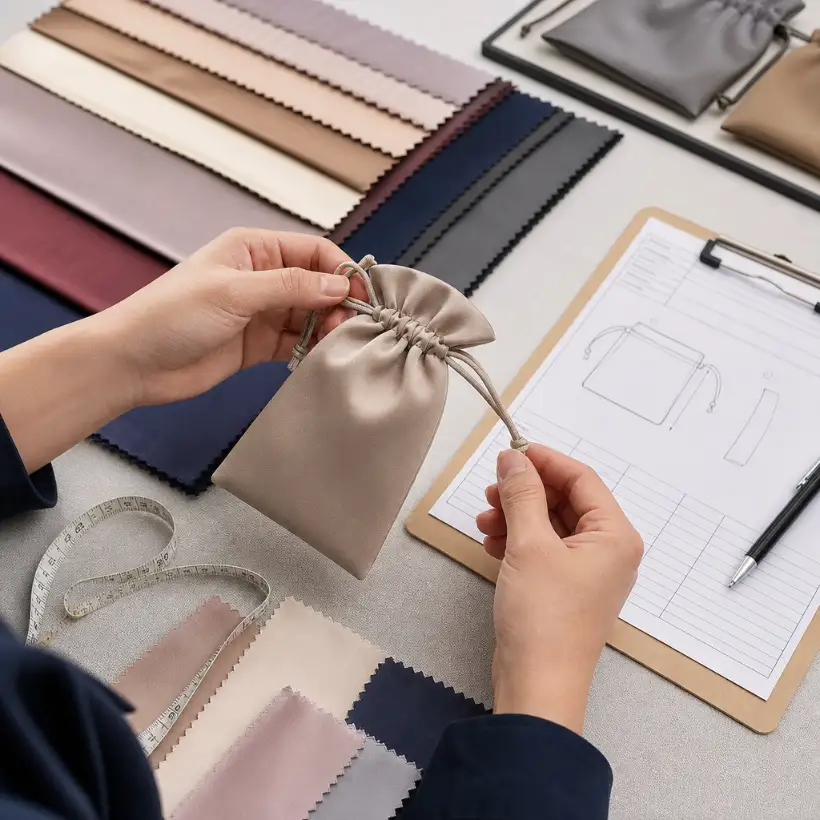
Sending a clear, specific inquiry saves time for both buyer and supplier. Before contacting YJXPACK or any custom jewelry pouch supplier, prepare answers to the following questions — or identify them as items requiring supplier guidance.
- What is the fiber content of the satin fabric? Polyester, silk, or a blend? What percentage?
- What is the fabric weight in gsm and the relevant weave specification?
- What finished size do you need, measured flat as width × height?
- What closure style is required: drawstring, flap, envelope, or another option?
- Is a lining required? If so, what fabric and color?
- What logo method do you want: foil, screen print, heat transfer, embroidery, or another method?
- What are the logo size, placement, and color requirements, including a Pantone reference if applicable?
- What is the target order quantity?
- What delivery date is required?
- Do you require specific material, recycled-content, or textile-safety documentation?
A complete brief helps the supplier prepare a quote based on the same specification you intend to order. If key details remain open, ask the supplier to identify the assumptions used in the quote so that changes can be evaluated before production.
Frequently Asked Questions
Is satin the same as silk?
No. Satin is a weave structure that can be produced from polyester, nylon, acetate, or genuine silk fiber. Many satin jewelry pouches are woven from polyester. Genuine silk is a natural protein fiber with a distinct hand feel and usually a higher cost. Ask for a written fiber-content declaration before ordering.
How do I verify whether a pouch is genuine silk or polyester satin?
A burn test can provide an initial field indication: genuine silk typically burns slowly, smells similar to burning hair, and leaves crushable ash; polyester melts and can leave a hard bead. For commercial sourcing, request a written fiber-content declaration and consider independent laboratory testing for orders where fiber content is a critical requirement. The U.S. FTC’s textile labeling guidance addresses fiber-content disclosure for products sold in the United States.
Which logo method works well on a satin jewelry pouch?
Foil stamping is commonly used on polyester satin for simple logos. Screen printing can suit flat, simple designs when ink selection and printing settings are appropriate. Embroidery is possible but requires suitable backing and stitch density to limit puckering on lightweight satin. Debossing is generally not suitable for satin or silk. Confirm compatibility with the supplier for the fabric weight in your specification.
What size satin pouch fits a necklace?
A pendant necklace may fit a pouch of approximately 10 × 14 cm, while a longer chain necklace may need 12 × 16 cm or larger. The appropriate size depends on chain length, pendant dimensions, and whether the piece should lie flat or can be loosely gathered. Measure the actual product and confirm finished pouch dimensions, rather than fabric-cut dimensions, with the supplier before production.
What should I check when approving a satin pouch sample?
Check fabric hand feel and sheen against your specification, color under the agreed lighting conditions, seam quality and finish, logo placement, closure function, and finished dimensions. Compare the sample with the written specification and document the approved version with photographs, measurements, and agreed tolerances so bulk production has a clear reference standard.
Share This Story, Choose Your Platform!