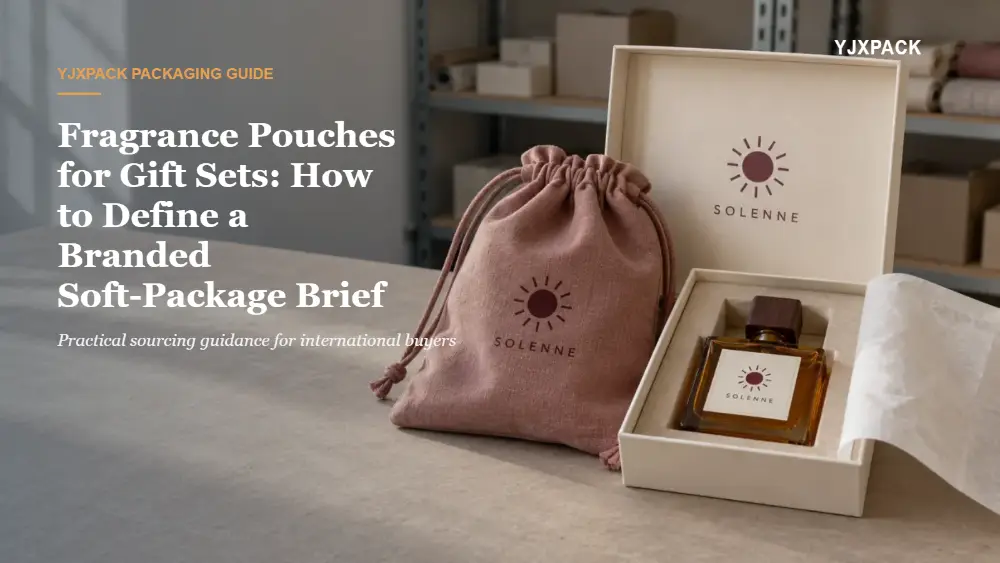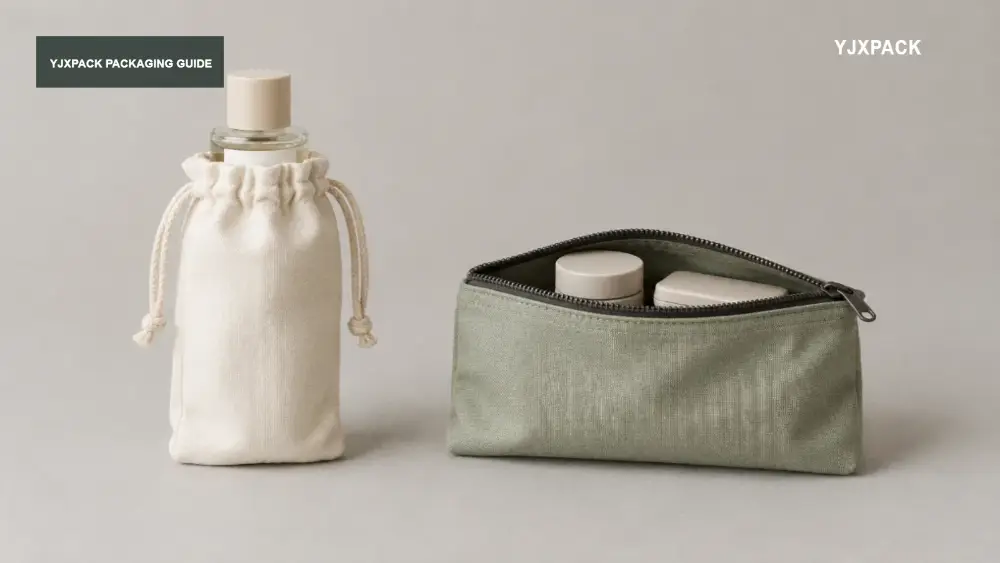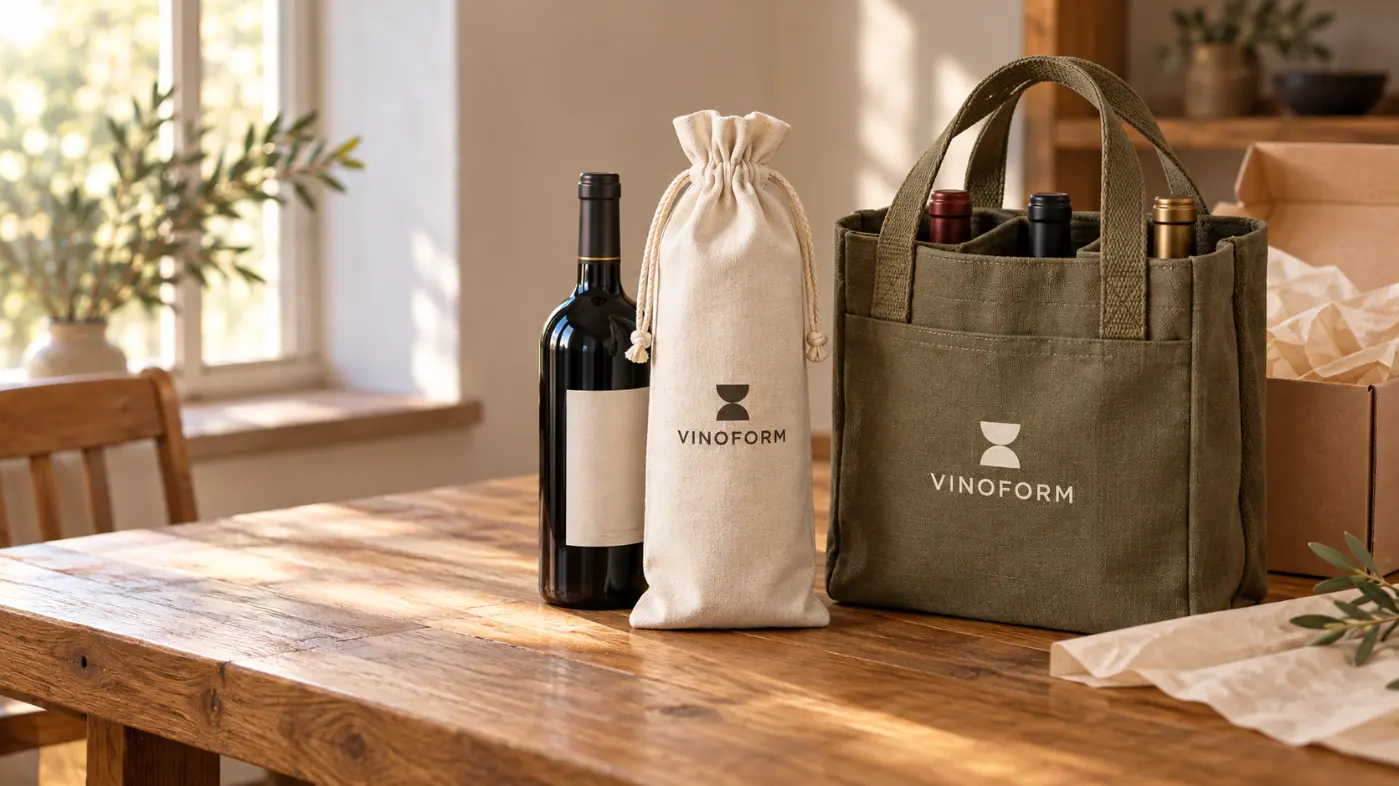
A dust bag protects a finished product—handbag, shoe, garment, accessory—during storage, transit and shelf display. For retail brands, it also carries the logo, reinforces material quality and shapes the unboxing moment. Yet the specification decisions behind a custom dust bag are more layered than many buyers expect.
Five variables interact to determine the final result: fabric weight, pouch size and fit, closure type, logo method and the level of physical protection the product actually needs. Getting any one of these wrong changes cost, appearance or protection. This guide walks through each variable so that brand owners, traders and e-commerce sellers can build a clear brief before requesting samples.
> Scope note: This guide explains selection logic that applies across dust bag projects. Fabric availability, construction options, artwork limits, MOQ, sampling, pricing and documentation are factory-dependent details that must be confirmed against your final brief during quotation.
—
Quick Summary: The Specification Decisions That Shape Custom Dust Bags
Every dust bag brief comes down to a short chain of choices. Getting them in the right order prevents rework:
- What does the product need protection from? Dust, light, scratches, moisture or a combination. This determines fabric type and weight.
- How large is the product, and how much room does the bag need? A tight fit prevents movement; too much ease looks sloppy and wastes material.
- How does the bag close? Drawstring cord, ribbon tie, flap with snap, or open top. Closure affects usability and branding space.
- Where does the logo go, and how is it applied? Print, foil, embroidery and debossing each interact differently with fabric weight and texture.
- What order volume is realistic, and what sample steps are needed? These determine which construction details are feasible at your price point.
The sections below unpack each decision in sequence.
—
Product Use, Protection Requirements and Pouch Construction
Before choosing fabric or logo method, define what the dust bag must do. A bag designed for a leather handbag sitting on a retail shelf for months has different requirements from one protecting a pair of suede shoes during e-commerce shipping.
Protection levels and what drives them
- Dust and light exposure. An opaque, tightly woven fabric can reduce dust exposure and limit light reaching the product. Confirm the protection level against the actual use conditions and product material.
- Scratch prevention. Products with polished surfaces, patent leather or hardware need a soft inner face. Brushed cotton, microfiber or a flannel-weight fabric reduces contact abrasion.
- Moisture. A dust bag is not a moisture-control system. If humidity, storage duration or carton conditions are important for the product, define the required packaging approach with the product owner and supplier.
- Compression and padding. A standard single-layer dust bag offers almost no cushioning. If the product needs impact protection during shipping, the dust bag alone is not the solution—it works inside a box or mailer, not as a replacement for structured packaging.
Single-layer versus lined construction
Many retail dust bags are single-layer pouches. Adding a lining—for example, a satin inner face on a cotton outer shell—increases fabric cost, sewing time and unit weight. Lining is worth considering when:
- The product surface is highly scratch-sensitive (polished metal, lacquered wood, patent leather).
- The brand wants a contrasting color visible when the bag is opened.
- The outer fabric is coarse (raw linen, jute blends) and would mark the product.
For basic dust protection, a single appropriately selected layer may be enough. Assess scratch sensitivity, product finish and handling on a physical sample before choosing a lower-cost construction.
—
How Should Fabric Weight and Material Be Selected for the Product?
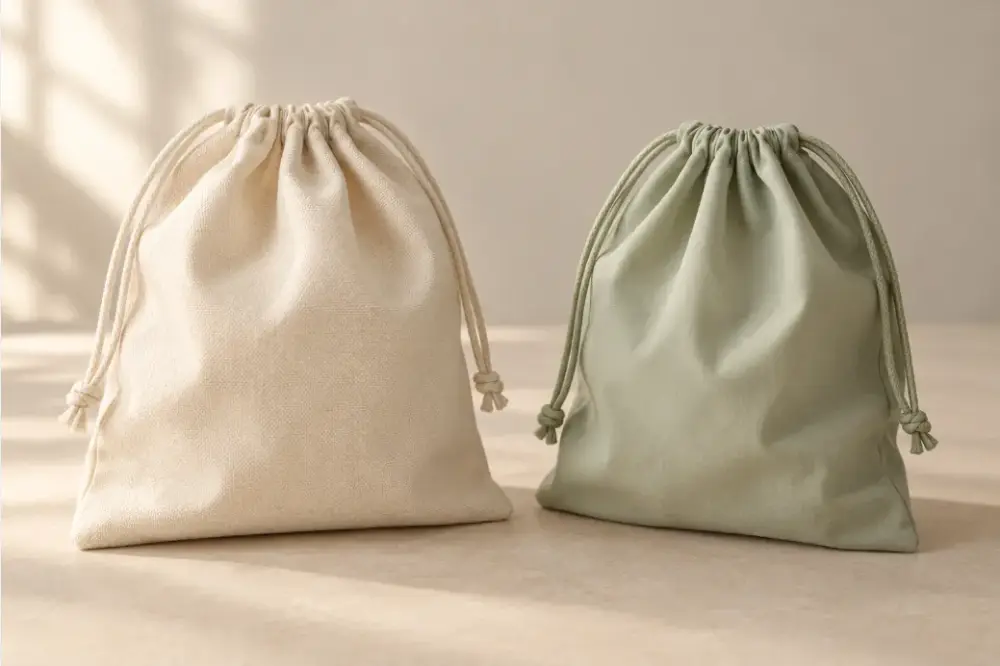
Fabric weight—measured in grams per square meter (GSM)—affects drape, opacity, print quality and perceived value. The most common dust bag materials fall into a few families.
Common material families
| Material | Weight and construction | Typical characteristics | Potential product direction |
|---|---|---|---|
| Cotton twill / canvas | Supplier-dependent | Opaque, structured, often suitable for screen printing | Handbags, shoes, larger accessories |
| Cotton muslin | Supplier-dependent | Lightweight, breathable, soft hand | Small leather goods, garments, delicate items |
| Non-woven polypropylene (PP) | Supplier-dependent | Lightweight, consistent finish | High-volume retail packaging |
| Microfiber | Supplier-dependent | Soft surface; confirm lint and abrasion requirements on sample | Sensitive surfaces and small accessories |
| Flannel / brushed cotton | Supplier-dependent | Soft nap and tactile finish | Premium soft-goods presentation |
| Polyester satin | Supplier-dependent | Smooth, glossy face, lightweight | Fashion accessories, lingerie, gift sets |
How GSM changes the specification
- Lighter fabrics: May be more packable, but opacity, logo registration and shape retention need checking on the intended sample.
- Mid-weight fabrics: Often balance handling, opacity and construction, but the appropriate range depends on the product, logo method and desired hand feel.
- Heavier fabrics: Can feel more substantial but may increase shipping weight, carton volume and construction requirements.
Choosing between natural and synthetic
Natural fibers (cotton, linen) can suit sustainability-oriented positioning, but organic or recycled claims must be verified through documentation rather than assumed from the fiber name. Synthetic options (non-woven PP, polyester) may offer consistent color and a different cost structure, subject to the final specification and quotation. Compare the actual hand feel, opacity and logo result on samples.
—
Size Planning, Ease of Use and Fit Confirmation
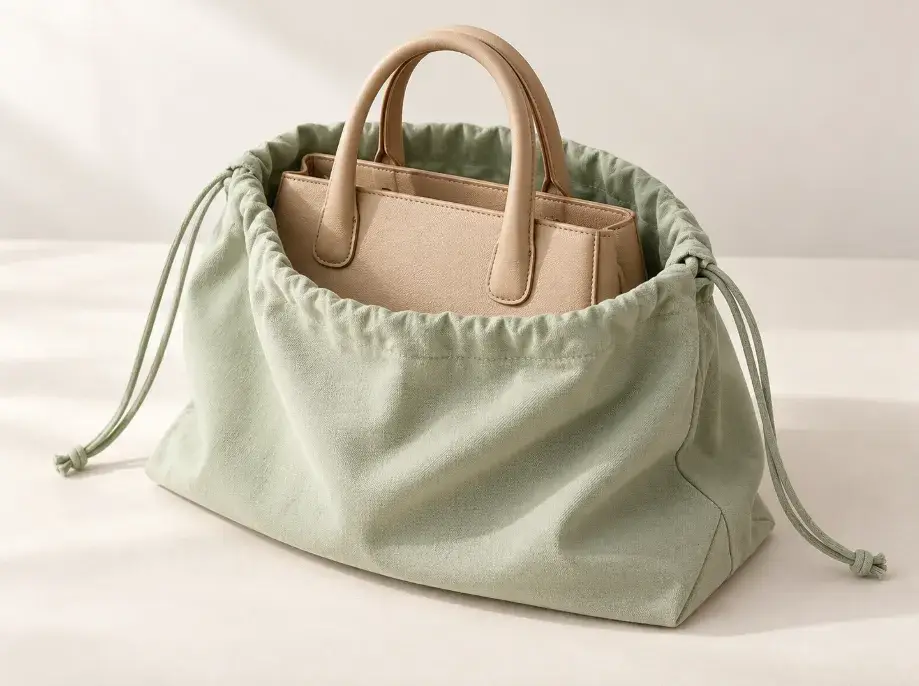
A dust bag that is too small will not cover the product. One that is too large looks careless and adds unnecessary bulk in the shipping carton. Size planning requires measuring the actual product, not estimating from product category.
Measuring the product
Take three measurements of the largest item the dust bag must contain:
- Width at the widest point
- Height (or length) at the tallest point
- Depth (front-to-back thickness)
For soft goods like handbags, measure with the bag stuffed to its normal shape. For rigid items like boxed sets or electronics, measure the box, not just the product inside.
Adding ease
“Ease” is the extra fabric beyond the product dimensions. Start with the product’s loaded width, height and depth, plus enough room for insertion and closure. Then approve the allowance on a physical sample. Stiffer construction, handles, hardware or multiple projections may need more room than a soft, simple shape.
Flat pouch versus gusseted construction
A flat pouch (two panels sewn on three sides) works for thin or compressible products. A gusseted pouch has a folded panel along the bottom and sometimes the sides, creating depth. Gussets are important when the product has significant depth—a structured handbag, a pair of boots, a boxed gift set.
Define gusset depth from the actual packed product depth and the room needed for insertion and closure. Confirm this on a physical sample: a pouch can look correct when laid flat yet still be impractical when loaded.
For guidance on measurement method, see How to Measure a Drawstring Pouch: Size Guide for Brands.
—
Closure Options and Branding Method Selection
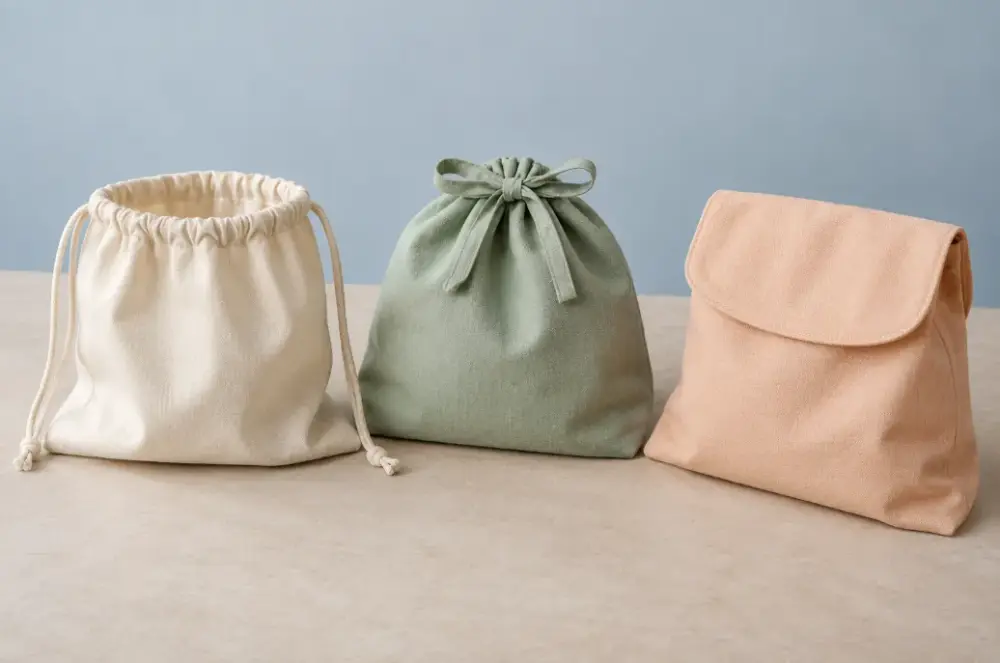
The closure determines how the dust bag seals around the product and how easily the end user can open and reclose it. It also affects where the logo can be placed and how the bag looks when displayed in-store.
Closure types
- Single drawstring: One cord threaded through a channel at the top of the bag. Simple, low-cost, suitable for most applications. The cord exits at one point or two points depending on the channel design.
- Double drawstring: Two separate cords, each exiting from opposite sides. Pulls shut more evenly and creates a symmetrical gathered top. Slightly higher material and labor cost.
- Ribbon tie: A flat ribbon replaces the round cord. Often used for premium fashion and bridal applications. Ribbon can be branded with a repeated logo print.
- Flap closure (with or without a fastener): A fabric flap folds over the opening. May include a snap, button, magnetic closure or Velcro tab. More structured, higher cost, common in garment covers and large handbag dust bags.
- Open top (no closure): The simplest option. The product sits inside without a seal. Acceptable when the bag is used only for in-store shelf storage and never travels alone.
Closure selection logic
Ask three questions:
- Will the bag be opened and reclosed repeatedly? If yes, drawstring or flap closures are more practical than ribbon ties, which require retying.
- Does the product have sharp edges or hardware that could snag a cord? If yes, consider a wide ribbon or a flap closure to avoid catching.
- Will the bag be visible to the end customer during unboxing? If yes, the closure is a branding opportunity—custom cord color, branded ribbon, embossed snap.
For details on drawstring cord types, aglet styles and custom options, see The Drawstring Cord Guide.
—
Artwork, Logo Placement and Color Approval
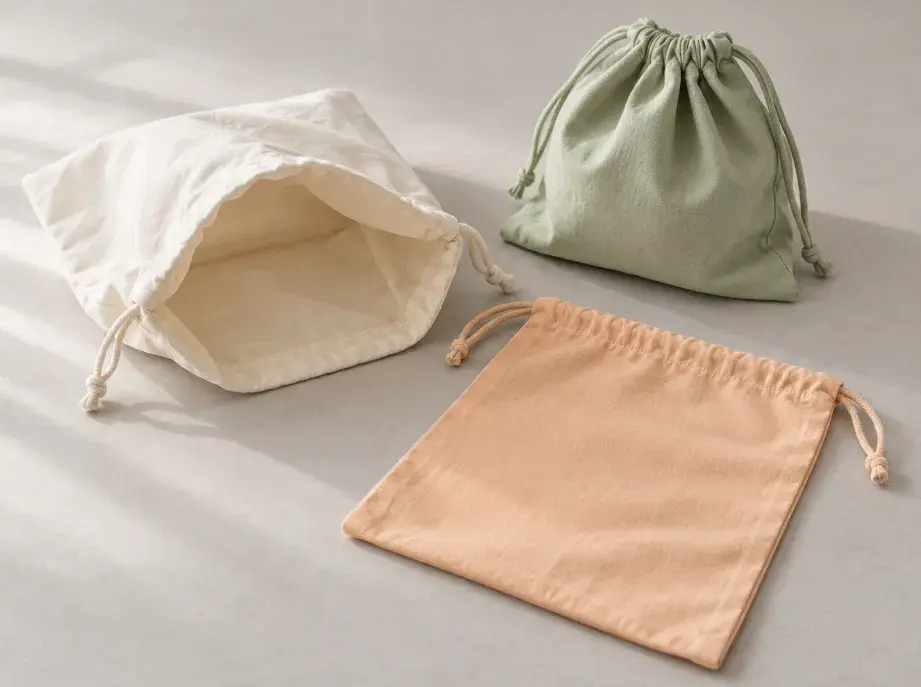
The logo on a dust bag serves brand recognition, but its execution depends on the interaction between fabric type, bag size and printing method. A method that works well on heavyweight cotton may fail on lightweight satin.
Common logo methods for dust bags
| Method | How it works | Potential fabric direction | Detail level | Typical look |
|---|---|---|---|---|
| Screen printing (silk screen) | Ink is pushed through a mesh stencil onto the fabric | Cotton, canvas, non-woven | Good for bold graphics; fine lines may bleed on textured fabric | Flat, matte or slightly raised ink surface |
| Hot stamping (foil) | A heated die presses metallic or pigmented foil onto the fabric | Velvet, satin, smooth cotton | Limited to simple logos and text; fine detail depends on die quality | Metallic or tonal sheen |
| Heat transfer | A printed film is heat-pressed onto the fabric | Polyester, non-woven, smooth cotton | Good for full-color or photographic logos | Smooth, slightly glossy patch |
| Embroidery | Thread is stitched into the fabric by machine | Medium-to-heavy cotton, canvas, twill | Limited by stitch density; not suited for very small text | Textured, raised, premium feel |
| Debossing | A heated die presses the logo into the fabric without ink or foil | Velvet, microfiber, thick cotton | Best for simple logos; depth depends on fabric thickness | Tone-on-tone, subtle, tactile |
For a detailed comparison of these methods—including how setup fees and unit costs differ—see Screen Printing vs Heat Transfer vs Embroidery.
Logo placement considerations
Where you place the logo depends on how the dust bag is seen:
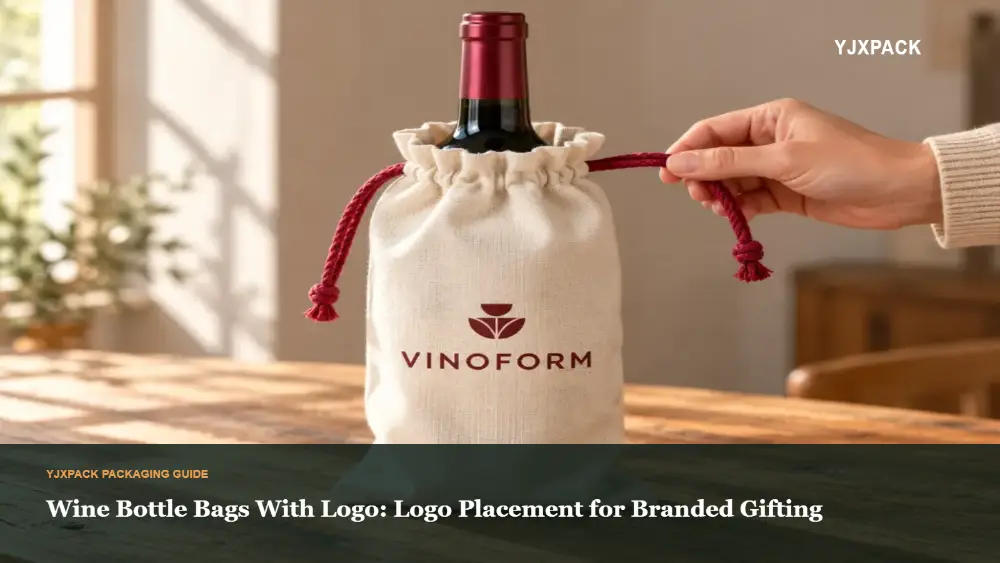
- Center front: The default for most retail dust bags. Visible when the bag is laid flat or standing upright.
- Off-center or corner placement: Used by some fashion brands as a design choice. Requires careful positioning relative to the drawstring channel to avoid distortion when the bag is cinched.
- Bottom or back: Rare for dust bags. Sometimes used when the bag doubles as a gift pouch and the brand wants a discreet mark.
- Drawstring cord or ribbon: A second branding touchpoint. Cord can be custom-dyed; ribbon can carry a repeated logo.
Color matching
Many brands use a named color standard, such as a Pantone reference, for logo and fabric color. Fabric dyeing and ink mixing each have tolerances, and the same reference may look different on cotton versus satin because texture affects light reflection.
Key steps in color approval:
- Supply an agreed color reference rather than relying only on a screen image.
- Request a fabric swatch dyed to the target color before full production.
- Request a logo strike-off (a test print or foil impression on the actual production fabric) to check logo color against fabric color.
- Evaluate swatches and strike-offs under an agreed controlled lighting condition.
For a thorough walkthrough of Pantone matching for pouches, see Pantone Color Matching for Custom Fabric Pouches.
—
How Should Quality Control Be Structured for Dust Bag Orders?
Quality control for custom dust bags is less complex than for structured bags with zippers and multiple compartments, but several failure points still need attention.
Common defects in dust bag production
- Inconsistent dimensions: Cutting variance across a production run means some bags are slightly larger or smaller. This matters most when the bag must fit inside a branded box.
- Logo misalignment: The logo drifts off-center or sits at different heights across units, especially on smaller bags where a few millimeters of shift is noticeable.
- Thread tails and loose stitching: Untrimmed threads or skipped stitches at seam ends or drawstring channels.
- Fabric color variance: Dye lots across fabric rolls may differ slightly. This is more visible on solid pastel or white fabrics.
- Cord or ribbon defects: Fraying cord ends, uneven cord length, missing or loose aglets (the finished tips on the cord).
- Stains or marks: Ink smudges, machine oil spots or handling marks from the sewing floor.
Inspection points to include in a QC checklist
When setting up inspection criteria—whether using an in-house team, a third-party inspection service, or reviewing the factory’s own QC process—cover at least these areas:
- Dimensional check: Measure units selected under the agreed sample plan against the approved specification.
- Logo position and quality: Check centering, color match against the approved strike-off, adhesion (for heat transfer and foil), stitch density (for embroidery) and legibility.
- Seam integrity: Inspect stitching and perform any agreed handling or strength check.
- Cord function: Operate the drawstring according to the agreed usability check and confirm that it moves freely without binding.
- Cleanliness: Inspect the inner face of the bag for dust, thread tails, oil spots or marks.
- Packing and labeling: Confirm that bags are folded, bundled or individually poly-bagged per the packing instruction and that carton labeling matches the purchase order.
Acceptance criteria and sampling plan
Define defect categories, the sample plan, acceptance thresholds and any escalation or reinspection steps in writing before production. Do not assume that a default AQL level or inspection standard applies to every dust bag project.
—
Sampling, Quality Control and Supplier Confirmation Checklist
Before placing a production order, agree the sampling process that is relevant to the project and record the approved reference clearly.
Sample stages
- Material swatch. A small piece of the proposed fabric, dyed to the target color. Evaluate weight, hand feel, opacity and color under controlled lighting.
- Construction sample (unprinted or with a placeholder logo). A sewn pouch in the correct dimensions and closure type. Confirms size, fit, seam construction, drawstring function and overall shape. Test the sample by inserting the actual product.
- Logo strike-off. A test of the logo method on the production fabric. May be done on a flat fabric panel or on a finished pouch. Confirms logo color, detail, adhesion and placement.
- Pre-production sample (PPS). A fully finished sample incorporating approved fabric, logo and closure details. Use it as the reference standard for the production run, and record buyer approval and factory acknowledgement.
- Production sample or top-of-production sample. If required, compare an early production unit against the approved reference before the full run is complete.
Buyer confirmation checklist
Use this checklist to organize the information needed before requesting a quotation. All specifications must be confirmed against the actual project requirements:
Product and protection:
– Product type, dimensions and weight
– Required protection level (dust, light, scratch, moisture)
– Whether the bag will be used for storage, shipping, retail display or all three
Fabric:
– Material family (cotton, non-woven, microfiber, satin, etc.)
– Target GSM or weight range
– Fabric color (Pantone reference preferred)
– Any certification or documentation requirements for the fabric
Size and construction:
– Finished pouch dimensions (width × height, plus gusset depth if applicable)
– Single-layer or lined
– Seam finish preferences (overlocked, French seam, bound edges)
Closure:
– Closure type (drawstring, ribbon, flap, open top)
– Cord or ribbon material, color and diameter/width
– Aglet type if applicable (metal, heat-sealed, knotted)
Logo and branding:
– Logo method (screen print, foil, heat transfer, embroidery, debossing)
– Logo file format (vector AI or EPS is often preferred; follow the supplier’s recommended specifications for raster artwork)
– Logo dimensions and placement on the bag
– Logo color(s) with Pantone references
– Whether the drawstring cord or ribbon also carries branding
Order and logistics:
– Target order quantity
– Packing method (bulk, individual poly bag, bundled)
– Carton labeling and shipping mark requirements
– Destination country and any import documentation needed
– Desired delivery timeline
Quality control:
– Agreed defect categories, acceptance criteria and sample plan
– Whether third-party inspection will be used
– Which sample stages are required before production approval
—
Next Step
Build your specification using the checklist above, then contact YJXPACK with your completed brief. A clear specification—covering product dimensions, fabric preference, closure type, logo artwork and target quantity—allows the factory to assess the project and proceed to sampling.
Frequently Asked Questions
Can I use the same dust bag design for different product sizes?
You can, but it creates a trade-off. A single large bag can hold multiple product sizes, but it looks oversized on smaller items and may allow the product to shift. Most brands with a range of product sizes specify two or three dust bag sizes to maintain a fitted appearance. This does increase the number of SKUs in the order.
What is the most cost-effective logo method for large-volume dust bag orders?
Screen printing can be cost-effective at higher volumes when the logo and fabric suit the process. Hot stamping and embroidery may involve different setup or run-time costs while better matching a premium brand position. Compare quotations for your specific logo, color count, fabric and order quantity.
Do dust bags need to be individually poly-bagged?
It depends on the product and supply chain. If bags are inserted into product boxes on a packing line, bulk packing in counted stacks may be suitable. If bags are sold as a standalone retail item or shipped directly to end consumers, individual poly-bagging may help limit handling marks in transit. Confirm the packing method against the actual flow.
How do I prevent color fading on cotton dust bags?
Color fastness depends on the dye process, fabric and intended use, not just the fiber. Request a fabric sample and, where relevant, ask for applicable wash-fastness or light-fastness test information. Evaluate the actual production fabric rather than relying on a generic dye-process assumption.
Should I order extra dust bags beyond the product quantity?
An overage can cover packing damage, QC rejects or replacement needs. Agree the exact quantity with the supplier based on the order, packing plan and expected tolerance rather than applying a generic percentage.
—
Share This Story, Choose Your Platform!