
The “eco-friendly” label on your packaging quote means almost nothing. The certification number behind it means everything. So when a supplier sends you a beautiful PDF claiming “GOTS organic, GRS recycled, FSC paper,” your first job isn’t to thank them — it’s to ask for the certificate number and verify it on the issuing body’s website. Plus, in 2026, that’s no longer optional.
In fact, sustainability certifications have shifted from “nice to have” to “non-negotiable” in just three years. EU regulations now mandate them. Major US retailers won’t onboard suppliers without them. Plus, sophisticated consumers increasingly know the difference between a vague green claim and an actual certificate. So the brands winning shelf space and retailer contracts in 2026 aren’t the ones with the prettiest packaging — they’re the ones whose suppliers can produce verifiable certificate numbers on demand.
This guide investigates which sustainability certifications actually matter for jewelry packaging. First, you’ll see why certification suddenly became non-negotiable. Second, you’ll get a decoded breakdown of GRS, OCS, GOTS, FSC, and OEKO-TEX — what each one actually proves and what it doesn’t. Third, you’ll learn the right certification stack for your retail channel, plus a 5-minute verification process to catch fake certificates before they cost you a contract.
1. Why Certification Suddenly Became Non-Negotiable in 2026
Three forces converged to make verifiable certifications a hard requirement — not a marketing perk.
Regulation caught up. The EU’s Packaging and Packaging Waste Regulation (PPWR), now active, sets binding targets for recycled content, reuse, and recyclability across all packaging sold in the EU. So even US brands shipping to European customers face direct compliance obligations. California’s SB 54 demands 25% single-use plastic reduction before 2032. UK Extended Producer Responsibility (EPR) makes brands financially responsible for end-of-life packaging waste. Plus, more US states are following California’s lead each year.
Retailers got serious. Major sustainable retailers — and increasingly mainstream ones — won’t onboard a packaging supplier without third-party certificates. Plus, consortiums like the Sustainability Consortium publish supplier scorecards that directly affect shelf placement and contract terms. A supplier who claims “eco” without paperwork loses to one who hands over verifiable certificate numbers in the same email.
Consumers got smart. Recent surveys show that roughly 78% of high-income shoppers under 40 say verifiable sustainability claims influence their buying decisions. Plus, social media has trained buyers to spot greenwashing. So a “natural materials” claim with no certificate behind it now reads as a red flag, not a feature.
The net effect: announcing “eco-friendly” has stopped being enough. Instead, what wins in 2026 is showing a current, third-party certificate number that anyone can independently verify in 30 seconds. Plus, this is exactly what most of your competitors haven’t figured out yet — which is your opportunity. For the materials side of this discussion, see our earlier sustainable packaging materials guide. This article focuses on the certification side — which is what actually proves the material claims are real.
In short, sustainability certifications jewelry packaging buyers need today aren’t a checkbox. They’re the entry ticket to the room where premium retail decisions get made.
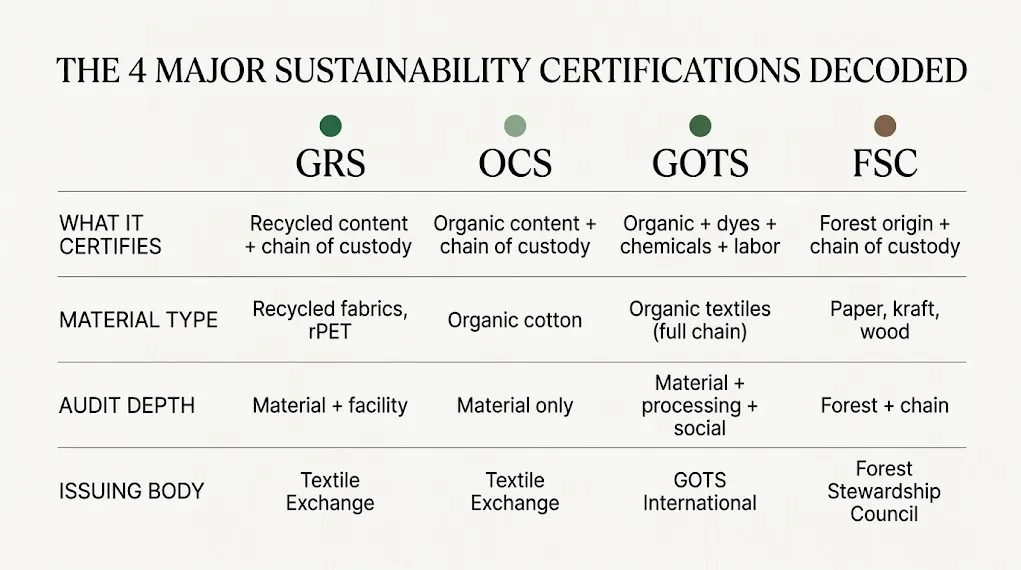
2. GRS (Global Recycled Standard) — Decoded
Who issues it. GRS is administered by Textile Exchange, a nonprofit that runs the most respected recycled and organic textile certifications in the world.
What it actually certifies. GRS verifies recycled content in a product — and tracks that recycled material through every step of the supply chain. So when a supplier holds GRS, they’ve proven (a) the recycled fiber is genuinely recycled, (b) the chain of custody from input to output is documented, and (c) they meet additional social and environmental criteria at the production facility. Plus, GRS sets a minimum 20% recycled content threshold for any product to carry the label.
Where it applies in jewelry packaging. Recycled polyester pouches (rPET velvet, rPET microfiber), recycled cotton pouches, recycled paper components. So if your “recycled velvet” supplier doesn’t hold GRS, the “recycled” claim is unverifiable — and that’s a real problem in retailer audits.
What GRS does NOT certify. Here’s the limitation most articles skip: GRS audits social and environmental practices at the production facility, but it doesn’t deeply audit dyeing chemicals or textile finishing chemistry. So GRS proves “this material is recycled and made under reasonable conditions” — not “this material is chemically safe for skin contact.” That gap matters, and we’ll cover what fills it in section 6.
The GRS vs OCS distinction. Both come from Textile Exchange. GRS is for recycled. OCS is for organic. So they’re complementary, not redundant — and a supplier may legitimately hold both.
In short, GRS is the credibility anchor for any recycled-content claim. So when you’re buying recycled pouches, GRS is the certificate number to demand first.
3. OCS (Organic Content Standard) — Decoded
Who issues it. Also Textile Exchange — the same body behind GRS.
What it certifies. OCS verifies organic content in a product and tracks the flow of organic fiber from farm through processing to finished goods. So OCS confirms the organic raw material is real and properly chain-of-custody documented. Plus, like GRS, OCS sets a minimum content threshold (typically 5% to qualify for OCS Blended, 95%+ for OCS 100).
Where it applies in jewelry packaging. Organic cotton pouches are the main category. So if a supplier claims “organic cotton drawstring bag,” OCS is the entry-level certificate to ask for.
The critical limitation most brands miss. OCS certifies the organic origin of the fiber. It does NOT certify how that fiber was dyed, finished, or treated downstream. So a pouch can hold OCS while being dyed with conventional chemicals, processed with synthetic finishes, or sewn under poor labor conditions. This is why OCS alone isn’t enough for serious sustainability positioning — it proves the fiber is organic, not that the finished product is.
The industry trap. Many factories market pouches as “organic” with only OCS, hoping buyers won’t notice the gap. So when retailer audits dig deeper, the brand finds itself unable to prove the rest of the production chain meets its sustainability story. Plus, this gap is exactly what GOTS solves — which is the next certificate to understand.
In short, OCS is necessary but rarely sufficient. So if “organic” is part of your brand narrative, treat OCS as the floor — and look to GOTS for the ceiling.
4. GOTS (Global Organic Textile Standard) — The Gold Standard
Who issues it. The GOTS International Working Group, a globally recognized standards body.
What it certifies. Everything OCS does — plus the entire downstream chain. GOTS audits the organic fiber, the dyeing process, the chemicals used, wastewater treatment, working conditions, and social compliance. So GOTS is end-to-end, from farm to finished textile, with strict criteria at every stage. Plus, GOTS requires minimum 70% certified organic content (GOTS Made with Organic) or 95%+ (GOTS Organic).
What this means in practice. If a supplier holds GOTS on an organic cotton pouch, they’ve proven the cotton is organic AND the dyes are GOTS-approved AND the wastewater meets GOTS limits AND the workers were treated according to GOTS social criteria. So GOTS is the most defensible single certificate for any “organic” or “fully sustainable” claim.
Where it applies in jewelry packaging. Premium organic cotton pouches, organic linen pouches, organic hemp packaging. So GOTS is the right certificate for brands building a premium sustainable narrative.
The tradeoff. GOTS is significantly harder and more expensive for factories to achieve and maintain than OCS. Plus, fewer factories hold it. So GOTS-certified products typically cost more — but they’re also the only single certificate that holds up to deep retailer audits and skeptical consumer scrutiny without needing additional documentation.
Who genuinely needs GOTS. Brands selling into high-end retailers, EU and UK markets with strict compliance requirements, sustainability-led DTC brands whose entire identity rests on credibility, and any brand whose product carries a premium price for being “organic.”
In short, OCS is the entry. GOTS is the destination. So if organic is core to your brand, eventually you’ll need GOTS — and the brands who got there first have a real competitive moat.
5. FSC (Forest Stewardship Council) — For Paper Packaging
Who issues it. The Forest Stewardship Council, an international nonprofit overseeing responsible forestry standards globally.
What it certifies. FSC verifies that the paper, cardboard, or wood used in a product comes from forests managed according to FSC’s environmental and social criteria — plus full chain of custody from forest to finished product. So when you see FSC on a kraft box, the cellulose fiber can be traced back to certified responsible forestry.
Where it applies in jewelry packaging. Kraft paper outer boxes, kraft paper inner cards, hangtags, recycled paper inserts, and any paper-based component of your packaging system. So if your packaging system uses both fabric pouches AND paper boxes (which most premium brands do), FSC handles the paper side that GRS/OCS/GOTS can’t.
Why it pairs with the others. A complete sustainable packaging system rarely uses just one material. So a typical premium brand might use GOTS organic cotton pouches inside an FSC-certified kraft box, with FSC-certified hangtag cards. Each certificate covers what the others can’t. Plus, retailer auditors specifically look for FSC on paper components — its absence is a visible gap in any otherwise well-certified packaging system.
The variants matter. FSC 100% (all materials from FSC-certified forests), FSC Mix (combination of certified and recycled), and FSC Recycled (recycled content only). So when you see “FSC” on a quote, ask which variant — they’re not equivalent.
In short, FSC is the only widely accepted sustainability certificate for paper-based packaging. So for any jewelry packaging system that includes paper, FSC isn’t optional — it’s the standard everyone else is meeting.
6. OEKO-TEX Standard 100 — The Safety Net
Who issues it. The OEKO-TEX Association, an independent textile testing body.
What it certifies. Unlike the others, OEKO-TEX doesn’t certify origin or recycled content. Instead, it tests finished products for harmful chemicals — more than 1,000 specific substances, including those that affect skin safety and regulated globally. So OEKO-TEX proves the finished pouch is safe for consumer contact.
Why it’s the critical complement. Here’s the gap: GRS and OCS prove material origin but don’t deeply audit chemistry. GOTS covers chemistry on organic textiles. So for any non-organic but recycled product (rPET microfiber, recycled polyester velvet), OEKO-TEX is the certificate that proves the finished material is chemically safe — filling the chemical gap GRS leaves open.
The smart stacking strategy. Pair GRS with OEKO-TEX, and you have origin credibility (recycled) plus chemistry credibility (safe). Plus, OEKO-TEX is relatively inexpensive for factories to maintain, so its presence on a quote signals a supplier who’s serious about full credibility rather than minimum compliance.
In short, OEKO-TEX is the safety net under your sustainability claims. So for any pouch where customer skin contact matters — which is essentially all of them — OEKO-TEX should be part of the certification stack.
7. The Certification Stack That Wins Retailer Audits
So which certifications should your brand actually pursue? It depends on your retail channel and product positioning. Here’s the strategic stack matrix.
| Brand Profile | Minimum Stack | Recommended Stack |
|---|---|---|
| Entry-level sustainable DTC | OCS + OEKO-TEX | OCS + OEKO-TEX + FSC (if paper used) |
| Premium organic-positioned | GOTS | GOTS + OEKO-TEX + FSC |
| Recycled-materials focused | GRS + OEKO-TEX | GRS + OEKO-TEX + FSC |
| Selling into major US retailers | GOTS or GRS + OEKO-TEX | GOTS + GRS + OEKO-TEX + FSC |
| EU / UK market (PPWR-bound) | GOTS + FSC | GOTS + GRS + OEKO-TEX + FSC |
| Top-tier luxury sustainability | GOTS + GRS + OEKO-TEX + FSC | Full stack + BSCI for social compliance |
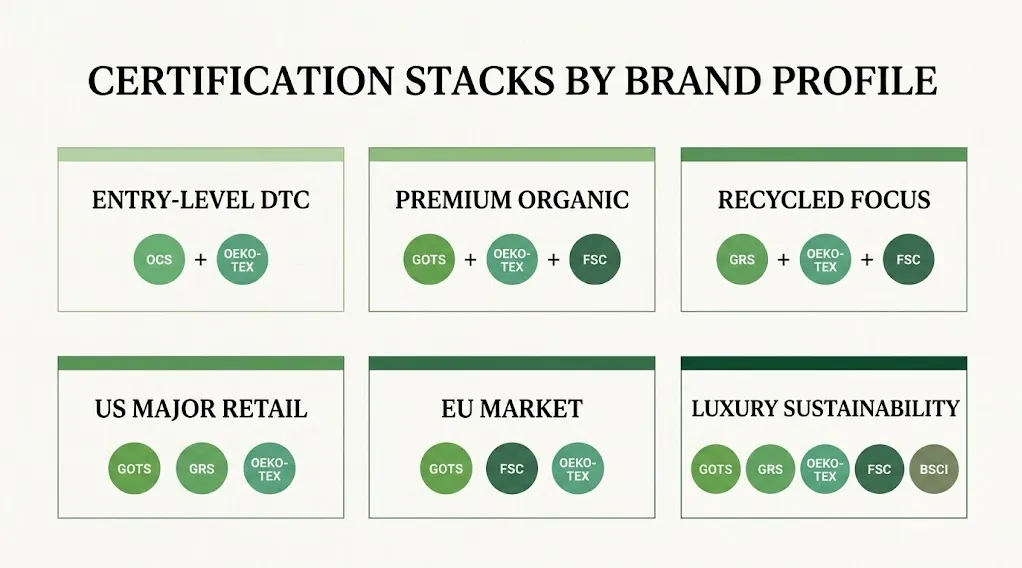
What “minimum” vs “recommended” really means. Minimum is what gets you past most retailer audits and avoids credibility gaps in your storytelling. Recommended is what positions your brand at the front of the pack and forecloses common audit questions before they’re asked.
The order to pursue them. If you’re starting from zero, the practical sequence is: OEKO-TEX first (cheapest, broad coverage), then OCS or GRS (matches your material strategy), then GOTS (if organic is core), then FSC (if paper is in the system), then BSCI (for full social compliance maturity).
For brands building a complete certified packaging system, our full range of sustainable jewelry pouches includes options across all the major certifications above.
In short, the right stack is the one that matches both your brand story and your retail channel — not the longest list you can afford. Pick deliberately.
8. How to Verify a Certification Is Real
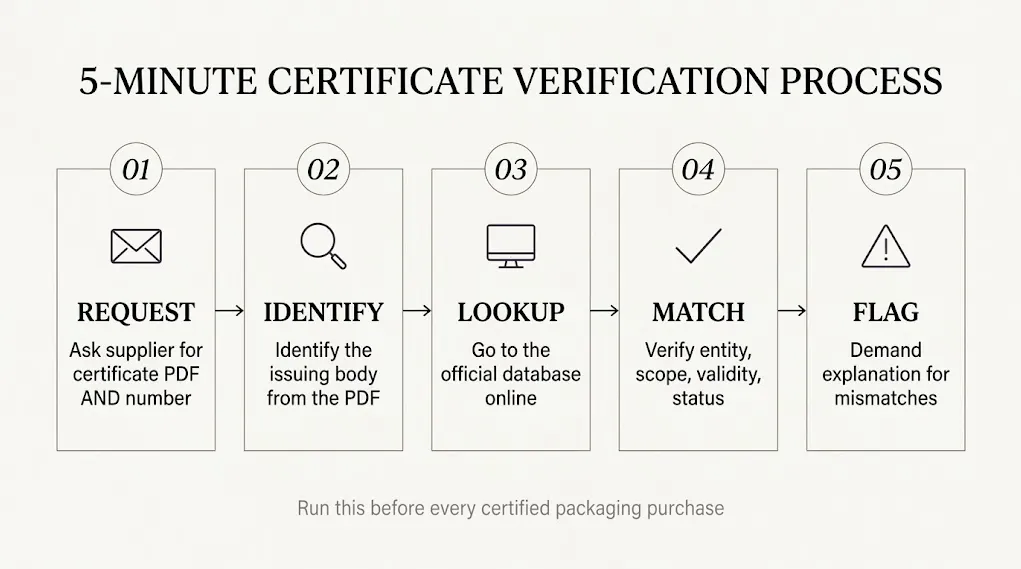
Here’s the part most brand owners never learn — and it’s the one that separates serious buyers from gullible ones. Every legitimate sustainability certificate has a number that can be independently verified online in under 5 minutes.
The 5-minute verification process.
Step 1. Ask the supplier for the certificate PDF AND the certificate number. A real supplier sends both in one reply. A supplier who sends only the PDF — or who delays on the number — is signaling something.
Step 2. Identify the issuing body from the PDF. GRS and OCS → Textile Exchange. GOTS → global-standard.org. FSC → fsc.org. OEKO-TEX → oeko-tex.com.
Step 3. Go to the issuing body’s official database. All four major certifications have public lookup tools where you can verify a certificate number, the certified entity, the scope of certification, and the expiration date.
Step 4. Match four specific things on the live record vs. the PDF you received: certified entity name (must match the factory you’re buying from), product scope (must include the specific product you’re ordering), validity dates (must be current), and certificate status (must be active, not suspended).
Step 5. If anything doesn’t match, ask the supplier for an explanation. Plus, legitimate suppliers can explain mismatches in seconds (e.g., “the certificate was renewed and the number changed — here’s the current one”). Suppliers who can’t explain mismatches in writing are showing you the answer.
The red flags. Beautiful PDF without a verifiable number. Certificate number that returns “not found” on the official database. Expired certificate that the supplier dismisses as “still valid in practice.” Scope on the certificate that doesn’t include the specific product you’re buying. Plus, any refusal to provide a number for verification is itself a complete answer.
In short, a 5-minute verification habit is the single highest-ROI protection against greenwashing in your supply chain. Develop it, and you’ll catch problems your competitors miss.
9. The 4 Greenwashing Traps to Watch For
Even with certifications in hand, watch for these common traps that survive on language tricks rather than fraud.
Trap 1 — “Made from natural materials.” Natural how much? 5% natural, 95% polyester is technically true and entirely meaningless. So always demand the percentage. Plus, a real claim looks like “made from 100% GOTS-certified organic cotton.” A weak claim looks like “made with natural fibers.”
Trap 2 — “Eco-friendly ink” or “soy-based ink.” Eco by whose standard? Soy-based ink isn’t automatically certified. So ask which body certified it. OEKO-TEX or GOTS-approved inks are real claims. “Eco-friendly ink” with no certification is marketing language.
Trap 3 — Self-created “Green” logos. Many factories invent their own green leaf logo or eco mark and put it on their packaging. So a logo that doesn’t come from a third-party certifying body is just a graphic. Real ones come from auditing organizations with public databases.
Trap 4 — “Recyclable” ≠ recycled. Theoretically recyclable doesn’t mean actually recycled. Global plastic recycling rates remain below 9% — meaning 91% of “recyclable” plastic ends up in landfills, oceans, or incinerators anyway. So a “recyclable” claim with no recycled content is far weaker than recycled-content claims backed by GRS.
In short, even legitimate language can mislead when it’s vague. So demand specifics, demand percentages, and demand certificate numbers. The legitimate suppliers will be relieved you’re asking — because it filters out the competitors who can’t deliver.
10. How YJXpack Handles Certifications
To turn certification strategy into actual production, here’s how we work at YJXpack.
We hold GOTS, GRS, OEKO-TEX Standard 100, BSCI, ISO 9001, and SABER — all third-party verified with current certificate numbers we share before you commit to anything. So when you ask for verification, you get the certificate PDF AND the certificate number in the same reply, with the issuing body’s verification URL highlighted. Plus, we don’t market certifications we don’t hold — every certificate we mention can be independently verified within minutes.
For brands building a multi-certificate stack, we help match your retail channel to the right combination. So if you’re launching into the EU market under PPWR, we’ll suggest the GOTS + FSC + OEKO-TEX stack that meets the requirements without overbuying coverage you don’t need. If you’re a recycled-materials DTC brand, GRS + OEKO-TEX is usually the right starting point.
MOQ starts at 100 pieces across all certified materials. So small brands can launch with proper certifications without the inventory burden most factories impose. To request verification of any of our certificates or start a quote with full documentation, visit YJXpack.
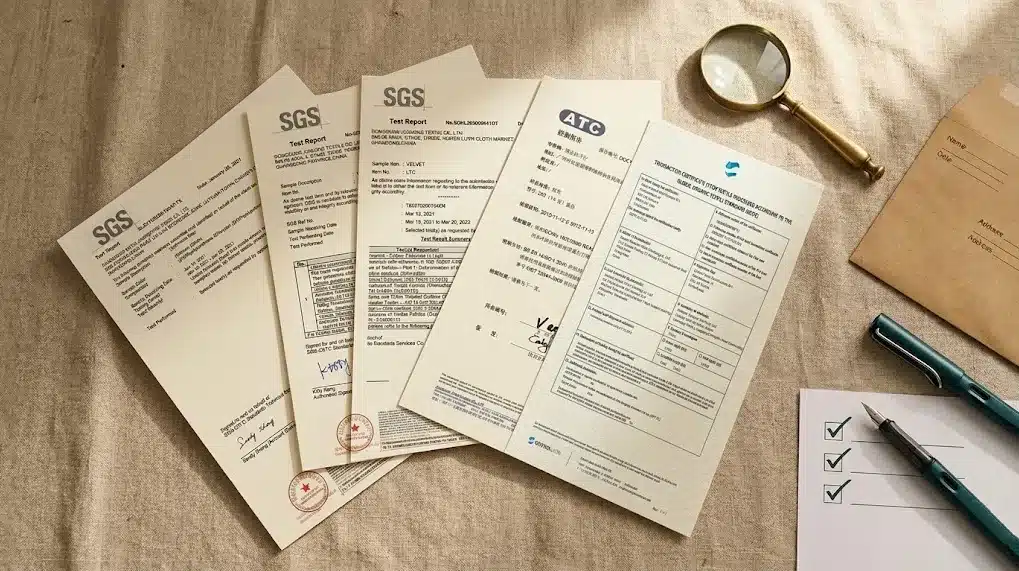
11. The Bottom Line — Certifications Are Currency
Here’s what to take away. In 2026, the word “eco-friendly” without a certification number behind it is just marketing language. With one — particularly a verified, current, scope-correct one — it’s currency. So the brands winning retailer contracts, EU compliance, and skeptical consumer trust aren’t the ones with the most beautiful packaging. They’re the ones whose suppliers can produce certificate numbers, verification URLs, and active scope coverage in one email.
So pick your stack deliberately based on your retail channel. Demand the certificate numbers. Verify them in 5 minutes before committing. And treat any supplier who can’t or won’t provide that as showing you the answer to a question you didn’t have to ask.
12. FAQs
Q1: What’s the difference between OCS and GOTS?
OCS certifies organic fiber origin and chain of custody. GOTS certifies all of that PLUS dyeing chemicals, wastewater, working conditions, and social compliance. So OCS is the entry-level organic certificate, while GOTS is the comprehensive end-to-end gold standard. Plus, OCS alone leaves chemistry and social compliance gaps that GOTS fills.
Q2: Is GRS enough for an eco claim?
For “recycled” claims, GRS is the right certificate. However, GRS doesn’t deeply audit dyeing chemistry. So pair GRS with OEKO-TEX Standard 100 to cover both recycled origin and chemical safety. For brands selling into EU or premium US retail, the GRS + OEKO-TEX combination is usually the minimum credible stack for any recycled-materials claim.
Q3: Do I need FSC if I only sell fabric pouches?
If your packaging system is purely fabric — pouches only, no paper boxes, no hangtags, no inserts — then FSC isn’t necessary. However, most premium brands include at least one paper component (kraft outer box, care card, hangtag). So if any paper touches your customer, FSC is the standard. Plus, FSC certificates are inexpensive to maintain on the supplier side, so there’s no real reason to skip it when paper is involved.
Q4: How long are certificates valid?
Most major certifications (GRS, OCS, GOTS, OEKO-TEX, FSC) have annual validity and require yearly renewal audits. So always check the expiration date on any certificate you’re shown. A “GOTS certified” supplier whose certificate expired six months ago is no longer GOTS certified — they’re using outdated paperwork. Plus, valid renewal requires passing the annual audit, so expiration dates are meaningful indicators.
Q5: Can I share my supplier’s certificates with my own customers?
Yes — and you should. Certificates establish the credibility of your packaging story. So display the certificate logos on your product pages, include the certificate scope in your About / Sustainability page, and provide certificate numbers to wholesale buyers and retail partners on request. Plus, transparency about certification builds significantly more trust than vague “eco” claims.
Q6: What does it cost to get certified packaging?
As a brand buying from a certified factory, you don’t pay for the certifications directly — the factory holds them. However, certified materials typically cost 15–30% more than uncertified equivalents because the factory invests in audits and compliant production. So certified packaging adds real cost, but it’s almost always justified by the retail and brand value it unlocks. Plus, the per-unit cost difference is usually pennies, while the brand and compliance value is significant.
Get Certificate Numbers Before You Commit — Free Certification Verification Pack
YJXpack — Yijiaxin (Shenzhen) Packaging Co., Ltd.
For 20+ years, we’ve made custom jewelry pouches for 8,000+ brands worldwide. We hold GOTS, GRS, OEKO-TEX Standard 100, BSCI, ISO 9001, and SABER — all third-party verified with current certificate numbers ready to share. So you can verify our certifications independently before any commitment, just like we recommend in this guide.
Request a free certification verification pack. We’ll send you all our current certificate PDFs, the verification URLs for the issuing bodies, and the certificate numbers — so you can confirm everything is current, valid, and in scope for your product before requesting a quote. Plus, a free 3D mockup and material recommendations matched to your target retail channel.
Email: info@yjxpack.com
WhatsApp / WeChat: +86 18617112946
Website: www.yjxpack.com
Free certification verification pack · All certificates third-party verifiable · GOTS / GRS / OEKO-TEX / BSCI / ISO 9001 / SABER · MOQ 100 pieces
Share This Story, Choose Your Platform!