
A packaging supplier may describe itself as “BSCI compliant” when you source custom fabric pouches from China. Treat that statement as a starting point, not as approval evidence. Your practical task is to confirm which legal business and production address will make the order, then compare that information with the social compliance records the supplier is permitted to share. Complete this check before you approve samples, sign a purchase contract, or pay a deposit.
Quick Summary
- Do not approve a supplier based only on a BSCI logo, badge, or brief website statement.
- Identify the legal business and the physical production site for your pouch order.
- Ask for available audit information that identifies the audited site, date, scope, and any shareable follow-up details.
- Compare the audit-site details with the quotation, contract, invoice party, and business-registration information.
- Confirm whether cutting, sewing, printing, or packing may move to another site.
- Review social compliance separately from fabric, artwork, dimensions, samples, and product quality controls.
- Do not treat amfori BSCI, Sedex, SMETA, and SA8000 as interchangeable documents.
What a BSCI Claim Does—and Does Not—Tell You

BSCI generally refers to amfori BSCI, a social compliance framework used to assess workplace topics. These topics can include working conditions, occupational health and safety, working hours, remuneration, and protections related to forced labour and child labour. An audit may assess a facility against the framework, but a supplier’s BSCI claim does not automatically show that every requirement is met at every time or at every location.
Ask the supplier what evidence supports its statement. Access to a complete audit report may depend on report ownership, confidentiality arrangements, and the buyer program involved. A supplier may instead provide a summary, selected audit details, corrective-action information, or a permitted route for buyer verification. At a minimum, it should be able to identify the audited site and explain whether that site will produce your order.
For general background, review amfori’s official information . Use official framework information to understand the terms, but make the supplier’s site details and your company’s approval rules the basis of your decision.
A social compliance review is only one part of supplier approval. It does not confirm pouch fabric composition, construction, print durability, packing method, or communication quality. This guide to auditing a custom packaging factory without visiting explains how buyers can add operational and product checks to a remote supplier review.
Start With the Actual Production Site
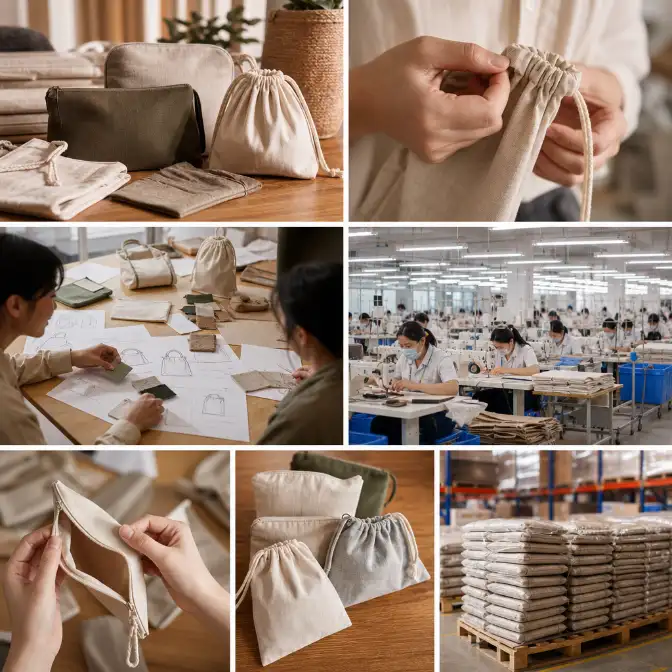
The most important question is simple: where will the goods be made? A trading company, sales office, parent company, and production factory may operate under different names or at different addresses. Audit information tied to one company or location does not automatically apply to another location.
Ask for the following details in writing before production begins:
1. The legal business named on the quotation, purchase contract, and invoice.
2. The full address where cutting, sewing, printing, and packing will take place.
3. The processes that will be completed at that address.
4. Whether the supplier may subcontract any process.
5. The factory name and address shown in the available social compliance information.
6. Whether the audited facility is the same site that will make your pouches.
Different company names do not automatically indicate a problem. A group may use separate entities for sales and manufacturing. Ask for a plain-language explanation of each entity’s role, then save the written confirmation in your supplier-approval file.
Apply this check to YJXPACK and every other prospective pouch supplier. A consistent review process makes missing addresses, vague site descriptions, and conflicting answers easier to identify.
Documents to Request Before Supplier Approval
A focused request list helps you compare suppliers on the same basis. You do not need every possible document. You need enough information to connect the social compliance claim, company identity, and proposed production plan.
| Document or Question | What to Check | Why It Helps |
|---|---|---|
| Available BSCI audit report or shareable summary | Factory name, site address, audit date, scope, and available findings | Helps establish whether the information relates to the proposed production site |
| Business-registration information | Registered business name and address | Lets you compare the contract party with the supplier’s stated identity |
| Production-site confirmation | Where cutting, sewing, printing, and packing will occur | Reduces confusion between a sales office and the actual factory |
| Subcontracting statement | Whether outside facilities may be used and for which processes | Lets you assess another production site before work moves there |
| Corrective-action information, if available | How the supplier describes actions on identified issues | Shows whether the supplier can explain its follow-up process |
| Order-specific quality records | Fabric details, dimensions, artwork approval, and packing requirements | Keeps product verification separate from social compliance review |
Avoid requesting documents that are not relevant to your stated approval process. For example, do not assume that every supplier holds an ISO certificate. If a supplier voluntarily provides any certificate, compare the legal business, site address, scope, dates, and issuing body with the actual production plan.
When YJXPACK is on your shortlist, request the same document-to-site comparison that you would request from any other factory. Equal standards help buyers make a more defensible sourcing decision.
Questions to Ask During a Supplier Call
Documents matter, but a short call or written question-and-answer exchange can reveal whether a supplier understands its own production arrangement. Keep questions specific and save the answers with the sourcing file.
| Buyer Question | A Useful Answer Should Clarify | Follow-Up if the Answer Is Unclear |
|---|---|---|
| Which site will make this pouch order? | Full address and the work completed there | Ask whether printing, sewing, and packing occur at the same location |
| Does the available BSCI information cover that exact site? | A direct connection between the audit site and the production site | Request matching names and addresses in writing |
| Will any work be subcontracted? | Which process may move off-site and why | Ask for proposed subcontractor details before approval |
| What audit information can you share? | Available details, report ownership, and confidentiality limits | Ask what verification route your buyer program accepts |
| How do you control approved materials and artwork? | Sample approval, material records, and production checks | Include agreed specifications in the purchase contract |
A supplier does not need perfect wording. It should provide answers that match its quotation, documents, and production plan. Repeated uncertainty about the site address, audit relationship, or subcontracting plan calls for further review before you place an order.
Warning Signs That Need Follow-Up
The following points do not prove misconduct. They identify areas where a buyer should investigate further.
- A badge without site details. A logo or marketing statement does not identify the audited factory.
- Audit information for another address. Ask whether that location will make any part of your order. If it will not, request information for the actual production site.
- Missing key details. Confidentiality may limit access to a full report, but the supplier should still explain the factory identity and its connection to your order.
- Unclear subcontracting. A supplier that cannot identify where sewing, printing, or packing will occur cannot provide a dependable production-site answer.
- An older audit record without context. Do not rely on a generic validity period. Ask what the audit date means under the relevant buyer program and whether later information exists.
- Claims that change across documents. Compare the website, quotation, registration information, audit details, and contract. Resolve material inconsistencies in writing.
For fabric pouch orders, consider adding site identity and subcontracting approval to your purchase terms. If production moves to another location, require written notice before the move takes place.
BSCI, Sedex, SMETA, and SA8000 Are Not the Same
Buyers often see several social compliance terms in supplier profiles. Compare the actual document, site, scope, and date instead of simply counting acronyms.
| Term | What It Generally Refers To | What Buyers Should Review |
|---|---|---|
| amfori BSCI | A social compliance framework for workplace monitoring and improvement | Audited site, audit date, disclosed results, and available follow-up information |
| Sedex | A platform used for supply-chain data and audit-related information sharing | Supplier profile details and the specific audit document, if shared |
| SMETA | An ethical trade audit methodology commonly associated with Sedex | Audit scope, site identity, findings, and corrective-action information |
| SA8000 | A social accountability standard with a certification model | Certificate holder, certified site, scope, dates, and issuing certification body |
A Sedex profile is not automatically a SMETA audit. A BSCI audit is not automatically an SA8000 certificate. If your retailer, brand, or internal compliance team specifies a required program, audit format, or report-sharing route, follow that requirement first.
If no framework has been specified, define the evidence you need before requesting quotations. For example, your process may require an identified production address, social compliance information acceptable to your company, no unapproved subcontracting, and an approved pre-production sample. This approach focuses on sourcing controls rather than labels alone.
Pair Compliance Checks With Product Verification
A social audit does not verify whether a drawstring pouch has the correct fabric weight, seam quality, print placement, drawcord, or finished dimensions. Run product checks alongside the compliance review.
Start with a written specification that covers pouch size, fabric type, color reference, logo method, artwork version, drawcord, label, packing, and inspection expectations. Then use a sample or pre-production approval step that fits your project. This custom packaging samples guide can help buyers organize sample questions before larger production approval.
State in the purchase contract that the supplier must notify you before moving production to another location or using a subcontractor. Save approved artwork, sample photos, specification sheets, and key site confirmations in the order file. These records make later discussions clearer if the delivered goods or production location differ from the agreed plan.
This process gives buyers a consistent way to evaluate YJXPACK alongside other custom fabric pouch factories. It also keeps social compliance evidence, product approval, and contract controls in separate but connected workstreams.
A Practical Verification Sequence
Use this sequence when comparing a short list of custom fabric pouch suppliers:
1. Request the legal business name and exact production address.
2. Ask for available BSCI audit information for that same site.
3. Compare the audit details with the quotation, business-registration information, and contract party.
4. Confirm whether sewing, printing, or packing may be subcontracted.
5. Review product specifications and sample approval separately from social compliance information.
6. Put the approved site, subcontracting notice requirement, and product specification into purchase documents.
7. Recheck the production arrangement if the supplier changes the quoted factory, address, or process.
This sequence does not replace a buyer’s own compliance process, legal review, or retailer-required audit procedure. It gives purchasing teams a practical record of what they asked, what the supplier confirmed, and which site they approved for the order.
Frequently Asked Questions
Does a BSCI logo on a supplier website prove compliance?
No. A logo does not identify the audited legal business, production address, audit date, scope, or findings. Ask for available audit information and confirm that it applies to the site making your order.
Is BSCI a certificate that proves good working conditions?
No. Do not treat a BSCI claim as a blanket statement about all workplace conditions. Review the specific audit information available for the factory, ask about follow-up actions when relevant, and keep social compliance review separate from product quality checks.
Can a trading company’s audit information cover the factory making my pouches?
Not automatically. Confirm the exact factory that will cut, sew, print, and pack the goods. If the audit information names a different business or address, request a written explanation and information for the actual production site.
What should I do if the supplier cannot share a full audit report?
Ask what information it can share, who owns the report, which site was audited, and what alternative verification route your buyer program accepts. Then decide whether the available evidence meets your company’s supplier-approval rules.
What should I verify besides a BSCI claim for custom fabric pouches?
Verify the production address, subcontracting plan, material specification, pouch dimensions, logo method, approved artwork, sample process, packing requirements, and contract terms. Social compliance information is one part of a complete sourcing review.
Share This Story, Choose Your Platform!