You found a great supplier on Alibaba. The prices look good. The photos look real. But you’ve never been to China. So how do you know it’s a real factory? Maybe it’s just a trading company with a nice website.
This question matters more than ever. In 2025, US Customs rejected over $2.8 billion in goods tied to supplier identity issues. Many buyers paid for “factory direct” pricing. They got trading company markups instead. Worse, some never got their goods at all. So learning how to vet packaging supplier claims early avoids all three outcomes.
Here’s the good news. You don’t need to fly to China. A China factory audit can be done remotely — for free or for a few hundred dollars. This guide shows you exactly how.
In plain English, you’ll learn three things. First, the three types of factory audits and when to use each. Second, the 8 things every audit must verify, plus a 15-question video call template. Third, 8 red flags that reveal a trading company posing as a factory.
By the end, you’ll know how to vet a packaging supplier with confidence. No plane ticket needed.
1. China Factory Audit — The 1-Minute Quick Answer
Let’s skip ahead. Here’s the bottom line.
A China factory audit comes in three levels. Document audits are free and basic. Virtual audits cost $0-200 and show you real production. Third-party on-site audits cost $400-800 and give full verification. As a result, most buyers should start with a virtual audit before any large order.
Here’s the fast-look table.
| Audit Type | Cost | Time Needed | What It Verifies |
|---|---|---|---|
| Document Audit | Free | 1-2 days | Business license, export rights, certificates |
| Virtual/Video Audit | $0-200 | 1-3 days | Production floor, equipment, working conditions |
| Third-Party On-Site Audit | $400-800 | 5-10 days | Full verification with photo/video report |
That’s the fast version. Now let’s break it down properly. A remote factory audit can cover most of these levels — you rarely need to fly anywhere.
2. China Factory Audit Risk — Why It Matters Now
The risk is real. So let’s look at the numbers.
In 2025, US Customs rejected $2.8 billion in shipments. The cause: false origin claims and fake suppliers. Plus many of these cases involved buyers who never verified their supplier was a real factory.
Here’s what often happens without an audit. A buyer finds a supplier online. The photos look real. The prices look competitive. So the buyer places an order and pays a deposit.
Then problems start. Quality doesn’t match samples. Lead times stretch from 30 days to 90. Communication gets vague. The buyer realizes too late. They were dealing with a trading company, not a factory. This is exactly why China supplier verification matters before money changes hands.
Trading companies aren’t always bad. Many are honest middlemen. However, when a trading company claims to be “the factory,” pricing and accountability both suffer. So a China factory audit isn’t about distrust. It’s about knowing exactly who you’re working with — and what they can actually deliver.
3. 3 Types of Factory Audits — Document, Virtual, On-Site
Each audit type serves a different purpose. So pick based on your order size and risk tolerance.
| Audit Type | Best For | Limitations |
|---|---|---|
| Document Audit | First contact, low-value test orders | Documents can be forged or borrowed |
| Virtual/Video Audit | Orders $1,000-$10,000, repeat suppliers | Supplier controls what camera shows |
| Third-Party On-Site Audit | Orders $10,000+, new long-term partners | Costs money and takes longer |
Three practical notes.
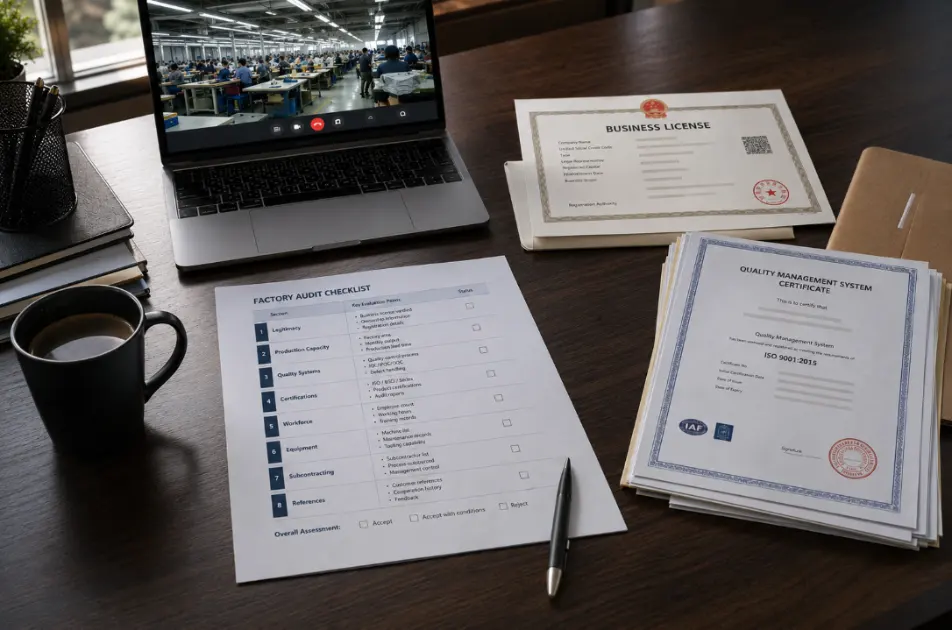
First, document audits check business licenses, export licenses, and certificates. Plus you can verify these against Chinese government databases. However, documents alone don’t prove production capability.
Second, virtual audits are the sweet spot for most B2B buyers. A live video call shows real-time production. You see actual workers, actual machines, actual product. By contrast, photos can be old or borrowed from another factory.
Third, on-site audits give the deepest verification. A trained auditor visits in person. They check everything — equipment, workforce size, quality systems, and subcontracting. So for large or long-term orders, this cost is worth it.
For most first orders, a virtual audit plus a paid sample covers most of your risk. This applies especially under MOQ packaging thresholds.
4. The 8 Things Every Audit Must Verify
Whatever audit type you choose, check these 8 things. Each one reveals something different about your supplier.
4.1 Legitimacy — Business License and Export Rights
Ask for the supplier’s business license number. Then verify it on China’s National Enterprise Credit Information System (publicly searchable). Check that the registered business scope includes manufacturing — not just trading.
4.2 Production Capacity — Does It Match Their Claims?
If a supplier claims 50,000 pieces per day, ask how many sewing machines and workers they have. Specifically, a realistic ratio is 100-150 pieces per worker per day for simple pouches. So do the math — claims should add up.
4.3 Quality Systems — Is There a Real QC Process?
Ask to see their QC checkpoints. A real factory has incoming material inspection, in-process checks, and final inspection before packing. By contrast, trading companies often skip this — they just relay your specs to whoever makes the goods.
4.4 Certifications — Are They Verifiable?
Certificates like ISO 9001, BSCI, or GOTS should have certificate numbers. You can verify these directly with the issuing body. Plus ask for the certificate’s expiry date — expired certificates are a red flag.
4.5 Workforce and Conditions
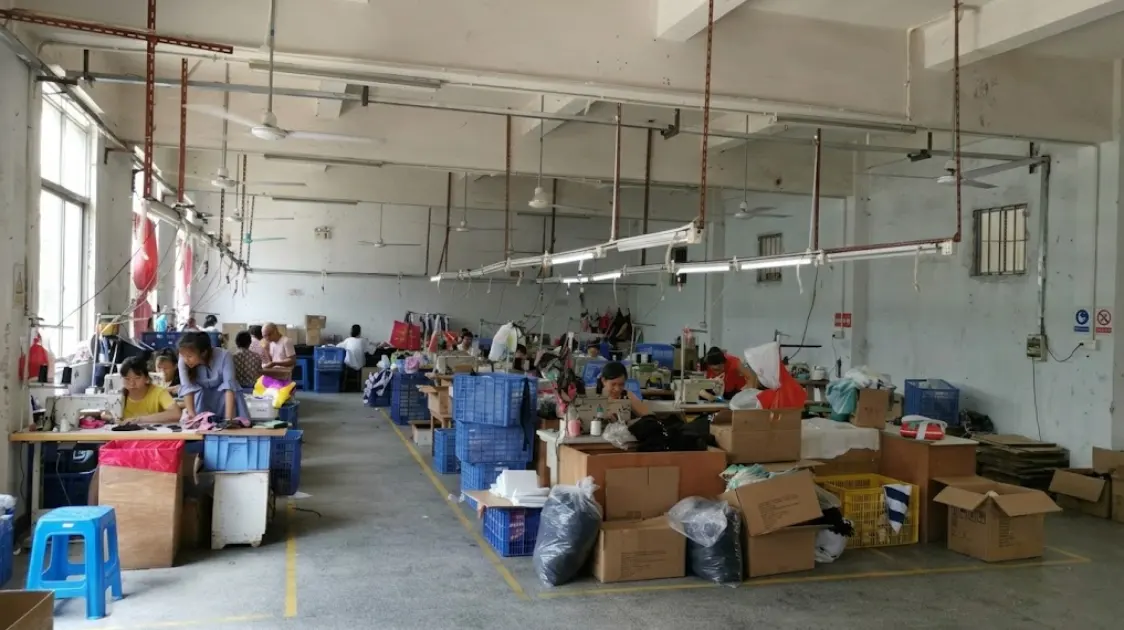
During a video call, ask to see the actual workshop floor. Count workstations. Notice whether workers seem rushed, whether the space is organized, and whether safety equipment is visible.
4.6 Equipment and Technology
Ask what brands of sewing machines they use (Juki, Brother, and similar brands are common). Plus ask about specialty equipment for your product — like heat presses for logo printing or embroidery machines.
4.7 Subcontracting Transparency
Ask directly: “Will any part of my order be subcontracted?” Honest factories often say yes for specific processes (like embroidery or dyeing) — that’s normal. However, a supplier who denies all subcontracting but can’t show in-house equipment for every step is hiding something.
4.8 Past Performance and References
Ask for 2-3 references from buyers in your industry. Plus check if the supplier appears in trade show directories (Canton Fair exhibitor lists are public). A factory with a real track record will have both.
5. Step-by-Step: How to Run a Video Factory Audit
Here’s the actual process. Follow these steps in order.
Step 1: Schedule a live video call — not a pre-recorded video. Specifically, request WeChat video, Zoom, or WhatsApp video at a time convenient for your timezone.
Step 2: Ask them to walk you through the production floor live. As a result, you see real-time conditions — not edited footage.
Step 3: Request close-ups of machines actively running. Plus ask to see your specific product type being made, if possible.
Step 4: Ask to see the raw materials warehouse. This confirms they stock fabric — not just finished goods bought from elsewhere.
Step 5: Request a view of the QC station and any inspection records. Naturally, a messy but real QC area beats a suspiciously perfect empty one.
Step 6: Ask follow-up questions in real time. Specifically, watch how quickly and confidently staff answer. Hesitation on basic questions is informative.
Step 7: Take screenshots or recordings (with permission) for your records. So you have a reference if claims later don’t match reality.
6. The 15-Question Video Call Template
Use these questions during your video audit. They’re designed to reveal real operational details.
About the Factory
1. How many years has this factory been operating at this location?
2. How many total employees work here, and how many in production?
3. What other products does this factory make besides what I’m ordering?
4. Can you show me your business license on screen?
5. What’s your monthly production capacity for a product like mine?
About the Process
6. Walk me through your process from raw material to finished product.
7. Which steps, if any, are subcontracted to other factories?
8. What brands of equipment do you use for cutting, sewing, and printing?
9. How do you handle quality control at each stage?
10. What happens if a batch fails QC — do you have rework capacity?
About Compliance
11. What certifications do you currently hold, and can you share certificate numbers?
12. Do you have fire safety equipment and emergency exits visible from here?
13. What’s your standard payment terms and bank account name (should match company name)?
About History
14. Can you share contact info for 2 existing clients in my industry?
15. Have you exhibited at any trade shows — which ones, and when?
So if a supplier answers all 15 confidently and consistently, that’s a strong signal. By contrast, vague or rehearsed-sounding answers deserve follow-up.
7. 8 Red Flags — Spotting a Trading Company Disguised as a Factory
These are real warning signs from years of B2B sourcing. Watch for them.
Documentation Red Flags
Red Flag 1: Business license shows “trading” not “manufacturing.” If the registered scope says import/export trading only, production claims don’t match the paperwork.
Red Flag 2: Bank account name doesn’t match company name. Payments going to a personal account or a different company name than your contract is a serious warning sign.
Red Flag 3: Certificates can’t be verified independently. If a certificate number doesn’t match any record with the issuing body, it may be fake or borrowed.
Operational Red Flags
Red Flag 4: They refuse live video calls. Honest factories show their floor. Reluctance — especially with excuses every time — suggests there’s nothing to show.
Red Flag 5: Production photos look identical to stock photos online. A quick reverse image search often reveals “factory photos” used by dozens of different suppliers.
Red Flag 6: Quoted capacity doesn’t match visible equipment. If they claim 50,000 pieces daily but the video shows 10 sewing machines, the math doesn’t work.
Communication Red Flags
Red Flag 7: Different people answer technical vs. commercial questions — but neither knows the other’s answers. In a real factory, sales and production teams usually align on basic facts.
Red Flag 8: They can’t answer specific process questions. If asked “how do you attach drawstrings,” a real factory describes their actual method. A trading company often gives vague, generic answers.
If you spot 2-3 of these, proceed carefully. If you spot 4+, treat this as a strong signal. Look elsewhere — or at least price them as a trading company, not a factory.
8. Certifications That Actually Matter
Not all certifications carry equal weight. Here’s what each one actually proves.
| Certification | What It Verifies | Who Issues It |
|---|---|---|
| ISO 9001 | Quality management system exists | Accredited certification bodies |
| BSCI | Social compliance audit completed | amfori (Business Social Compliance Initiative) |
| SA8000 | Labor standards verified on-site | Social Accountability International |
| SMETA/Sedex | Ethical trade audit on file | Sedex member exchange |
| GOTS/GRS | Organic or recycled material chain verified | Global Standard / Textile Exchange |
Three things to know.
First, ISO 9001 is common but easy to obtain. Specifically, it proves a quality system exists on paper. However, it doesn’t guarantee strong execution — pair it with other evidence.
Second, BSCI and SMETA via Sedex are social audits. They verify working conditions, hours, and safety — not product quality. As a result, brands focused on ethical sourcing should prioritize these.
Third, material certifications (GOTS, GRS) require chain-of-custody documentation. So ask for the certificate’s scope — it should list your specific fabric type, not just “the company.”
For more on which certifications matter for fabric packaging specifically, see our GRS, OCS, GOTS, FSC certifications guide.
9. China Factory Audit Services & Cost Comparison
If you want professional verification, several services specialize in this. Here’s how they compare.
| Service | Typical Cost | Turnaround | Best For |
|---|---|---|---|
| Pro QC | $300-500 | 5-7 days | Small-medium orders, quick reports |
| AsiaInspection | $350-600 | 5-10 days | Mid-size brands, recurring audits |
| Bureau Veritas | $500-800 | 7-14 days | Large enterprise compliance needs |
| SGS | $500-800 | 7-14 days | Global brands, strict compliance |
Two notes here.
First, prices vary by audit scope and location. Specifically, a basic factory capability audit costs less than a full social compliance audit. So get a quote for the exact scope you need.
Second, third-party audits are worth it for orders above $10,000 or for ongoing partnerships. By contrast, for first orders under $2,000, a virtual audit plus sample evaluation usually suffices. See our custom packaging samples guide for how sampling fits into this process.
10. Post-Audit — What to Do With Your Findings
You’ve completed your audit. Now what? Here’s how to act on the results.
If everything checks out, proceed with a sample order before committing to bulk. Plus document what you verified — this becomes your reference if issues arise later.
If you found minor concerns (like some subcontracting), ask the supplier directly. Specifically, request which processes are subcontracted and to whom. Honest answers here often resolve the concern.
If you found major red flags, don’t proceed without further verification. Naturally, you can request a third-party audit before committing, or simply look at alternative suppliers.
One more tip. Keep your audit notes and screenshots. If a dispute arises later, having documented what you verified — and when — strengthens your position.
11. YJXpack’s Transparency — What You Can Verify on Us
We believe in the audit-friendly approach. So here’s what you can verify about YJXpack directly.
Our business license and export registration are available on request, and our scope explicitly includes manufacturing. Plus we welcome live video factory tours — no advance notice required for basic floor walkthroughs.
We hold ISO 9001, BSCI, GOTS, GRS, OEKO-TEX, and SABER certifications. Each comes with verifiable certificate numbers you can check with the issuing bodies directly.
Our production floor runs over 100 sewing stations across multiple workshops. As a result, our capacity claims are backed by equipment you can count on a video call.
We’ve worked with 8,000+ brands across the US, Europe, and the Middle East. Plus we can connect you with reference clients in similar industries upon request.
Our core sewing is in-house for cotton tote bags and jewelry pouches. So there’s no surprise subcontracting on those steps. Only specialty processes, like custom embroidery, are sometimes subcontracted. We’ll always tell you which.
12. Conclusion — China Factory Audit Decision Test
Skip the long analysis. Use this 60-second test instead.
Ask yourself four quick questions:
1. Is this your first order with this supplier? → Do a document audit plus video call minimum.
2. Is your order value over $10,000? → Add a third-party on-site audit.
3. Did the supplier refuse a live video call? → Treat this as a major red flag.
4. Do their certifications have verifiable certificate numbers? → If not, request alternatives or independent verification.
Answer these four before placing any order. Then your China factory audit becomes a 30-minute confidence check. It stops being a leap of faith.
That’s it. Sixty seconds. Real answer.
13. FAQs
Q1: How much does a China factory audit cost?
Document audits are free. Virtual video audits typically cost $0-200, often free if the supplier wants your business. Third-party on-site audits run $300-800 depending on scope and provider. So most first-time buyers can start with a free or low-cost virtual audit.
Q2: Can I trust a supplier who refuses a video call?
This is a significant red flag. Specifically, honest factories show their production floor readily. Repeated excuses or refusals suggest there may be nothing real to show. So treat this as a serious signal to investigate further or look elsewhere.
Q3: What’s the difference between a factory and a trading company?
A factory owns production equipment and employs workers who make your product. A trading company sources from factories and resells to you — often without telling you. Plus trading companies add a markup. Neither is inherently bad, but you should know which you’re dealing with.
Q4: Are Alibaba verified suppliers automatically trustworthy?
Verification badges help, but they’re not complete guarantees. Specifically, Alibaba’s verification confirms business registration — not production capability or current operations. So combine platform verification with your own video audit for real confidence.
Q5: How long does a virtual factory audit take?
A live video call typically takes 30-60 minutes. Plus you can schedule it within 1-3 days of requesting it from a responsive supplier. By contrast, third-party on-site audits take 5-14 days including scheduling and report writing.
Q6: What if my supplier is honest but uses subcontractors?
This is common and not necessarily bad. Specifically, many factories specialize in core processes and subcontract specialty work like embroidery or specific dyeing. The key is transparency — ask directly, and a good supplier will tell you exactly what’s subcontracted.
Q7: Should I still audit a supplier I’ve worked with for years?
Periodic re-audits are good practice, especially for major orders or after long gaps between orders. Factories change — ownership, capacity, and quality systems can shift over time. So an annual check-in audit, even informal, helps catch changes early.
Get a Quote — Schedule Your Virtual Factory Tour
YJXpack — Yijiaxin (Shenzhen) Packaging Co., Ltd.
For 20+ years, we’ve operated as a real manufacturing facility — not a trading company. We hold ISO 9001, BSCI, GOTS, GRS, OEKO-TEX, and SABER certifications, all with verifiable certificate numbers. We welcome live video factory tours, no advance notice required, and serve over 8,000 brands worldwide.
Want to see for yourself? Send us a message. We’ll schedule a live video walkthrough of our production floor. No script, no pre-recorded footage — just a real look at how your order would be made.
Email: info@yjxpack.com
WhatsApp / WeChat: +86 18617112946
Website: www.yjxpack.com
Live video factory tours · Verifiable certifications · 100+ sewing stations · 8,000+ brands served · GOTS / GRS / OEKO-TEX / BSCI / ISO 9001 certified
Share This Story, Choose Your Platform!