 Understanding jewelry packaging importance is one of the highest-leverage decisions a brand owner can make — yet most treat it as a cost to minimize rather than a tool to maximize. A pouch that costs $0.50 more per unit looks like an expense on a spreadsheet. In practice, it can be the difference between a customer who posts an unboxing video and one who drops the piece in a drawer and forgets where it came from.
This article makes the business case with data. In plain English, with real numbers from published research, you’ll learn why packaging is marketing — and why brands that invest in it consistently outperform those that don’t. By the end, you’ll have five data-backed reasons to rethink why packaging matters for your next collection.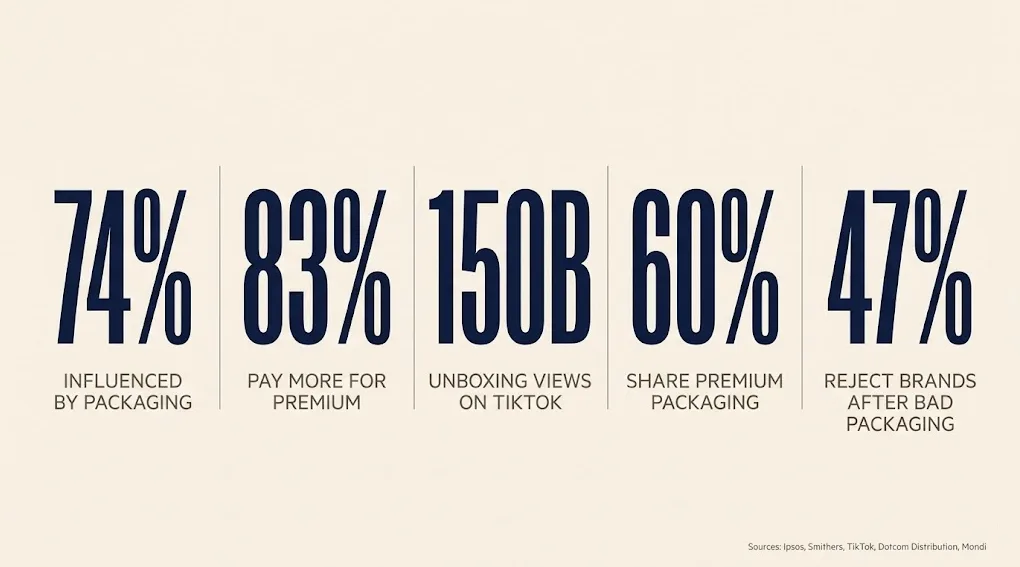
1. The Packaging ROI Problem Most Brands Get Wrong
Ask a jewelry brand owner how they evaluate packaging, and most will tell you the same thing: they look at unit cost, compare two or three quotes, and pick the cheapest option that still “looks okay.” That approach treats packaging as a pure expense — a line item to compress.
The accounting trap
The problem with that framing is that it only counts costs going out. It ignores the revenue side: the repeat purchase that happens because the customer felt valued, the social post that brings in three new customers, the word-of-mouth recommendation triggered by a memorable unboxing moment. None of those benefits appear on a packaging invoice.
When you account for both sides, the math changes. A $0.50 upgrade on a $60 ring adds 0.8% to your cost of goods. However, if that upgrade increases the probability of a social media share, a repeat purchase, or a five-star review by even a few percentage points, the return on that $0.50 dwarfs the cost.
What the data actually shows
The packaging industry isn’t short on research. What follows are five evidence-backed reasons why jewelry packaging importance goes far beyond aesthetics — and why the ROI math almost always favors investment over cost-cutting.
2. Packaging Influences Purchase Decisions Before the Product Is Seen
The customer experience doesn’t start when the jewelry touches someone’s skin. It starts the moment the package arrives. And the data on what happens in those first seconds is striking.
The 74% rule
A 2024 survey by Ipsos found that 74% of U.S. consumers say packaging design directly influences their purchasing decisions. That figure covers all product categories — but in jewelry, where the purchase is inherently emotional and the price point is often significant, the influence is even more pronounced.
Why first impressions compound
Behavioral economics research is clear on this point: first impressions are disproportionately weighted in how people evaluate an entire experience. A customer who receives a jewelry piece in a limp, generic plastic bag starts their experience in a deficit. Recovering from that first impression requires the piece itself to overcompensate. By contrast, a customer who receives the same piece in a well-constructed velvet pouch with a debossed logo starts their experience in surplus — predisposed to feel good about what’s inside before they’ve even opened it.
The price perception effect
Premium packaging doesn’t just feel better — it changes what customers are willing to pay. Research cited by Smithers found that 83% of consumers are willing to pay approximately 18% more for products with premium packaging. For a jewelry brand selling at a $50 average order value, that means premium packaging could support a $9 price increase without losing the sale. The packaging upgrade that costs $0.50 more per unit more than pays for itself in pricing power alone.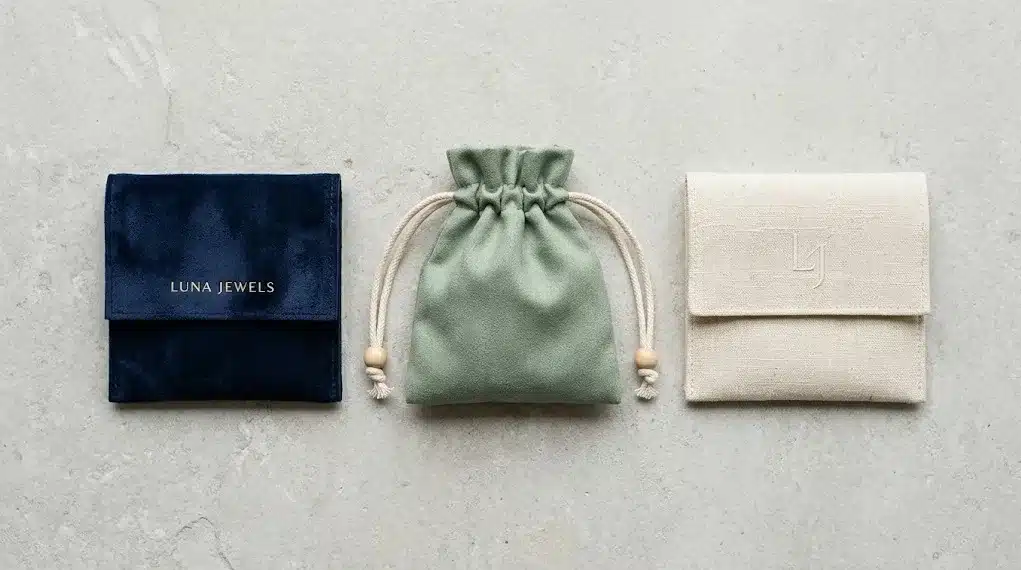
3. Unboxing Has Become a Marketing Channel
The rise of unboxing content is one of the most significant shifts in consumer marketing of the past decade — and it’s almost entirely free for brands that earn it through good packaging.
The scale of unboxing content
According to TikTok’s What’s Next Trend Report 2024, the hashtag #unboxing has surpassed 150 billion views on the platform alone. YouTube data shows that the number of videos containing “unboxing” in the title has grown by 871% since 2010. Smithers research confirms that more than 80% of Gen Z consumers have watched an unboxing video, and over 58% of Millennials have as well.
Unboxing converts viewers into buyers
This isn’t passive entertainment. A Google consumer survey found that 62% of people who watch unboxing videos are actively researching a potential purchase when they watch them. In other words, unboxing videos sit directly in the consideration phase of the buying funnel — exactly where brand impressions matter most.
Furthermore, the Dotcom Distribution Packaging Survey 2024 found that 60% of consumers are more likely to share a purchase online if the packaging is creative, attractive, or fun to open. For jewelry brands, that number is particularly meaningful: jewelry is a natural subject for photography and gifting content, and a beautiful pouch is a ready-made prop in every customer’s hands.
What this means for jewelry brands specifically
Every piece you ship is a potential piece of organic marketing content. The customer who films their unboxing and posts it to 800 followers is giving you a free ad placement — but only if the packaging is worth filming. A plain brown mailer or a generic plastic bag gets no coverage. A custom-printed velvet pouch with a logo cord and a color-matched tissue insert gets the close-up.
4. Packaging Drives Repeat Purchases and Customer Retention
The most expensive customer you’ll ever acquire is a new one. The cheapest revenue you’ll ever generate comes from a customer who comes back. Packaging sits at the intersection of both — and its influence on repeat purchase behavior is measurable.
The retention math
Bain & Company research has shown that improving customer retention by just 5% can increase profits by 25% to 95%. Meanwhile, research from SellersCommerce confirms that repeat customers spend 67% more in their third year of purchasing than they did in their first six months. For a jewelry brand with an average order value of $60, a loyal three-year customer is worth dramatically more than the acquisition cost of finding them in the first place.
How packaging connects to retention
Packaging creates what behavioral researchers call an “emotional memory anchor” — a physical, sensory moment that the brain encodes as part of the overall product experience. When that moment is positive and distinctive, it gets associated with the brand. The next time the customer needs jewelry — for a gift, for a special occasion, for themselves — the brand surfaces in memory faster and with stronger positive associations than a competitor whose packaging left no impression.
The functional loyalty layer
Beyond emotion, there is a practical dimension. A well-made jewelry pouch that a customer keeps and reuses puts your brand logo in their daily environment for months or years after the purchase. Every time they reach for that pouch — to travel with a necklace, to store a ring on their nightstand, to gift a piece — they see your name. That passive brand reinforcement has a documented effect on repurchase probability that no loyalty program email can replicate.
5. Sustainable Packaging Is Now a Purchase Decision Factor
The sustainability dimension of packaging has moved from a nice-to-have to a genuine purchase driver — particularly among the demographics most likely to buy jewelry online.
What consumers say they want
McKinsey research published in the 2023 packaging landscape report found that more than 60% of consumers say sustainability credentials influence their packaging preferences when choosing between comparable products. Among consumers aged 18–34 — a primary demographic for jewelry e-commerce — that figure is consistently higher.
The certification advantage
For B2B buyers sourcing custom packaging, this creates a direct commercial opportunity. Brands that can display GOTS, GRS, or OEKO-TEX certification logos on their packaging — or in their product listings — are addressing a real purchase criterion for end consumers. The certification doesn’t just reduce environmental impact; it serves as a trust signal that influences the end customer’s choice of jeweler.
The perception gap
Research from Smithers also identified a significant gap between what brands think consumers want from packaging and what consumers actually prioritize. Brands tend to over-weight aesthetics and under-weight sustainability. Consumers increasingly weight them roughly equally. Brands that close that gap — by choosing certified sustainable materials without sacrificing presentation quality — capture both the emotional and the rational side of the purchase decision simultaneously.
6. Premium Packaging Reduces Returns and Negative Reviews
One of the least-discussed dimensions of packaging ROI is its effect on the negative end of the customer experience: returns, complaints, and low-star reviews.
Protection translates to satisfaction
A jewelry piece that arrives scratched, tangled, or visibly mishandled generates an immediate return or complaint. Research from Mondi’s 2024 e-commerce packaging survey — based on 6,000 consumers across six countries — found that 47% of consumers would not buy from a brand again after a negative packaging experience. Not after a bad product. After bad packaging.
The review asymmetry problem
Negative reviews driven by packaging failures are particularly damaging for jewelry brands because they appear on product pages where new customers are making their first purchase decision. A one-star review that says “arrived tangled and the bag ripped” is not a review of the jewelry — it’s a review of your packaging. However, the prospective customer reading it cannot distinguish between the two. That review costs you far more in lost future revenue than the $0.30 you saved on a cheaper bag.
The protection premium
A properly spec’d pouch — the right material weight, the right interior finish, the right closure type for the piece — prevents the scratches, tangles, and compression damage that generate those reviews. Investing $0.40 more per unit to get the right specification is not packaging spend. Rather, it is quality assurance spend — the same category as inspecting a shipment or certifying a supplier.
For guidance on matching the right pouch style to your jewelry type and shipping method, the jewelry pouch styles comparison guide covers all five main closure types with protection ratings and cost data.
7. The B2B Calculation: What This Means for Brands Ordering in Bulk
If you’re sourcing custom pouches for a jewelry line, the data above translates into a straightforward sourcing framework. The question isn’t “how do I minimize packaging cost?” — it’s “what packaging specification maximizes return across the full customer lifecycle?”
A simple ROI framework
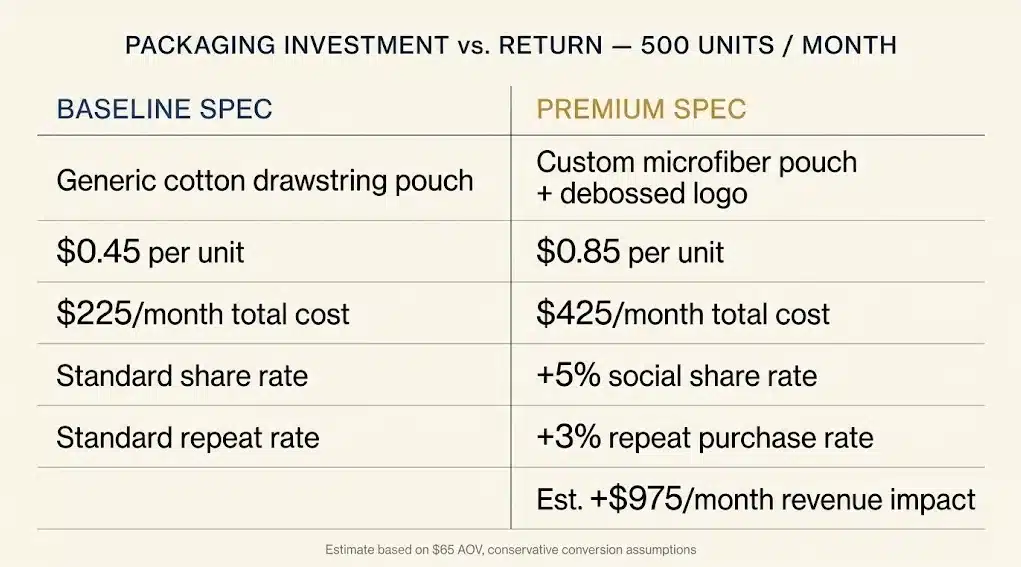
Consider a jewelry brand shipping 500 pieces per month at an average retail price of $65.
At the baseline: a $0.45 generic cotton drawstring pouch. Total packaging cost: $225/month.
At the upgraded spec: a $0.85 custom microfiber pouch with debossed logo and matching cord. Total packaging cost: $425/month. Delta: $200/month, or $2,400/year.
What that $200/month buys back
If the premium packaging increases the social media share rate by 5 percentage points (from the Dotcom Distribution baseline), that’s 25 additional organic posts per month. At even a conservative 2% conversion rate on each post’s audience, that’s measurable incremental revenue. If it increases repeat purchase rate by 3 percentage points — well within the documented effect of premium packaging on loyalty — that adds roughly 15 additional orders per month at $65 each: $975 in incremental revenue against a $200 cost increase.
The compounding effect
These effects compound over time as the customer base grows and as organic content accumulates. The brand that invests in premium packaging from day one builds a compounding marketing asset. The brand that cuts packaging costs saves $2,400 in year one and leaves an unknown but meaningful multiple of that on the table in lost retention and organic reach.
8. What Premium Jewelry Packaging Actually Costs
The data makes the case for investing in packaging. However, “investing” doesn’t mean spending without discipline. The goal is the right specification at the right price — not the most expensive option available.
Realistic cost ranges
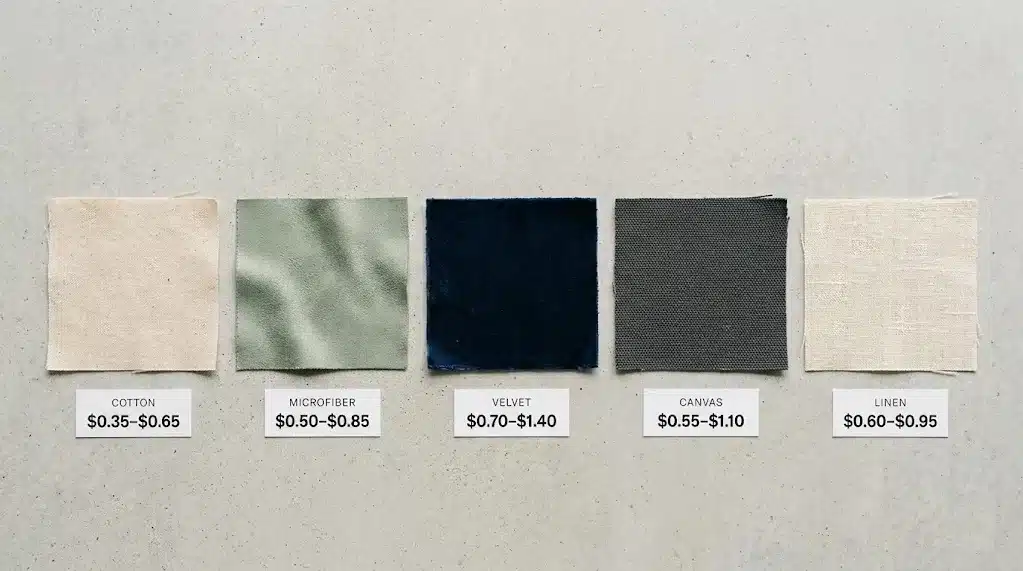
At MOQ 100 pieces, custom jewelry pouches across the five main styles typically cost:
| Style | Material | Cost range (MOQ 100) | Best for |
|---|---|---|---|
| Drawstring | Cotton / microfiber | $0.35 – $0.90 | Most jewelry types, e-commerce |
| Envelope | Linen / microfiber | $0.40 – $0.85 | Flat pieces, retail display |
| Flap (snap/tie) | Velvet / suede | $0.60 – $1.40 | Fine jewelry, gift sets |
| Zipper | Canvas / microfiber | $0.55 – $1.20 | Travel, multi-piece sets |
| Roll pouch | Canvas / leather | $1.00 – $2.50+ | Gift sets, collections |
Where the premium actually comes from
The cost difference between a generic pouch and a brand-elevating one usually comes from three things: fabric weight and finish, logo execution method (screen print vs. deboss vs. hot stamp), and cord or closure hardware quality. Upgrading any one of those three elements meaningfully changes the perceived value. Upgrading all three simultaneously is usually not necessary — identifying which element matters most for your specific brand position is the smarter investment.
For a detailed look at how material choice affects both cost and perceived quality, the guide to velvet vs microfiber vs suede jewelry pouches breaks down each option with brand-fit and durability data.
9. How to Audit Your Current Packaging Against These Benchmarks
If you’re already shipping jewelry, this section gives you a practical checklist for evaluating whether your current packaging is working as hard as it should.
The five-question audit
Ask these questions about your current packaging spec:
1. Does your packaging photograph well? Hold your current pouch next to a piece of jewelry and take a photo with your phone. Does the pouch enhance the image or diminish it? If you wouldn’t post that photo, neither will your customers.
2. Would a customer keep this pouch? Examine the construction quality, the material weight, and the closure durability. If the pouch is likely to be discarded within a week, your brand disappears with it. By contrast, if it’s built to last, it becomes a durable brand touchpoint.
3. Does the logo add or subtract? A poorly executed logo — cracked screen print, misaligned stamp, incorrect placement — actively damages brand perception. Test the logo on a sample before placing a bulk order. Ask your supplier for a durability test on the printing method.
4. Is the closure right for the piece? A drawstring that lets a small stud earring fall out is a protection failure. A zipper that scratches a plated pendant is a quality failure. Match the closure spec to the specific pieces in your range, not to a generic “jewelry pouch” category.
5. Does the packaging match the price point? As a rough guide, packaging should represent 3–8% of retail product price. Below 3%, you’re likely under-investing and leaving brand equity on the table. Above 8%, you may be over-investing in packaging at the expense of margin.
For detailed guidance on choosing the right size alongside the right style and material, the jewelry pouch size guide covers standard dimensions for every jewelry type.
10. Conclusion
The data makes a clear case: jewelry packaging importance is not a matter of aesthetics — it’s a matter of revenue. Packaging influences purchase decisions before the product is seen, generates organic marketing content through unboxing culture, drives repeat purchase rates, and actively reduces returns and negative reviews. The $0.40 difference between average and premium packaging is not a cost. It’s one of the highest-return investments available to a jewelry brand at any stage.
The brands winning in jewelry e-commerce today are not competing on price. They’re competing on experience — and packaging is the first and most tangible moment of that experience. Getting it right doesn’t require a large budget. It requires understanding which elements of the spec drive the most return for your specific product, customer, and price point.
That is exactly what the sourcing process at YJXpack is designed to help you figure out — before the order is placed, not after.
FAQs
Q1: Why does jewelry packaging matter for small brands?
For small brands, packaging is often the primary brand touchpoint — it’s what customers photograph, share, and remember. Research shows 60% of consumers are more likely to share a purchase online if the packaging is attractive, generating organic marketing that small brands especially depend on. Premium packaging also supports higher price points and better customer retention, which compounds over time as the brand grows.
Q2: What is the ROI of premium jewelry packaging?
The ROI comes from multiple channels simultaneously: higher price acceptance (research supports up to 18% more for premium packaging), increased social sharing rates, improved repeat purchase probability, and reduced returns from better product protection. In practice, a $0.40 per-unit upgrade on a 500-unit monthly order ($200 additional monthly cost) can generate several multiples of that in incremental revenue through social reach and retention improvements alone.
Q3: How does packaging affect customer loyalty in jewelry?
Packaging creates an emotional memory anchor — a physical, sensory experience the brain encodes alongside the product. When that moment is positive and distinctive, the brand is more easily recalled during future purchase decisions. Functionally, a well-made pouch that customers keep and reuse also puts the brand logo in their environment for months or years, providing passive brand reinforcement that actively increases repurchase probability.
Q4: Do unboxing videos actually drive jewelry sales?
Yes — and the data is clear. A Google consumer survey found 62% of unboxing video viewers are actively researching a purchase when they watch. The #unboxing hashtag has surpassed 150 billion views on TikTok alone. For jewelry brands, this is a largely free marketing channel: every customer who films an unboxing is producing content that appears in the consideration phase of new customers’ buying journeys.
Q5: How much should a jewelry brand spend on packaging per unit?
A practical guideline is 3–8% of retail price. For a $50 piece, that means $1.50–$4.00 per complete packaging unit (including pouch, box, tissue, and insert card if applicable). Below 3%, brands typically under-invest and leave brand equity on the table. Above 8%, packaging cost begins to compress margin without proportional return. Custom fabric pouches from a direct manufacturer like YJXpack start at $0.35–$0.85 per unit at MOQ 100, making the math highly favorable for most jewelry price points.
Q6: Does sustainable packaging really influence buying decisions?
Yes, particularly for younger buyers. McKinsey research found more than 60% of consumers say sustainability influences their packaging preferences when choosing between comparable products. For jewelry brands targeting the 18–34 demographic online, certified sustainable materials (GOTS cotton, GRS-certified recycled microfiber) serve as a genuine purchase differentiator — not just a CSR exercise.
Q7: What is the most important element of jewelry packaging?
It depends on the brand’s primary objective. For social media reach, visual distinctiveness and unboxing experience design matter most. For customer retention, material quality and durability matter most — packaging customers keep drives passive brand reinforcement. For premium perception and price support, logo execution quality and material finish have the greatest impact. Most brands benefit from optimizing all three, but identifying the priority based on current stage and customer base makes the investment more efficient.
Custom Jewelry Pouches That Work as Hard as Your Brand
YJXpack — Yijiaxin (Shenzhen) Packaging Products Co., Ltd.
For 20+ years, we’ve manufactured custom fabric jewelry pouches for brand owners, traders, and e-commerce sellers across the US, Europe, and the Middle East. We hold GOTS, GRS, OEKO-TEX, BSCI, and ISO 9001 certifications. MOQ starts at 100 pieces per style. Samples are ready in 1–3 days.
Ready to upgrade your packaging spec? Contact us for a free sample and a quote within 3 minutes.
Email: info@yjxpack.com
WhatsApp / WeChat: +86 18617112946
Website: www.yjxpack.com
Free stock samples · Quote in 3 minutes · 3D mockup in 30 minutes · MOQ 100 pieces · GOTS / GRS / OEKO-TEX / BSCI / ISO 9001 certified
Share This Story, Choose Your Platform!