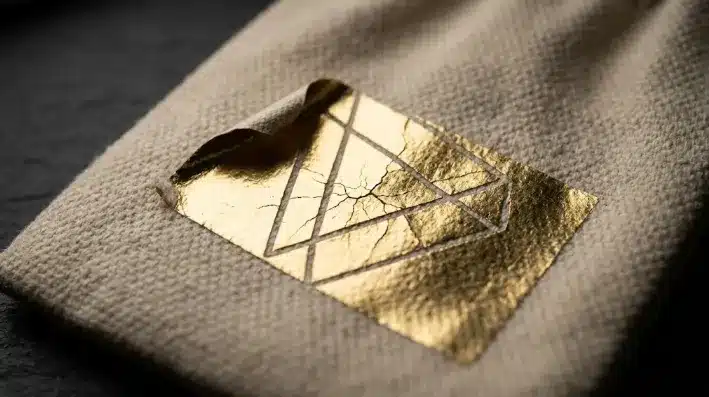
Your logo didn’t print badly. It printed onto the wrong material. So when a customer messages you that the gold logo on their pouch “started flaking after a month,” the problem usually isn’t a sloppy factory — it’s a printing method that was never going to survive on soft fabric in the first place. Plus, most brands don’t discover this until the complaints arrive.
Here’s what almost every logo printing guide gets wrong: it’s written for rigid boxes. A jewelry gift box is flat, stiff, never washed, and barely handled. So almost any print method looks perfect on it for years. A fabric pouch is the opposite — it bends, rubs, gets stuffed into bags, and sometimes gets washed. So a method that’s flawless on a box can peel, crack, or fade on a pouch within months.
This guide investigates why. First, you’ll see why soft fabric fights every print method differently than a box does. Second, you’ll learn exactly how hot stamping peels, silk screen cracks, and heat transfer lifts — and which 3 methods actually survive. Third, you’ll get the adhesion test you should demand before approving any bulk order. By the end, you’ll choose logo methods based on survival, not just looks.
1. The Hidden Truth — Soft Fabric Fights Every Print Method
Let’s start with the physics nobody explains. Fabric is one of the hardest surfaces in the world to print on durably — and it’s hard for four specific reasons.
It bends. A pouch flexes constantly — every time it’s opened, stuffed, folded, or cinched. So any rigid surface coating (foil, thick ink film) is forced to bend with it. Bend a hard coating enough times, and it cracks along the fold lines. A box never does this. A pouch does it daily.
It rubs. Pouches rub against each other in storage, against the jewelry inside, and against everything else in a customer’s bag or drawer. So surface-applied logos face constant abrasion. Over weeks and months, that friction wears the print down.
It gets washed. Many customers eventually wash a fabric pouch — something nobody does with a box. So water, heat, and mechanical agitation attack the bond between the print and the fabric. Cheap prints don’t survive a single wash.
It has texture. Velvet has pile. Cotton has weave. Canvas has a coarse grain. So the printing surface isn’t smooth — and a logo struggles to adhere evenly across an uneven, fibrous surface. Boxes are smooth and coated. Fabric is none of those things.
So here’s the reframe that changes everything. On a box, you choose a logo method by how good it looks. On a fabric pouch, you choose it by whether it can survive bending, rubbing, washing, and texture. In short, logo printing on fabric pouches is a durability problem first and an aesthetic problem second. Get that order wrong, and your logo fails in the field — no matter how good it looked on the sample.
2. Why Hot Stamping Peels on Fabric — The #1 Complaint
Hot stamping is the most common source of “my logo is flaking” complaints. So let’s investigate exactly why.
Hot stamping works by pressing a thin metallic foil onto a surface under heat and pressure. On a rigid box, this is nearly permanent — the box doesn’t move, so the foil stays bonded indefinitely. That’s why hot stamping looks so good on packaging and why brands assume it’ll work everywhere.
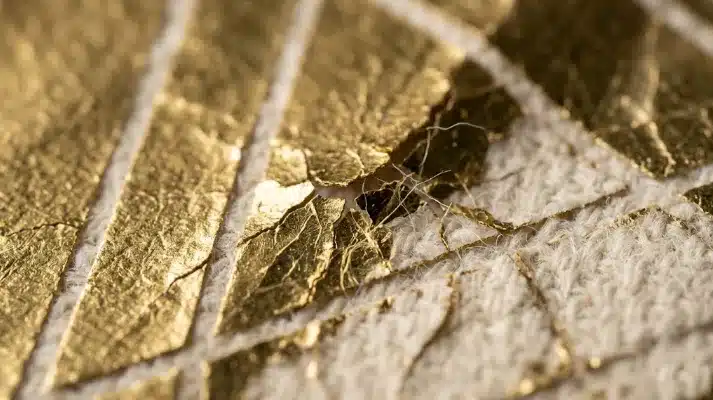
But on fabric, the mechanism is fundamentally different. The foil bonds to the surface of the fibers — it sits on top, rather than soaking in. So the bond is shallow by nature. Then the fabric does what fabric does: it bends. Each fold flexes the rigid foil layer. Foil doesn’t flex — it’s metal. So microscopic cracks form along the fold lines. Plus, abrasion catches those cracked edges and lifts them. Over weeks, the foil peels away flake by flake. This is most severe on coarse, textured fabrics like cotton and canvas, where the foil has even less even surface to grip.
So does this mean you can’t use hot stamping on fabric? No — but you have to use it correctly. Hot stamping survives much better on smooth, dense surfaces: velvet’s tight pile, microfiber, and PU leather all hold foil far better than loose-weave cotton. Plus, a proper adhesive underlayer dramatically improves bonding. And keeping the logo away from high-flex zones (like right at the drawstring channel) reduces cracking.
In short, hot stamping cracking and logo peeling fabric problems aren’t random factory defects — they’re predictable physics. So the fix isn’t “find a better factory.” It’s “use hot stamping only on the materials that can actually hold it, with the right adhesive process.”
3. Why Silk Screen Cracks After Washing
Silk screen is cheaper and more flexible than hot stamping — but it has its own failure mode, and washing is where it shows up.
Silk screen works by pushing ink through a mesh screen onto the fabric, forming a thin layer of ink that sits on the surface. So the logo is essentially a flexible film bonded to the top of the weave. On a cotton jewelry pouch, this works reasonably well — better than foil, because ink has some flexibility foil doesn’t.
However, two things break it. First, thick ink layers. To make a logo really opaque and vivid, factories sometimes lay the ink on heavy. So that thick layer becomes stiff — and stiff layers crack when the fabric flexes repeatedly. Second, washing. Water plus mechanical agitation attacks the ink-to-fabric bond. A properly cured silk screen print resists this. A poorly cured one — rushed through curing to save time — softens and peels after just a few washes.
So the durability of silk screen comes down to two factory decisions most buyers never ask about: ink type and curing. Flexible inks (like quality plastisol) move with the fabric instead of cracking. Proper curing — correct temperature, correct time — locks the ink into the fibers. Cheap silk screen skips or rushes curing, which is exactly why the bargain quote fails after three washes.
In short, silk screen can last 3–5 years on cotton — or fail in three washes. The difference isn’t the method. It’s whether the factory used a flexible ink and cured it properly. So always ask. For matching ink color consistently across runs, specify a Pantone color matching number too.
4. Why Heat Transfer Lifts at the Edges
Heat transfer is the method brands reach for when they need full-color, photo-quality logos. But it’s also one of the least durable on fabric — and the failure always starts at the edges.
Heat transfer works by printing a design onto a film, then heat-pressing that entire film onto the fabric. So unlike ink that soaks in, the transfer sits as a distinct layer bonded on top. The problem is that the film and the fabric are two different materials with different flexibility and different responses to heat and stress. So at the edges of the design — where the film meets bare fabric — stress concentrates. Plus, the edges are where abrasion catches first.
Over time, the sequence is predictable: the edges catch on something, lift slightly, then peel further with each rub and flex. Once an edge lifts, the whole transfer starts coming away. So complex multi-color designs with lots of fine detail and small edges are the most vulnerable — every tiny edge is another potential lift point.
There are ways to improve it. Higher-quality transfer films (and cold-peel rather than hot-peel processes) bond better. Plus, rounding the corners of a design reduces stress concentration at sharp edges. And keeping transfers away from high-friction zones helps. Still, even at its best, heat transfer trades durability for color range.
So here’s the honest tradeoff: choose heat transfer when you genuinely need full-color or photographic detail that no other method can reproduce. But accept that it’s among the least durable options on fabric. In short, if your customer will reuse the pouch heavily, heat transfer is usually the wrong call — its color advantage doesn’t outweigh its edge-lifting weakness.
5. The 3 Methods That Actually Survive on Fabric
So which methods actually last on soft fabric? Three stand out — and they share one critical trait: none of them rely on a surface coating that can peel.
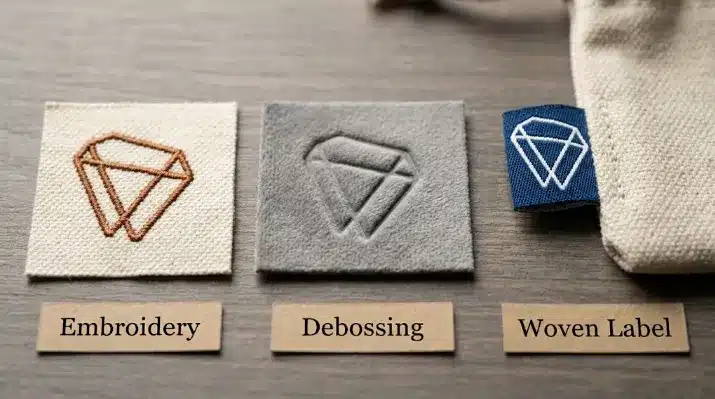
Embroidery — the most durable print alternative. Embroidery doesn’t sit on the fabric; it’s stitched into it. So the logo becomes part of the fabric structure itself. There’s no coating to crack, no film to lift, no ink to wash away. Plus, embroidery survives washing, resists abrasion, and often looks better with age. The thread is physically locked through the weave. So short of cutting the threads, there’s almost nothing that makes embroidery fail. For brands whose customers reuse pouches heavily, embroidery is the safest durable choice.
Debossing — no adhesion to fail. Debossing presses the logo into the material as a physical impression — no ink, no foil, no coating at all. So there’s literally nothing that can peel, because nothing was added to the surface. The logo is a permanent deformation of the material itself. This works best on dense materials that hold an impression: microfiber, suede, PU leather, and premium velvet. Since there’s no coating, there’s no coating failure — ever.
Woven label — the ultimate in durability. A woven label is your logo woven into a small piece of fabric, which is then sewn onto the pouch. So the logo isn’t printed at all — it’s textile. Plus, a sewn-on woven label is nearly indestructible: it survives washing, abrasion, bending, and years of use without degrading. It’s the same technology used on clothing brand labels precisely because it lasts the life of the garment.
The common thread (literally): all three avoid surface coatings. Embroidery and woven labels are fiber-level constructions. Debossing is a physical deformation. So none of them can peel, crack, or lift the way foil, ink, and transfer films do. In short, if print durability pouch performance is your priority — especially for pouches customers reuse or wash — choose one of these three over any surface-applied method.
6. The Adhesion Test You Should Demand Before Bulk
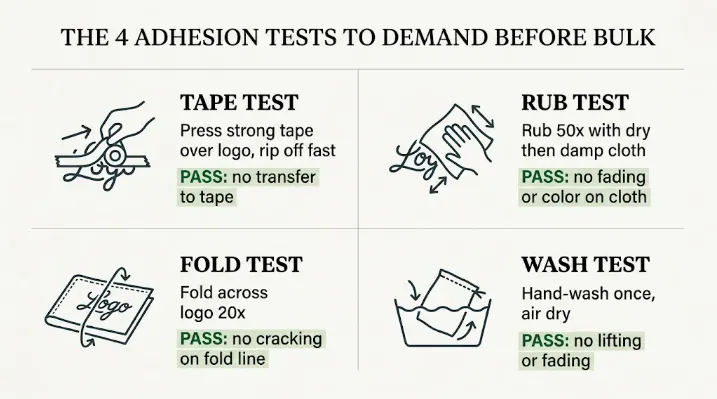
Here’s how to protect yourself before committing to a bulk order. Don’t trust a sample that just “looks good” — stress-test it. So demand these four tests on your physical sample before you approve production.
The tape test. Press a strip of strong tape firmly over the logo, then rip it off quickly. So if any foil, ink, or transfer comes away with the tape, the adhesion is weak — and bulk will fail in the field. A durable logo shows zero transfer to the tape.
The rub test. Rub the logo back and forth firmly about 50 times with a dry cloth, then again with a slightly damp one. So you’re simulating months of abrasion in 30 seconds. Watch for fading, edge lifting, or color coming off on the cloth.
The fold test. Fold the fabric sharply across the logo, back and forth, about 20 times. So you’re simulating the bending a pouch endures in real use. Then check the fold line for cracking, flaking, or peeling — this is where hot stamping and thick silk screen fail first.
The wash test. Hand-wash the sample once in lukewarm water with gentle agitation, then air-dry. So you’ll see immediately whether the logo survives what many customers will eventually do to it. Fading or lifting after one wash means guaranteed failure over the pouch’s life.
How to ask: tell your supplier, “Please run a tape, fold, and rub test on the logo sample and send me a short video.” So a confident factory does this without hesitation. The red flag: any supplier who dodges the request, refuses to test, or won’t commit to a durability standard is telling you something about their confidence in the work. In short, the 5 minutes it takes to demand these tests prevents months of logo fade fabric complaints down the line.
7. Material-by-Material Survival Guide
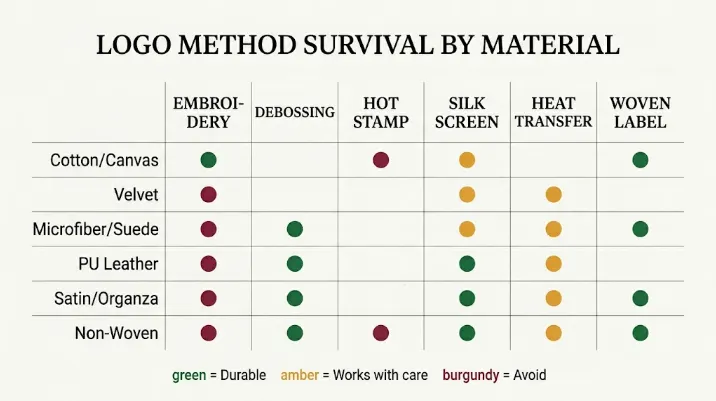
Screenshot this. The table below maps each common pouch material to the logo methods that survive on it, the ones that work with risk, and the ones to avoid.
| Material | Most Durable | Works (with care) | Avoid |
|---|---|---|---|
| Cotton / Canvas | Embroidery, woven label | Silk screen (flexible ink, cured) | Hot stamping (peels on weave) |
| Velvet | Embroidery | Hot stamping (dense pile) | Silk screen (sinks into pile) |
| Microfiber / Suede | Debossing | Hot stamping | Silk screen, heat transfer |
| PU Leather | Debossing, hot stamping | Silk screen | Embroidery (perforates) |
| Satin / Organza | Woven label | Silk screen (light) | Hot stamping, embroidery (snags) |
| Non-Woven | Woven label | Heat transfer, silk screen | Hot stamping, debossing |
So read across your material row, and you have a durability-first method choice. For the full range of materials these methods apply to, browse our custom jewelry pouches. And if you’re still deciding which method fits your brand look (not just durability), our guide to designing a logo for pouches covers the aesthetic side.
8. How YJXpack Prevents Print Failure
To turn all this into reliable production, here’s how we approach logo durability at YJXpack.
First, every logo method × material combination has a defined adhesion standard. So we don’t just print what you ask onto whatever material you picked — we flag mismatches before production. If you want hot stamping on loose-weave cotton, we’ll tell you it’s likely to peel and recommend a better pairing. Second, during sampling, we run tape, fold, and rub tests free of charge and send you the results. So you see the durability evidence before you commit to bulk.
Plus, we offer the high-durability options many factories don’t push — embroidery, debossing, and custom woven labels — for brands whose customers reuse or wash their pouches. So if longevity matters to your customer experience, you have genuinely durable choices, not just the cheapest surface print.
MOQ starts at 100 pieces across all methods, and we hold GOTS, GRS, OEKO-TEX, BSCI, ISO 9001, and SABER certifications — all third-party verified. So material and process quality is documented, not just promised. To start with an adhesion-tested sample, visit YJXpack.
9. The Bottom Line — Durability Is a Material Decision
Here’s what to take away. A logo that peels, cracks, or fades isn’t usually a printing mistake — it’s a mismatch between the method and the fabric it was applied to.
So before you choose any logo method, ask one question: will my customer reuse or wash this pouch? If yes, lean toward embroidery, debossing, or a woven label — the three that can’t peel because they don’t rely on a surface coating. If the pouch is a single-use gift wrapper, you have more freedom. Either way, demand the tape, fold, and rub tests on your sample before bulk.
Get that one question right, and “my logo is flaking” stops being a message you ever receive. Instead, your branding survives exactly as long as the pouch does.
10. FAQs
Q1: Why does my hot-stamped logo peel off the fabric?
Hot stamping bonds foil to the surface of the fibers — it sits on top rather than soaking in. So when the fabric bends, the rigid foil cracks along the fold lines, and abrasion lifts the cracked edges over time. It peels worst on coarse, loose-weave fabrics like cotton. So hot stamping works far better on dense, smooth surfaces like velvet, microfiber, or PU — ideally with an adhesive underlayer.
Q2: Which logo method lasts longest on cotton pouches?
Embroidery and woven labels last longest on cotton — both are fiber-level constructions that can’t peel or crack. A properly cured silk screen with flexible ink is a solid second choice and far cheaper. Hot stamping is the riskiest on cotton, since the loose weave and bending cause the foil to flake over time.
Q3: Can silk screen survive washing?
Yes, if it’s done right. A silk screen print with flexible ink that’s been properly cured (correct temperature and time) can survive years of washing. The failures come from thick, stiff ink layers and rushed curing — common in bargain production. So always ask whether the factory uses flexible ink and full curing, and run a wash test on your sample.
Q4: Is embroidery really more durable than printing?
Yes, significantly. Embroidery stitches thread through the fabric, so the logo becomes part of the textile structure. There’s no coating to crack, no film to lift, and no ink to wash away. So short of physically cutting the threads, embroidery survives washing, abrasion, and years of bending — making it the most durable option for reused pouches.
Q5: What’s a woven label and is it worth it?
A woven label is your logo woven into a small piece of fabric, then sewn onto the pouch — the same technology used on clothing brand tags. It’s nearly indestructible: washing, abrasion, and bending don’t degrade it. So for pouches customers keep and reuse for years, a woven label is often worth the small added cost, especially for detailed or multi-color logos that print methods struggle to hold.
Q6: How can I test logo durability before placing a bulk order?
Run four tests on your physical sample: a tape test (press and rip tape over the logo), a rub test (rub 50 times with a cloth), a fold test (fold across the logo 20 times), and a wash test (hand-wash once). So you simulate months of wear in minutes. Ask your factory to run these and send video — and treat any refusal as a warning sign.
Don’t Risk a Peeling Logo — Get a Free Adhesion-Tested Sample
YJXpack — Yijiaxin (Shenzhen) Packaging Co., Ltd.
For 20+ years, we’ve made custom jewelry pouches with logos that survive real-world use — embroidery, debossing, woven labels, and properly cured printing — for 8,000+ brands worldwide. We test logo adhesion before every bulk run and recommend the right method for your material, not just the cheapest one. Plus, we hold GOTS, GRS, OEKO-TEX, BSCI, ISO 9001, and SABER certifications, all third-party verified.
Worried about a logo that flakes? Request a free adhesion-tested sample — we’ll print your logo, run tape, fold, and rub tests, and send you the video proof before you commit to bulk. Plus, a free 3D mockup within 30 minutes.
Email: info@yjxpack.com
WhatsApp / WeChat: +86 18617112946
Website: www.yjxpack.com
Free adhesion-tested sample · Tape / fold / rub test video proof · Embroidery, debossing & woven labels available · MOQ 100 pieces · GOTS / GRS / OEKO-TEX / BSCI / ISO 9001 certified
Share This Story, Choose Your Platform!