In 2022, almost nobody outside the printing industry had heard of DTF printing. By 2024, it had quietly taken over small-batch logo decoration. And by 2026, it’s the fastest-growing custom logo method on the planet — for one simple reason. It does what screen printing and heat transfer couldn’t do well, at a price both can’t match.
If you’re sourcing custom pouches and your supplier just quoted you DTF printing, this guide explains exactly what that means and whether it’s right for your brand.
Here’s the problem with most online articles. They focus on t-shirts. Plus, they show you DIY DTF setups for hobbyists. And worst of all, they don’t tell you what matters for B2B fabric bag orders — minimum quantities, real durability tests on packaging fabrics, or how DTF compares to screen printing on a 1,000-piece cotton pouch run.
This article fixes that. In plain English, you’ll learn three things. First, what DTF printing actually is and how the process works. Second, why DTF prices already beat screen printing on small runs. Third, when to pick DTF and when to stick with traditional methods.
By the end, you’ll know exactly how to brief your next supplier on DTF.
1. DTF Printing — The 1-Minute Quick Answer
Let’s start with the simple version.
DTF printing — short for “direct to film printing” — is a digital process that prints your full-color logo onto a special transfer film, then heat-presses it onto fabric. As a result, you get a soft, full-color logo with no minimum color count, no screen setup, and surprisingly low per-piece cost.
Naturally, the right choice depends on your bag material, color count, and quantity. Here’s the fast-look table.
| Aspect | Detail |
|---|---|
| Process | Digital print on PET film → heat-press to fabric |
| Best fabrics | Cotton, canvas, polyester, microfiber, satin |
| Color options | Unlimited (full-color, gradients, photos) |
| Cost per piece (1,000 pcs) | $0.25 – $0.60 |
| Setup time | Almost zero (no screens needed) |
| Best for | Complex logos, small runs, beauty packaging |
| Durability | 40-60 wash cycles with quality films |
That’s the fast version. Now let’s break it down properly.
2. What Is DTF Printing? (Direct to Film Explained)
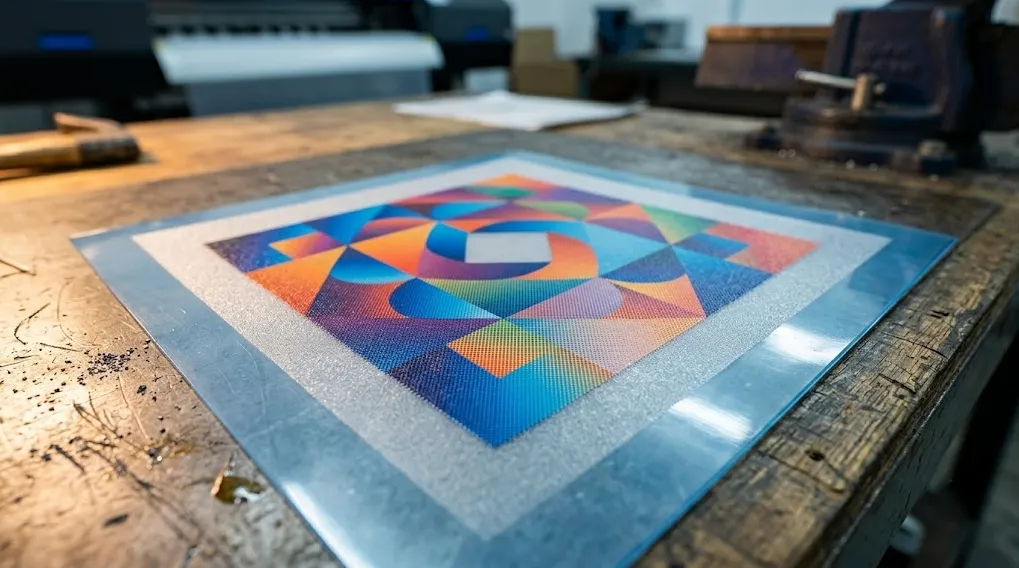
DTF stands for “direct to film” — the name tells you the entire process. So instead of printing ink directly onto fabric (like screen printing) or using sublimation dyes, DTF prints your design onto a clear PET (polyester) film first. Then it transfers that film to the fabric using heat and pressure.
Here’s why this matters. The PET film acts as a carrier — it holds your logo perfectly, in any color, with any detail level. Then heat-activated adhesive powder bonds the design permanently to the fabric. As a result, you can print photo-realistic logos on cotton, canvas, polyester, or even mixed-fiber bags without changing the setup.
Three things make DTF different from older methods. First, no screens. DTF is fully digital — your logo goes from file to film in minutes, with zero per-color setup cost. Second, no fabric limits. Plastisol screen printing struggles on polyester blends. By contrast, DTF works on almost any fabric. Third, full color is free. Each additional color in your logo doesn’t add a cent to per-piece cost — unlike screen printing where 4 colors can double the price.
So what is DTF really? It’s the printing industry’s answer to “I want any color, any quantity, any fabric, at low cost.” That’s why every major decoration shop in 2024-2026 has either added DTF or is planning to. Brands sourcing custom pouches now expect their supplier to offer it.
3. The DTF Printing Process — Step by Step
Let’s break down the DTF printing process so you know exactly what your supplier is doing.
Step 1: Artwork prep. Your logo gets opened in design software. Then the colors get adjusted slightly to account for how DTF inks behave on film. No color separations needed. No screens to make.
Step 2: Film printing. A specialized DTF printer prints your design onto a clear PET film using CMYK + white inks. The white layer prints on top of the colors — this is what makes DTF work on dark fabrics.
Step 3: Adhesive powder application. While the ink is still wet, hot-melt adhesive powder is sprinkled onto the printed design. The powder sticks only to the inked areas. Then excess powder gets shaken off and recycled.
Step 4: Curing the powder. The film passes through a curing oven at around 320°F (160°C) for 2-3 minutes. As a result, the adhesive powder melts and bonds with the ink, creating a flexible film ready for transfer.
Step 5: Heat-press to fabric. The cured film is positioned face-down on your fabric bag. A heat press applies 280-320°F (138-160°C) at 40-60 PSI for 10-20 seconds. So the adhesive remelts and bonds your design to the fabric fibers.
Step 6: Peeling and post-press. After cooling, the PET film peels away cleanly, leaving the logo on the fabric. A second short heat press locks the design in. Naturally, this final press is what gives DTF its durability advantage over cheap heat transfers.
So the DTF printing process is digital, fast, and forgiving — exactly what small-batch B2B orders need.
4. DTF Printing vs Screen Printing — Cost & Quality
This is where buyers get confused most. Both methods print ink onto fabric. But the economics and use cases are very different.
| Property | DTF Printing | Screen Printing |
|---|---|---|
| Setup cost | Near zero | $50-100 per color |
| Cost per piece (1,000 pcs) | $0.25 – $0.60 | $0.15 – $0.50 |
| Cost per piece (100 pcs) | $0.50 – $1.20 | $1.20 – $2.50 |
| Color count | Unlimited | 1-6 spot colors |
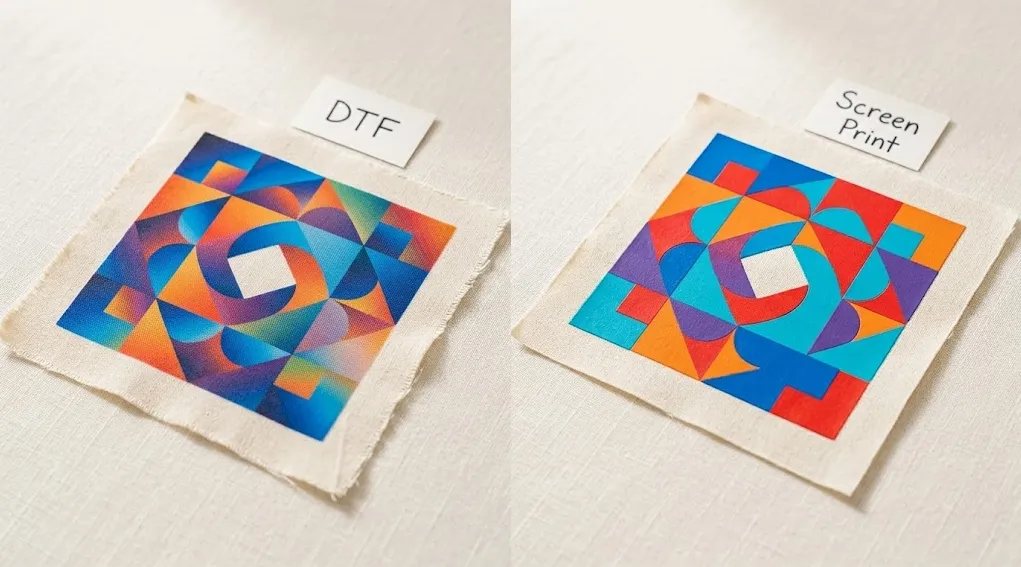
| Photo realism | Excellent | Poor (halftones only) |
| Hand-feel | Soft, slightly raised | Slight ink layer on top |
| Durability | 40-60 washes | 30-60 washes |
| Best for | Small runs, complex art | High volume, simple logos |
| Setup time | Hours | 1-3 days |
Three patterns emerge from this comparison.
First, DTF wins on small runs. Below 500 pieces with multi-color logos, DTF is usually cheaper than screen printing on fabric bags. The reason is simple — DTF skips the entire screen-setup cost that dominates small screen-print orders.
Second, screen printing still wins at high volume with simple logos. For 5,000-piece runs with a 1-color logo, screen printing’s per-piece cost is hard to beat. By contrast, DTF’s per-piece cost stays relatively flat as quantity scales.
Third, DTF wins on complexity. If your logo has gradients, photos, fine detail, or 5+ colors, DTF is the only economical choice. Screen printing simply can’t reproduce a gradient logo without expensive halftone setup.
So the DTF vs screen printing decision is really a matrix — quantity × color complexity. Use DTF for small-to-medium runs with rich designs. Use screen printing for large runs with bold simple logos.
5. Why DTF Has Exploded in 2024-2026
Three years ago, almost nobody outside specialty print shops used DTF. Today, it’s the fastest-growing decoration method in custom packaging. Here’s why.
First, the price collapsed. Early DTF printers cost $30,000+ and produced rough results. By 2024, reliable industrial DTF systems dropped to under $5,000 — and Chinese factories started adopting them at scale. As a result, B2B pricing for DTF dropped 60-70% between 2022 and 2026.
Second, quality improved dramatically. Early DTF transfers had a thick plasticky feel and visible film edges. Modern DTF (2025+ generation) uses thinner films, softer adhesives, and CMYK + white ink systems that match traditional printing quality. Naturally, this killed the main objection — “DTF feels cheap.”
Third, brand needs shifted. Modern brands launch SKUs faster. They want small test runs of 200-500 pieces before scaling. Plus, they want full-color packaging without 4-color setup fees. And they want their logo to look the same whether it’s on a cotton pouch or a polyester dust bag. DTF transfer fabric printing answers all three at once.
The environmental story is improving too. Newer DTF inks are water-based and meet OEKO-TEX certified standards for skin contact. PET film is recyclable in many regions. By contrast, plastisol screen-printing ink still uses PVC, which is harder to recycle.
So DTF didn’t just enter the market — it solved problems that screen printing and heat transfer couldn’t fix. That’s why every modern packaging supplier now offers it.
6. Best Fabrics For DTF Printing
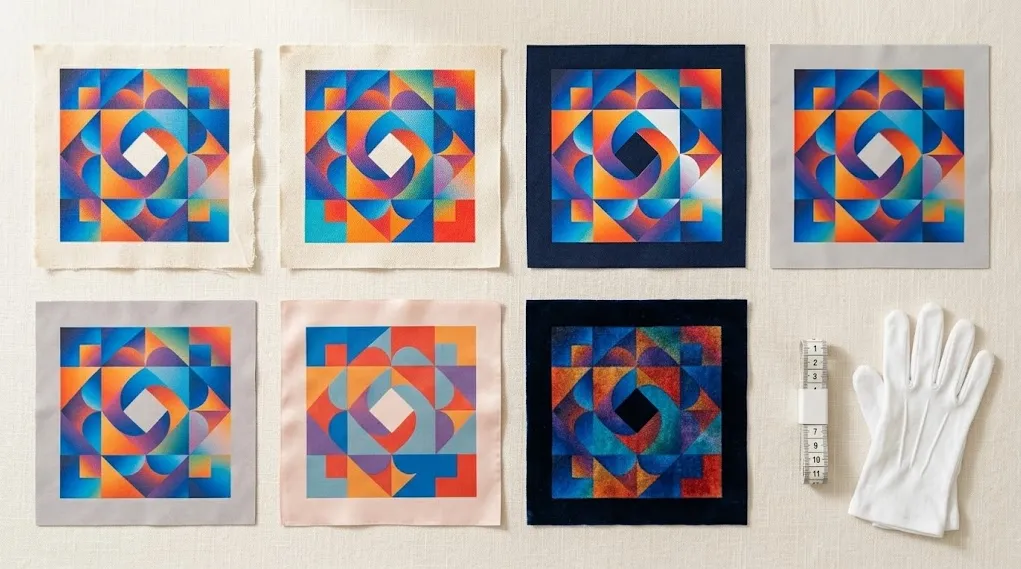
DTF printing fabric compatibility is one of the method’s biggest strengths. Almost everything takes DTF — but some materials still work better than others.
| Fabric | DTF Result | Notes |
|---|---|---|
| Cotton | ✅ Excellent | Default; soft hand, vibrant colors |
| Canvas | ✅ Excellent | Heavy fabric grips adhesive well |
| Polyester blend | ✅ Excellent | DTF beats screen printing on these |
| Microfiber | ✅ Excellent | Smooth surface, great for jewelry pouches |
| Satin | ✅ Good | Lower press temp needed |
| Velvet | ⚠️ Fair | Pile interferes; specialty press required |
| Organza / mesh | ❌ Poor | Too sheer, film shows on reverse |
| Leather | ⚠️ Fair | Possible but specialty knowledge needed |
Two patterns stand out.
First, DTF dominates synthetic and blended fabrics. Specifically, polyester, microfiber, and poly-cotton blends — fabrics where screen printing struggles — all take DTF beautifully. As a result, this is why beauty and cosmetic brands have largely switched to DTF for cosmetic pouches and microfiber bags.
Second, DTF handles natural fibers too. Cotton and canvas — the traditional screen-printing fabrics — also work great with DTF. So you can use one method across an entire product line without retooling.
For most B2B packaging buyers, our recommendation order is microfiber, cotton, canvas, and polyester for DTF projects. We also offer DTF on cotton pouches as a low-MOQ alternative to screen printing.
7. DTF Printing Cost by MOQ
Cost is where DTF really shines. So here’s the honest breakdown by quantity.
| Order Quantity | Simple Logo (1-3 colors equivalent) | Full-Color / Photo Logo |
|---|---|---|
| 100 pcs | $0.50 – $1.00 | $0.80 – $1.50 |
| 500 pcs | $0.30 – $0.70 | $0.45 – $1.00 |
| 1,000 pcs | $0.25 – $0.55 | $0.35 – $0.75 |
| 5,000 pcs | $0.20 – $0.45 | $0.30 – $0.60 |
Three things drive DTF printing cost.
First, logo size. A 4-inch logo uses 4x more film and adhesive than a 2-inch logo. So size affects cost more than color count does — the opposite of screen printing economics.
Second, fabric type. DTF on cotton runs slightly cheaper than DTF on polyester because the press cycle is shorter. By contrast, microfiber and canvas sit in the middle of the cost range.
Third, order quantity has less impact than with screen printing. DTF has no major setup cost to amortize. As a result, the per-piece price drops gently from 100 to 5,000 pieces — not dramatically like screen printing.
One quick tip. Always ask your supplier about minimum logo size. Most DTF systems struggle below 0.5mm line thickness. So ultra-fine logos may need a switch to embroidery or hot stamping.
8. DTF Printing vs Other Logo Methods
DTF isn’t your only choice. Here’s how it stacks up against the four main alternatives.
| Method | Best When | Avoid When |
|---|---|---|
| DTF Printing | Small-medium runs, full-color, multi-fabric | 5,000+ pcs with simple logo (use screen) |
| Screen Printing | High volume, 1-3 colors, cotton/canvas | Photo logos, polyester, small runs |
| Heat Transfer (Vinyl) | Tiny runs, simple shapes, fast turnaround | Anything over 500 pcs or complex art |
| Embroidery | Luxury bags, premium feel, durable | Fine detail, gradients, tight budgets |
| Hot Stamping | Metallic foil logos, jewelry packaging | Photo logos, rough fabrics |
Two practical rules emerge.
First, DTF replaces vinyl heat transfer for almost everyone. Vinyl was the go-to for small runs because it skips screen setup. Now DTF does that better — full color, softer feel, longer durability. So if you’ve been using vinyl, switching to DTF is usually an upgrade with no downsides.
Second, DTF and traditional methods can coexist. Many premium brands now use embroidery for the main logo and DTF for secondary decoration (like care labels or hangtags). So the question isn’t “which one wins” — it’s “which one for which element.”
For metallic foil logos, see hot stamping on fabric. For luxury premium feel, embroidery is still king. For everything else, DTF is now the default in 2026.
9. 5 Common Mistakes Brands Make With DTF
After hundreds of DTF orders, the same five mistakes show up constantly. So avoid these.
Mistake 1: Treating DTF like cheap vinyl transfer. DTF has come a long way. Modern DTF prints feel almost as soft as screen printing — far from the plasticky vinyl you might remember. So request a current sample, not a 2022 reference.
Mistake 2: Comparing DTF cost to screen printing at high volume. Screen printing wins big at 5,000+ pieces with simple logos. So for huge orders, run both quotes — DTF isn’t always cheaper.
Mistake 3: Ignoring film quality. Cheap DTF films use brittle adhesive that cracks after 10-15 washes. Premium films (Cold-Peel CP series, Korean A-grade) last 40-60 washes. So always ask which film brand your supplier uses.
Mistake 4: Designing logos too small. DTF needs at least 0.5mm line thickness for clean reproduction. Anything finer blurs. So simplify your logo before quoting if it has hairlines.
Mistake 5: Skipping the wash test. Photos can’t show how DTF holds up after 20 washes. So ask your supplier for a wash-tested sample. Reputable factories already do this internally.
DTF printing for pouches becomes much smoother once these five mistakes are avoided.
10. Conclusion — DTF Printing Decision Test
Skip the long analysis. Instead, use this 60-second test.
Ask yourself four quick questions:
1. Is your order between 100 and 1,000 pieces? → DTF wins on cost.
2. Does your logo have 3+ colors, gradients, or photo elements? → DTF is the only practical choice.
3. Is the fabric polyester, microfiber, or a blend? → DTF beats screen printing here.
4. Do you need fast turnaround (under 7 days)? → DTF skips screen setup.
If three answers point to yes, DTF printing is your method. If most point to no — large volume + simple cotton + 1-color logo — stick with screen printing.
That’s it. Sixty seconds. Real answer.
11. FAQs
Q1: What does DTF stand for?
DTF stands for “Direct To Film.” Specifically, the process prints your design onto a PET film first, then heat-transfers the film to fabric. So unlike sublimation or direct-to-garment printing, the film acts as a carrier for the design.
Q2: How long does DTF printing last on a fabric bag?
Quality DTF lasts 40-60 wash cycles before noticeable fading. Premium films can reach 60-80 washes. By contrast, cheap DTF films may fail in 10-15 washes. So film quality matters as much as the process itself.
Q3: Is DTF better than screen printing?
It depends on your order. For under 500 pieces with full-color logos, DTF usually wins on cost and quality. For 5,000+ pieces with 1-3 color logos, screen printing still wins. So neither is universally “better” — they serve different needs.
Q4: Can DTF printing handle gold or metallic logos?
Standard DTF can’t replicate true metallic foil — it just simulates gold with CMYK pigment. So for actual metallic shine, you need hot stamping instead. However, holographic and metallic-effect DTF films are emerging in 2026, which can approximate metallic looks for medium-quality applications.
Q5: Does DTF work on dark fabrics?
Yes, beautifully. DTF prints a white underbase layer on the film first, then the colors. As a result, the design shows up vibrantly on black, navy, or any dark fabric. By contrast, screen printing on dark fabrics needs separate white underbase setup.
Q6: What’s the MOQ for DTF printing?
Most factories accept DTF at just 50-100 pieces. Naturally, this is because DTF has near-zero setup cost. So small test runs that would be uneconomical for screen printing are practical with DTF.
Q7: Is DTF eco-friendly?
Newer DTF systems use water-based pigment inks that meet OEKO-TEX standards. PET films are technically recyclable, though local recycling depends on infrastructure. By contrast, DTF still uses petrochemical-based adhesive powder. So it’s “more eco” than PVC plastisol but not fully sustainable yet.
Get a Quote — Custom DTF Printed Pouches
YJXpack — Yijiaxin (Shenzhen) Packaging Co., Ltd.
For 20+ years, we’ve made custom fabric pouches with every decoration method — DTF printing, screen printing, embroidery, heat transfer, hot stamping, embossing, and more. We hold GOTS, GRS, OEKO-TEX, BSCI, ISO 9001, and SABER certifications, and we serve over 8,000 brands worldwide.
Curious how DTF feels on your fabric? Request a free sample with your logo DTF-printed on the exact pouch you’re considering. Touch it, wash it, compare it to screen printing. Decide with confidence.
Email: info@yjxpack.com
WhatsApp / WeChat: +86 18617112946
Website: www.yjxpack.com
Free DTF sample shipped to your door · Quote within 3 minutes · 3D mockup in 30 minutes · MOQ 100 pieces · GOTS / GRS / OEKO-TEX / BSCI / ISO 9001 certified
Share This Story, Choose Your Platform!