You’ve just received five supplier quotes for the same custom pouch. The unit prices range from $0.85 to $2.40. The setup fees range from $50 to $480. The MOQs range from 100 to 1,000 pieces. And every supplier swears their offer is the most competitive.
Sound familiar? Welcome to the procurement nightmare that is logo printing cost comparison. Without a clear framework, B2B buyers waste hours comparing apples to oranges.
This guide fixes that. We’ve worked with 8,000+ brands over 20 years, and we’ll walk you through the five core logo decoration methods — screen printing, DTF, embroidery, hot stamping, debossing — and break down exactly what each costs.
You’ll learn three things. First, the four components that actually drive logo printing cost (most quotes hide one or two). Second, real numbers for setup fees, unit prices, MOQ, and lead times across all five methods. Third, an ROI formula that converts “$0.50 per piece” into “cost per brand impression” — the metric that actually matters.
By the end, you’ll never get blindsided by a supplier quote again.
1. Logo Printing Cost — The 1-Minute Quick Answer
Let’s skip ahead. Here’s the bottom line.
For most B2B fabric bag orders, the logo printing cost ranges from $0.10 to $2.50 per piece, depending on method and quantity. The cheapest is screen printing at scale. The most expensive is large embroidered logos at low quantity.
Naturally, the real answer depends on your order specifics. Here’s the fast-look table.
| Method | Setup Fee | Unit Price (1,000 pcs) | MOQ | Lead Time |
|---|---|---|---|---|
| Screen Printing | $50-100/color | $0.15-0.50 | 100 pcs | 5-7 days |
| DTF Printing | ~$0 (digital) | $0.25-0.60 | 50 pcs | 3-5 days |
| Embroidery | $60-150 | $0.50-1.80 | 100 pcs | 5-7 days |
| Hot Stamping | $80-150 | $0.20-0.80 | 100 pcs | 5-7 days |
| Debossing | $80-150 | $0.15-0.40 | 100 pcs | 5-7 days |
That’s the fast version. Now let’s break it down properly.
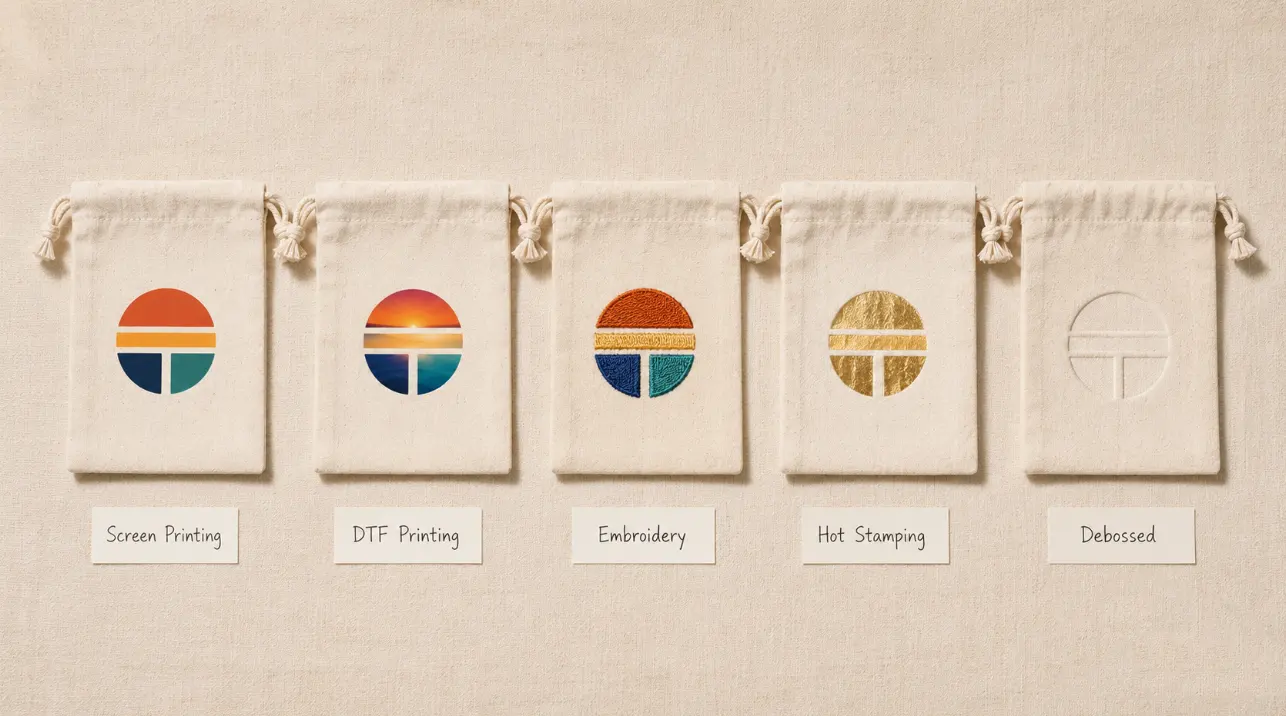
2. The 4 Components That Drive Logo Printing Cost
Most quotes lump everything into one number. So let’s separate the four real components.
Component 1: Setup fee. This is the one-time cost to prepare your logo for production. Screen printing needs screens. Embroidery needs digitizing. Hot stamping needs a brass die. Naturally, setup is fixed — it costs the same whether you order 100 or 10,000 pieces.
Component 2: Unit price (per-piece printing cost). This is what you pay for each individual logo application. For high-volume orders, this number dominates. For small runs, the setup fee often beats the unit price in total impact.
Component 3: Material markup. Premium inks (water-based, OEKO-TEX certified), specialty foils (holographic, rose gold), or specialty threads (metallic, polyester sheen) add 20-50% to standard pricing. So always confirm what “standard” includes in your quote.
Component 4: Logo size & complexity. A 4-inch embroidered logo can cost 4x a 2-inch logo (stitch count grows non-linearly). For instance, embroidery cost per piece scales with stitch density, not just dimensions. Plus, a multi-color screen print needs multiple screens. And a photo-realistic DTF transfer uses more ink. As a result, logo design choices directly impact logo printing cost.
So when you get a quote that just says “$0.80 per piece,” ask which of these four components is included and which isn’t. Reputable factories break them out openly. By contrast, hidden bundling makes apples-to-apples comparison impossible.
3. Setup Fee Breakdown by Method
Setup fees are where buyer confusion starts. The setup fee logo printing equation has more variables than most quotes reveal. Here’s the real breakdown.
| Method | Setup Type | Typical Cost | What You Get |
|---|---|---|---|
| Screen Printing | Mesh screen per color | $50-100 per color | Reusable screens; 1-color logo $50-100, 3-color logo $150-300 |
| DTF Printing | Digital file prep | $0-30 (often free) | No physical setup; just artwork sizing |
| Embroidery | Digitizing (stitch program) | $60-150 | One-time digital file; complex logos higher |
| Hot Stamping | Brass die engraving | $80-150 | Reusable metal die; larger logos $200+ |
| Debossing | Steel die engraving | $80-150 | Single die (vs embossing’s 2-die pair) |
| Embossing | Male+female die pair | $150-300 | Pair must align within 0.1mm |
Three key insights here.
First, DTF wins on setup. With near-zero setup cost, DTF lets you test small batches without committing. As a result, brands launching new SKUs increasingly default to DTF for pilot runs.
Second, screen printing setup scales linearly. Each color adds $50-100. So a 5-color logo can mean $250-500 in setup alone — sometimes more than the per-piece printing cost for a 200-piece order.
Third, dies are reusable. Once you pay $120 for an embroidery digitization or a brass stamp die, future re-orders skip that cost entirely. So budget your first order accordingly and plan for cheaper re-orders later. For more on screen setup specifically, see our deep dive on screen printing on fabric bags.
4. Logo Printing Cost by Order Quantity
Now the unit price — the number most buyers obsess over. Here’s the real breakdown across quantities.
| Method | 100 pcs | 500 pcs | 1,000 pcs | 5,000 pcs |
|---|---|---|---|---|
| Screen Printing (1 color) | $0.80-1.50 | $0.30-0.60 | $0.15-0.40 | $0.10-0.25 |
| DTF Printing | $0.50-1.20 | $0.30-0.70 | $0.25-0.60 | $0.20-0.45 |
| Embroidery (small logo) | $1.50-3.00 | $0.90-2.00 | $0.70-1.80 | $0.60-1.50 |
| Hot Stamping | $1.20-2.50 | $0.45-1.00 | $0.25-0.80 | $0.15-0.50 |
| Debossing | $0.80-1.50 | $0.30-0.60 | $0.15-0.40 | $0.10-0.30 |
Three patterns emerge.
First, screen printing and debossing both have aggressive volume discounts. From 100 to 5,000 pieces, the per-piece cost drops 6-8x. Naturally, this is why large promotional orders default to these methods. For mass-market cotton tote bags, screen printing is almost unbeatable on cost.
Second, DTF stays remarkably flat across quantities. The price drops only 2-3x from 100 to 5,000 pieces. So DTF doesn’t reward volume — but it doesn’t punish small orders either. We covered this in our full guide on DTF printing for pouches.
Third, embroidery is the most expensive at every quantity. By contrast, it’s also the most durable — so the logo printing cost calculation should factor in lifetime, not just upfront price.
One critical tip. The unit price ranges above assume standard inks/foils/threads. Premium materials (OEKO-TEX inks, holographic foils, metallic threads) add 20-50%. So always confirm material spec when comparing quotes.
5. MOQ Reality Check — What Suppliers Actually Accept
MOQ is where supplier marketing meets supplier reality. Here’s the honest breakdown.
| Method | Official MOQ | Practical MOQ | Notes |
|---|---|---|---|
| Screen Printing | 100 pcs | 300+ pcs | Setup cost dominates below 300 |
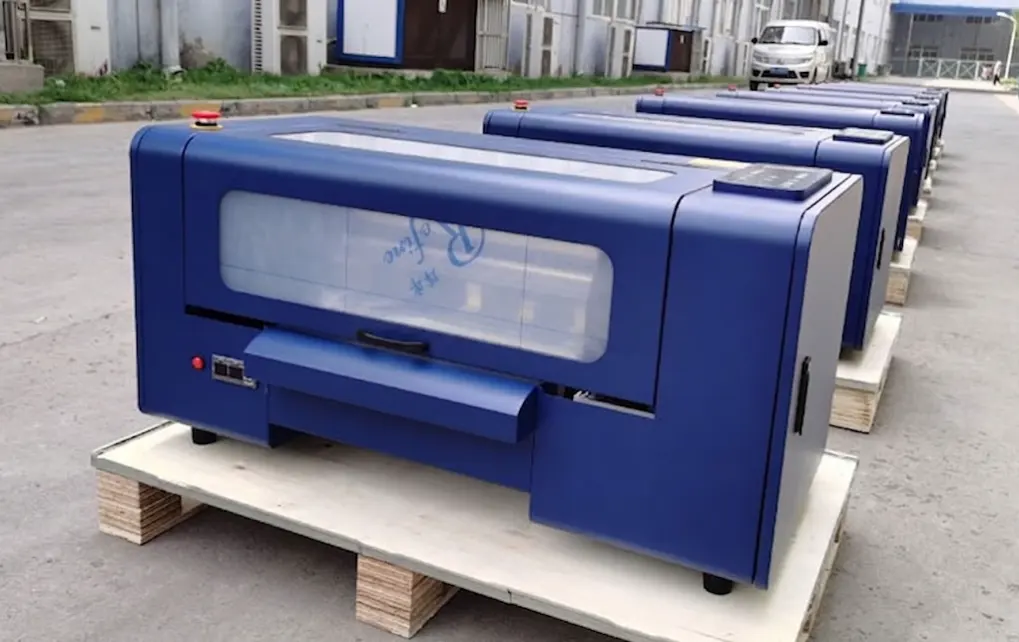
| DTF Printing | 50 pcs | 50-100 pcs | Truly low-MOQ friendly |
| Embroidery | 100 pcs | 100-200 pcs | Digitizing setup fixed |
| Hot Stamping | 100 pcs | 200+ pcs | Die cost spreads better at higher qty |
| Debossing | 100 pcs | 200+ pcs | Same die economics as hot stamping |
Two practical rules.
First, “official MOQ” is often a marketing number. A factory may accept 100 pieces for screen printing — but the unit price at 100 will be so high that you’d save money ordering 300 instead. So always ask for tiered pricing at 100, 300, 500, 1,000.
Second, DTF is the genuine low-MOQ champion. For sample runs, market tests, and small-batch launches, screen print MOQ economics don’t work. By contrast, DTF prices at 50-100 pieces are reasonable enough to justify pilot orders.
So when a supplier says “MOQ 100,” ask the right follow-up: “What’s the unit price at 100 vs 300 vs 500?” The answer reveals whether they really want small orders or just market that they do.
6. Lead Time Comparison — From Sample to Shipping
Time is money — especially in fast-moving consumer packaging. Here’s what to expect.
| Method | Sample Lead Time | Production Lead Time | Rush Available? |
|---|---|---|---|
| Screen Printing | 3-5 days | 5-7 days (1,000 pcs) | Yes, +15-25% rush fee |
| DTF Printing | 1-3 days | 3-5 days (1,000 pcs) | Yes, often no rush fee |
| Embroidery | 2-4 days | 5-7 days (1,000 pcs) | Yes, +15-25% rush fee |
| Hot Stamping | 3-5 days | 5-7 days (1,000 pcs) | Yes, +20-30% rush fee |
| Debossing | 3-5 days | 5-7 days (1,000 pcs) | Yes, +20-30% rush fee |
Three insights.
First, DTF wins on speed too. Because there’s no physical setup, samples can ship in 1-3 days. As a result, DTF is the default choice for last-minute campaigns or trade show deadlines.
Second, methods using dies (hot stamping, debossing, embossing) have the longest sample lead times. Die engraving takes 2-3 days minimum. So plan accordingly if you’re sampling these methods.
Third, all methods support rush orders — but at a premium. Generally, 15-30% surcharge buys you 2-3 days off the standard timeline. So if your deadline is tight, just ask. Reputable factories price rush transparently.
One quick tip. Total lead time = sample lead + sample shipping (3-5 days international) + approval time (your team) + production lead + ocean/air freight. Naturally, this often totals 30-45 days for international B2B orders. So plan 6 weeks out, not 6 days.
7. The ROI Formula — Calculating True Cost Per Brand Impression
Unit price alone is misleading. Here’s a better metric.
Cost per brand impression = (Unit price + setup fee ÷ qty) ÷ expected lifetime impressions
This formula matters because a $0.40 screen-printed logo on a disposable cotton tote is not equivalent to a $1.20 embroidered logo on a reusable canvas bag. The first generates maybe 10 brand impressions before getting tossed. The second generates 500+ over its multi-year life.
Let’s run real numbers.
Example A — Promotional cotton tote
– Unit price: $0.40 screen print
– Setup fee: $100 ÷ 1,000 pcs = $0.10
– True cost per piece: $0.50
– Lifetime impressions: 10 (used at event, then tossed)
– Cost per impression: $0.050
Example B — Premium canvas tote with embroidery
– Unit price: $1.20 embroidered
– Setup fee: $120 ÷ 1,000 pcs = $0.12
– True cost per piece: $1.32
– Lifetime impressions: 500 (reusable for 3+ years)
– Cost per impression: $0.0026
So the “expensive” embroidered bag is actually 19x more cost-efficient as brand marketing. Naturally, this is why luxury brands invest in embroidery — they’re optimizing for impression cost, not unit cost.
This is especially true for custom jewelry pouches, where customers keep the bag forever as a keepsake. Each impression compounds.
8. The Logo Printing Cost Sweet Spot for Each Method
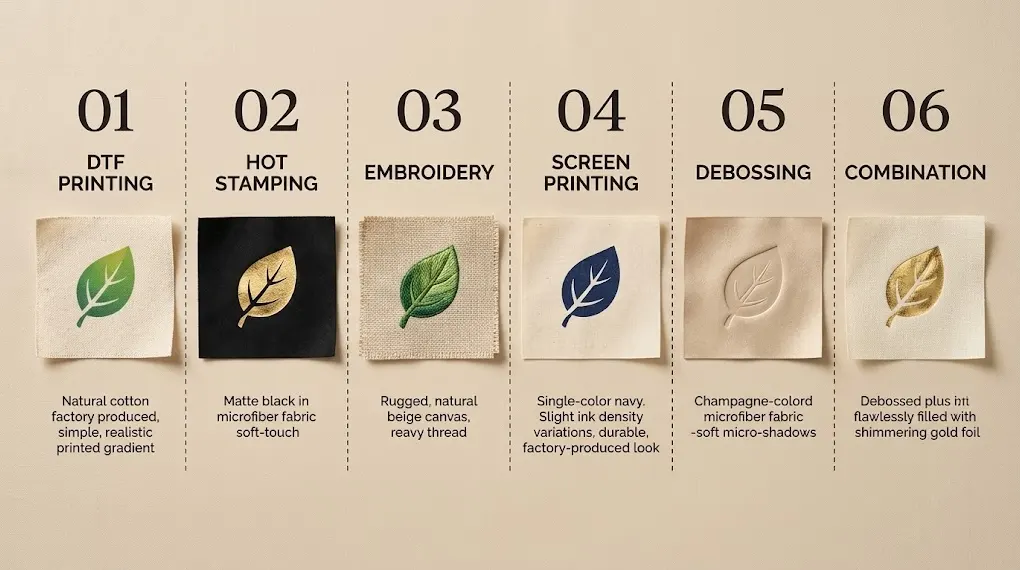
Each method has a sweet spot where its logo printing cost beats every alternative. So a smart logo method comparison considers volume, complexity, and brand position together. Here’s the matrix.
| Scenario | Best Method | Why |
|---|---|---|
| Promotional totes, 5,000+ pcs, 1-color | Screen Printing | Setup amortizes, unit drops below $0.15 |
| Small launch batches, 100-500 pcs, complex art | DTF Printing | No setup, handles full color free |
| Luxury packaging, premium feel, durable | Embroidery | Highest brand perception per dollar |
| Beauty/jewelry pouches, metallic logo | Hot Stamping | Foil shine impossible to fake |
| Modern luxury, leather pouches | Debossing | Permanent, low maintenance, quiet luxury |
| Cotton totes, mid-volume, 2-3 colors | Screen Printing | Volume discount kicks in at 500 pcs |
| Cosmetic pouches, photo logos | DTF Printing | Photo realism + multi-fabric support |
| Welcome bags, mass-market gifts | Screen or Debossing | Lowest cost at high volume |
Three rules emerge.
First, screen printing dominates volume + simplicity. Anytime you have 1,000+ pieces with a simple 1-3 color logo, screen printing is the default.
Second, DTF dominates small + complex. For under 500 pieces or full-color art, DTF wins on both cost and quality.
Third, premium methods (embroidery, hot stamping, debossing) win on brand perception, not unit price. So pick these for products where customers value the package itself — like cosmetic pouches kept for daily use. We covered the foil decision in detail in hot stamping on fabric.
9. 5 Common Cost Mistakes Brands Make
After 20 years of B2B quotes, the same five mistakes show up constantly. So avoid these.
Mistake 1: Comparing unit price without setup. A $0.30 unit + $300 setup beats a $0.45 unit + $50 setup only above 1,500 pieces. So always calculate total cost at your actual quantity, not just per piece.
Mistake 2: Forgetting material spec premiums. “Water-based ink” sounds cheap but adds 20-30% to standard plastisol. OEKO-TEX certified inks add another 10%. So confirm material spec when comparing quotes.
Mistake 3: Underestimating logo size impact. A 4-inch logo can cost 3-4x a 2-inch logo in embroidery or hot stamping. By contrast, screen printing and DTF size up cheaper. So design with method in mind.
Mistake 4: Ignoring sample fees. Pre-production samples cost $15-50. Many buyers skip them to save money. Then they get the wrong logo at full quantity. So always pay for the sample — it’s the cheapest insurance you’ll buy.
Mistake 5: Picking based on quote alone. The cheapest quote often hides setup fees, uses inferior inks, or has 30% reject rates. So evaluate factories on QC track record, sample quality, and certifications — not just unit price.
Logo printing cost decisions become much smoother once these five mistakes are avoided.
10. Conclusion — Logo Printing Cost Decision Test
Skip the long analysis. Instead, use this 60-second test.
Ask yourself four quick questions:
1. Is your order 1,000+ pieces with 1-3 colors? → Screen printing wins on logo printing cost.
2. Is your order under 500 pieces with complex art? → DTF wins.
3. Will customers keep the bag for years? → Pay up for embroidery or hot stamping.
4. Is your budget under $0.30 per piece total? → Screen printing or debossing.
If three answers align, that’s your method. If they split, optimize for cost-per-impression (Section 7), not unit price.
That’s it. Sixty seconds. Real answer.
11. FAQs
Q1: Why do logo printing cost quotes vary so much between suppliers?
Three reasons. First, setup fees are calculated differently — some bundle them into unit price, others list them openly. Second, material spec varies — premium inks add 20-50%. Third, supplier overhead differs. So always request a line-item quote covering setup, unit, materials, and any minimums.
Q2: What’s the cheapest logo printing method overall?
For high-volume orders (1,000+ pieces) with simple logos, screen printing wins at $0.10-0.25 per piece. For small-volume orders (under 300 pieces), DTF wins because it has near-zero setup cost. Naturally, embroidery is the most expensive at every volume tier.
Q3: Should I pay extra for OEKO-TEX certified inks?
Yes, if your product reaches EU markets or skin-contact applications. OEKO-TEX certified inks cost 10-20% more but they’re required by many EU retailers and reassure end customers. By contrast, US-only domestic orders can usually skip this premium.
Q4: How does logo size affect total cost?
Significantly. For embroidery and hot stamping, doubling logo size can triple the cost because stitch count or foil consumption grows non-linearly. For screen printing and DTF, size impact is smaller — typically 30-50% more for double the size. So always quote with actual final logo dimensions, not “approximate.”
Q5: Can I negotiate setup fees down?
Yes, sometimes. Setup fees are usually fixed for new dies/screens. However, for re-orders using the existing setup, ask explicitly if setup is waived. Many factories don’t volunteer this discount — you have to request it. So track your setup investments across re-orders.
Q6: What’s a fair markup for rush production?
Industry standard is 15-30% for 30-50% time reduction. Specifically, 5-7 day standard production compressed to 3-5 days typically costs +20%. Compressed to 2-3 days costs +30-40%. So budget rush premium into your planning if deadlines are tight.
Q7: How do I compare logo printing cost across different methods fairly?
Calculate “true total cost per piece” at your actual order quantity. The formula is: (Unit Price × Quantity + Setup Fee + Sample Fee) ÷ Quantity. Then compare that single number across suppliers and methods. By contrast, comparing raw unit prices is misleading — setup amortization changes everything at different quantities.
Get a Quote — Transparent Logo Printing Cost Breakdown
YJXpack — Yijiaxin (Shenzhen) Packaging Co., Ltd.
For 20+ years, we’ve quoted thousands of B2B custom pouch orders with line-item transparency. Every YJXpack quote breaks out setup fees, unit prices, material premiums, and lead times — so you can compare apples-to-apples with any other supplier. We hold GOTS, GRS, OEKO-TEX, BSCI, ISO 9001, and SABER certifications, and we serve over 8,000 brands worldwide.
Want a real cost comparison across methods? Send us your logo and target quantity. We’ll send back a single PDF comparing screen print, DTF, embroidery, hot stamping, and debossing — with full breakdowns. Free, no commitment.
Email: info@yjxpack.com
WhatsApp / WeChat: +86 18617112946
Website: www.yjxpack.com
Free cost comparison across 5 methods · Quote within 3 minutes · 3D mockup in 30 minutes · MOQ 100 pieces · GOTS / GRS / OEKO-TEX / BSCI / ISO 9001 certified
Share This Story, Choose Your Platform!