You’re about to launch your brand’s first custom jewelry pouch. You contact three factories. All three say “sure, we can send a sample.” Then the surprises start. Factory A sends a stock pouch in a similar color — free. Meanwhile, Factory B sends a custom-made pouch with your logo — $35 each. And Factory C sends a fully-finished production-quality piece — $80 and a 14-day wait.
Why such different responses? Because “sample” doesn’t mean one thing. It means three different things, and most online guides skip this entirely. Here’s the problem with most articles on custom packaging samples. They explain “ordering samples” as one process. Plus, they don’t tell you which sample type to ask for. And worst of all, they skip both the packaging sample cost ranges and the evaluation checklist that determines whether your sample is actually production-ready.
This article fixes that. In plain English, you’ll learn three things. First, the three distinct types of custom packaging samples and when each makes sense. Second, real cost ranges, lead times, and a 7-step ordering process. Third, a 12-point evaluation checklist that catches problems before they become production-scale disasters.
By the end, you’ll order samples with confidence — not guesswork.
1. Custom Packaging Samples — The 1-Minute Quick Answer
Let’s skip ahead. Here’s the bottom line.
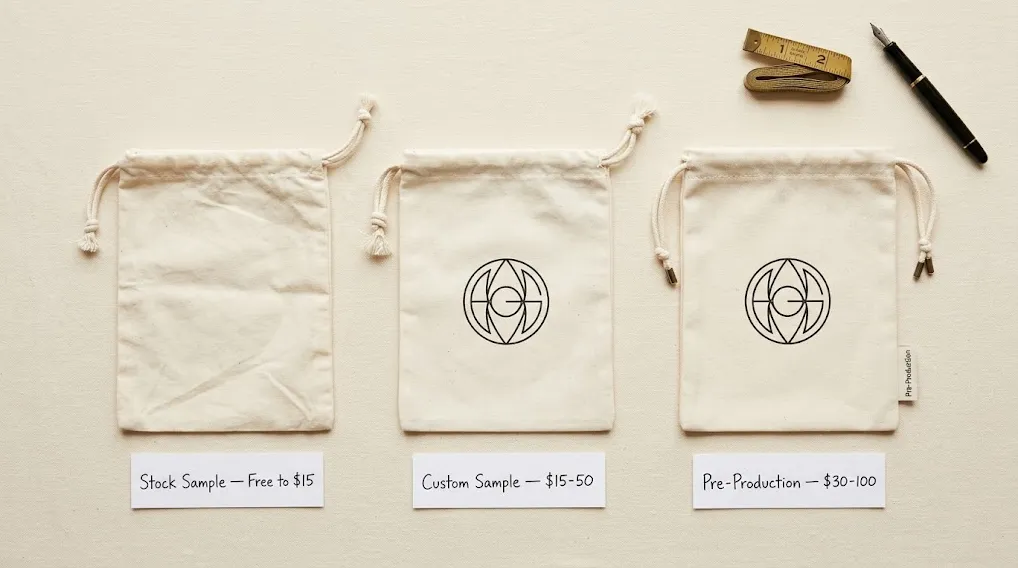
Custom packaging samples come in three types: stock samples (free or $5-15, 3-5 days), custom factory samples ($15-50, 5-10 days), and pre-production samples ($30-100, 10-21 days). As a result, the right type depends on whether you need to check fabric, design, or full production quality.
Naturally, the right choice depends on your stage in the sourcing process. Here’s the fast-look table.
| Sample Type | Typical Cost | Lead Time | Use When |
|---|---|---|---|
| Stock sample (off-the-shelf) | Free – $15 | 3-5 days | Evaluating fabric & quality |
| Custom factory sample | $15-50 | 5-10 days | Confirming design & logo |
| Pre-production sample | $30-100 | 10-21 days | Final approval before bulk |
| Lab dip (color match only) | Free – $20 | 3-7 days | Checking dye accuracy |
| Photo sample (no shipping) | Free | 1-2 days | Quick visual check only |
That’s the fast version. Now let’s break it down properly.
2. What Is a Packaging Sample? (3 Types Explained)
The word “sample” hides three completely different products. So let’s separate them clearly.
| Property | Stock Sample | Custom Factory Sample | Pre-Production Sample |
|---|---|---|---|
| Made specifically for you? | Pulled from inventory | Yes — made on demand | Yes — production conditions |
| Includes your logo? | None | Yes | Yes (production-locked) |
| Includes your custom color? | Stock colors only | Yes — within library | Yes — exact Pantone match |
| Production quality? | Generic | Hand-crafted, often nicer | Matches actual production |
| Cost | Free – $15 | $15-50 | $30-100 |
| Lead time | 3-5 days | 5-10 days | 10-21 days |
| Refundable from production order? | N/A | Sometimes (50-100%) | Often refunded fully |
Three insights here.
First, stock samples are for evaluating the factory itself. They tell you about fabric quality, stitching tightness, and the factory’s general workmanship. By contrast, they tell you nothing about whether your specific design will work.
Second, custom factory samples are the most overlooked type. Specifically, they’re made by the factory’s senior craftsmen — often nicer than actual production quality. As a result, buyers approve them, then complain when bulk production looks “rougher.” This is the #1 source of post-shipment disputes.
Third, pre-production samples are the only way to truly preview your bulk order. They’re made by the same production line that will run your order. The fabric is from the same dye batch. The logo is the locked formula. Naturally, this is why pre-production samples matter most for premium brands.
So when you say “send me a sample,” you’re actually asking for one of three different products. Be specific — or your supplier will guess.
3. When You Actually Need a Sample — 5 Real Scenarios
Not every order needs every type of sample. Here are the five scenarios where samples save real money.
Scenario 1: First-time supplier. Always order a stock sample before any quote discussion. Specifically, you’re testing whether the factory can deliver quality you’ve never seen from them. So the $5-15 cost protects you from a $5,000 bad order.
Scenario 2: First custom design with a known supplier. Order a custom factory sample. Plus include all spec details — fabric, color, logo, size, hardware. By contrast, skipping this means you’ll likely find issues in bulk that could’ve been caught at sample stage.
Scenario 3: Re-order with design changes. Even small changes (logo size, dye color, drawstring length) need a fresh sample. Naturally, factories occasionally “forget” change details if not visually confirmed.
Scenario 4: Production order over $5,000. Always request a pre-production sample for high-value orders. The cost is trivial. The protection is real — catching one production-line setting issue can save thousands in rejected stock.
Scenario 5: New fabric or new factory floor. If the factory recently switched fabric suppliers or moved production to a new line, request a fresh sample even on repeat orders. Specifically, production conditions affect outcomes more than buyers realize.
So the pouch sample process protects every transaction above $500. For smaller orders, the trade-off shifts — sometimes accepting supplier photos is reasonable.
4. Stock Sample vs Custom Sample — The Cost & Time Reality
The stock vs custom sample choice is where most buyers make their first mistake. So let’s compare them properly.
| Question | Stock Sample | Custom Sample |
|---|---|---|
| How fast? | 3-5 days (ready to ship) | 5-10 days (made from scratch) |
| How much? | Free to $15 | $15-50 |
| Refund from bulk order? | Not applicable | Often refunded 50-100% |
| Shows your logo? | No | Yes |
| Color accuracy? | Stock colors only | Custom Pantone available |
| Tells you about? | Factory capability | Your specific design |
| Best for | Vetting new suppliers | Approving final design |
Three rules emerge.
First, always start with stock samples when vetting new suppliers. Specifically, the goal isn’t to see your final product — it’s to see whether the factory can produce quality at all. As a result, even free stock samples tell you 70% of what you need to know about a supplier.
Second, custom samples are worth paying for. Naturally, $15-50 is trivial compared to a $2,000+ production order. So when a supplier offers a free custom sample, be suspicious — quality custom sampling has a real cost.
Third, the stock vs custom sample decision often becomes “both.” The professional workflow is: stock sample first (3-5 days, free) → if quality passes → custom sample (5-10 days, $15-50) → if design approved → production order. This sequence rarely takes more than 3 weeks total.
So budget two sample rounds for any new supplier relationship. Plus expect to pay $20-80 total in sample fees. By contrast, this is the cheapest insurance you’ll ever buy in B2B procurement.
5. The 7-Step Sample Ordering Process
The professional sample workflow has seven specific steps. Skip one and you’ll pay for it later.
Step 1: Define what you actually need. Write down fabric (cotton/canvas/velvet/satin), exact dimensions, color (with Pantone code if specified), logo method (screen print, embroidery, hot stamp, DTF), and any hardware. Specifically, vague specs (“a nice cotton bag with my logo”) get vague samples. By contrast, detailed specs get accurate samples.
Step 2: Contact 2-3 suppliers in parallel. Send identical spec sheets to multiple factories. As a result, you can compare samples directly. Plus you gain leverage on pricing.
Step 3: Request the right sample type. If you’re vetting the factory, ask for stock samples first. If you’re confirming design, ask for custom factory samples. Naturally, mention both options if you want comparison.
Step 4: Pay sample fees and shipping upfront. Most factories require sample payment before production. International shipping (DHL, FedEx) typically runs $25-60. So budget $50-150 total for samples from each supplier.
Step 5: Confirm specs in writing before factory starts. Before the factory begins making your custom sample, get a written confirmation of all specs. Plus request a 3D rendering or technical drawing if possible. By contrast, skipping this step often means the factory makes assumptions you’ll dispute later.
Step 6: Receive and evaluate. When the sample arrives, use the 12-point checklist (Section 8). Specifically, evaluate within 3-5 days of receipt — factories appreciate quick feedback and respond faster.
Step 7: Approve, request revision, or reject. Send written approval (or specific change requests) within 7 days. If approved, the sample becomes your reference for production QC. As a result, every piece in your bulk order should match this approved sample.
So the entire pouch sample process takes 14-30 days from initial contact to approved sample. Plus another 20-45 days from approval to delivered bulk order. Naturally, this is why experienced buyers start sourcing 90+ days before they need product.
6. Custom Packaging Samples — How Much Should They Cost?
Sample pricing varies wildly. So here’s what’s fair to pay by category.
| Pouch Category | Stock Sample | Custom Sample | Pre-Production Sample |
|---|---|---|---|
| Cotton drawstring | Free – $5 | $10-25 | $25-50 |
| Canvas tote | Free – $8 | $15-35 | $30-60 |
| Velvet jewelry pouch | $5-12 | $20-45 | $40-80 |
| Microfiber pouch | $5-10 | $18-40 | $35-70 |
| Satin gift pouch | Free – $8 | $15-30 | $30-60 |
| Custom-dyed Pantone | N/A | $30-60 (incl. lab dip) | $50-100 |
| Specialty (linen, hemp) | $10-15 | $25-50 | $50-90 |
Three practical rules.
First, free is sometimes a red flag. Specifically, factories that offer fully-custom samples for free are either making generic stock items, or they’re recovering costs elsewhere — usually through inflated unit pricing on the production order. So paying $15-30 for a real custom sample protects you in the long run.
Second, sample fees should be refundable from bulk orders. Naturally, reputable factories refund 50-100% of sample fees once a production order is placed. By contrast, “non-refundable sample fees” are a sign the factory isn’t confident you’ll order in volume.
Third, premium materials cost more to sample. Velvet pouches require thicker fabric and more careful stitching. As a result, expect higher sample fees for premium fabrics. For most clients we accept sample fees for cotton tote bags in the $10-25 range and refund them fully on production orders. For a full breakdown of how sample fees fit into total cost, see our logo printing cost comparison.
7. Sample Lead Time Breakdown — Why It Takes 1-21 Days
Lead time confuses many buyers. Here’s where the days actually go.
| Step | Stock Sample | Custom Sample | Pre-Production Sample |
|---|---|---|---|
| Order confirmation | 1 day | 1 day | 1-2 days |
| Sample preparation | 0 days (already made) | 2-4 days | 3-7 days |
| Logo decoration | 0 days | 1-3 days | 2-5 days |
| QC & finishing | 0-1 day | 1 day | 1-2 days |
| International shipping | 2-5 days | 2-5 days | 2-5 days |
| Total typical | 3-7 days | 7-14 days | 9-21 days |
Three insights.
First, international shipping is rarely the bottleneck. Specifically, DHL Express delivers China-US in 3-5 days. By contrast, the factory’s internal time (sample prep + decoration + QC) is where delays happen.
Second, custom Pantone matching adds 3-5 days. Naturally, dye lab work takes time — colors must be mixed, tested, dried, and approved before fabric production starts. So if exact brand color matters, budget extra time. Plus see our Pantone color matching guide for the full workflow.
Third, holidays delay everything. Chinese New Year (late January – mid February) effectively shuts factories for 2-3 weeks. By contrast, Western holidays (Christmas, Thanksgiving) affect shipping but not production. So plan your sample requests around these calendars.
8. The 12-Point Custom Packaging Samples Evaluation Checklist
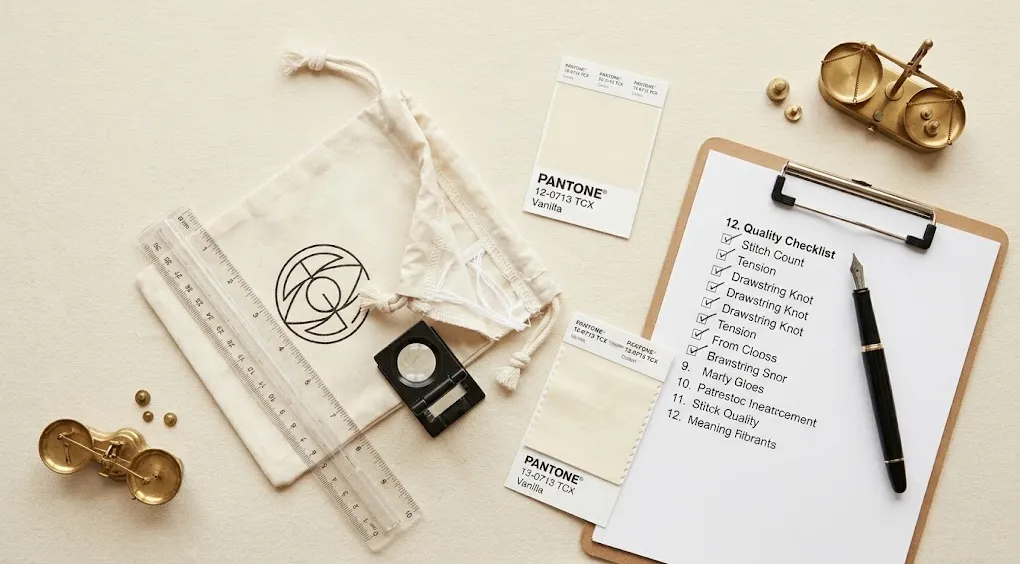
When your sample arrives, evaluate it systematically. So work through these 12 points in order.
1. Fabric weight and hand-feel. Does the fabric feel as substantial as specified? Specifically, request the GSM (grams per square meter) before sampling so you have a target.
2. Color accuracy. Compare the sample to your Pantone reference under D65 daylight (or a north-facing window). Plus take photos for record. By contrast, fluorescent office lighting distorts color perception.
3. Dimensions. Measure the bag with a ruler. Allow ±2-3mm tolerance on standard fabric. Naturally, larger deviations indicate the cutting pattern is off.
4. Logo placement and size. Measure logo position from seams and edges. Confirm logo dimensions match your spec. As a result, this catches mockup-to-production drift early.
5. Logo quality. Check edge sharpness, color saturation, and registration (color alignment for multi-color prints). Plus check for any blurring or fading at the edges.
6. Stitch quality. Count stitches per inch — should be 8-12 SPI for tote bags, 12-16 SPI for premium pouches. Check for skipped stitches, loose threads, or uneven seams.
7. Drawstring or hardware. Test drawstring smoothness, knot security, and aglet attachment. For pouches with metal hardware, check finish and attachment strength.
8. Inside finish. Turn the bag inside out. Check for clean seam finishes, no loose threads, and consistent stitching. Specifically, low-quality factories often skip inside finishing.
9. Smell and chemical residue. Genuine concern for skin-contact products. A strong chemical smell suggests poor dye washing. By contrast, OEKO-TEX certified production should have no chemical odor. See OEKO-TEX standards for the safety framework.
10. Wash test (optional but recommended). Hand-wash one sample at 30°C with mild detergent. Air dry. Then check for color bleeding, shrinkage, or logo degradation. Naturally, this catches dye and ink quality issues.
11. Stretch test. Gently pull the fabric and seams to test durability. Plus pull on the drawstring with normal force. As a result, this verifies the bag will survive customer use.
12. Final visual inspection. Step back, place the sample on a desk, view from 6 feet away. Does it look like a product you’d be proud to ship? If anything looks “off,” request revision before approving.
This 12-point checklist takes about 20 minutes per sample. By contrast, skipping it can cost weeks of production rework. So make it a permanent part of your sample approval process.
9. Sample to Mass Production — What Changes & Why (Factory Insider View)
This is the section nobody else writes. Here’s what really changes between sample and bulk production.
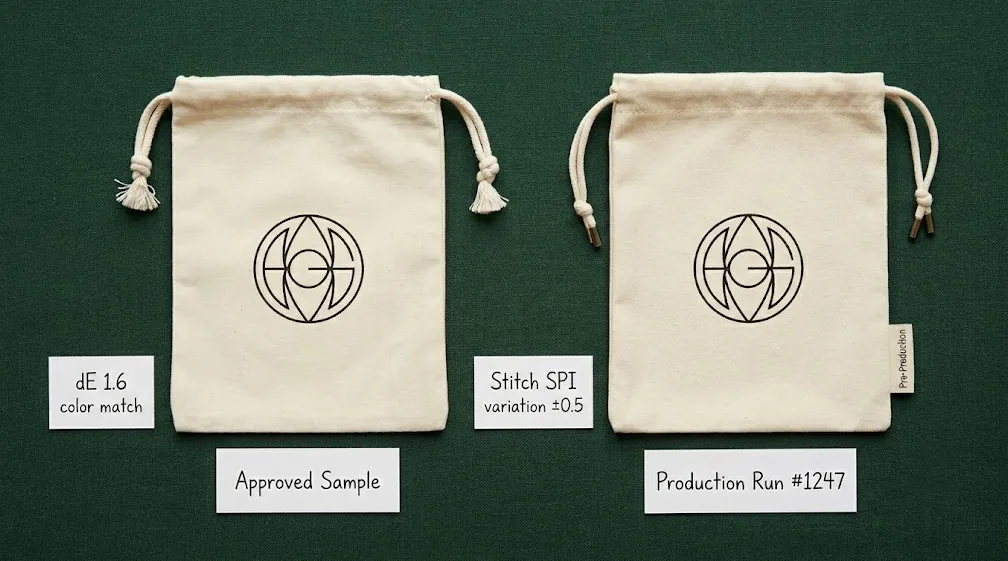
First, sample-makers are usually senior. Specifically, factories assign samples to the most experienced craftsmen — the people who can hand-tune any stitch. Plus they typically work slower and more carefully than the production line. As a result, samples often look slightly nicer than actual production pieces.
Second, dye batches vary. The dye batch used for your sample is rarely the exact batch used for bulk production. Naturally, even careful factories see dE 1-2 color drift between sample dye and production dye. By contrast, smaller factories without dye-formula records may see dE 3-4 drift.
Third, sewing-line speed differs. Production lines run at 80-95% of sample speed. So bulk pieces have slightly less hand-finishing time. The difference is usually invisible — but it’s real.
Fourth, fabric bolts can differ. Two bolts of “the same” fabric from the same mill may have 1-2% weight or texture variation. Specifically, this is why most factories produce all bulk pieces from a single fabric bolt when possible. As a result, requesting “same fabric lot as sample” is a useful spec for premium orders.
Fifth, hardware variations happen. Metal eyelets, drawstring aglets, and clips often come from sub-suppliers. A second batch of “the same” eyelet may have slightly different finish. Naturally, this is why high-end brands lock down hardware suppliers in writing.
So the sample is your reference — but bulk pieces are allowed minor variations. Realistic acceptance criteria are: dE ≤ 3 on color, ±2-3mm on dimensions, ±5% on fabric GSM, and visually comparable stitching. By contrast, demanding “identical to sample” is unreasonable and signals you don’t understand manufacturing.
For more on managing this gap, see our MOQ packaging guide covering pre-production sample workflows in detail.
10. Conclusion — Custom Packaging Samples Decision Test
Skip the long analysis. Instead, use this 60-second test.
Ask yourself four quick questions:
1. Is this a new supplier you haven’t worked with? → Order stock sample first ($0-15, 3-5 days).
2. Have you confirmed factory quality but need to approve design? → Order custom factory sample ($15-50, 7-14 days).
3. Is your bulk order over $5,000? → Order pre-production sample ($30-100, 10-21 days).
4. Do you need exact Pantone color? → Add a lab dip request ($0-20, 3-7 days extra).
If you sequence custom packaging samples this way — stock → custom → pre-production — you catch problems at the cheapest possible stage. By contrast, jumping straight to production without samples is the most expensive mistake in B2B sourcing.
That’s it. Sixty seconds. Real answer.
11. FAQs
Q1: Are custom packaging samples really worth the cost?
Yes, almost always. Specifically, a $30 sample protects a $3,000+ bulk order. As a result, the sample’s cost is typically 1% of order value — for 95% of the risk reduction. By contrast, skipping samples saves $30 but exposes you to thousands in rejected stock or unhappy customers.
Q2: Why do some factories charge for samples and others give them free?
Three reasons. First, factory size — larger factories can absorb free sample costs. Second, material complexity — custom Pantone samples cost real money. Third, buyer screening — paid samples filter out tire-kickers. So “free samples” usually means stock items, not customized.
Q3: How many sample revisions are normal?
For a typical custom design, 1-2 revisions are normal. Plus most factories include the first revision free. By contrast, 4+ revisions indicate either unclear specs from the buyer or quality issues from the factory. So aim to confirm specs precisely before sampling — it cuts revision cycles in half.
Q4: Can I keep the sample after the production order?
Yes, and you should. The approved sample becomes your QC reference. As a result, keep it in a sealed bag with the approval date written on it. So when bulk arrives, you can compare each piece against the locked sample.
Q5: What’s the difference between a sample and a prototype?
In packaging, the terms are mostly interchangeable. Specifically, “sample” typically means a single piece for evaluation. “Prototype” sometimes implies an iteration before final design. By contrast, in other industries (electronics, software), the distinction is stricter. So clarify with your factory which they mean.
Q6: Should I order samples from multiple factories at once?
Yes, this is standard procurement practice. Specifically, order from 2-3 suppliers in parallel using identical spec sheets. As a result, you can compare samples directly side by side. Plus it gives you negotiating leverage when discussing production orders.
Q7: What if my sample arrives damaged or wrong?
Contact the factory immediately with photos. Reputable factories will send a replacement at their cost. Naturally, this is also a quality signal — how a supplier handles sample mistakes predicts how they’ll handle bulk issues. So consider it part of the evaluation process.
Get a Quote — Free Custom Packaging Samples
YJXpack — Yijiaxin (Shenzhen) Packaging Co., Ltd.
For 20+ years, we’ve shipped thousands of samples to brands across the US, Europe, and the Middle East. Our sample workflow is straightforward — request stock samples free of charge on your first inquiry, custom samples for $15-30 (fully refunded on production orders 500+ pieces), and pre-production samples for high-value orders at $30-50. We hold GOTS, GRS, OEKO-TEX, BSCI, ISO 9001, and SABER certifications, and we serve over 8,000 brands worldwide.
Ready to evaluate our quality? Tell us your fabric, dimensions, and logo method. We’ll ship a stock sample within 3-5 days at zero cost — no commitment needed. Just real fabric, real stitching, real proof of capability.
Email: info@yjxpack.com
WhatsApp / WeChat: +86 18617112946
Website: www.yjxpack.com
Free stock samples · Custom samples refundable on bulk orders · Pre-production samples for $5,000+ orders · GOTS / GRS / OEKO-TEX / BSCI / ISO 9001 certified
Share This Story, Choose Your Platform!