Lingerie, bralettes, underwear and hosiery create a packaging challenge that differs from most other apparel: the garments are delicate, close to skin in use, and buyers expect the packaging to feel clean, private and considered. A custom lingerie bag should be specified around the product’s fabric sensitivity, the intended sales channel, folded size and brand presentation. Getting those inputs wrong—such as selecting a rough inner texture, an unexpectedly transparent material or a pouch too large for a single thong—can create a mismatch between the product promise and the unboxing experience.
This guide walks through the practical questions a packaging buyer needs to answer before sampling or requesting a quote for custom lingerie bags. It covers fabric-contact safety, opacity and closure selection, sizing logic, branding methods, cost trade-offs and quality-control checkpoints.
> Scope note: This guide explains selection logic and the decisions buyers face when specifying custom lingerie bags. Material availability, construction options, artwork limits, MOQ, sampling terms, pricing and documentation must be confirmed against your final brief during quotation.
—
What Must the Pouch Protect Against During Fabric Contact and Handling?
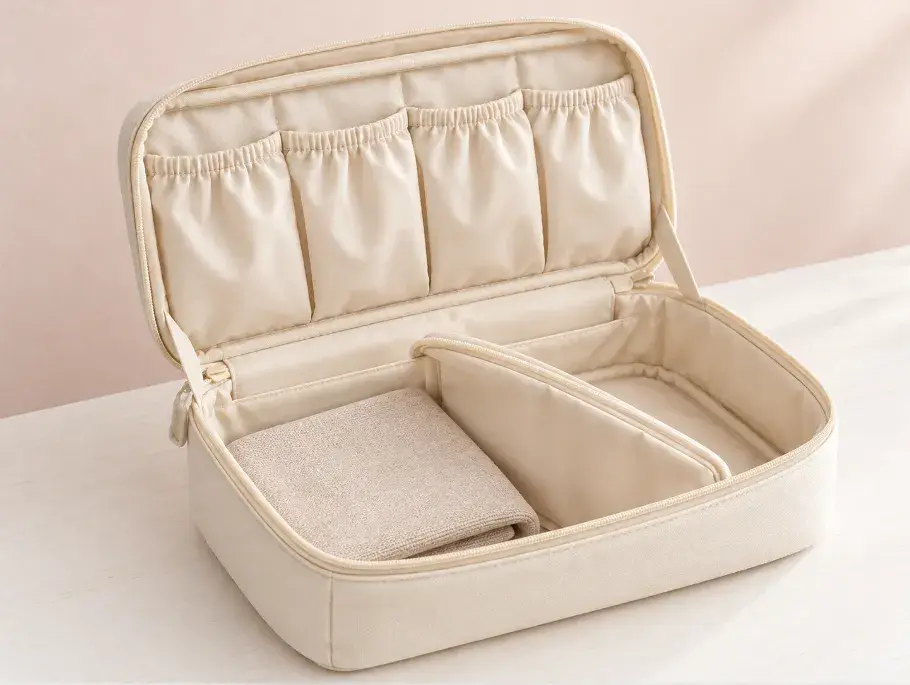
Lingerie fabrics—lace, mesh, silk charmeuse, microfiber, modal blends—are among the most snag-prone textiles a pouch will ever hold. The inner surface of the bag is the first thing the product touches, and it stays in contact throughout storage, shipping and retail display. Two categories of risk dominate the brief.
Surface abrasion and snagging
A pouch fabric with a coarse weave, loose threads or rough seam allowances can pull threads from lace or catch on delicate embroidery. The buyer decision here is not just “which fabric” but specifically:
- Inner-face texture: If the pouch is unlined, assess the shell fabric’s inner side against the actual garment on a sample. A light fingernail-drag or fabric-contact check can be a useful discussion point; satin-weave polyester, brushed microfiber and fine cotton sateen are commonly considered for their smoother surfaces.
- Seam finish: French seams, enclosed seams or bound seams keep raw edges away from the product. An exposed overlocked seam inside a lingerie pouch is a potential snag point.
- Drawstring cord or ribbon end: Metal aglets, rough-cut cord tips or unfinished ribbon ends may create an avoidable contact risk. Compare finishing options, such as knotted or heat-sealed ends, against the actual product and sample.
Chemical transfer and odor
Lingerie sits against skin. Buyers in markets with textile-safety awareness—Europe, Japan, parts of North America—often ask whether the pouch fabric itself could transfer dye, finish chemicals or odor to the product inside. This is distinct from product-level certification (the lingerie brand handles its own compliance), but it matters because:
- A pouch dyed in a deep color that bleeds onto a white bra creates a warranty claim.
- Residual chemical odor from fabric finishing can transfer to the lingerie during weeks of warehouse storage.
Buyer action items:
- Request any relevant dye-fastness information or agreed rubbing check on the pouch fabric sample.
- If the target market, customer or project documentation requires OEKO-TEX or equivalent textile documentation, raise this during quotation so the supplier can confirm scope, validity and whether the relevant material is covered.
- Discuss whether fabric finishing or storage odor is a project concern and agree the relevant sample-review approach for the expected storage conditions.
For a broader look at how fabric choice affects pouch performance, the comparison in Cotton vs Linen vs Velvet Pouches: The Ultimate Material Guide for Brands covers hand feel, weight and branding compatibility across common shell materials.
—
Privacy and Presentation: Choosing Opacity, Closure and Structure
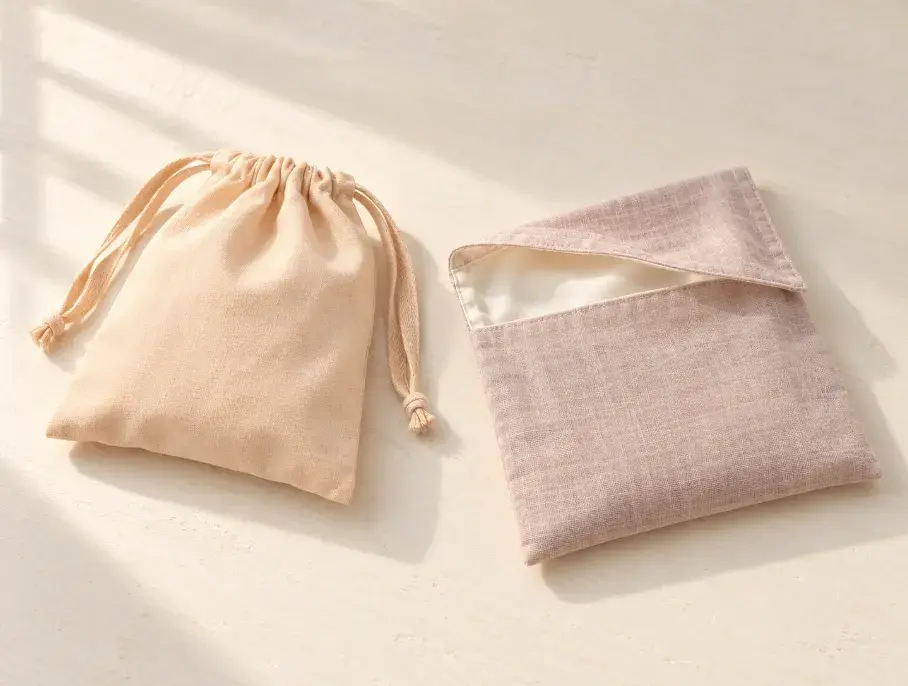
Lingerie packaging carries a privacy expectation that most product categories do not. Whether the pouch is used for e-commerce shipping, in-store gifting or subscription boxes, the buyer must decide how much of the product should be visible—and when.
Opacity levels and the decision they shape
| Opacity level | Typical fabrics | Visibility | Common use case |
|---|---|---|---|
| Fully opaque | Cotton twill, velvet, satin, microfiber | Product hidden entirely | E-commerce mailers, subscription boxes, gift packaging |
| Semi-sheer | Lightweight cotton voile, organza with lining panel | Silhouette or color visible | Retail display where product color matters |
| Sheer / transparent | Organza, fine mesh | Product fully visible | Point-of-sale presentation, lingerie boutiques |
The decision depends on the sales channel:
- E-commerce and subscription: Most buyers choose fully opaque pouches. The customer opens the pouch as part of the unboxing ritual, and privacy during shipping is expected.
- Retail boutique display: Some brands use semi-sheer or windowed pouches so the customer can see color and style without opening the bag. A small transparent panel in an otherwise opaque pouch is one way to balance privacy with browsing convenience.
- Gifting: Opaque pouches with a quality closure reinforce the “reveal” moment. Organza works for lightweight gift sets where the visual appeal of the fabric inside is part of the presentation.
Closure types and their trade-offs
The closure must keep the pouch shut during transit and feel intentional when the customer opens it. For lingerie bags, the common options are:
- Single drawstring: Simple, low-cost, familiar. Works well for pouches that hold a single folded item. Risk: a single cord can leave a gap at the top if the pouch is overfilled.
- Double drawstring: Closes more evenly. Slightly higher material cost. Preferred when the pouch is tall relative to its width.
- Ribbon tie: Creates a gift-ready look. The ribbon can match brand colors. Risk: ribbon slides open more easily than cord, so it is less secure for shipping.
- Flap with snap or magnetic closure: Structured, premium feel. Adds cost and requires a stiffer construction. Works for flat lingerie sets (bra + underwear) presented as a gift box alternative.
- Zip closure: Practical for reusable travel lingerie bags. Less common in retail presentation because zippers can snag lace.
Key decision: If the pouch is intended for reuse as a travel organizer, laundry-separation pouch or other repeated-use item, define the expected handling in the brief. Compare closure options on the selected sample rather than assuming one closure will outlast another in every material and construction. If the pouch is primarily for retail presentation and first unboxing, a drawstring or ribbon tie may be sufficient.
—
Which Size and Shape Fit the Lingerie Range and Retail Display?
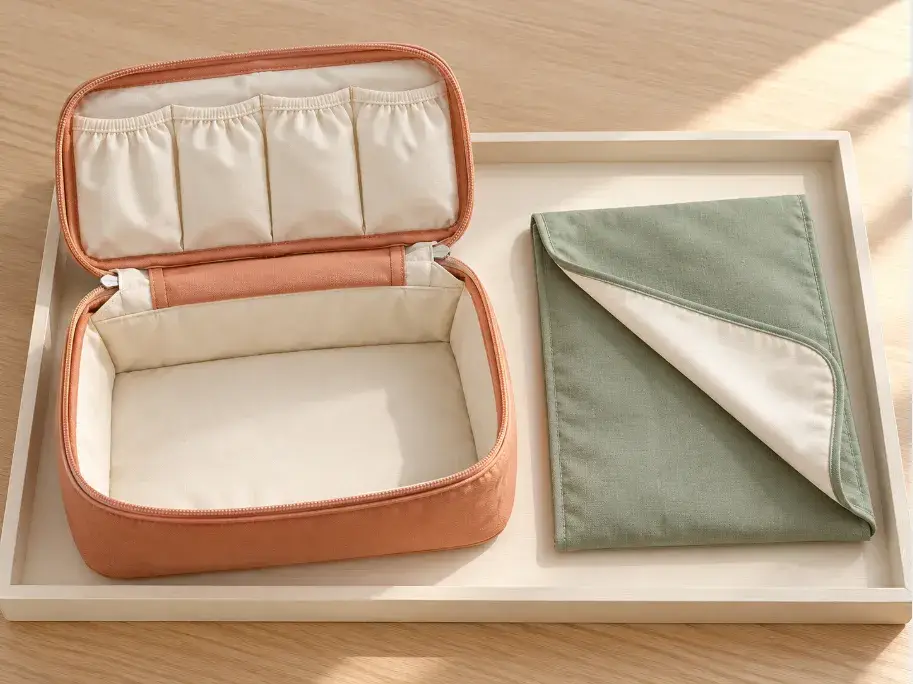
Sizing a custom lingerie bag is less straightforward than sizing a dust bag for a handbag, because lingerie items vary enormously in folded volume—from a flat thong to a padded bra that resists compression.
The sizing principle
A well-sized lingerie pouch should allow the product to sit inside without compression damage, while avoiding so much empty space that the product shifts and wrinkles during shipping. The general approach:
- Fold the actual product the way it will be packed in the factory or fulfillment center.
- Measure the folded footprint (width × height × depth if the item has volume, like a molded bra cup).
- Add clearance on each side so the pouch is not skin-tight against the product. The exact clearance depends on the fabric weight and closure type—confirm with the factory on a pre-production sample.
Common format decisions
- Flat pouch (no gusset): Suitable for thongs, briefs, bralettes without padding, hosiery. Lies flat in a shipping box or retail drawer.
- Gusseted pouch (side or bottom gusset): Needed for molded-cup bras, padded sets or multi-item gift bundles. The gusset prevents the pouch from bulging and distorting the logo print area.
- Envelope / flap pouch: Works for flat items presented face-up. Creates a “folder” look that some brands use for subscription unboxing.
One SKU or tiered sizing?
Brands with a large lingerie range face a practical question: should they order one universal pouch size, or two to three sizes matched to product categories?
One universal size:
– Simpler inventory management
– Lower tooling and setup cost
– Risk: looks oversized on small items, which cheapens the presentation
Tiered sizes (e.g., small for underwear, medium for bralettes, large for sets):
– Better product-to-pouch fit
– Higher perceived quality at unboxing
– Risk: more SKUs to manage, higher combined MOQ across sizes
The right answer depends on your product range breadth and order volume. If you sell only three styles of underwear in similar folded dimensions, one size works. If your catalog spans thongs to robe-and-nightgown sets, tiered sizing is worth the added complexity.
For guidance on how to measure pouches accurately—including where the drawstring channel affects usable interior height—see How to Measure a Drawstring Pouch: Size Guide for Brands.
—
Branding Choices That Preserve a Soft, Premium Hand Feel
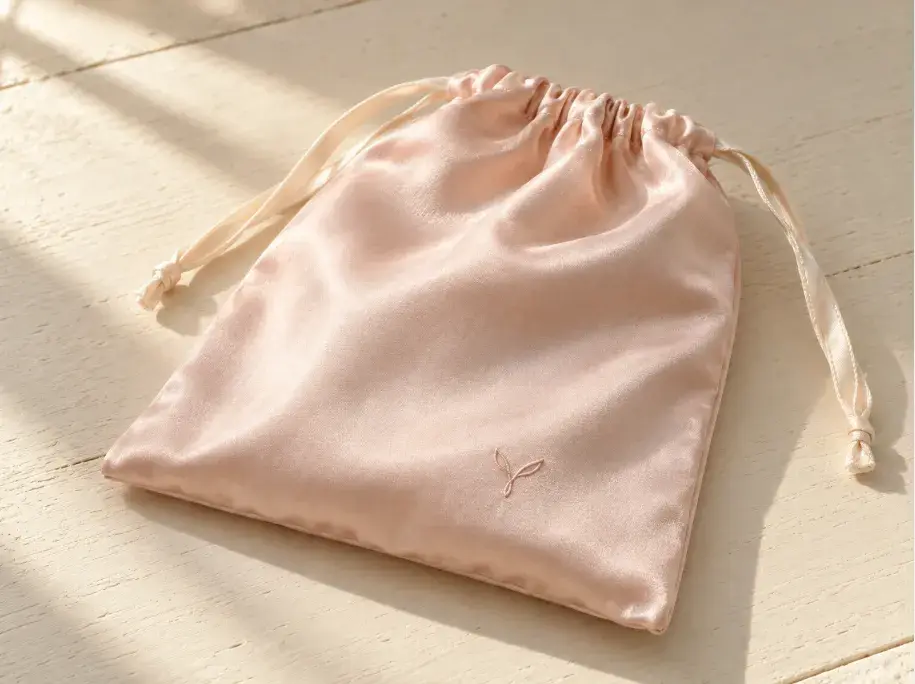
Branding on a lingerie bag must respect the softness of the pouch. A stiff heat-transfer patch, an oversized screen print with heavy ink deposit, or a rigid woven label stitched to the interior can all undermine the tactile promise that the pouch is supposed to deliver.
Logo method considerations for lingerie pouches
| Method | Feel on fabric | Detail capability | Notes for lingerie bags |
|---|---|---|---|
| Screen printing | Thin ink layer; soft if printed correctly | Good for simple logos, 1–3 colors | Confirm ink flexibility on stretch or satin fabrics |
| Hot stamping / foil | Smooth, minimal texture | Best for text and simple marks | Works well on satin and velvet; confirm adhesion on the specific fabric |
| Embroidery | Adds texture; can feel premium | Good detail on heavier fabrics | May be too stiff on lightweight satin; confirm thread count and backing |
| DTF (direct-to-film) transfer | Thin, flexible film | Full color, photographic detail possible | Confirm hand feel and washability if the pouch will be reused |
| Woven label (sewn in) | Depends on placement | High detail | Interior placement avoids disrupting the outer surface |
| Debossing | No ink or film; texture only | Limited to simple marks on plush fabrics | Works on velvet; not viable on thin satin |
Placement decisions
- Centered on the front face is the most common position. On a drawstring pouch, the logo should sit below the drawstring channel so it is fully visible when the bag is closed.
- Bottom corner or tag position works for brands that want a subtle, understated look.
- Interior printing or label appeals to brands that want a clean exterior with a branded reveal when the customer opens the pouch.
Color and contrast
Lingerie brands often work with soft, muted palettes—blush, ivory, champagne, black, mauve. The pouch color and logo color should be selected together so the branding is legible without looking harsh. A tonal approach (e.g., matte gold foil on blush satin) preserves elegance but may reduce legibility at a distance. Confirm the specific Pantone or foil reference on a physical sample, not a screen mockup.
For a detailed comparison of logo methods including setup costs and minimum run expectations, the guide on Screen Printing vs Heat Transfer vs Embroidery covers the trade-offs in depth.
—
Cost, MOQ and Sampling: Comparing the Full Sourcing Trade-Off
Custom lingerie bags are not expensive per unit relative to the product they hold, but the total project cost depends on several variables that interact. Buyers should evaluate these together rather than optimizing for the lowest unit price alone.
Variables that affect unit cost
- Fabric type and weight: Satin and microfiber typically cost differently from cotton canvas. Specialty fabrics (organic cotton, RPET) may carry a premium.
- Lining: An unlined satin pouch costs less than a satin-over-cotton lined pouch, but lining improves opacity and hand feel.
- Closure complexity: A drawstring is simpler than a magnetic-snap flap. Each added component (snap, magnet, zipper) adds cost.
- Logo method and coverage area: A single-color screen print is less expensive than multi-color embroidery or all-over printing.
- Size: Larger pouches use more fabric. Gusseted pouches use more fabric than flat pouches of the same face dimensions.
- Finishing: Individual polybag wrapping, tissue inserts, hang tags or retail header cards all add to the per-unit cost.
MOQ considerations
MOQ varies by factory and by the complexity of the specification. Factors that tend to push MOQ higher:
- Custom-dyed fabric in a non-stock color
- Specialized closure hardware
- Multiple logo colors or positions
Factors that may allow lower MOQ:
- Using a factory’s stock fabric in a standard color
- A simple single-color logo
- Standard pouch dimensions that match existing cutting templates
The buyer should request MOQ for each size and color combination, not just the total order quantity. A factory may accept a total order of a few thousand units but require a minimum per SKU to keep production efficient.
Sampling steps
Before committing to production, the standard sampling sequence for custom lingerie bags is:
- Specification alignment: Provide a written brief covering fabric, color, dimensions, closure, logo method, logo artwork file and any interior finishing requirements.
- Pre-production sample: The factory produces one or more samples to the agreed specification. The buyer evaluates fabric feel, color accuracy, logo quality, sizing, closure function and seam finish.
- Product fit test: Place your actual lingerie items inside the sample pouch. Check for snag risk, compression, closure security and visual proportions.
- Approval or revision: Note any changes and request a revised sample if needed before approving production.
Do not skip the product fit test. A pouch that looks correct empty may perform differently once a molded bra cup or lace bodysuit is folded inside.
—
Quality-Control Checkpoints Before Approval and Production
Quality control for lingerie packaging bags focuses on the same categories covered in the brief—fabric contact, privacy, sizing and branding—but translates them into inspectable criteria.
Pre-production checklist
The checks below are a project framework, not a default test protocol. Before production, the buyer and supplier should agree the relevant fabric-contact method, closure cycles, sample quantity, inspection conditions and acceptance criteria for the actual pouch, garment and sales channel.
Before the factory cuts fabric for bulk production, confirm:
- Fabric swatch approval: The production fabric matches the approved sample in color, weight and surface texture.
- Logo strike-off approval: A test print, foil or embroidery on the production fabric matches the approved artwork in color, size, position and adhesion.
- Seam and closure construction: The seam type, stitch density and closure hardware match the approved sample.
In-line and final inspection points
During and after production, the following checks apply to custom lingerie bags:
- Interior smoothness: Run a hand or soft cloth across all interior seams. No loose threads, sharp seam edges or exposed raw fabric.
- Drawstring or closure function: Open and close the pouch using the agreed handling check. Assess whether the drawstring, snap, magnet or zip operates as intended for the selected construction.
- Size consistency: Measure a random selection of pouches against the specification. Confirm that the usable interior (not just the outer dimension) accommodates the intended product.
- Logo quality: Check for smudging, incomplete print, misalignment, thread trimming (for embroidery) and foil adhesion (for hot stamping).
- Color consistency across units: Compare pouches from different production batches or cutting positions. Dye-lot variation is a common issue on satin and velvet.
- Odor check: Where odor is a project concern, agree how cartons or samples will be assessed after storage. Record the relevant requirement in the production specification rather than relying on a generic “odor-free” claim.
- Packing and labeling: Confirm that pouches are packed in the correct quantities per inner carton, with any required retail tags, polybags or tissue paper included.
For a more detailed QC framework applicable to soft pouches, the checklist in A Practical Quality-Control Checklist for Custom Jewelry Pouches covers many of the same inspection points and is adaptable to lingerie bag specifications.
—
When Is a Custom Pouch Suitable for Your Sales and Gifting Model?
Not every lingerie brand needs a custom fabric pouch. The decision depends on how the pouch fits into the customer journey and whether it adds enough value to justify the cost.
Scenarios where a custom lingerie bag adds clear value
- E-commerce unboxing: A pouch can be considered as part of a branded first impression. Assess its role alongside any required protective, hygiene or shipping layers rather than assuming it replaces another packaging component.
- Subscription boxes: A reusable lingerie pouch inside each monthly box gives the subscriber a functional bonus—a travel bag or drawer organizer—that extends brand visibility beyond the first delivery.
- Retail gifting: Lingerie is one of the most commonly gifted apparel categories. A branded pouch eliminates the need for separate gift wrapping and doubles as a keepsake.
- Wholesale and B2B distribution: When selling to boutiques or department stores, a branded pouch protects the product during handling between warehouse, stockroom and display floor.
- Travel and lifestyle positioning: Brands that market lingerie alongside travel or wellness lifestyles can position a reusable storage bag as part of the product offering, not just packaging.
Scenarios where a simpler format may be enough
- High-volume basics: If the product is a multi-pack of everyday underwear sold at a competitive price point, the pouch cost per unit may not be justified. A printed tissue wrap or branded polybag may serve the purpose at lower cost.
- Retail environments with rigid display systems: Some retailers require hang-tag or clamshell packaging for fixture compatibility. A fabric pouch may not fit the merchandising system.
- Very early-stage brands with uncertain SKU counts: If the product range is still changing rapidly, committing to sized pouches across multiple SKUs can create dead inventory. Starting with a single universal pouch or branded tissue paper allows flexibility while the range stabilizes.
The reuse question
A lingerie pouch that the customer keeps and reuses—for travel, drawer organization or laundry separation—extends the brand impression far beyond the point of sale. But reuse changes the specification:
- The fabric, closure and logo should be specified around the expected repeated handling.
- If cycle, friction or washing performance matters, define the use condition, evaluation method and acceptance criteria with the supplier before sampling.
If reuse is part of your brand promise, state it in the specification brief so the factory can recommend construction and materials suited to that expectation. A pouch designed only for retail presentation may not hold up to daily use, and the gap becomes a quality complaint.
—
Next Step
Prepare a written brief covering fabric type and interior texture, opacity requirement, closure format, target pouch dimensions based on folded products, logo artwork and method preference, reuse expectation, and the number of size or color variants needed. The more specific the brief, the more accurately suppliers can scope the quotation and sample discussion.
—
Frequently Asked Questions
Can I use the same pouch for different lingerie items across my range?
You can, but the fit will vary. A pouch sized for a padded bra set will look oversized on a thong. If you want one universal pouch, size it for your most common mid-range item and accept that the smallest and largest items will fit less precisely. Confirm the visual result by placing actual products in the sample before approving.
What fabric is safest for direct contact with lace and silk lingerie?
Smooth-faced fabrics with minimal surface texture carry the lowest snag risk. Satin-weave polyester, brushed microfiber and fine cotton sateen are commonly used. The specific fabric must be tested against your actual product—request a sample and perform a snag test by rubbing the lingerie against the pouch interior before approval.
Should the pouch be washable?
If you market it as a reusable travel or laundry bag, washing tolerance matters. Confirm with the factory whether the fabric, dye and logo method can withstand the wash conditions you intend to recommend to your customer. If the pouch is single-use retail packaging, washability is less critical.
How do I handle multiple colors across a lingerie collection?
You have two approaches: match each pouch color to the product color (higher SKU count, more complex inventory) or choose a single neutral pouch color that works across the range (simpler logistics, lower combined MOQ). Many brands choose a signature neutral—black, ivory or blush—and let the logo carry the brand identity.
Share This Story, Choose Your Platform!