
BSCI vs Sedex vs SA8000: Factory Audit Certifications Explained
BSCI vs Sedex vs SA8000: The Quick Answer
If you’re comparing BSCI vs Sedex vs SA8000 while vetting a packaging supplier, here’s the short version before we get into the details.
BSCI, run by amfori, is a social compliance program that scores factories on a graded scale from A to E, rather than issuing a pass-or-fail certificate. Sedex, through its SMETA audit methodology, works similarly — it’s a data-sharing platform and audit format, not a certification you either hold or don’t. You can see how the Sedex platform itself describes the process directly on their site. SA8000 is different from both. It’s an actual certification, issued by accredited third-party bodies under Social Accountability International, and it’s valid for a set period before requiring renewal.
So when a supplier says they’re “BSCI certified” or “Sedex certified,” that phrasing is technically a bit loose, since neither program issues certificates in the strict sense. Understanding that distinction upfront saves a lot of confusion later.
For packaging buyers specifically, this isn’t just a technicality. Retailers increasingly ask for proof of ethical sourcing before they’ll list a product, and getting the terminology wrong on your own compliance paperwork can slow down an otherwise straightforward approval process. Knowing exactly what each program does — and doesn’t — promise makes those conversations go a lot smoother.

BSCI vs Sedex vs SA8000: What Each Audit Actually Checks
All three programs look at working conditions, but they go about it differently.
BSCI audits assess a factory against 13 performance areas, covering things like fair wages, working hours, health and safety, and freedom of association. Since amfori BSCI describes itself as a risk-management program rather than a certification, an auditor asks a set of questions, checks records, and interviews workers, then the factory gets graded from A (best) to E (needs urgent improvement).
Sedex doesn’t own a single audit standard on its own. Instead, member factories complete a SMETA audit, which measures the site against the ETI Base Code and relevant ILO conventions. Results get uploaded to the Sedex platform, where approved buyers can view them without requiring a brand-new audit for every relationship.
SA8000 takes a management-systems approach rather than a simple checklist. It requires a factory to build ongoing policies and procedures around child labor, forced labor, health and safety, and eight other core areas, then maintain that system continuously rather than just passing a single audit day.
The practical difference shows up most clearly in how each program treats time. A BSCI or SMETA audit captures conditions on a specific date, and while both encourage follow-up audits, the underlying model is still built around periodic snapshots. SA8000, by contrast, asks a factory to prove it can sustain compliance between audits through documented internal processes, worker training records, and a functioning grievance system — not just clean up before the auditor arrives.
BSCI: Pros & Cons
BSCI has become one of the most common audit requests among European retailers and importers.
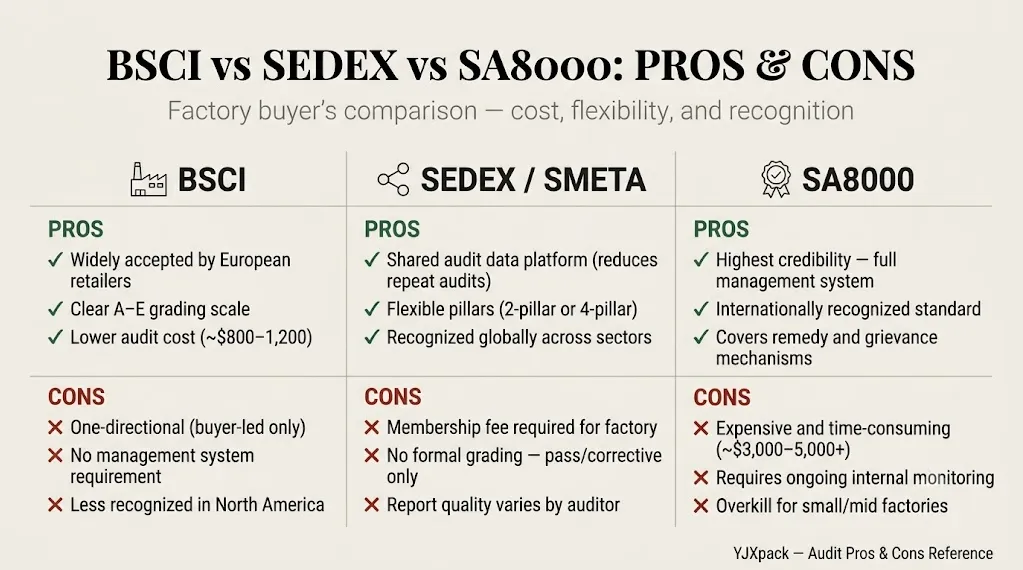
Pros: The graded scale gives buyers a quick, comparable snapshot of factory performance, and the two-year audit cycle keeps data reasonably current without demanding annual re-audits for well-performing factories. It’s also widely recognized, so many retailers accept an existing BSCI report instead of commissioning their own.
Cons: Since amfori itself states BSCI isn’t a certification, buyers sometimes get confused when a supplier claims “BSCI certified” status that doesn’t technically exist. Grades also don’t tell the whole story on their own — a factory graded “C” might have one serious issue or several minor ones, and it takes reading the actual report to know which.
Overall, BSCI works well as a first screening step for new suppliers, especially in the EU market where amfori membership runs deep. It’s rarely the final word on a factory’s practices, but as a starting filter before deeper due diligence, it does the job efficiently.
Sedex (SMETA): Pros & Cons
Sedex approaches the problem from a data-sharing angle rather than a scoring angle.
Pros: The biggest advantage is reduced audit fatigue. Once a factory completes a SMETA audit and uploads it to the platform, multiple buyers can view the same report instead of each commissioning a separate audit. This saves both time and money across a factory’s whole customer base.
Cons: Like BSCI, Sedex doesn’t issue a pass-or-fail certificate — it’s a reporting and data platform, and the underlying SMETA audit produces a Corrective Action Plan rather than a simple approval stamp. Buyers still need to read the actual findings rather than relying on a single label to mean “safe to work with.”
Sedex tends to work best for buyers who already have several suppliers in common with other companies, since the shared-data model gets more valuable the more it’s used across an industry. A factory that ships to a dozen different retailers only needs to complete one SMETA audit rather than a dozen separate ones, which is a meaningful time savings across a supply base of any real size.
SA8000: Pros & Cons
SA8000 sits apart from the other two because it’s a genuine third-party certification, not just an audit report.
Pros: A valid SA8000 certificate means a factory built an actual management system around social accountability, not just passed a single inspection. Certification typically runs for three years, with surveillance audits in between to confirm the system stays in place. For buyers who want the strongest paper trail, SA8000 usually provides it.
Cons: Building and maintaining a full management system costs more than a one-time audit, so SA8000-certified factories are less common than BSCI or Sedex-audited ones, especially among smaller manufacturers. That relative rarity can also narrow your supplier options if SA8000 becomes a hard requirement.
SA8000 makes the most sense for buyers who need a durable, ongoing certification rather than a point-in-time snapshot. Because renewal requires surveillance audits rather than a fresh full audit each cycle, it also tends to build a longer, more consistent compliance history for factories that stick with it over several years.

Audit Process & Cost Compared
Numbers make this easier than adjectives, so here’s a direct comparison across the three programs.
| Feature | BSCI | Sedex (SMETA) | SA8000 |
|---|---|---|---|
| Type | Audit + grading program | Audit + data platform | Certification |
| Result format | Grade A–E | Report + Corrective Action Plan | Pass/fail certificate |
| Validity period | Up to 2 years | Audit-specific, no fixed certificate | 3 years, with surveillance audits |
| Relative cost | Moderate | Moderate, shared across buyers | Higher, ongoing system required |
| Common in | EU retail and import | UK/EU multi-buyer supply chains | Global, brand-driven requirements |
If you need a durable, standalone credential, SA8000 wins. If you need something widely recognized and shareable across multiple buyer relationships, BSCI or Sedex usually gets there faster and cheaper.
Which Certification Do Retailers Usually Require
This varies quite a bit by region and industry, so it’s worth checking with your specific buyers rather than assuming.
European retailers, especially those with amfori membership, often request BSCI audits as a baseline requirement for new suppliers. It’s become something of a default in that market, particularly for general merchandise and packaging goods.
UK and multi-market retailers frequently lean on Sedex and SMETA, partly because the shared-data model fits well with large retail groups sourcing from thousands of factories across multiple countries. If your buyer already has other suppliers registered on Sedex, they may specifically ask for a SMETA audit to keep everything on one platform.
SA8000 shows up more often when a specific brand has built ethical sourcing deeply into its own marketing and positioning, since the certification carries stronger, more durable proof than a single audit report. It’s also more common in industries with heightened labor-risk scrutiny.

How to Read a Factory’s Audit Report
Getting a copy of a report is only half the job — knowing what to look for matters just as much.
Start with the overall grade or result, but don’t stop there. A BSCI grade of “B,” for example, still comes with a detailed breakdown across all 13 performance areas, and it’s worth scanning for any single area scoring notably worse than the rest.
Next, check the date. Audits reflect a snapshot in time, and a report from two years ago may not reflect current conditions, especially if the factory has changed ownership, expanded, or shifted production lines since then.
Then look at the corrective action section, if one exists. A factory with a few flagged issues and a clear remediation plan in progress is often a more honest, transparent partner than one with a suspiciously perfect report and no findings at all.
Finally, confirm the audit was actually conducted by an approved third party. Both BSCI and Sedex publish lists of approved audit companies, and a report from an unrecognized auditor may not carry the weight you’d expect.
It’s also worth asking whether the report covers the full facility or just a portion of it. Some larger manufacturing complexes house multiple production lines or even multiple companies under one roof, and an audit scoped to one building doesn’t necessarily reflect conditions across the whole site. A quick question to your supplier about audit scope can save a surprise later.
How to Choose Between BSCI vs Sedex for Your Supplier Requirements
Start with what your own buyers or retail partners actually require, since that often settles the question before you even need to weigh the two options yourself.
If you’re selling into the EU and don’t have a specific mandate yet, BSCI is a reasonable default, given how common amfori membership has become among European importers. It’s relatively affordable to request and widely understood across that market.
If your supply chain already touches other retailers using Sedex, matching that platform saves duplicate audit costs down the line, since the factory’s existing SMETA report may already satisfy your requirement without commissioning anything new.
For brands built around a strong ethical sourcing story, SA8000 is worth the extra cost and complexity, since it demonstrates an ongoing system rather than a single audit snapshot. It plays especially well in marketing materials aimed at socially conscious consumers.
Whichever program you choose, treat the audit as a starting point, not a finish line. Documentation from an audited, socially compliant factory adds real credibility when you’re sourcing jewelry bags or other packaging that carries your brand name. For fabric-based products specifically, pairing a factory audit with material safety documentation, like our cotton bag collection sourced from certified mills, rounds out the compliance picture. When you’re ready to talk sourcing requirements directly, yjxpack.com can walk you through what documentation is available.
Budgeting for Factory Audit Costs
Cost is often the deciding factor for smaller brands weighing these three programs, so it’s worth laying out roughly what a factory social compliance audit tends to cost in practice.
A single BSCI audit typically runs from a few hundred to around a thousand dollars, depending on factory size and location, and that cost is usually paid by the factory itself as part of doing business with amfori members. Since the audit result is graded rather than pass-or-fail, there’s no separate “certification fee” beyond the audit itself.
SMETA audits through Sedex follow a similar cost range, with pricing depending on whether the factory opts for a 2-pillar or 4-pillar scope. Because results can be shared across multiple buyers, the effective cost per buyer relationship often works out lower than a dedicated audit would, especially for factories serving several retail customers at once.
SA8000 costs more overall, since it involves both the initial certification audit and ongoing surveillance audits over the three-year cycle, plus the internal work of building and documenting a management system. Factories don’t take this on lightly, which is part of why SA8000-certified suppliers are rarer than BSCI or Sedex-audited ones. For buyers, that rarity is worth factoring into sourcing timelines — finding an SA8000-certified factory for a specific product category may simply take longer.
Common Mistakes Buyers Make With Factory Audits
A handful of misunderstandings come up often enough to flag directly.
Treating any audit as a guarantee. An audit report reflects conditions on the day of the visit, not a permanent promise. Factories can and do change between audit cycles, which is why the validity period matters as much as the result itself.
Confusing “audited” with “certified.” As covered earlier, BSCI and Sedex produce reports and grades, not certificates. Only SA8000, among these three, issues an actual certification. Getting this distinction right matters if your own compliance documentation gets reviewed by a retailer or regulator.
Accepting a report without checking the auditor. Both amfori and Sedex maintain lists of approved audit companies. A report from an unlisted or unapproved auditor may not be accepted by your own buyers, even if the factory presents it confidently.
Assuming one audit type covers everything. A factory might hold a strong BSCI grade but never have gone through SMETA or SA8000. If your specific buyer requires one of the others, an existing audit under a different program usually isn’t an automatic substitute.
FAQs
What is the difference between BSCI and Sedex?
BSCI, run by amfori, grades factories from A to E based on a set of social performance areas. Sedex is a data-sharing platform where factories upload SMETA audit results for multiple buyers to view, rather than issuing its own grade.
Is SA8000 better than BSCI?
SA8000 is a genuine certification requiring an ongoing management system, while BSCI is a graded audit program rather than a certificate. Which one is “better” depends on whether your buyers need a durable certification or a widely recognized audit report.
Do I need BSCI, Sedex, and SA8000 all at once?
Not usually. Most buyers require one specific program based on their own retail partners’ requirements, though a factory can hold audits or certification under more than one program if it serves multiple markets.
How often does a factory need to be re-audited?
BSCI audits are generally valid for up to two years, SMETA audits don’t carry a fixed certificate but are typically refreshed periodically, and SA8000 certification runs for three years with surveillance audits in between.
How do I verify a factory’s audit report is genuine?
Ask for the report directly from the factory and confirm it was conducted by an approved audit company listed on the amfori or Sedex website. For SA8000, you can also verify certification status through the accrediting body.
Share This Story, Choose Your Platform!