
Electronic accessories come in a wide range of weights, shapes and surface sensitivities. A custom electronics pouch must address five practical questions before it can protect the product and represent the brand: How heavy is the item? Does it need cushioning against impact? Will surfaces rub against each other or against the pouch wall? Is there a static-electricity risk? And how will the end user identify what is inside?
Each of those questions changes the fabric, lining, construction and closure specification. This guide walks through the selection logic so that brand owners, traders and e-commerce sellers can evaluate whether a fabric pouch is the right packaging format for their electronic accessories—and prepare the information needed for an accurate quotation.
> Scope note: This guide explains general material and construction selection logic. Fabric availability, specific construction options, artwork limits, MOQ, sampling, pricing, lead time and documentation must be confirmed against your final brief during quotation.
—
Quick Summary
| Decision factor | What it changes in the pouch specification |
|---|---|
| Product weight | Fabric weight, seam reinforcement, closure load capacity |
| Cushioning need | Lining material, padding thickness, internal divider choice |
| Abrasion exposure | Shell fabric density, lining softness, internal partition format |
| Static-control requirement | Whether documented anti-static or ESD-protective packaging is required |
| Identification and branding | Logo method, label placement, color coding, transparency |
Each factor is covered in detail below. The final section provides a sample-confirmation checklist you can use when requesting samples from any supplier.
—
Product-Fit Criteria for Custom Electronics Pouches
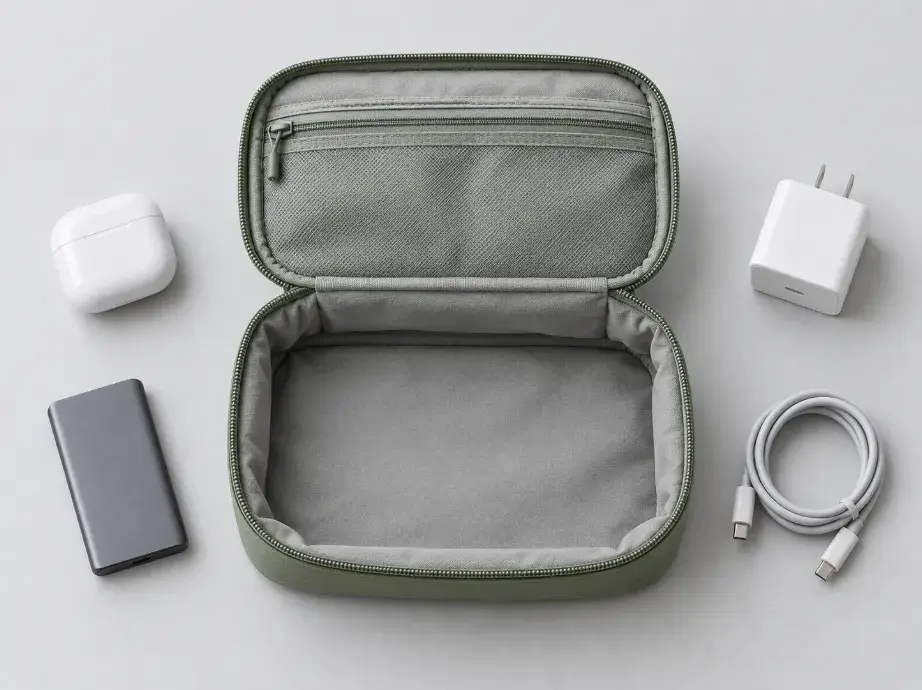
Not every electronic accessory needs a fabric pouch. Before committing to a custom electronics pouch program, evaluate the product against four fit criteria.
Weight range
Fabric pouches can suit lightweight, enclosed accessories when their construction is matched to the actual contents. Cables, adapters, earbuds, portable drives, stylus pens, small speakers, USB hubs and sensors may all be candidates, but weight is only one input. Larger power banks or multi-port docking stations may need reinforced seams, more structure or a semi-rigid format; confirm the choice against the packed item and intended handling.
Surface sensitivity
Polished, coated or glossy plastic and metal surfaces scratch easily during shipping and retail handling. A custom cable and accessory pouch with a soft lining can reduce surface contact marks. If the product has a matte rubber finish, the priority shifts from scratch prevention to dust and lint resistance.
Shape regularity
A rectangular power adapter fits neatly in a flat pouch. An irregularly shaped adapter with folding prongs may need a slightly oversized pouch or a closure that accommodates the odd profile. Items with protruding connectors or sharp edges may require a padded construction or internal pocket to prevent the connector from pressing through the shell fabric.
Storage and reuse expectation
End users keep fabric pouches when the pouch is useful for storage. A drawstring pouch for earbuds travels in a backpack. A padded pouch for a portable SSD sits in a desk drawer. If the pouch will be reused, the construction must tolerate repeated opening, closing and occasional compression.
—
Material and Lining Variables That Affect Protection
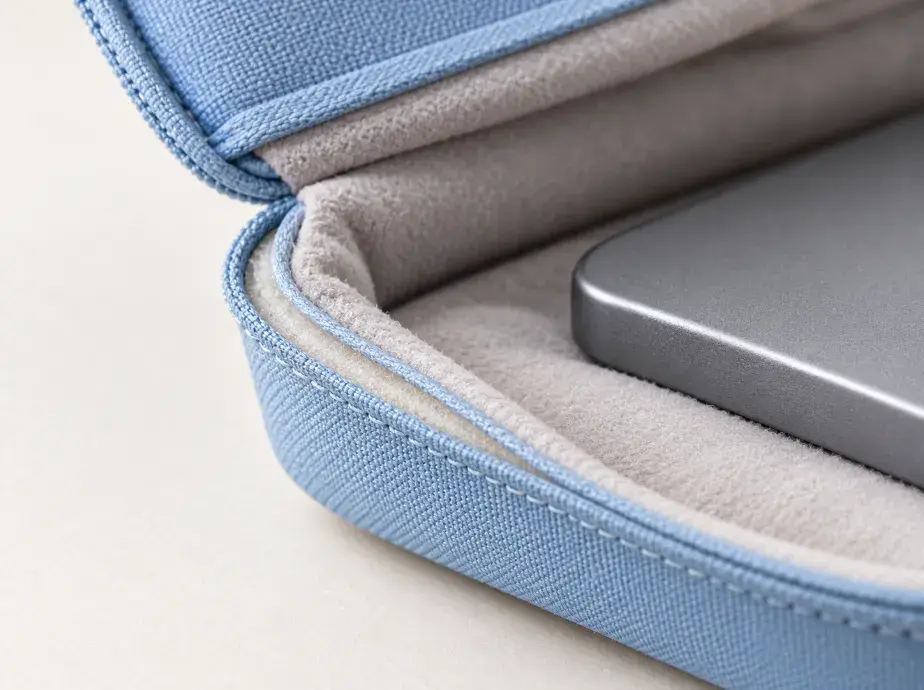
The shell fabric and the lining fabric serve different functions. The shell handles external abrasion and branding requirements; any moisture resistance depends on the specific material and finish. The lining contacts the product surface directly.
Shell fabric options
Several fabric families are commonly used for branded electronics pouches:
- Microfiber polyester — A fine, soft surface available in a range of weights. It can suit accessories with glossy or coated surfaces, subject to the actual fabric and finish. Confirm logo-method compatibility on the sample.
- Nylon (ripstop or plain weave) — Can offer a light, durable shell for applications involving connector edges or metal clips. Confirm the selected fabric’s weight, weave and tear performance with the supplier.
- Cotton or cotton-canvas — Natural fiber option for brands with sustainability positioning. Heavier canvas grades add stiffness. Lighter cotton works for cable wraps and earbud pouches.
- Polyester twill or satin — Smooth hand feel; often used for consumer-facing gift packaging where the accessory is a premium add-on.
Each fabric reacts differently to logo methods, so the branding plan influences the shell choice. A detailed comparison of logo methods on fabric is available in Screen Printing vs Heat Transfer vs Embroidery: Which Logo Method Is Best for Custom Pouches?.
Lining fabric considerations
The lining touches the product. For electronic accessories, the lining choice matters more than the shell in many cases:
- Microfiber lining — Provides a soft contact surface for accessories with screens or polished metal. Confirm its surface feel and any cleaning expectation on the physical sample. For more detail on microfiber properties, see What Is a Microfiber Bag? Uses for Jewelry, Eyewear and Electronics.
- Soft-brushed polyester or flannel lining — Provides light cushioning without adding bulk. Suitable for accessories that do not need a cleaning surface.
- Foam laminate lining — A thin foam layer bonded to the lining fabric can add impact cushioning. Confirm the available thickness, compression behavior and final pouch dimensions with the factory.
- Anti-static or conductive lining — Discussed separately below under static-control requirements.
Fabric weight and its effect on protection
Heavier fabric does not automatically mean better protection. A lighter shell with a suitable lining or foam layer can perform differently from a heavier unlined shell. Compare the actual combination of shell density, lining softness and total wall thickness on a sample.
When requesting quotation, specify the product weight and surface material so the factory can recommend an appropriate fabric-weight combination. Sending a product sample alongside the pouch brief reduces misunderstandings.
—
Construction Choices for Weight, Abrasion and Cushioning
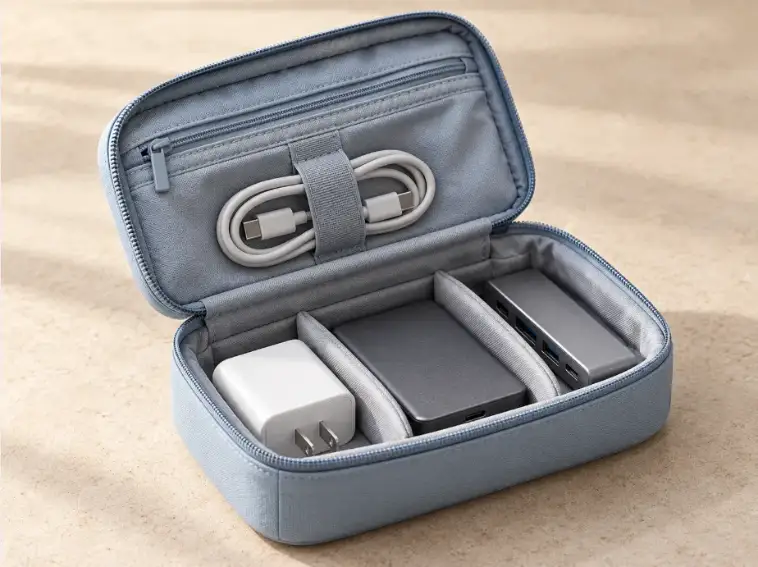
Construction details—seam type, reinforcement points, internal structure—determine how the pouch performs under load and repeated use.
Seam reinforcement for heavier accessories
A simple side seam may suit lightweight items such as earbuds or USB cables. For heavier items (portable chargers, multi-adapter kits, small tool sets), consider:
- Double-stitched or flat-felled seams — Distribute stress across a wider seam area.
- Binding tape along internal seams — Prevents fraying and adds a small amount of structural rigidity.
- Bartack reinforcement at stress points — Especially important at the drawstring channel or zipper endpoints, where repeated pulling concentrates force.
Cushioning construction
For accessories that need additional impact protection—portable SSDs, wireless earphone charging cases, compact cameras or glass-screen devices—the pouch may need a cushioning layer. Common approaches include:
- Foam-laminated panels — Foam bonded to the lining or shell fabric before sewing. Creates a uniform cushion across the entire pouch wall.
- Quilted construction — Stitching through outer fabric, foam and lining at intervals. Prevents foam from shifting inside the panel and adds a textured visual.
- Padded base insert — A separate foam or felt pad at the bottom of the pouch, absorbing impact when the pouch is set down.
The cushioning thickness affects the pouch’s external dimensions and packing volume. Specify the maximum acceptable external size if the pouch must fit inside a retail box or shipping carton of a fixed dimension.
Internal dividers and pockets
Electronic accessory kits often include multiple small items: a charger, a cable, an adapter tip, a SIM-ejector pin. A single-cavity pouch lets these items rattle against each other. Options for internal organization include:
- Sewn fabric divider — Splits the pouch into two compartments.
- Elastic loops or straps — Hold cables or pens in position against one wall.
- Slip pocket — An internal flat pocket for a warranty card, quick-start guide or thin flat adapter.
- Snap-in or Velcro tab — Secures a coiled cable so it does not tangle with other items.
Each internal feature adds sewing time and material cost. Decide which items genuinely need separation (based on surface-scratch risk or tangle risk) and which can share a cavity.
—
Which Electronic Accessories Are Suitable for a Soft Pouch?
A fabric pouch is not the right format for every electronic product. This section helps buyers distinguish good-fit items from poor-fit items.
Good candidates for a custom electronics pouch
- Earbuds and wireless earphone charging cases
- USB cables, Lightning cables, USB-C cables
- Portable power adapters and chargers, subject to their packed weight and shape
- USB flash drives and portable SSD drives
- Bluetooth speakers (compact models)
- Smartwatch bands and charger pucks
- Stylus pens and digital drawing accessories
- Smart-home sensors, dongles and small hubs
- Camera memory cards and card readers
- Travel adapter kits
Items that may require a semi-rigid or hard case instead
- Tablets or e-readers (screen fragility exceeds soft-pouch cushioning capacity)
- Full-size laptops (weight and screen vulnerability)
- Items with exposed circuit boards or bare components
- Batteries shipped loose (regulatory packaging requirements may apply)
- Precision measurement instruments requiring calibration stability
For items in a gray area—such as a small power bank with a glass surface—a padded fabric pouch with foam-laminated walls may be sufficient, but the decision should be based on drop-test expectations and the brand’s return-rate tolerance. Do not assume a soft pouch replaces a rigid enclosure without evaluating the specific product.
—
Does the Accessory Need Static-Control Packaging?
Static electricity can damage sensitive electronic components. Whether your custom electronic accessory packaging needs anti-static properties depends on what is inside the pouch.
When static control matters
Static-sensitive items include:
- Bare circuit boards or modules
- Loose semiconductor chips or integrated circuits
- Unshielded electronic components sold as spare parts
- Memory modules (RAM sticks, bare SSDs without enclosures)
Finished consumer accessories and ESD-sensitive items are not the same category. Earbuds in a case, a charger in its housing and a cable with molded connectors may not need specialized ESD-protective packaging, but that decision should come from the product owner or engineering requirement—not from the presence of a plastic or metal housing alone.
When standard soft packaging may be appropriate
If the product has not been identified as ESD-sensitive and the pouch is intended for normal consumer presentation, storage or transport, selection can focus on fit, abrasion, cushioning and closure. If the product owner specifies ESD-sensitive handling or ESD-protective packaging, a standard microfiber or polyester pouch should not be assumed to meet that requirement.
Anti-static fabric options
When ESD-protective packaging has been explicitly specified, discuss the requirement with a qualified packaging supplier and the product owner. Possible material directions may include purpose-designed static-dissipative materials, shielding bags or other packaging systems selected for the required application. A surface treatment or conductive fiber alone does not prove that a finished pouch provides the required protection.
ESD-protective packaging is defined by the required properties and test methods, not by a generic “anti-static” label. Confirm the applicable packaging requirement, requested technical data and agreed test evidence before making a claim about ESD protection. Do not use a fabric pouch as an ESD-protective solution unless the product requirement and supporting evidence have both been confirmed.
—
Closure, Internal Organization and Identification Options
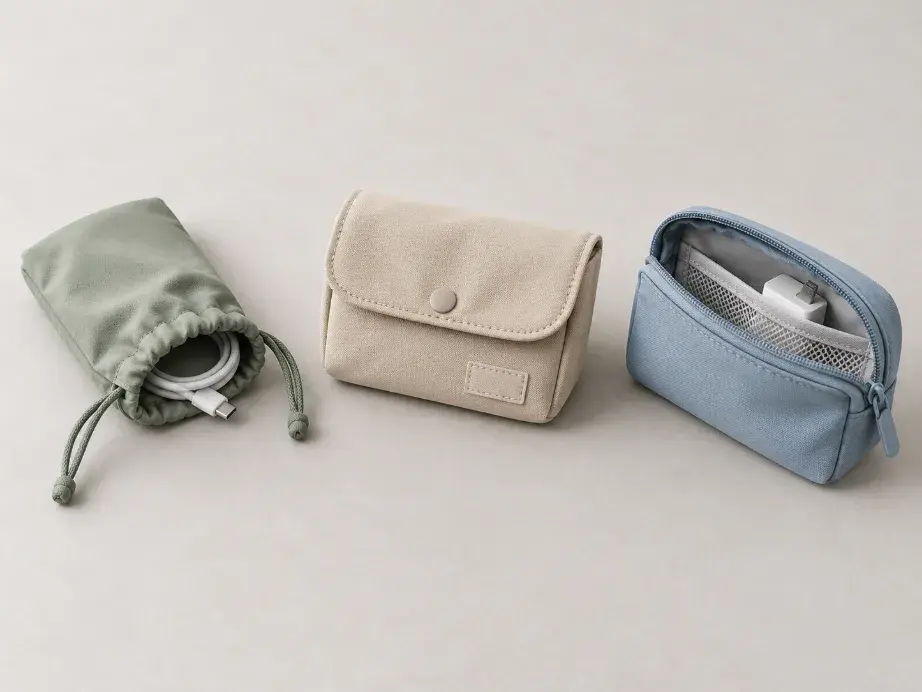
The closure type affects both protection and user experience. For electronic accessories, choose a closure that provides suitable retention during intended transport and access during daily use.
Closure types commonly used for electronics pouches
| Closure | Advantages | Limitations |
|---|---|---|
| Drawstring (single or double cord) | Simple, accommodates variable item thickness, low cost | Less secure for heavy items; cord may snag on connectors |
| Flap with magnetic snap | Clean look, one-hand opening, good for flat items | Magnet proximity to magnetic-sensitive items must be evaluated |
| Flap with Velcro (hook-and-loop) | Secure, adjustable, tolerates repeated use | Hook side may scratch glossy surfaces if it contacts the product |
| Zipper (nylon coil or metal) | More defined containment; fully encloses the item | Zipper teeth or slider can scratch adjacent items if placed close to the product |
| Elastic-top slip pouch | Quick access, minimal hardware | Lower retention; assess fit and handling before selecting it |
When selecting a closure for branded electronics pouches, consider whether the end user will open the pouch daily (earbuds), occasionally (travel adapter), or rarely (backup cable). Frequency of use influences how durable the closure mechanism must be.
Identification and content visibility
Electronic accessories often look similar. A black cable pouch and a black adapter pouch are hard to distinguish in a travel bag. Identification options include:
- Color coding — Different pouch colors for different accessory types within a product line.
- Printed or woven labels — A small label identifying the contents (e.g., “USB-C Cable” or a product icon).
- Transparent window panel — A clear PVC or mesh panel sewn into the pouch body, allowing the user to see the contents without opening.
- Embroidered or printed icon — A simple graphic on the exterior identifying the category.
Color coding and icon identification can help users distinguish accessory pouches within a kit.
—
Logo Methods and Artwork Confirmation for Accessory Brands
Branding on a custom electronics pouch must balance visibility, durability and compatibility with the shell fabric. Methods to consider include:
- Screen printing — Suitable for flat surfaces, bold logos and one-to-three-color designs. Works well on polyester, nylon and cotton.
- Heat transfer printing — Handles gradients and photographic detail better than screen printing. Best on smooth, stable fabrics.
- Hot stamping (foil) — Metallic or matte foil pressed onto the fabric. Creates a premium look on velvet, microfiber or satin shells. For a deeper explanation, see What Is Hot Stamping? A Brand’s Guide to Foil Logos on Fabric Pouches.
- Embroidery — Durable and tactile. Works best for simple logos with limited color count. Adds thread thickness to the surface, which may matter if the pouch is stored in a tight space.
- Woven label — A separate label sewn into the seam or onto the pouch face. Good for brand name and care instructions.
- Debossing — Pressing the logo into the fabric surface without ink or foil. Subtle, but only visible on fabrics with enough pile or thickness to hold the impression.
Artwork preparation notes
When preparing artwork files for a custom electronics pouch, keep these points in mind:
- Supply vector files (AI, EPS or PDF with outlined fonts) for screen printing, embroidery and foil stamping.
- For heat transfer, follow the supplier’s recommended raster-file requirements for the intended print size, especially when the design includes photographic elements.
- If color matching matters, provide an agreed color reference and confirm the acceptable tolerance on the physical sample. Fabric dye lots and ink batches can vary.
- Confirm the logo placement area on the pouch. A logo centered on the front panel behaves differently than a logo placed near the drawstring channel, where fabric gathers.
- Request a pre-production sample with the actual logo applied to the actual fabric before approving bulk production.
Logo durability depends on the fabric-method combination. A screen-printed logo on a textured canvas surface may wear differently than the same logo on a smooth polyester twill. Confirm wash and abrasion expectations with the factory during sampling.
—
Sample-Confirmation Checklist and Buyer Questions
Before approving a bulk order for custom electronics pouches, request and evaluate physical samples. The following checklist covers the key items to confirm.
Product-fit confirmation
- [ ] The product fits inside the pouch with enough room to close the closure comfortably, but not so much room that the item shifts excessively.
- [ ] The pouch wall thickness provides adequate cushioning for the product’s surface sensitivity and fragility.
- [ ] The product’s weight does not stretch or distort the pouch when lifted by the closure.
- [ ] Any protruding connectors, prongs or sharp edges do not press through the pouch wall.
Material and lining confirmation
- [ ] The shell fabric matches the approved swatch in color, weight and texture.
- [ ] The lining fabric is appropriate for the product surface. Inspect it against the actual product; do not treat a light rub as a formal abrasion or durability test.
- [ ] If ESD-protective packaging was specified, obtain the agreed technical data and test evidence for the required packaging property.
- [ ] Fabric weight and hand feel are consistent across multiple sample units.
Construction confirmation
- [ ] Seams are straight, even and reinforced at stress points.
- [ ] Internal dividers, pockets or elastic loops are positioned correctly relative to the items they will hold.
- [ ] Padding thickness and firmness match the specification.
- [ ] The closure operates repeatedly under the intended load without visible damage or distortion at the closure point.
Closure and hardware confirmation
- [ ] Drawstring cords slide smoothly without bunching.
- [ ] Zipper opens and closes without catching on lining or shell fabric.
- [ ] Magnetic snaps hold securely and release cleanly.
- [ ] Velcro patches align correctly and do not contact the product surface when the pouch is closed.
- [ ] If magnets are used, confirm that the magnet does not interfere with any magnetic-sensitive item stored in the pouch.
Branding and identification confirmation
- [ ] Logo color matches the approved color target under the agreed viewing conditions.
- [ ] Logo position and size match the approved artwork layout.
- [ ] Logo adhesion and appearance meet the approved sample standard; use an agreed test method if abrasion or wash durability is required.
- [ ] Woven labels or hang tags are correctly attached and legible.
- [ ] Color-coding or content-identification features (icons, window panels) are correctly placed.
Documentation and compliance
- [ ] Confirm any required compliance documentation (material safety data sheets, test reports, certification copies) with the factory during quotation.
- [ ] If the pouch will be sold in markets with specific packaging-material regulations, verify that the fabric composition meets those requirements before production.
—
Next Step
Prepare your product sample, artwork files and the checklist items above, then contact YJXPACK to discuss material options, construction details and sampling for your custom electronics pouch program.
Frequently Asked Questions
Can a fabric pouch replace a rigid box for electronic accessories?
For lightweight, fully enclosed consumer accessories—cables, earbuds, small adapters—a well-constructed fabric pouch can serve as the primary protective packaging, especially when the accessory is already inside its own housing. For fragile items with exposed screens or bare components, a rigid or semi-rigid enclosure is generally safer.
How do I decide between a drawstring and a zipper closure?
Consider the product weight, the frequency of opening and the user context. A drawstring works well for lightweight items accessed occasionally. A zipper provides more secure enclosure for items carried in bags where the pouch may be compressed or inverted. Confirm zipper-tooth material to ensure it will not scratch adjacent items in the same bag.
What is the minimum information I should include in a quotation request?
At minimum, provide the product name and dimensions, the product weight, the surface material of the product, your preferred pouch material (or a description of the desired look and feel), the closure type, the logo artwork, and the estimated order quantity. Sending a physical product sample alongside the brief significantly improves the accuracy of the factory’s recommendation.
Do all electronics pouches need anti-static lining?
No. First ask whether the product owner has identified the item as ESD-sensitive or specified ESD-protective packaging. A normal consumer accessory pouch may focus on fit, abrasion and cushioning, while bare components, loose modules or unshielded parts can require an explicitly defined ESD packaging system. Do not infer ESD suitability from the pouch material or the product housing alone.
—
Share This Story, Choose Your Platform!