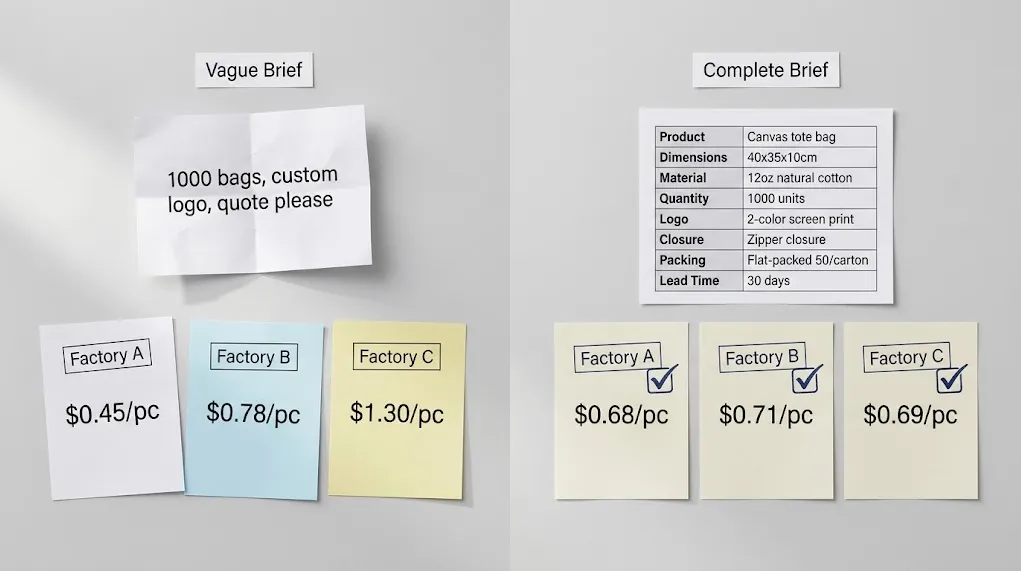
You send the same request to three factories. “I need 1,000 custom pouches. Please quote.”
Quote 1 comes back: $0.45 per piece. Quote 2: $0.78 per piece. Quote 3: $1.30 per piece. Same product, right? So why the huge gap?
Here’s the truth. The gap isn’t about the factories. It’s about your brief. A vague request gets vague quotes. Each factory guesses at your specs differently. Then they quote based on their guess — not your real needs.
This guide fixes that. You’ll learn three things. First, the 8 elements every packaging brief needs. Second, 5 mistakes that wreck your quotes. Third, a free packaging brief template you can copy and send today.
By the end, you’ll get quotes that are accurate, comparable, and fast.
1. Packaging Brief Template — The 1-Minute Quick Answer
Let’s skip ahead. Here’s the bottom line.
A good packaging brief template has 8 parts. It covers your product, exact dimensions, material, quantity, logo method, closure type, packing format, and shipping needs. Give a factory all 8, and your quotes become accurate. Skip any, and quotes become guesses.
Here’s the fast-look table.
| Brief Element | Why It Matters | Common Mistake |
|---|---|---|
| Product type | Sets base cost and process | Too vague (“a bag”) |
| Dimensions (mm) | Drives fabric usage | Rough estimates only |
| Material + GSM | Major cost driver | No GSM given |
| Quantity | Sets unit price tier | “A few hundred” |
| Logo + Pantone | Sets print cost | No color code |
| Closure type | Adds hardware cost | Not specified |
| Packing format | Affects shipping cost | Often skipped entirely |
| Lead time + destination | Affects freight quote | No destination given |
That’s the fast version. Now let’s go deeper.
2. What Is a Packaging Brief? (Brief vs RFQ vs PO)
These three terms get mixed up a lot. So let’s sort them out.
| Term | What It Is | When You Send It |
|---|---|---|
| Brief | Your product specs and needs | First contact, before any quote |
| RFQ (Request for Quote) | A brief plus a formal ask for pricing | When comparing 2-3 suppliers |
| PO (Purchase Order) | A confirmed order with agreed price | After you accept a quote |
A packaging brief is the starting point. It’s not a contract. Neither is it a quote request yet. Think of it simply as: “here’s exactly what I need.”
An RFQ builds on the brief. Specifically, a packaging RFQ adds formal language and asks multiple suppliers for pricing at once. Plus it often sets a deadline for responses. When you request quote packaging options from several factories, an RFQ is the right format — it signals seriousness and gets better responses. For standard RFQ structure, ISO procurement guidelines define what constitutes a formal specification.
A PO comes last. By this point, you’ve picked a supplier. The price is set. Now you’re confirming the order in writing.
So why does this matter? Because most buyers skip straight to “please quote” — without ever writing a real brief first. As a result, every supplier fills in the blanks differently. Then quotes can’t be compared fairly.
For early sourcing, a solid packaging specification template solves this. It forces you to think through specs once, then reuse them for every supplier.
3. Why Quotes Vary 3x — The Brief Is the Problem
Let’s go back to our $0.45 vs $1.30 example. What happened?
Factory A assumed thin cotton, no lining, basic screen print. Meanwhile, Factory B assumed heavier canvas, a lining, and a 2-color logo. And Factory C assumed premium organic cotton with embroidery.
None of them were wrong. They just filled gaps with their own assumptions. Each assumption changes the price. Stack five assumptions together, and a 3x price gap is normal — not unusual.
Here’s the fix. Write down every spec before you ask for a quote. Then send the exact same brief to every factory. Now the quotes reflect real price differences — not guesswork differences.
This single habit saves more money than any negotiation tactic. Plus it saves time. No more “wait, what did you assume for the lining?” emails going back and forth for a week. Instead, you get comparable, accurate numbers on the first round.
4. The 8 Essential Elements of a Great Packaging Brief
Here’s the full breakdown. Cover all 8, and your brief is complete.
Element 1: Product Type
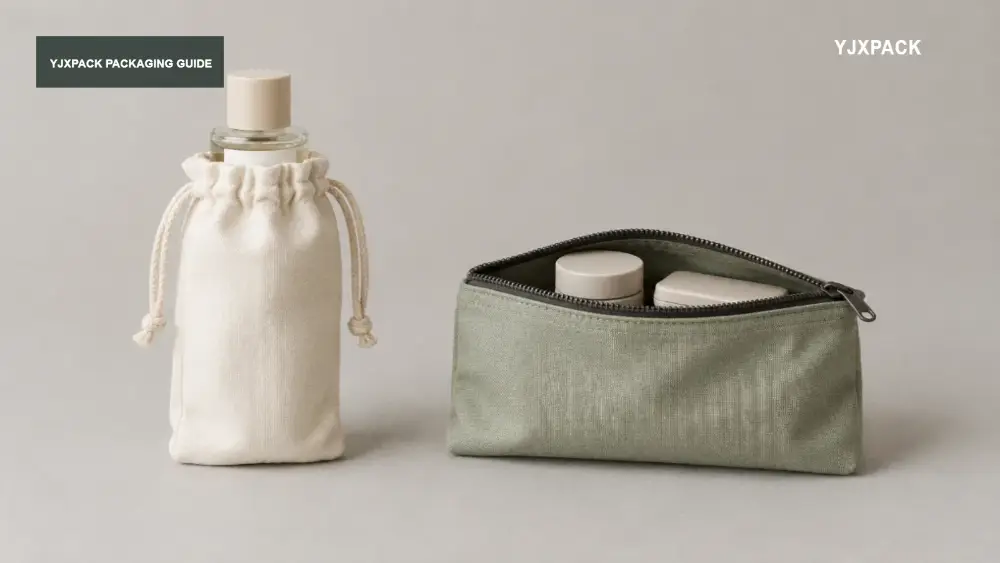
Be specific. Not “a bag” — say “drawstring pouch,” “zipper cosmetic bag,” or “tote bag with handles.” Plus mention the use case if relevant (jewelry, cosmetics, gifts).
Element 2: Dimensions (in mm)
Give width, height, and depth in millimeters. Round numbers in inches (“about 6 inches”) leave room for error. So use mm — it’s the standard for factories.
Element 3: Material and GSM
Name the fabric type (cotton, canvas, velvet, satin, microfiber). Then add the weight in GSM (grams per square meter). GSM is the single biggest driver of fabric cost. Don’t skip it.
Element 4: Quantity (and Future Volume)
Give an exact number, not a range like “a few hundred.” Plus mention your expected annual volume. This helps factories quote the right price tier — see our MOQ packaging guide for how quantity affects pricing.
Element 5: Logo Method and Pantone Color
State the logo method (screen print, embroidery, hot stamping, DTF). Then give the exact Pantone code for your colors. See our Pantone color matching guide for how to specify this correctly.
Element 6: Closure Type and Accessories
Specify the closure — drawstring, zipper, snap, flap. Plus list any hardware: metal eyelets, cord locks, ribbons, or tags. Each accessory adds cost, so list them all.
Element 7: Packing Format
State how many pieces go in each poly bag, and how many poly bags go in each carton. Plus give any carton size limits if you have warehouse constraints. This affects both cost and shipping.
Element 8: Lead Time and Shipping Destination
Give your target delivery date and the destination city or port. Freight cost depends heavily on destination — our packaging shipping cost guide breaks this down by route and volume.
So that’s all 8. Miss even one, and a factory has to guess. Guesses create price gaps.
5. 5 Mistakes That Get You Bad Quotes
These five mistakes show up constantly. Avoid them, and your quotes improve fast.
Mistake 1: “Just Give Me a Quote”
This phrase, with no specs attached, forces a factory to guess everything. Plus it signals you haven’t done your homework — some factories may not prioritize a reply.
Mistake 2: “Like the One on Amazon” (With a Blurry Photo)
A low-resolution screenshot tells a factory almost nothing. Fabric type, GSM, stitching detail, and exact size are all invisible in a blurry photo. So always pair any reference photo with written specs.
Mistake 3: Quantity Written as “A Few Hundred”
“A few hundred” could mean 200 or 900. That’s a huge cost difference. Plus it makes it impossible for the factory to quote the right price tier. Always give an exact number.
Mistake 4: No Pantone Code — Color “Like the Picture”
Screen colors and printed colors never match exactly. Without a Pantone code, the factory guesses your color from a photo. Then your first sample arrives the wrong shade — and you start over.
Mistake 5: No Shipping Destination
Freight cost varies a lot by destination. A factory without your destination can’t include shipping in the quote — or worse, guesses using a default that’s wrong for you. Always include your city and country.
6. The Perfect Brief — A Real Example
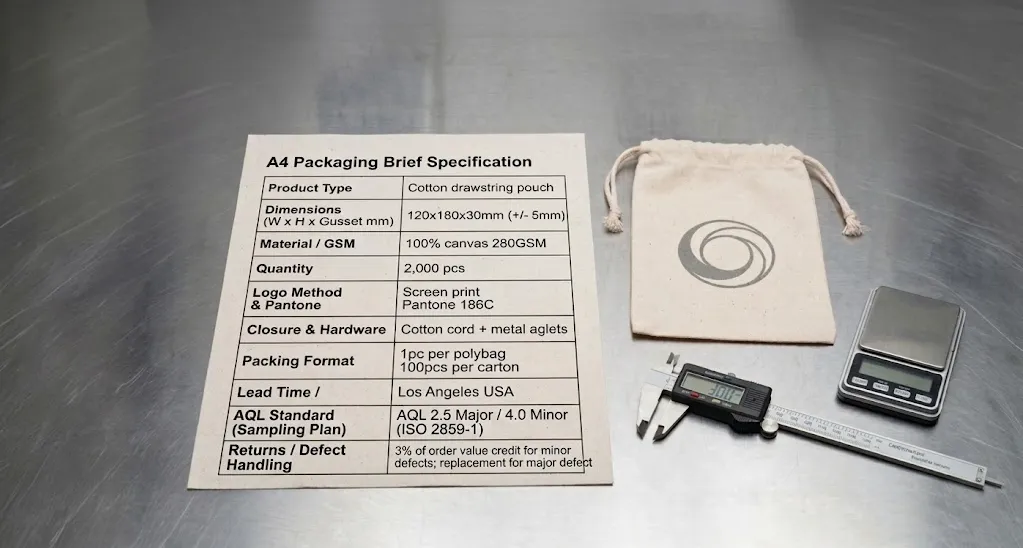
Here’s what a complete brief looks like. Use this as your model.
| Field | Example Entry |
|---|---|
| Product | Cotton drawstring pouch |
| Dimensions | 120mm (W) x 180mm (H), gusset 30mm |
| Material | 100% cotton canvas, 280 GSM |
| Quantity | 2,000 pcs (initial), 8,000 pcs/year est.) |
| Logo | 1-color screen print, Pantone 186 C, front center |
| Closure | Cotton drawstring, natural color, with metal aglets |
| Packing | 1 pc per poly bag, 100 pcs per carton |
| Lead Time / Destination | 30 days production, ship to Los Angeles, USA |
Notice what’s missing: nothing. Every cost-affecting detail is here. As a result, three different factories quoting this brief would land within 10-15% of each other — not 300% apart.
This is the difference a complete custom packaging samples process starts with. Get the brief right, and the sample stage goes faster too.
7. Free Downloadable Packaging Brief Template
You don’t need to build this from scratch. We’ve made a fill-in-the-blank version covering all 8 elements above.
The template includes a field for each element, plus example values to guide you. Just copy it, fill in your specs, and send it to up to 5 suppliers at once. Every supplier gets the exact same information — so every quote becomes comparable.
Want the template? Message us using the form below, and we’ll send you our Custom Pouch RFQ Template — built specifically for fabric pouches, with both English and bilingual versions available for international sourcing teams.
8. How to Send Your Brief — Email vs WeChat vs Alibaba
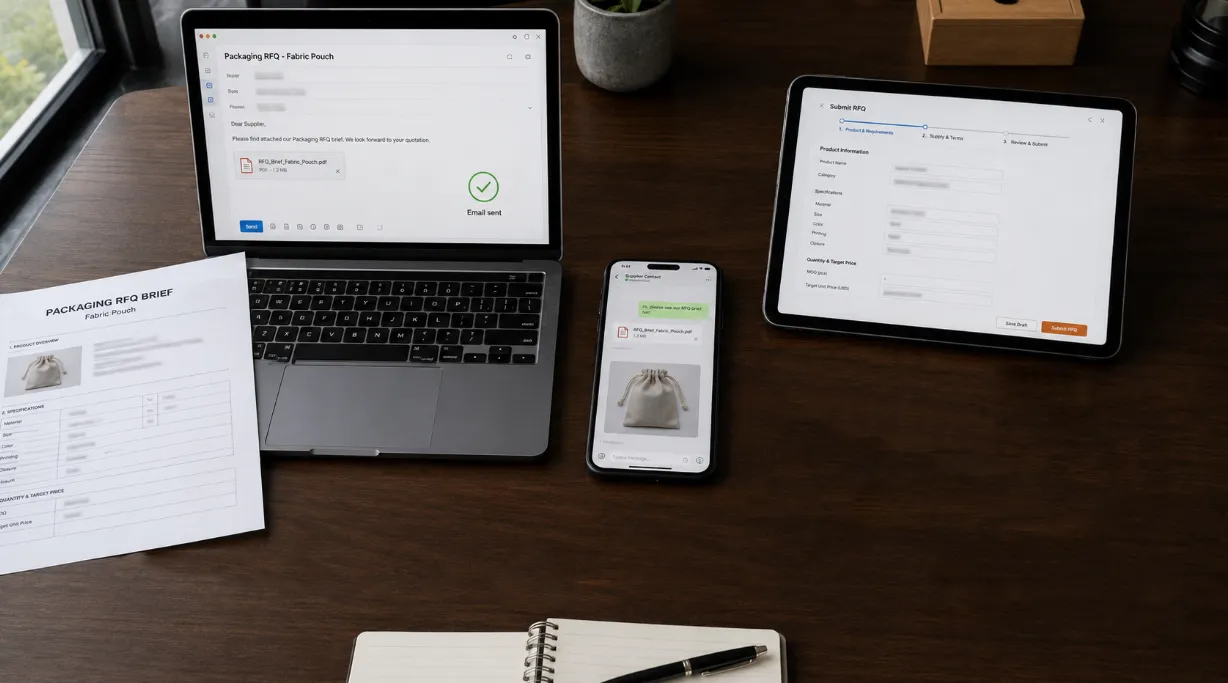
Once your brief is ready, where do you send it? Each channel has trade-offs.
| Channel | Pros | Cons |
|---|---|---|
| Formal record, easy to attach files | Slower replies, may land in spam | |
| Fast replies, good for quick photos | Easy to lose track of details in chat | |
| Alibaba RFQ | Reaches many suppliers at once | Replies vary widely in quality |
Three practical tips.
First, email works best for the full brief. It creates a clear record. Plus attachments (like your template) stay organized.
Second, WeChat works well for fast follow-ups. Once a supplier has your brief, WeChat speeds up sample photos and quick questions.
Third, Alibaba RFQs cast a wide net. However, replies range from excellent to copy-paste spam. So always cross-check Alibaba quotes against your own complete brief — many “quotes” there ignore half your specs. In short, use Alibaba to discover suppliers, then switch to email for your actual packaging RFQ.
04 packaging rfq sending channels
9. What to Ask After You Get a Quote
A quote number alone doesn’t tell the full story. So ask these follow-up questions.
First, ask what’s included. Does the price cover the logo, packing, and inland freight to the port? Or are these extra? Get this in writing.
Second, ask about the MOQ at this price. Sometimes a quoted price only applies above a certain quantity. So confirm the price holds for your exact number.
Third, ask for the sample lead time and cost. A quote without a sample timeline is incomplete. Plus sample cost tells you a lot about how the factory treats new customers.
Fourth, ask what happens if specs change slightly. Small changes (like adding a tag) shouldn’t blow up the whole quote. But you should know the cost impact before you commit.
10. Red Flags in a Quote Response
Some quote responses signal trouble ahead. Watch for these.
First, a quote that ignores your brief entirely. If you specified 280 GSM canvas and the quote says “cotton bag, standard,” they didn’t read your brief. This often predicts poor communication later.
Second, a price that’s dramatically lower than everyone else. A quote 50% below the rest often means a corner will get cut — thinner fabric, no lining, or a cheaper closure swap without telling you.
Third, no questions back from the supplier. A good factory often asks one or two clarifying questions, even with a complete brief. Zero questions can mean zero attention to your order.
Fourth, vague timelines like “soon” or “fast.” Real factories give number ranges — “7-10 days for sample,” not “fast.”
11. Conclusion — Packaging Brief Template Decision Test
Skip the long version. Use this 60-second test instead.
Ask yourself four quick questions:
1. Does your brief cover all 8 elements from Section 4? If not, fill the gaps first.
2. Are you sending the exact same brief to every supplier? If not, standardize it now.
3. Did you give an exact quantity and Pantone code? These two alone fix most quote gaps.
4. Did you include your shipping destination? Without it, no quote is truly final.
Answer yes to all four, and your next round of quotes will land close together — not three times apart.
That’s it. Sixty seconds. Real answer.
12. FAQs
Q1: What’s the difference between a packaging brief and an RFQ?
A brief is your full spec sheet — what you need, in detail. An RFQ adds a formal request for pricing, often sent to several suppliers at once with a deadline. So the brief is the content, and the RFQ is the action of sending it out for quotes.
Q2: Do I need exact dimensions before getting a quote?
Yes, and use millimeters. Rough sizes like “about 6 by 8 inches” leave room for error on both sides. Plus exact dimensions in mm let the factory calculate fabric usage precisely — which directly affects your price.
Q3: What if I don’t know the GSM for my fabric?
That’s common for first-time buyers. In that case, describe the look and feel you want — “lightweight like a t-shirt” or “heavy like a tote bag.” A good supplier can suggest a GSM range and send fabric swatches for you to compare.
Q4: Can I use the same brief for multiple product types?
No — write one brief per product type. A drawstring pouch and a zipper pouch have different closures, different hardware, and often different fabric needs. Mixing them into one brief causes confusion. So keep briefs product-specific.
Q5: How many suppliers should I send my brief to?
3-5 is a good range. Fewer than 3 limits your comparison. More than 5 becomes hard to manage and compare fairly. Plus most buyers find that 3-5 solid replies are enough to make a confident decision.
Q6: Is a packaging brief the same as a technical pack (tech pack)?
They’re closely related. A tech pack is often more detailed — with diagrams, exact stitch types, and construction notes. A packaging brief covers the same core info but in a simpler, faster-to-write format. For most sourcing, a complete brief is enough to start.
Q7: What if the factory still gives me a vague quote after my detailed brief?
This is itself useful information. If a factory ignores a complete brief, it may signal poor attention to detail — a preview of how they’d handle your actual order. So treat a vague response to a clear brief as a quality signal, not just a pricing issue.
Get Your Free Packaging Brief Template + Quote
YJXpack — Yijiaxin (Shenzhen) Packaging Co., Ltd.
For 20+ years, we’ve quoted custom fabric pouches for brands across the US, Europe, and the Middle East. We built our Custom Pouch RFQ Template around our own quoting system — so when you fill it in, you’ll get a fast, accurate quote with zero back-and-forth.
Want the free template? Message us below, and we’ll send you the Custom Pouch RFQ Template (English and bilingual versions available). Fill it in, send it back, and we’ll reply with a full quote within 3 minutes.
Email: info@yjxpack.com
WhatsApp / WeChat: +86 18617112946
Website: www.yjxpack.com
Free Custom Pouch RFQ Template · Quote within 3 minutes · 3D mockup in 30 minutes · MOQ 100 pieces · GOTS / GRS / OEKO-TEX / BSCI / ISO 9001 certified
Share This Story, Choose Your Platform!