A travel shoe bag is one of the few packaging items your customer keeps using after the sale. It leaves the box, goes into a suitcase, comes back out in a hotel room, and sits in a closet for years. That second life is why the specification matters more than the price per piece. A bag that is slightly too small, or that lets a dirty sole touch a folded shirt, gets thrown away — and with it goes your logo.
The decision in front of you is not “which fabric is nicest.” It is whether a given combination of size, sole isolation and logo placement fits the channel you sell through. A hotel gift shop, an e-commerce shoe brand and a suitcase brand bundling accessories all need different answers from the same factory.
This guide defines the parts of that decision, explains what each specification actually controls, and ends with a checklist to complete before you ask for a quote. It explains selection logic; availability, construction options, artwork limits, MOQ, sampling, pricing and documentation should be confirmed against the final brief during quotation.
Quick Summary
- A travel shoe bag is defined by three specifications that interact: internal dimensions, sole isolation, and the logo method.
- Material choice follows the channel, not the reverse. Lightweight synthetic and coated fabrics suit mass travel retail; natural woven fabrics suit gift and boutique channels.
- Size should be set from the largest shoe in the range plus clearance — never from a “standard” bag size.
- Sole isolation is a construction decision, not a fabric decision. It is the single most common source of buyer complaints.
- Logo placement should be confirmed against how the bag is packed and displayed, not just how it looks flat on a table.
- Cost drivers are predictable: material weight, closure type, isolation construction, logo steps, and order quantity.
Start With the Shoe, Channel and Protection Requirement
Every shoe bag specification is downstream of three questions. Get these wrong and no material upgrade will fix the result.
What shoes will go inside? Not “shoes” in general — the actual range. A bag sized for women’s flats will not hold men’s US 12 sneakers. A bag sized for sneakers may swallow a pair of ballet flats and look empty in a gift box. If you sell more than one category, you are either designing to the largest item, designing two SKUs, or accepting that some pairs fit loosely.
Where does the bag sit in the customer journey? There are at least four distinct jobs a travel shoe bag can do:
- Retail packaging. The bag is the shoe box’s interior wrapping. The customer sees it once, at unboxing, and probably keeps it because it looks good.
- Travel accessory included with the product. The bag is part of what the customer paid for. Durability and fit matter more than surface appearance.
- Standalone retail item. The bag is sold on its own, often near luggage. It needs to survive handling on a shelf and read clearly at a distance.
- Promotional or gift-with-purchase. Cost per unit dominates, and the bag carries a logo more than a product.
Each job weights the three specifications differently. A retail packaging bag can accept a thinner fabric because it experiences one unboxing. A standalone travel item cannot.
What is the protection requirement? Shoe bags deal with four things: dirt, moisture, abrasion, and odor. Decide which of these your buyer actually cares about.
- Dirt comes mostly from the outsole. A clean new shoe from a factory has minimal dirt; a customer’s worn running shoes have plenty.
- Moisture is a materials question. Most simple woven fabrics let moisture through. Coated or laminated fabrics resist it. A wet bag inside a suitcase is a real complaint source.
- Abrasion is about how the bag is used. A bag that gets stuffed into a duffel repeatedly needs a tougher surface than one that sits in a drawer.
- Odor is about airflow and closure. Drawstring bags vent; zippered bags trap.
Write down which of these four you are solving for. It narrows material and closure options quickly, and it gives you a defensible reason for the specification when a colleague asks why a cheaper bag was rejected.
What Changes the Answer
Three variables move everything downstream:
- Shoe size range. Determines internal dimensions and therefore material consumption.
- Whether the sole is isolated from the rest of the bag. This is the biggest structural fork in the design.
- Whether the bag carries a logo in a channel where the logo is seen before purchase. This decides logo method, placement, and how much of the bag’s surface you must keep clean.
Compare Travel Shoe Bag Materials by Function and Presentation
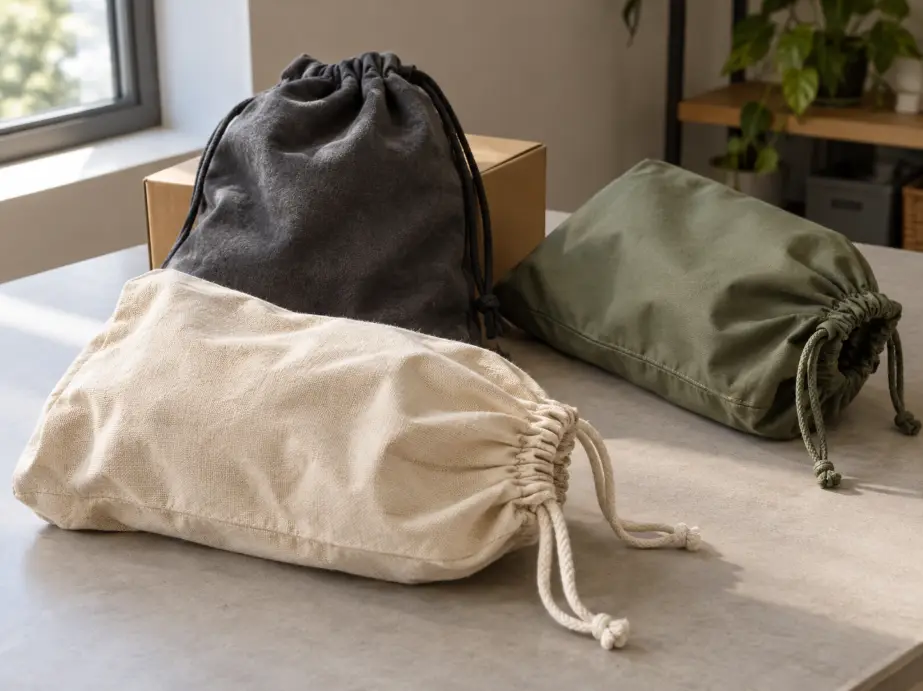
Fabric choice sets weight, hand feel, moisture behavior, print fidelity, and how the bag ages. Below are the material families commonly used for this type of pouch, described by what they do rather than by brand or supplier claims.
Woven Natural Fabrics: Cotton, Canvas, Muslin, Linen
These are the fabrics most buyers associate with reusable packaging.
- Cotton and canvas are the workhorses. They take screen print and embroidery well, feel substantial, and hold a printed shape without distortion. Heavier weights resist abrasion better; lighter weights pack smaller. Canvas is a heavier cotton construction, generally with a plainer weave.
- Muslin is a light, plain-woven cotton. It is soft and cheap in feel but thin; it tears more easily under abrasion and shows dirt. It suits a gift or promotional bag more than a hard-use travel bag.
- Linen has a dry, textured hand and a premium look in natural tones. It wrinkles, which can be a design feature or a complaint depending on your customer.
Natural woven fabrics are breathable, which helps with odor, and generally poor at blocking moisture. Print results depend on fabric weave and surface: a coarse weave swallows fine detail, so logo artwork may need simplification.
Synthetic and Microfiber Fabrics
Synthetics solve problems that natural fabrics do not.
- Polyester and nylon are lightweight, strong for their weight, and can be finished with a water-repellent treatment. They print well with heat-based methods and hold color sharply. Thinner versions feel like a laundry bag; heavier versions feel like a proper accessory.
- Microfiber is a fine synthetic fiber fabric that feels smooth and dense. It is often used where the pouch also serves as a wipe or cloth. It takes vibrant printing and is generally easy to clean.
Synthetics resist moisture better than untreated natural fabrics and are usually lighter, which matters if the bag ships in quantity or travels often. The trade-offs are hand feel and perceived sustainability. Some buyers find synthetics look less premium in a gift context; others find natural fibers look less technical.
Coated and Laminated Fabrics
Here the fabric carries a polymer layer or coating that blocks liquid.
- PU-coated fabric has a polyurethane layer. It is wipeable and gives a smooth, sometimes leather-like surface.
- TPU is a clear or tinted thermoplastic film, often laminated to a base fabric. It is more resistant to oils and abrasion than many softer coatings.
- PVC is the older, heavier option. It is the least favored in channels with sustainability requirements.
Coated and laminated materials are the straightforward answer to moisture and to dirty soles. They are also the heaviest and stiffest options, and they may have restrictions in markets with packaging material regulations. If your market has material requirements, confirm the coating chemistry and documentation before approving a sample.
Material Selection Table
| Material family | Weight | Moisture behavior | Logo compatibility | Best-fit channel |
|---|---|---|---|---|
| Cotton / canvas | Medium to heavy | Absorbs; poor barrier | Screen print, embroidery, heat transfer | Retail, gift, boutique |
| Muslin | Light | Absorbs; poor barrier | Screen print, simple heat transfer | Promotional, gift-with-purchase |
| Linen | Medium | Absorbs; poor barrier | Screen print, embroidery | Boutique, premium gift |
| Polyester / nylon | Light | Resists; better barrier | Heat transfer, screen print, DTF | Travel retail, e-commerce |
| Microfiber | Light to medium | Resists; wipes clean | Heat transfer, screen print | Multi-use, electronics-style retail |
| PU / TPU / PVC coated | Medium to heavy | Blocks liquid | Heat transfer, hot stamp on some surfaces | Hard-use travel, wet-climate markets |
Treat this table as a reasoning tool, not a stock list.
Set Dimensions for Shoe Geometry, Pairing and Packing Efficiency
Shoe bags fail on size more often than on anything else. The reason is that a shoe is a three-dimensional object, and a bag is usually described by two numbers.
What a Shoe Bag Must Accommodate
A shoe’s relevant measurements are:
- Length, heel to toe. This is the dominant dimension.
- Width, at the widest point — usually the ball of the foot for a dress shoe, or the widest part of the midsole for a sneaker.
- Height or depth, from the outsole bottom to the top of the instep or the highest point of the upper. High-tops and boots drive this number.
To those you add clearance: extra allowance so the shoe slides in without forcing, and so the bag fabric is not stretched tight across a hard edge. Clearance also absorbs variation between sizes in the same model.
One Bag or Two?
This is a channel decision.
- Two bags per pair protects shoes from each other and is standard for retail packaging where each shoe is separately wrapped.
- One bag per pair is cheaper and faster to pack. It suits promotional and low-cost travel channels.
If you choose one bag, confirm whether the two shoes go in side by side or one on top of the other, because that changes the required width or depth. Do not assume the factory will interpret “one bag per pair” the same way you do.
Packing Efficiency
Internal dimensions affect how the product ships. A bag with generous clearance is easier to pack but consumes more fabric, ships bulkier when packed empty, and may look slack in a retail box. A tight bag looks crisp but risks returns from customers who cannot get a shoe in easily.
Two practical checks:
- Measure your largest shoe, add your chosen clearance, and compare the result against your box or carton interior. If the bag only fits diagonally, it will damage in transit.
- For packs that ship empty, confirm the flat fold-down dimensions rather than the filled dimensions.
Write your dimensions as internal measurements and state the tolerance you will accept. Also state how they are measured — flat width × height, or gusseted width × height × depth. For a general method of measuring a pouch consistently between buyer and factory, see How to Measure a Drawstring Pouch: Size Guide for Brands. Confirm the final size and tolerance on the approved sample.
Specify Sole Isolation, Closures and Internal Separation
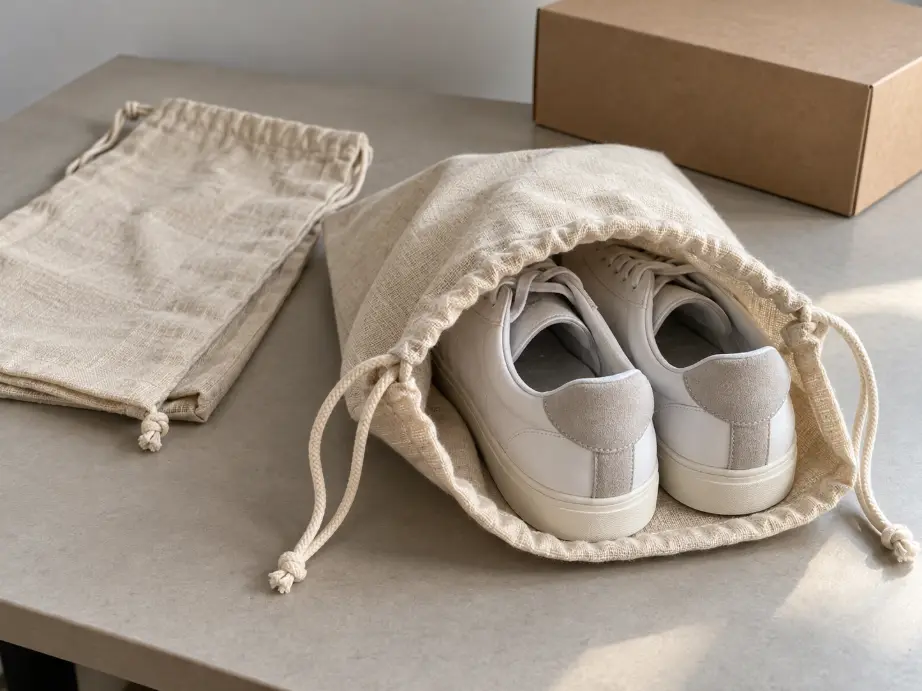
This is where most travel shoe bags either work or do not.
Sole Isolation
The sole is the part of a shoe that touches the ground. Isolating it means the dirty surface cannot contaminate the rest of the bag or anything else in the suitcase. There are four common approaches:
- Separate sole compartment. A partition creates a second space for the sole. It is the most protective option and the most expensive to construct.
- Lining or internal coating. A wipeable inner surface makes dirt easier to remove. It does not stop the sole from touching other items.
- Bags worn sole-outward. The bag is designed so the sole faces the exterior of the bag, keeping the interior cleaner. It works only if the user follows the intended orientation.
- No isolation. The simplest construction. Acceptable when the shoes are new and clean at unboxing, and when the bag is packaging rather than a use item.
Sole isolation is the specification most likely to be silently dropped. State it in writing, describe the construction you expect, and confirm it on the sample by putting a dirty-soled shoe in the bag and inspecting the interior afterward.
Closure Types
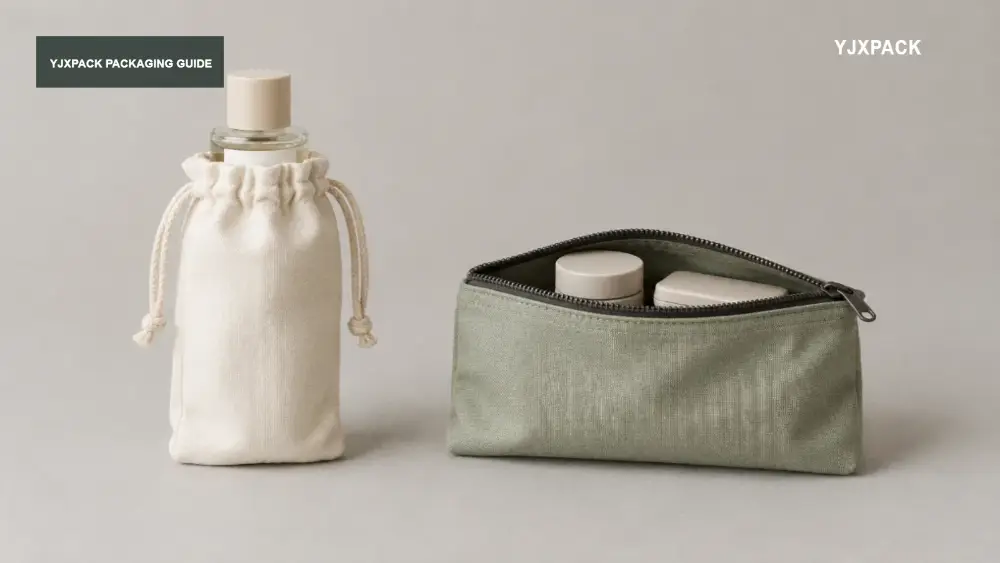
- Drawstring. A cord runs through a channel and cinches the opening. It is light, cheap, vents well, and closes loosely. It is the default for fabric shoe bags.
- Zipper. Closes fully and keeps contents contained. It adds weight, cost and a possible failure point at the pull. Nylon coil zippers are lighter and more flexible than metal; metal zippers feel more premium but can snag fabric.
- Flap with snap, hook-and-loop or magnetic closure. Good for a more structured, gift-like presentation. It adds material and assembly steps.
- Open top. No closure. Used when the bag is a liner inside a box.
Match the closure to the job. A drawstring bag that will be stuffed into a duffel holds shoes in place only if the cord is pulled tight; if your customer will not bother, a zipper is the more honest specification. Confirm the closure and hardware specification on the approved sample.
Internal Separation and Small Details
Consider whether the bag needs:
- A divider between the two shoes.
- A small internal pocket for a shoehorn, a polishing cloth, or a spare set of laces.
- A hang loop for retail display.
- A ventilation feature if odor is a stated concern.
Each addition is a construction step. Each should be shown on the sample and described in the approved specification sheet, because these are the details most likely to drift on a repeat order.
Choose Logo Methods and Placement for the Sales Channel
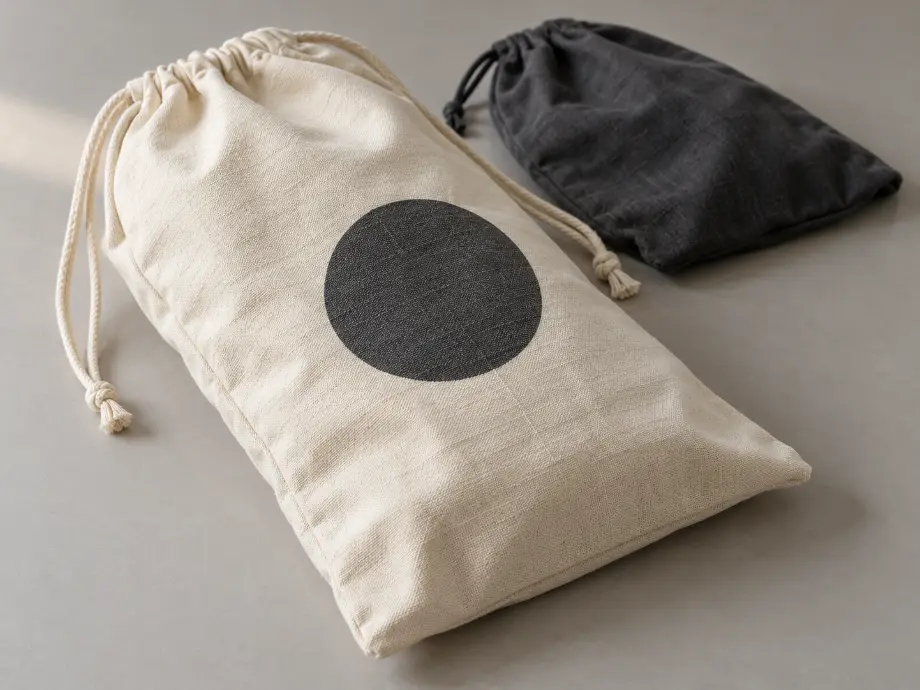
A logo method has to survive the fabric and the use. The wrong pairing fails quickly, usually by cracking, peeling or fading after washing or abrasion.
Method Definitions
- Screen printing pushes ink through a stencil-like mesh onto the fabric. It is economical at volume for simple, limited-color artwork on flat surfaces, and it works well on cotton and canvas.
- Heat transfer prints artwork onto a carrier film and bonds it to the fabric with heat and pressure. It handles multi-color and photographic detail better than screen printing.
- DTF (direct-to-film) printing transfers a printed film onto fabric with heat. It suits detailed, multi-color artwork and small runs of complex designs.
- Embroidery stitches thread into the fabric. It reads as premium, has physical depth, and holds up to wear, but it cannot reproduce fine detail or gradients and needs a digitized file.
- Hot stamping (foil) presses a metallic or colored foil onto the surface with a heated die. It is common on velvet and some coated surfaces and gives a metallic, high-contrast mark. It does not work on every fabric.
Two buyer-facing comparisons on this factory’s own site may help frame the decision: Difference Between Embroidery, Silk Screen & Heat Transfer for Pouches and Why Logos Peel, Crack & Fade on Fabric Pouches — And How to Prevent It.
Placement: A Channel Question
Placement should follow how the bag is seen, not how it looks on a table in your office.
| Channel | Where the bag is seen | Placement logic to consider |
|---|---|---|
| Retail shoe box interior | Once, at unboxing, in the hand | Works on the face; may also work on the closure area near the top |
| Standalone retail near luggage | On a shelf or hook, at distance | Requires a larger mark on a visible face; hang loop may matter |
| Included with product | During packing and during travel | Keep the mark away from the sole-contact zone and from abrasion points |
| Gift-with-purchase | Briefly, in the hand | Smaller mark on a clean area is usually enough |
Practical rules that hold across channels:
- Keep the mark away from the seam and from the area where the drawstring channel sits, because both distort the surface.
- Keep the mark away from the sole-facing panel on any bag with sole isolation, because that surface takes abrasion and dirt.
- Confirm the mark position relative to the finished bag dimensions, not the flat fabric dimensions, since fabric shifts during assembly.
Set logo size, placement and colour reference in the artwork approval before production. If you have not yet settled how a color target will be communicated and checked, Pantone Color Matching for Custom Fabric Pouches: A Brand’s Complete Guide covers that workflow.
Matching Method to Fabric and Use
Three pairings fail often enough to be worth stating plainly:
- Fine-detail artwork on a coarse natural weave. Screen print cannot hold hairline strokes on a textured surface. Simplify the mark or switch fabric.
- Foil on an absorbent or uneven fabric. Foil needs a surface it can bond to. On many woven naturals it does not take, or it wears off at fold lines.
- Embroidery on a lightweight fabric. Stitch density can distort a thin material or punch through it. Heavier canvas handles it; muslin generally does not.
Decide the method after the fabric is fixed, not before. Then run the pairing through the actual sample, and check it against the use — a fold line, a drawstring channel or a sole panel will each test the mark differently.
Evaluate Cost Factors, MOQ and Sampling Without Guesswork
There is no useful price in this article, and any figure you see quoted generically should be treated as worthless. Unit cost for a travel shoe bag is the sum of several independent variables, and only your supplier can price your combination.
What Actually Moves the Price
- Fabric type and weight. Heavier and more technical fabrics cost more per bag.
- Bag dimensions. Larger bags consume more material and more labor time.
- Construction complexity. A sole compartment, a divider, a lined interior or an internal pocket each add cutting and stitching steps.
- Closure type. Zippers cost more than drawstrings, before considering zipper quality and pull selection.
- Logo method and number of locations. Setup or plate or die charges apply per artwork, and each additional logo location adds a step. Screen printing carries a setup cost per color; embroidery carries a digitizing cost; foil carries a die cost. Multi-color artwork raises screen-print cost faster than heat-transfer cost.
- Order quantity. Setup costs spread across more units as quantity rises, so unit price falls, but not in a straight line.
- Packaging and carton configuration. Individual polybagging, hang tags, retail-ready cartons and carton labeling each add cost and lead-time steps.
- Inspection and documentation. Any testing, certification paperwork or third-party inspection you require is a separate line.
Write these into a single table with what you know and what you need quoted. That alone will get you comparable quotes instead of a set of numbers you cannot reconcile.
MOQ: What It Really Constrains
Minimum order quantity is usually set by the least flexible step in the process, not by the bag itself. Common constraints are:
- Minimum fabric purchase. A mill may not sell a small quantity of a specific color or weight.
- Setup economics. Screen-print plates, embroidery digitizing and foil dies have to be amortized.
- Minimum run time for a machine or a line.
That is why MOQ can differ between two otherwise identical bags — one uses a stocked fabric and a single-color print, the other uses a custom-dyed fabric and a four-color design. If your first order is small, options worth discussing with the supplier include using a stocked fabric, reducing color count, choosing a method with lower setup cost, or accepting a higher unit price for a smaller run. Request a quote against the final specification rather than planning a launch on an assumed MOQ.
Sampling: What to Ask For and What to Check
A sample is your only real risk control before production. Treat it as a formal approval step.
Ask the supplier to confirm what the sample represents — a stock item, a size reference, or a made-to-specification piece with your fabric, your dimensions, your closure and your logo. These are different things, and only the last one tests your actual specification. If your logo is part of the project, ask explicitly whether the sample will carry the logo or whether it will be a blank size reference, and treat a blank reference as a size and construction check only.
Then inspect it as a finished consumer item, not as a fabric swatch:
- Put the actual largest shoe in it, in the intended orientation.
- Put a dirty-soled shoe in it and inspect the interior afterward.
- Pull the drawstring tight, or zip and unzip the closure several times.
- Hold the logo up to the artwork and check placement against finished dimensions.
- Fold and refold the bag along its natural lines to see how the material and the mark behave.
- Check the seam, the cord ends or zipper pulls, and any internal pocket or divider.
Record what you find, photograph it, and turn the acceptable sample into a written approved specification before the production order is placed. For a structured approach to that approval cycle, see How to Order Custom Jewelry Pouch Samples: A Step-by-Step Guide for Brands — the workflow applies to any custom fabric pouch, including shoe bags.
Build a Quality-Control and Approval Checklist Before Ordering
Quality control is easiest when the acceptance criteria are written before production, and hardest when they are invented after a dispute. The table below separates what you can generally specify yourself from what can only come from the factory.
| Item | Status | Notes |
|---|---|---|
| Internal dimensions and tolerance | Your decision | Set from your largest shoe plus clearance; state measurement method |
| Sole isolation construction | Your decision | Describe expected construction; verify on sample |
| Closure type | Your decision | Drawstring, zipper, flap or open top |
| Fabric family | Your decision | Chosen for channel and protection requirement |
| Specific fabric weight, color and finish | Confirm with factory | Must be agreed in writing and referenced in the approved spec |
| Logo method, size, color, placement | Your decision, with factory input | Method must suit the chosen fabric |
| MOQ | Confirm with factory | Depends on fabric, color count and setup |
| Unit price, tooling and setup charges | Confirm with factory | No general figure is valid |
| Sample lead time and production lead time | Confirm with factory | Plan launch dates after confirmation, not before |
| Certifications and test documentation | Confirm with factory | Ask for the exact document type your market requires |
| Carton configuration and labeling | Your decision, with factory input | Affects packing labor and freight |
| Inspection arrangement | Your decision | Agree who inspects, at what stage and against what criteria |
Points to Inspect in Volume
Once a specification is approved, the recurring checks are:
- Dimensional check. Measure a sample of bags against the agreed internal dimensions and tolerance.
- Sole isolation check. Confirm the partition, lining or orientation construction is actually present as approved.
- Closure function check. Drawstrings should cinch and hold; zippers should run smoothly without catching.
- Logo check. Compare placement, size and color against the approved sample and artwork.
- Seam and stitch check. Look for skipped stitches, loose threads and open seams, especially at stress points.
- Fabric defect check. Look for stains, weaving faults, uneven color and creases set into the material.
- Carton and count check. Verify piece count per carton and carton markings against the agreed packing list.
Set the acceptance criteria for each check in writing. “Acceptable” is not a criterion; a measurement, a comparison to the approved sample, or a stated defect limit is.
Prepare This Before You Request a Quote
Collect the following and send it as one package. Quotes improve in proportion to how specific this list is.
- Product and channel: which shoe types, which sizes, which sales channel, and whether the bag is retail packaging, an included travel accessory, a standalone item or a promotional piece.
- Shoe measurements: length, width and height of the largest shoe in the range, plus the clearance you want.
- Quantity: expected first order quantity, whether it is a trial run or full launch, and your target reorder volume.
- Dimensions: internal measurements you want, the measurement method, and the tolerance you will accept.
- Construction: number of bags per pair, sole isolation requirement, divider or pocket requirement, hang loop requirement.
- Closure: type, and any cord, aglet or zipper specification you want.
- Material: fabric family, color direction, and whether sustainability documentation is required.
- Logo: artwork file, method preference, size, placement, number of locations, and color reference.
- Sampling: whether you want a blank size reference or a made-to-specification sample with your logo, and what you will use it to approve.
- Commercial: your shipping destination, carton requirements, and any inspection or documentation requirement.
- Timeline: when you need the sample, when you need production, and any hard date.
Send that package and ask the supplier to confirm each item, or to flag where their process differs. Their response will tell you as much about their reliability as the price does. Use the approved sample and final quotation as the reference before committing to an order.
FAQ
What is the difference between a travel shoe bag and a dust bag?
A dust bag usually ships with a new pair and stays in the box; its job is presentation and light protection. A travel shoe bag is expected to be used repeatedly, so it needs a more durable construction, and often a closure and a sole-isolation feature the dust bag does not have. If your customer will actually travel with the bag, specify it as a travel item even if it also ships in the box.
Should I use one bag per pair or two?
Two bags protect the shoes from each other and are standard for retail packaging. One bag is cheaper and faster to pack, and suits promotional channels. If you choose one bag, state whether the two shoes sit side by side or one on top of the other, because that changes the required dimensions.
Which logo method is best for a travel shoe bag?
It depends on the fabric you choose and how the bag will be used. Screen printing suits simple artwork on cotton and canvas. Heat transfer and DTF handle more detailed artwork and work well on synthetics. Embroidery reads premium but needs a heavier fabric. Foil needs a surface it can bond to. Fix the fabric first, then choose the method, then verify it on a sample.
Do I need sole isolation?
If the shoes are new and clean inside a retail box, the simplest construction is often enough. If the customer will put worn shoes into the bag and then into a suitcase, sole isolation — a separate sole compartment, a wipeable lining, or a sole-outward design — prevents the most common complaint. It is also the specification most likely to be dropped, so state it in writing and check it on the sample.
Why did two quotes for the same bag come back so far apart?
Almost always because the two suppliers are not quoting the same thing. Differences hide in fabric weight, the presence or absence of sole isolation, closure type, the number of logo locations, carton configuration and quantity breaks. Send an identical written specification to every supplier and ask each to confirm line by line, so you compare the same bag.
Get a Quote
Send us your shoe types, size range, preferred fabric family, sole-isolation requirement, logo artwork and target quantity, and we will confirm the specifications that matter for your channel. Where a detail is not yet fixed, we will tell you which ones need a decision before an accurate quote is possible.
Share This Story, Choose Your Platform!