A retail buyer sourcing custom clothing bags faces four interlinked decisions: how the bag performs during delivery, how well it protects the garment, whether the end customer will reuse it, and how strongly it communicates the brand. Get one wrong and the packaging either damages the product, disappoints the customer, or adds cost without adding value. This guide walks through the documents, material questions, size and branding logic, risk signals, quality-control stages and RFQ preparation that help a buyer define the project boundary before requesting quotes.
Scope note: This guide explains the selection logic for custom clothing bags used in retail delivery. Availability of specific materials, construction options, artwork methods, closures, MOQ, sampling, pricing, lead time and certifications must be confirmed against the final brief during quotation with the chosen supplier.
—
Documents to Request Before Comparing Custom Clothing Bag Suppliers
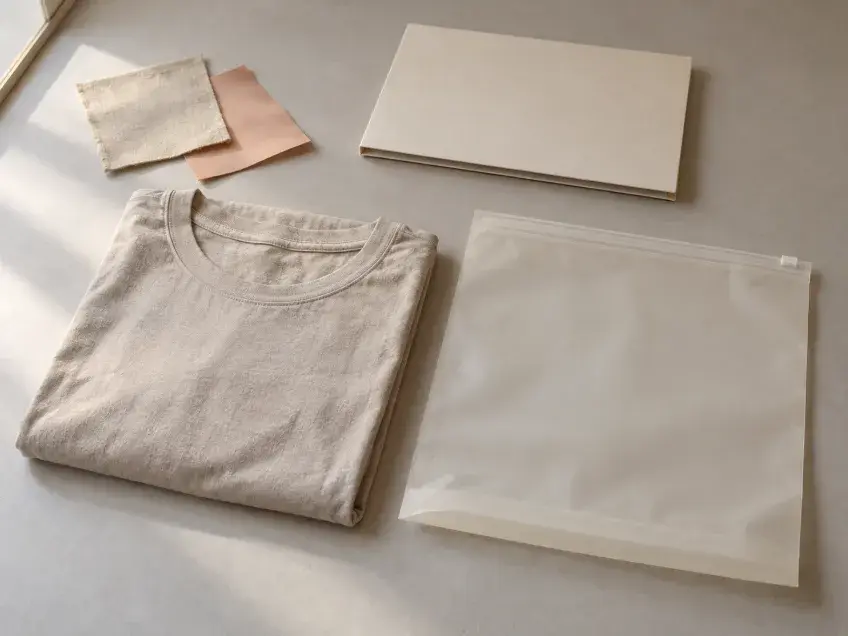
Before any material or price conversation, collect documentation that lets you compare suppliers on a level basis. Missing paperwork at the start creates confusion later—especially when you need to justify vendor selection to a buying committee or compliance team.
Capability and compliance documents
Request the following from each supplier on your shortlist:
- Product catalogue or line sheet showing fabric pouch formats the factory regularly produces—flat bags, drawstring bags, zippered pouches, garment covers, envelope-style bags
- Fabric swatch card or material list with fabric composition, weight range and available finishes
- Branding method summary listing which logo techniques the factory supports (screen printing, heat transfer, embroidery, hot stamping, woven labels, etc.) and any artwork file requirements
- Social-compliance audit report such as BSCI, Sedex or equivalent, with a valid date—never assume a report is current without checking the audit period
- Quality-management documentation describing inspection stages (incoming fabric, in-line, pre-shipment)
- Reference photos or case studies of past clothing-bag orders in similar formats, if the supplier can share them without breaching confidentiality
Shipping and trade documents
If you are importing directly, also request:
- Export licence or business registration for overseas trade
- Standard packing-list format showing how bags are folded, poly-bagged (if applicable) and cartoned
- Freight-ready carton dimensions and weights for the formats you are considering, so your logistics team can estimate container loading
Having these documents in hand before you discuss specifications can make supplier comparisons clearer and reduce avoidable questions during sample review.
For a broader look at how to evaluate a packaging factory remotely, the guide How to Audit a Custom Packaging Factory in China (Without Visiting) covers video-call inspection steps and document-verification questions.
—
Which Materials and Closures Fit the Retail Delivery Use Case?
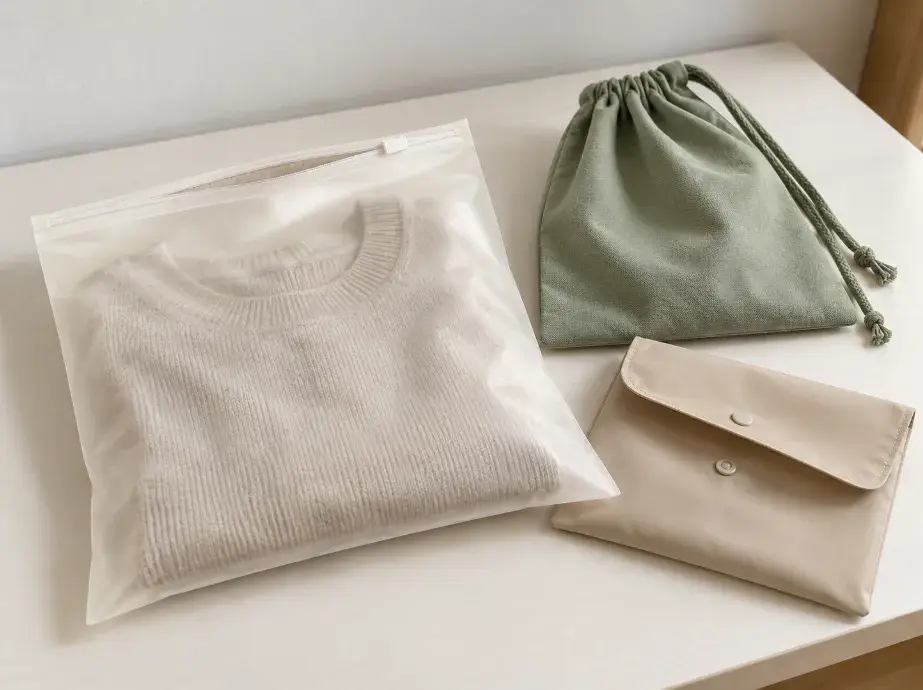
Custom clothing bags for retail delivery must handle a specific set of stresses: folding, stacking in transit cartons, shelf handling, and repeated opening by the end customer. The material and closure you choose determine whether the bag survives all of those steps and still looks presentable on arrival.
Material options and trade-offs
The table below outlines commonly used fabric categories and the considerations that matter most for clothing-bag applications. Specific fabric availability, weights and finishes must be confirmed with the supplier against your garment type.
| Fabric category | Typical characteristics | Key consideration for clothing bags |
|---|---|---|
| Cotton (woven) | Breathable, printable, available in multiple weights | Heavier and lighter options create different trade-offs in structure, packing weight and appearance; confirm the selected fabric on a sample |
| Non-woven polypropylene | Lightweight, low cost, accepts screen printing | Less premium feel; may not suit higher-positioned brands |
| Polyester / RPET | Smooth surface, colour-fast, recyclable variants available | Confirm recycled-content claims with GRS or equivalent certification |
| Canvas | Sturdy, holds structure, supports embroidery | Adds weight; best suited for reusable tote-style delivery bags |
| Muslin | Lightweight, natural look, breathable | Thinner weaves offer less protection; may suit layering inside an outer carton |
| Linen or linen-blend | Textured surface, natural aesthetic | Higher fabric cost; confirm shrinkage behaviour after logo application |
A deeper comparison of cotton, linen and muslin formats is available in the Cotton vs Linen vs Muslin fabric guide.
Closure types and their fit for retail clothing delivery
The closure affects how easy the bag is to open, how well it stays shut during transit, and whether the customer perceives the packaging as worth keeping.
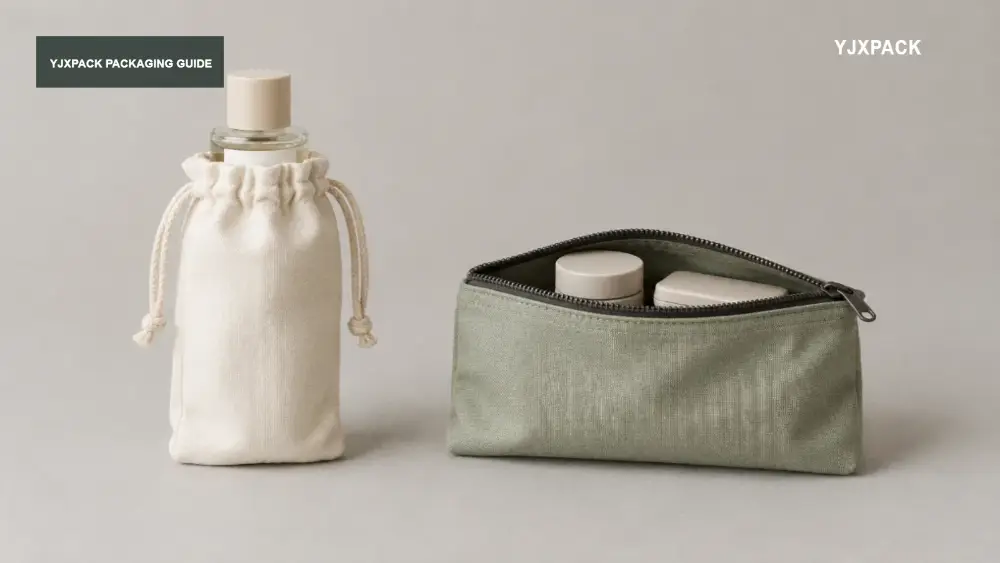
- Drawstring: Simple, low cost, allows some size flexibility. Works well for folded garments. Confirm cord material and stopper type.
- Zipper: Creates a more enclosed format than an open bag. Its suitability for the garment, handling and packing process should be assessed on the selected construction; it adds cost and requires an agreed closure check.
- Snap button or magnetic snap: Clean front appearance. Suits envelope-style bags for flat-folded items such as T-shirts or scarves.
- Flap with tuck-in: No hardware. Works for lightweight items where the bag is mainly a brand wrapper rather than heavy-duty protection.
- Self-adhesive strip: One-time seal, common in e-commerce poly mailers but less common in reusable fabric bags. Confirm if this format is available in fabric.
When comparing closures, ask the supplier whether the closure method changes the minimum order quantity or production lead time, because zipper sourcing or hardware procurement can introduce separate constraints.
—
How Should Size, Branding and Reuse Requirements Be Confirmed?
Size confirmation
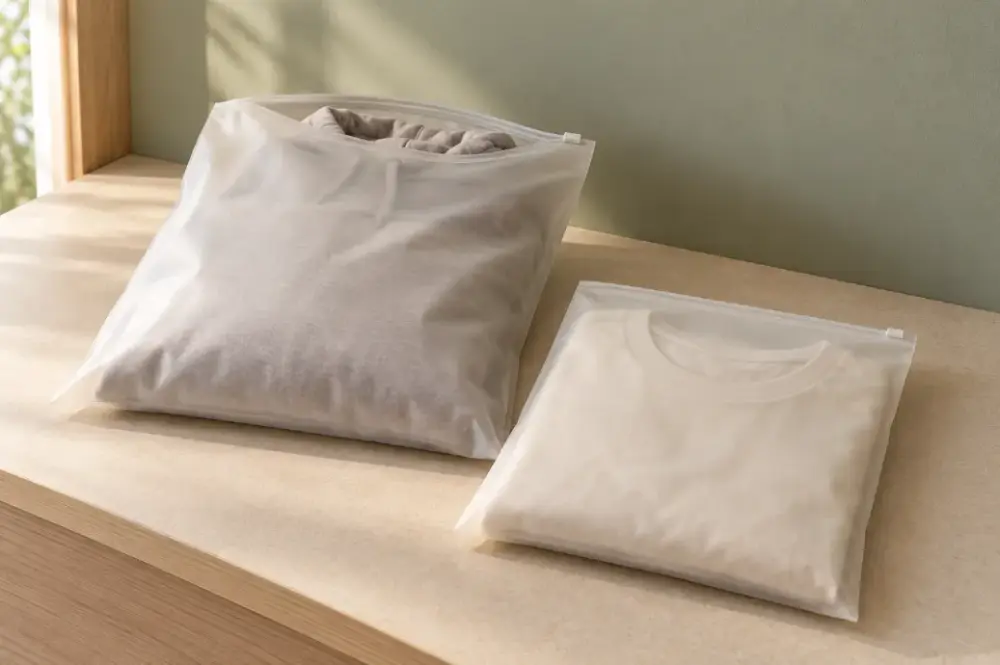
Clothing comes in a wide range of folded dimensions. A bag sized for a folded polo shirt will not work for a winter coat or a set of children’s pyjamas. Before sending a size request to a supplier, define these parameters internally:
- Garment types the bag must accommodate—list every SKU category, not just the most common one
- Folded dimensions of the largest and smallest garments in each category
- Clearance allowance—how much extra width and height the bag needs so the garment slides in and out without forcing
- Thickness when packed—a bulky knit takes more depth than a silk blouse; this affects whether a flat bag or a gusseted bag is needed
If the same bag must cover multiple garment types, you will likely need two or three size options rather than one universal size. Confirm the size matrix with the supplier—each additional size may be treated as a separate SKU for production and pricing purposes.
Branding elements
Branding on a custom clothing bag can range from a single-colour logo to full-coverage pattern printing. The following checklist helps you prepare artwork requirements before contacting a supplier:
- Logo file format: Vector files (AI, EPS, PDF) are generally required. Confirm accepted formats.
- Colour specification: Provide Pantone references for brand colours. Confirm at quotation whether exact Pantone matching is available on the chosen fabric.
- Logo placement: Specify centre-front, bottom-corner, all-over repeat, interior label or other positions.
- Branding method preference: Screen print, heat transfer, embroidery, hot stamping or woven/printed label. Each method has different visual results, minimum detail sizes and cost structures.
- Additional print areas: Care instructions, sustainability messaging, QR code, social-media handle—define these early so the factory can plan plate or screen layout.
For a comparison of logo methods across fabric types, see Screen Printing vs Heat Transfer vs Embroidery.
Reuse expectation
Some retailers and brands position packaging as reusable for garment storage, travel or gifting. If reuse is part of your brand message, confirm these points before sampling:
- Durability standard: How many uses should the bag reasonably survive? This affects fabric weight, seam construction and closure hardware grade.
- Washability: If you plan to market the bag as washable, confirm whether the fabric, print and closure can withstand the wash method you intend to recommend (hand wash, machine wash cold, etc.).
- Reuse messaging: If you print “reusable” on the bag, include the intended claim and evidence need in the brief. Where the target market or customer requires it, confirm the applicable current local rules and customer standards for environmental or reuse claims before publication.
—
Risk Signals in Samples, Specifications and Supplier Responses
Not every problem shows up in a price quote. Many issues surface only during sampling or after the first production run. Recognising early warning signs can prevent costly reorders.
Specification-stage red flags
- Vague fabric descriptions. A supplier describing fabric only as “cotton” without specifying weave type, weight (GSM) or blend ratio makes it impossible to compare quotes or control consistency across reorders.
- No artwork file requirements. If the supplier does not ask for file format, colour system or minimum line thickness, they may not have a reliable pre-press process.
- Single sample only. Receiving one perfect sample proves little. Ask whether the sample was produced on the same equipment and with the same fabric stock planned for bulk production.
- Reluctance to share construction details. Seam type (overlocked, French seam, bound seam), stitch count per centimetre and hem finish all affect durability. A supplier that avoids these details may be working without a fixed production specification.
Sample-stage red flags
- Logo colour shift. Compare the sample logo colour under daylight and indoor lighting against your Pantone reference. A noticeable mismatch at sample stage will likely recur—or worsen—in bulk.
- Uneven drawstring tension. If one cord pulls tighter than the other, the casing width or cord routing is inconsistent.
- Loose threads or unfinished seam ends. These suggest the sample was trimmed by hand rather than produced on production-line equipment.
- Fabric odour. A chemical smell may indicate residual dye-fixation agents or finishing chemicals. Ask the supplier to explain the source and whether a post-production wash or airing step is included.
- Size deviation. Measure the sample against the approved technical drawing and flag any deviation beyond the agreed tolerance. Indicative starting ranges, such as ±0.5 cm for smaller bags and ±1 cm for larger formats, are not default acceptance rules; the actual tolerance must be jointly defined for the bag, material and use case.
Communication red flags
- Delayed or non-specific responses. Repeatedly incomplete answers to straightforward questions about fabric weight or closure hardware are a signal to request clearer written clarification before moving to sampling or production.
- Pricing that changes after sample approval. A significant price increase after you approve a sample—justified by “material cost changes”—may indicate the original quote was based on a different material.
- No written confirmation of approved specifications. If the supplier relies only on verbal or chat confirmations, insist on a signed specification sheet before bulk production begins.
—
Can the Supplier Control Quality Across Approval and Production?
A well-run factory follows a traceable path from sample approval to bulk shipment. As a buyer, you need to understand what happens at each stage and what evidence you can request.
Pre-production approval
Before fabric is cut for bulk, confirm the following have been signed off in writing:
- Approved production sample (PPS) or sealed sample, with your signature or written approval on file
- Technical specification sheet listing fabric, GSM, colour reference, dimensions, closure type, branding method, logo position and stitch details
- Artwork proof showing final print or embroidery layout at actual size
- Packaging and packing instructions—how bags are folded, individually poly-bagged (if required), and packed into cartons
In-line inspection
Ask the supplier whether they perform in-line checks during production. Key checkpoints for clothing bags include:
- Fabric weight and colour consistency against the approved lot
- Logo position, colour and adhesion (for print methods) or stitch density (for embroidery)
- Closure function—drawstring pull, zipper slide, snap engagement
- Seam strength at stress points (corners, drawstring casing, zipper ends)
Pre-shipment inspection
A pre-shipment inspection, whether conducted by your own QC team, a third-party inspection company, or the supplier’s internal QC department, should check:
- AQL sampling—the acceptable quality level and sample size should be agreed before production starts, not negotiated after defects are found
- Dimensional accuracy on a random sample
- Carton marking and packing against your packing instructions
- Drop test or compression test on packed cartons, if required by your logistics team
The AQL plan, dimensional tolerances, test method, number of cartons or units sampled, pass/fail criteria and any drop or compression conditions are project inputs—not universal defaults. List them early in the brief; where the target market, retailer or customer requires a standard, confirm the current applicable requirement and agree the final plan with the supplier before production.
If you are new to fabric-pouch QC, the Quality-Control Checklist for Custom Jewelry Pouches covers inspection logic that applies broadly to soft packaging formats, including clothing bags.
Reorder consistency
When you place a repeat order, confirm whether the supplier retains:
- The original sealed sample
- Fabric lot records from the first production
- Print plates, screens or embroidery files
- The same technical specification sheet version
Small changes between production runs—a slightly different fabric lot, a replaced zipper supplier, a recalibrated print machine—can produce visible differences in the finished bag. Establishing a reorder protocol at the start of the relationship reduces this risk.
—
RFQ Checklist and Buyer Decision Matrix for Custom Clothing Bags
Buyer decision matrix
Use this matrix to map your project priorities before you compare suppliers. Rate each factor on a three-point scale (critical / important / nice-to-have) and share it with your shortlisted suppliers so they understand your weighting.
| Decision factor | Questions to answer internally | Why it matters for clothing bags |
|---|---|---|
| Garment protection | What damage risks exist during transit? Wrinkling, moisture, abrasion? | Determines fabric weight, closure seal level and whether lining is needed |
| Brand experience | Does the bag need to impress the end customer or simply contain the garment? | Drives material choice, branding method and finish quality |
| Reuse potential | Will customers keep and reuse the bag? For how long? | Affects durability spec, washability and cost justification |
| Sustainability claims | Do you need certified materials (organic, recycled, OEKO-TEX)? | Requires documentary proof; confirm certification scope and validity |
| Logistics efficiency | How does bag weight and packed volume affect shipping cost? | Lighter materials reduce freight but may sacrifice protection or feel |
| Unit cost target | What is the acceptable packaging cost as a percentage of garment retail price? | Sets the boundary for material, branding complexity and closure hardware |
| Regulatory compliance | Are there packaging-waste regulations or customer compliance requirements in your target market (e.g., EU packaging rules, UK EPR)? | May affect material choice, recyclability requirements and labelling; confirm the current applicable rule and customer standard for the project |
RFQ checklist
When you are ready to request quotes, include the following information in your RFQ. The more complete your brief, the more accurate and comparable the quotes you receive.
Product and garment information:
- List of garment types the bag must accommodate
- Folded dimensions for each garment category (or send a physical sample to the supplier)
- Expected packed weight range
Bag specification:
- Preferred fabric type and weight (or ask the supplier to recommend based on your requirements)
- Bag dimensions (width × height, plus gusset depth if needed)—confirm whether you are specifying finished internal or external dimensions
- Closure type
- Lining requirement (lined, unlined, partial lining)
- Seam finish requirement
Branding:
- Logo artwork files (vector format preferred)
- Colour references (Pantone codes)
- Branding method preference or request for supplier recommendation
- Number and position of print/embroidery areas
- Any additional text, labels, hang tags or QR codes
Quantity and timing:
- Estimated annual volume and initial order quantity
- Required delivery date or shipping window
- Destination port or address
Quality and compliance:
- AQL standard or other agreed pre-shipment inspection plan, where required
- Required certifications or test reports (fabric composition, colourfastness, restricted substances)
- Social-compliance audit requirement (BSCI, Sedex, etc.)
Packaging and shipping:
- Individual poly-bagging requirement (yes/no)
- Carton labelling and marking instructions
- Preferred shipping terms (FOB, CIF, DDP, etc.)
Samples:
- Number of pre-production samples required
- Whether you need blank fabric swatches before committing to a full sample
- Expected sample approval timeline on your side
—
Next Step
Prepare your garment list, folded dimensions and branding artwork before reaching out for quotes. A complete brief can make the quotation scope clearer and produce more comparable responses. Contact YJXPACK with your project details to start the specification and sampling discussion.
—
Frequently Asked Questions
What is the difference between a custom clothing bag and a custom garment bag?
In common B2B usage, “clothing bag” often refers to a flat or drawstring pouch used to wrap folded garments for retail delivery or e-commerce shipping. “Garment bag” more typically refers to a hanging cover designed to protect a garment on a hanger—such as a suit cover or dress bag. The terms overlap, so always clarify the format with your supplier using a sketch or reference photo. For hanging-format garment covers, the Custom Garment Bags sourcing guide covers specification details specific to that format.
Can one bag size work for all clothing types?
Rarely. Folded dimensions vary significantly between a lightweight T-shirt and a heavy knit sweater or a structured blazer. Most retail programmes require at least two or three bag sizes. Define your garment categories first, then confirm the size matrix with the supplier during quotation.
How do I confirm that a “reusable” clothing bag will actually last?
Ask the supplier what durability testing they can perform or arrange—seam-strength pulls, closure-cycle counts, wash tests. Request test conditions and results on the approved sample rather than relying on a general claim. If you plan to print “reusable” on the bag for a UK or EU market, check whether your compliance team requires supporting evidence for that environmental claim.
Should I request a fabric swatch before committing to a full sample?
Yes, especially when the fabric is new to you or when colour accuracy is critical. A swatch lets you assess hand-feel, weight, drape, surface texture and dye colour under your own lighting conditions—before the supplier invests time in cutting and sewing a complete sample. It also reduces the risk of approving a sample and then discovering the fabric does not match expectations once bulk fabric arrives.
What if my supplier cannot provide a social-compliance audit report?
A missing audit report does not automatically disqualify a supplier, but it does shift verification responsibility to you. You may need to commission a third-party audit or accept a different level of supplier evidence. For retailers or brands with supply-chain due-diligence requirements, an unaudited factory may create issues during supplier onboarding or buyer audits. Clarify your compliance requirements in the RFQ so the supplier can respond transparently.
Share This Story, Choose Your Platform!