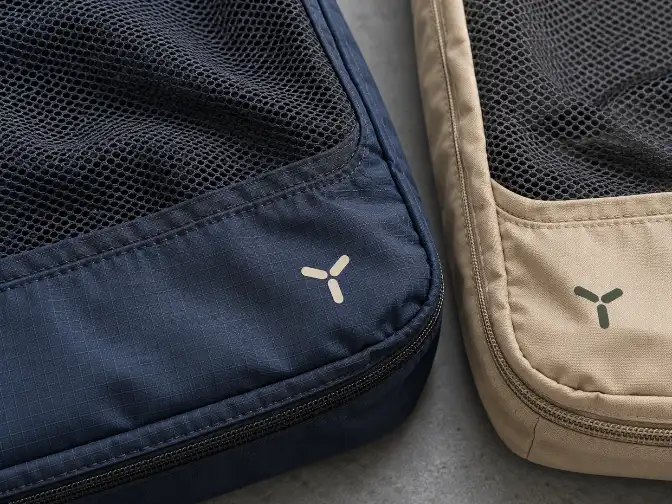
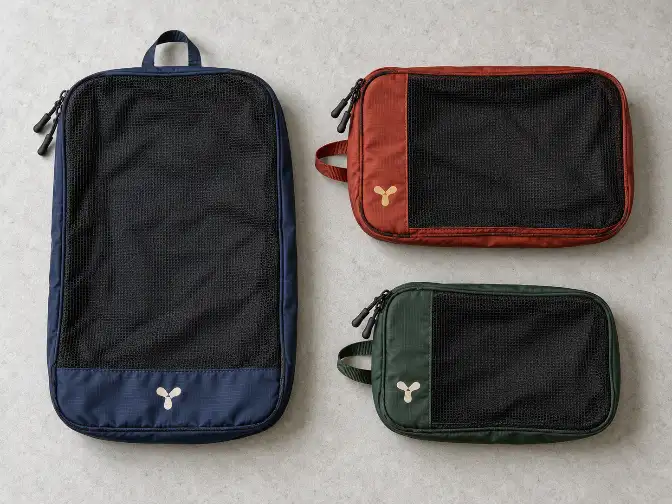
A packing cube looks simple — a zippered fabric rectangle with mesh panels. But when you source custom packing cubes for a travel brand, the specification decisions stack up quickly. Mesh type, zipper grade, size-set logic, compression mechanisms and branding all interact. Getting any one of these wrong creates a product that travelers reject or, worse, one that fails during the first trip.
This guide walks through the practical questions you need to answer before requesting samples or quotations. It follows the decision sequence most B2B buyers face: define the product role, choose materials, specify hardware, lock down sizes, decide on compression, plan branding, then protect your investment through sampling and quality control.
Scope note: This guide explains selection logic and general trade-offs for custom packing cubes. Availability of specific fabrics, mesh types, zipper brands, construction methods, branding techniques, MOQ, sample terms, pricing, lead time and any certifications or compliance documentation must be confirmed against your final brief during quotation with your chosen supplier.
—
What Product Role Should the Custom Packing Cube Serve?
Before choosing any material or feature, define the job the packing cube performs inside your product line. This single decision shapes almost every specification that follows.
Retail travel accessory vs. brand gift vs. bundled kit component
A packing cube sold as a standalone retail product faces different demands than one bundled inside a luggage set or included as a branded gift with purchase. The distinctions matter for specification:
- Standalone retail product — Must withstand repeated consumer use, multiple wash cycles, and direct price comparison against competitors on Amazon or in travel stores. Zipper quality, seam durability and fabric hand-feel carry more weight here.
- Bundled luggage or travel-kit component — Needs to match the parent product’s color, branding system and perceived quality tier. Size compatibility with a specific suitcase interior becomes a hard constraint.
- Promotional gift or subscription-box insert — Often faces tighter cost pressure. You may accept lighter-weight fabric or simpler construction, but the branding must still look sharp because this cube represents your brand.
- Corporate travel kit for hotels, airlines or events — Quantities tend to be higher, branding requirements are strict, and the cube may need to fit specific amenity dimensions.
Each role implies a different balance of cost, durability and visual finish. State the intended role clearly in your brief so the factory can recommend appropriate materials and construction without over-engineering or under-building the product.
Single cube vs. size set
Decide early whether you are sourcing a single packing cube size or a matched set. Sets of three, four, five or six cubes are the most common retail format. A set changes your brief because:
- All cubes in a set must nest or stack logically inside a standard carry-on or checked bag.
- Color coding, labeling or size indicators become part of the design.
- The factory needs to quote the set as a unit, since different sizes may have different material yields and sewing times.
—
Which Fabric and Mesh Combination Fits the Intended Use?
Fabric choice controls weight, durability, appearance and cost. For packing cubes, you are usually specifying two materials — a primary shell fabric and a mesh panel fabric — and how they are joined.
Shell fabric considerations
Common shell fabrics for custom travel packing cubes include:
- Ripstop nylon — Lightweight, tear-resistant, widely available in many deniers. A frequent choice for travel brands that emphasize packability.
- Polyester (various weaves) — Good color retention, lower cost than nylon in many cases, available in recycled (RPET) versions for sustainability-focused brands.
- Ripstop polyester — Combines the grid-pattern tear resistance of ripstop with polyester’s cost and dye characteristics.
- Nylon with water-resistant coating — Useful if the cube may contact damp items like swimwear or toiletries.
Key variables to specify for the shell fabric:
- Denier (D) — A measure of fiber thickness. Lower denier (e.g., 40D–70D) creates a lighter, more packable cube. Higher denier (e.g., 210D–420D) adds structure and abrasion resistance but increases weight and packed volume.
- Coating or treatment — Water-resistant coatings (PU, DWR, silicone) add function but affect how logos adhere and how the fabric feels.
- Color consistency — If you sell sets, every cube must match visually. Confirm dye-lot tolerance with the factory.
If your brand positions around sustainability, you may want to explore recycled polyester (RPET) options. The article RPET Bags for Custom Packaging: What Buyers Should Verify Before Sourcing covers verification steps for recycled-content claims that apply equally to packing cube shell fabrics.
Mesh panel decisions
Mesh panels serve two functions: they let travelers see what is inside the cube, and they allow airflow that reduces odor buildup. The type of mesh you choose affects visibility, durability and cost.
| Mesh characteristic | What it controls | Buyer decision |
|---|---|---|
| Openness (hole size) | Visibility and airflow. Larger holes = clearer view but weaker structure. | Match to your target traveler’s expectation. Frequent travelers prefer good visibility. |
| Weight and stretch | Whether the mesh panel distorts under pressure from packed clothing. | Heavier mesh resists bulging. Lighter mesh saves weight. |
| Color | Black mesh is standard and hides dirt. Colored mesh can match branding but may show wear faster. | Decide based on brand aesthetic and practical use. |
| Placement | Full-panel mesh top, half-panel window, or mesh side strip. | Full-panel gives maximum visibility. Partial mesh adds privacy for underwear cubes. |
Specify the mesh type separately from the shell fabric in your brief. Ask the factory for physical swatches of both, because mesh feel and transparency vary widely even within the same weight class.
—
How Should Zippers, Handles and Seams Be Specified?
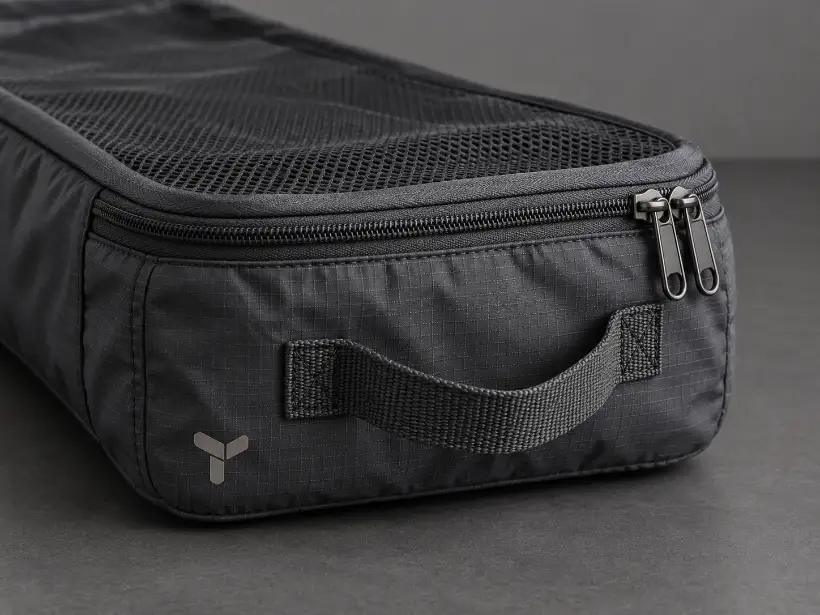
Zipper failure is the single most common quality complaint with packing cubes. Travelers stuff cubes full, yank on zippers at odd angles, and expect them to survive hundreds of openings. Handles and seams face similar stress.
Zipper specification
When specifying zippers for custom packing cubes, clarify these points:
- Zipper type — Coil zippers are most common for packing cubes because they flex around corners smoothly. Vislon (molded-tooth) zippers are bulkier but can feel more premium.
- Zipper gauge — Often expressed as a number (e.g., #3, #5, #8). Larger gauges are stronger but add weight and stiffness. For most packing cubes, a #5 coil zipper provides a reasonable balance.
- Zipper path — U-shaped (opening on three sides like a suitcase) gives the widest opening for packing. L-shaped or two-sided openings are simpler and cheaper but limit access. Compression cubes often use a two-zipper system (more on this below).
- Slider (pull) — Double sliders allow the opening point to be positioned anywhere along the zipper path. Single sliders are cheaper but less convenient. Custom zipper pulls with your logo are possible but affect tooling cost and MOQ.
- Zipper tape color — Should match or complement the shell fabric. Confirm color matching during sampling.
Specify zipper brand preferences if you have them, or ask the factory what brands or grades they stock. Zipper quality varies significantly between suppliers, and this is an area where cutting cost often backfires.
Handle and grab-loop details
Most packing cubes include a fabric handle or grab loop on one end. This lets travelers pull cubes out of a packed suitcase. Specify:
- Handle size and padding — A flat webbing handle is lightest. Padded handles add comfort but increase bulk and cost.
- Attachment method — Sewn into the top seam is strongest. Surface-stitched handles can tear under load.
- Material — Matching webbing, grosgrain ribbon, or the shell fabric itself folded into a strap.
Seam construction
Packing cubes endure stress at every seam because travelers push them to maximum capacity. Key seam decisions:
- Bound seams vs. raw-edge seams — Bound (taped) seams prevent fraying and look more finished inside the cube. Raw-edge seams are cheaper but can unravel over time.
- Bartack reinforcement — Small clusters of tight stitching at high-stress points (zipper ends, handle attachments, corners). Essential for durability. Specify bartack locations in your brief.
- Stitches per inch (SPI) — Higher SPI generally means stronger seams, but the right count depends on the fabric. Ask the factory to confirm their standard SPI for the chosen material.
—
Which Size Set and Shape Will Give Customers Practical Packing Flexibility?
Packing cube size sets are not random. They follow the logic of how clothing is folded and how suitcases are organized. Specifying the wrong sizes means customers cannot fill their cubes efficiently, and that leads to returns and poor reviews.
How size sets are typically structured
A common approach is to group cubes by clothing category:
- Large cube — Bulky items: sweaters, jeans, jackets.
- Medium cube — Folded shirts, shorts, skirts.
- Small cube — Underwear, socks, accessories.
- Slim or shoe cube — Shoes, belts, or electronics (sometimes a different shape entirely).
Sets of three (large, medium, small) are the most popular retail format. Sets of four to six add extra mediums, slim cubes, or a laundry bag.
Sizing relative to luggage
The critical constraint is that your cube set must fit together inside the target suitcase size. Most buyers design for one of these:
- Carry-on (approx. 22 × 14 × 9 inches / 56 × 36 × 23 cm) — Cubes must pack flat and tile neatly within these interior dimensions, accounting for the suitcase’s own structure reducing usable space.
- Checked bag (approx. 27 × 18 × 11 inches / 69 × 46 × 28 cm) — More room, so cube sizes can be larger, but the set should still organize the space logically.
Do not assume your factory knows your target suitcase dimensions. Include them in the brief and ask for a packing layout diagram or physical fit test during sampling.
Shape variations
Most packing cubes are rectangular, but shape variations exist:
- Standard rectangle — Easiest to manufacture, pack and stack.
- Slim rectangle — Narrower profile, useful for shirts or shoes. Fits into suitcase gaps.
- Square — Sometimes used for underwear or accessory cubes.
- Garment-folder style — A flat, wide format with an internal folding board for dress shirts or trousers. More complex to produce.
Each non-standard shape adds pattern-making complexity, changes material yield, and may require a separate sample round.
—
When Is a Compression Feature Worth the Added Complexity?
Custom compression packing cubes use a second zipper to reduce the cube’s packed volume after clothing is loaded. This is a popular feature for retail travel brands, but it adds cost and specification complexity.
How compression works
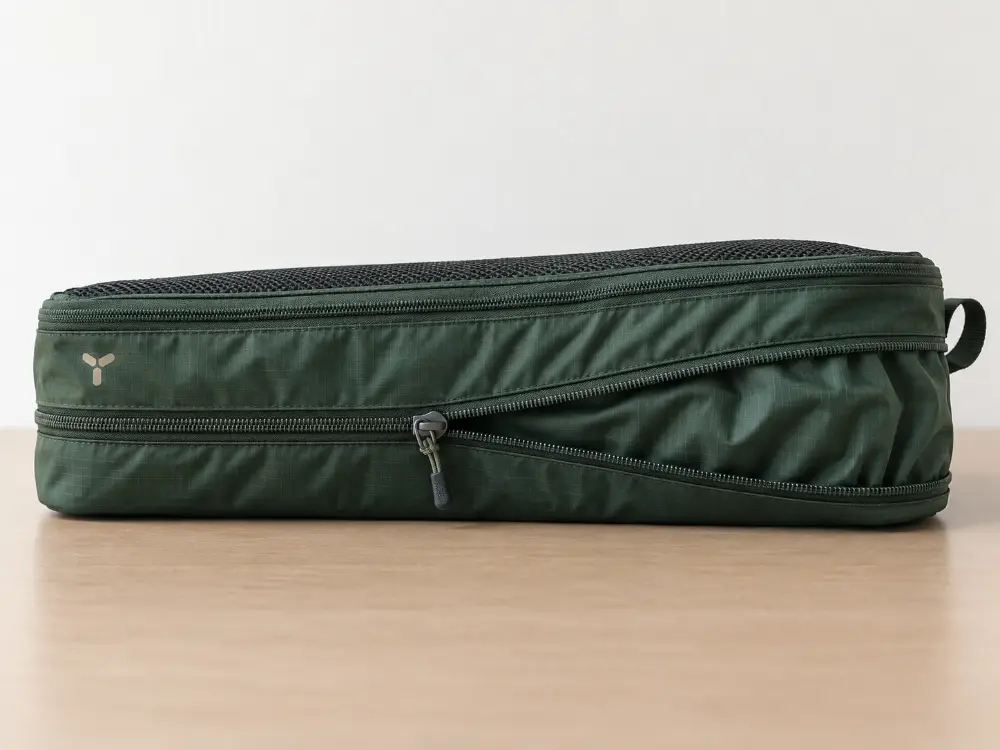
The basic mechanism: the cube has two zippers. The first zipper opens the main compartment for loading clothes. The second zipper runs around the cube’s perimeter at a lower height, and closing it compresses the contents by squeezing the cube thinner.
This means the cube has an expanded depth and a compressed depth. The difference between these two depths is the compression range.
Buyer decisions for compression cubes
Before adding compression to your spec, work through these questions:
- Does your target customer actually need compression? Frequent business travelers and backpackers value it. Casual vacationers may find it confusing.
- How much compression range do you want? More range means more fabric in the expansion panel, which increases material cost and manufacturing complexity.
- Single-side or double-side compression? Most compression cubes compress from the top only. Some premium designs compress from both sides, which is more effective but doubles the zipper hardware.
- Will the mesh panel be on the compression side or the non-compression side? If mesh is on the compression face, it must stretch or gather without tearing as the cube expands and contracts.
- Does the compression mechanism change the cube’s exterior dimensions when compressed? If compressed cubes are taller or wider than non-compression cubes in the same set, the set’s packing logic breaks.
Risk areas
Compression cubes have more failure points than standard cubes:
- The expansion panel fabric can tear at the seam where it meets the main panel.
- The secondary zipper experiences more lateral stress than a standard zipper.
- If the expansion panel uses a different fabric than the shell, color matching becomes harder.
- Travelers who do not understand the two-zipper system may leave negative reviews.
Include clear instructions — either a printed tag or a diagram inside the cube — if you choose a compression design. Specify this in your brief so the factory can plan for it.
—
How Should Logo Methods and Visual Details Be Evaluated?
Branding on custom packing cubes presents different challenges than branding on flat pouches or bags. The fabric is often synthetic, the surface may be coated, and the logo must survive repeated folding, compression and occasional washing.
Common logo methods for packing cubes
- Screen printing — Works well on flat nylon and polyester panels. Cost-effective for one- or two-color logos. Confirm adhesion on coated fabrics during sampling.
- Heat transfer — Handles multi-color and photographic logos. The transfer film must be compatible with the shell fabric’s coating and flexible enough to not crack when the cube is compressed.
- Woven label — Sewn into a seam or onto the surface. A classic approach for travel brands. Durable but limited in color detail and size.
- Embroidery — Premium appearance but adds weight and stiffness to the logo area. Works best on heavier-denier fabrics. May not be practical on lightweight ripstop.
- Rubber or silicone patch — Tactile and waterproof. Requires a mold (tooling cost). Good for outdoor and adventure brands.
- Debossed or embossed — Only practical on certain fabric types. Confirm feasibility with the factory before including in your brief.
- Printed zipper pull or custom slider — Adds brand presence at the point of interaction. Requires separate tooling.
For a detailed comparison of printing and decoration methods on fabric, see Screen Printing vs Heat Transfer vs Embroidery: Which Logo Method Is Best for Custom Pouches?
Logo placement on packing cubes
Placement decisions specific to packing cubes:
- Top panel (mesh side) — Visible when the suitcase is open, but printing on mesh is difficult. A sewn-on patch or woven label works better on mesh.
- Top panel (fabric side, if split-panel design) — Good surface for screen printing or heat transfer.
- Side panel — Visible when cubes are stacked vertically. Useful for size indicators or secondary branding.
- Handle area — A debossed or printed logo on the webbing handle is subtle but effective.
- Interior — A printed care/brand label inside the cube. Low visibility but adds a brand touchpoint.
Color and visual consistency across a set
If you sell packing cube size sets, visual consistency matters:
- All cubes should use the same fabric dye lot, or you need to specify acceptable color tolerance.
- If different sizes use different colors for identification (e.g., blue = large, green = medium), specify each color with a reference swatch or code.
- Logo size may need to scale with cube size. A logo that looks right on a large cube may overwhelm a small cube, or vice versa.
For guidance on color specification processes, Pantone Color Matching for Custom Pouches: A Brand’s Color Sourcing Guide covers the steps relevant to fabric products.
—
What Should Buyers Confirm During Sampling, Quotation and Quality Control?
Custom packing cubes involve more structural decisions than a simple drawstring pouch. That makes sampling and QC more important, not less.
Before requesting a quotation
Prepare a specification brief that covers at minimum:
- Product role and target retail price range — So the factory can recommend appropriate materials and construction.
- Size set dimensions (width × depth × height for each cube) — Include the target suitcase dimensions the set must fit.
- Shell fabric preference — Material type, denier range, color, any coating or treatment.
- Mesh preference — Placement, openness, color.
- Zipper specification — Type, gauge, path (U-shape, L-shape), single or double slider, any brand preference.
- Compression requirement — Yes or no. If yes, desired compression range and mechanism type.
- Handle specification — Size, material, attachment method.
- Logo method, size, position and number of colors — Provide vector artwork files.
- Packaging for the finished cubes — Individual polybag, set packaging, retail hang tags, care labels.
- Target market compliance — Any labeling, material testing or documentation requirements for your destination market (US, UK, EU).
- Expected annual volume — Helps the factory recommend appropriate MOQ tiers.
A well-prepared brief saves weeks of back-and-forth. The guide How to Write a Packaging Brief That Gets Accurate Quotes provides a framework that adapts well to packing cube projects.
During sampling
When you receive a packing cube sample, evaluate it against this checklist:
- Dimensional accuracy — Measure all three dimensions of each cube. Check that the set fits together inside the target suitcase.
- Fabric hand-feel and weight — Does the fabric feel appropriate for the price point and brand positioning?
- Mesh transparency and stretch — Can you see folded clothing colors through the mesh? Does the mesh distort when the cube is fully packed?
- Zipper smoothness — Open and close each zipper at least 20 times. Check for snagging, especially around corners. Pull the slider at oblique angles to simulate real use.
- Compression function (if applicable) — Load the cube with folded clothing, close the main zipper, then close the compression zipper. Is the mechanism intuitive? Does the expansion panel bunch or wrinkle excessively?
- Handle attachment — Pull the handle firmly. Check for stitching integrity and seam reinforcement.
- Seam finish — Turn the cube inside out. Check for bound seams, bartacks, and thread trimming.
- Logo appearance — Check color accuracy, adhesion, edge sharpness. Rub the logo firmly with a damp cloth to test for smearing or peeling.
- Overall weight — Weigh the empty cube. Compare against your target. Travel buyers are sensitive to weight.
- Wash test — If the product will be marketed as washable, wash the sample according to your intended care instructions. Check for color bleeding, shrinkage, logo damage and zipper function after washing.
Document every finding with photos. Send written feedback referencing specific measurements and locations, not vague impressions.
During production quality control
For bulk production, establish inspection criteria in advance:
- Acceptable Quality Level (AQL) — Agree on an AQL standard for critical, major and minor defects. Common AQL levels for soft goods are 1.5 for critical defects and 2.5 for major defects.
- Critical defects — Zipper failure, handle detachment, seam burst, sharp edges, wrong dimensions.
- Major defects — Logo misalignment, color mismatch beyond tolerance, mesh holes, uneven stitching visible from outside.
- Minor defects — Slight thread ends, minor color variation within tolerance, small wrinkles in packaging.
- Measurement spot checks — Random cubes measured against the approved sample dimensions.
- Compression function test (if applicable) — Random cubes loaded, zipped and compressed to confirm the mechanism works.
If you are not able to visit the factory or send an inspector, discuss third-party inspection options with the supplier or arrange a video walkthrough of the production line and finished goods before shipment.
—
Frequently Asked Questions
Can packing cubes be made from recycled or sustainable materials?
Yes, recycled polyester (RPET) and recycled nylon are increasingly common shell fabric options for packing cubes. However, the mesh panels, zippers, webbing and thread also contribute to the product’s sustainability profile. If you make sustainability claims on packaging or marketing, confirm what documentation (such as GRS certification for recycled content) the factory can provide. Do not make claims that cannot be supported by verifiable certificates.
How do I decide between a three-piece and a five-piece packing cube set?
Three-piece sets (small, medium, large) cover the core use case and are simpler to source, stock and price. Five- or six-piece sets appeal to frequent travelers and command a higher retail price, but they increase SKU complexity, packaging cost and the risk of size redundancy. Start with a three-piece set if this is your first packing cube product. Expand the set in a later order once you understand customer feedback on sizing.
Should packing cubes have a rigid internal structure?
Most packing cubes are fully soft — they have no internal stiffening. Some premium cubes include a thin plastic or cardboard stiffener in the base panel so the cube holds its shape when empty or lightly packed. A stiffener adds cost and weight but improves shelf presentation and in-suitcase stacking. Decide based on your brand positioning and whether the cube will be sold in physical retail (where shape matters on the shelf) or online only.
What happens if the zipper path is too tight around corners?
A zipper that turns a 90-degree corner too sharply will snag, especially under load. The radius of the corner turn should be gradual enough for the slider to pass smoothly. This is one of the most important things to test on a physical sample. If the corner is too tight, ask the factory to increase the corner radius in the next sample revision.
Are custom zipper pulls worth the tooling cost?
Custom zipper pulls (with your logo molded or engraved into the pull tab) add a visible brand detail at a high-touch point. They require a mold, which means a one-time tooling fee and a higher MOQ for the pulls themselves. If your order volume justifies the tooling cost and you plan to reorder, custom pulls are a worthwhile investment. For first orders or smaller quantities, a standard pull with a branded ribbon loop or hang tag is a more flexible option.
—
Next Step
A custom packing cube project involves more structural and hardware decisions than most fabric pouch orders. The brief you send to the factory determines whether sampling goes smoothly or turns into multiple revision rounds.
Prepare your specification — target suitcase dimensions, fabric and mesh preferences, zipper requirements, compression decision, logo artwork and size-set layout — then request samples and a quotation from YJXPACK. A clear, complete brief leads to faster, more accurate responses.
Share This Story, Choose Your Platform!