
Sourcing jewelry pouch packaging can seem straightforward until a factory asks for a detailed brief. Whether you are building a private-label jewelry brand, managing a seasonal gift program, or placing a repeat OEM order, the difference between consumer personalization and custom OEM production matters. Using the wrong terminology can lead to mismatched quotes, revisions, and delays. This guide explains what B2B buyers should specify so the first quote is more useful and the first sample is closer to the intended result.
Quick Summary
- Consumer personalization usually means adding a name or message to a stock pouch. Custom OEM jewelry pouches use a repeatable brand specification for business orders.
- A usable OEM brief covers material, format, finished size, color, logo method, quantity per design, and sampling expectations.
- Logo method depends on the fabric, artwork, and intended brand presentation. Foil, debossing, screen print, and embroidery may suit different materials and artwork styles.
- Sampling and quality-control checkpoints should be agreed before production starts, not after goods ship.
- A complete written brief gives suppliers a clearer basis for preparing a quote.
Personalized vs. Custom Jewelry Pouches: The OEM Difference
The word “personalized” is used in two different ways in the packaging industry, and confusing them can lead to the wrong type of quote. In a consumer context, personalized jewelry pouches usually means adding a name, date, or short message to an existing stock item, such as wedding favor bags with a couple’s initials. The pouch itself is standard; only the text changes.
For B2B sourcing, buyers looking for a repeatable branded packaging solution should use terms such as “custom jewelry pouch,” “custom OEM jewelry pouch,” or “private-label jewelry pouch.” These terms describe a pouch made to a brand specification, which may include a color reference, logo method, chosen fabric, and closure style. This is a different manufacturing task from adding text to a stock pouch. A factory quoting a personalized order may assume a stock base with a simple print add-on. A factory quoting a custom OEM order will need to assess the requested construction, sampling, and production requirements.
The practical rule is simple: if you expect the same pouch to appear in repeat shipments, prepare a custom OEM specification rather than a consumer-style personalization request. A full brief helps YJXPACK and other suppliers understand the requirement and provide a more relevant response.
For a broader look at how jewelry pouch packaging decisions affect brand perception, it helps to review the full category before selecting a format.
What to Specify in a Usable Jewelry Pouch Brief
A brief that produces a usable quote covers seven areas. Missing even one can force the factory to make assumptions, and those assumptions may not match what you had in mind.
The seven areas are:
- Pouch format and closure
- Outer material and lining
- Finished dimensions
- Color reference where needed
- Logo artwork and method
- Quantity broken down by design or SKU
- Sampling requirements and approval process
Factories receive many inquiries that say “custom velvet pouch with logo.” That gives a supplier limited information. A more complete inquiry identifies the pouch format, material, color requirement, lining, logo method and placement, quantity by design, and sampling expectations. This gives suppliers a clearer basis for preparing and comparing quotes.
The detailed checklist for what a jewelry pouch manufacturer needs for an accurate quote covers each field in depth and is worth reviewing before you send your first inquiry.
Choose Materials and Pouch Formats by Use Case
Material choice can affect cost, perceived quality, and logo compatibility. The table below provides general starting points only. Actual suitability depends on factors such as fabric weight, surface texture, color, artwork detail, pouch construction, finishing, equipment, and the supplier’s process.
| Material | Possible Brand Positioning | Possible Use Cases | Logo Methods That May Be Considered |
|---|---|---|---|
| Velvet (cut pile) | Mid to luxury | Fine jewelry, gift retail | Foil stamp, debossing, embroidery |
| Microfiber | Contemporary, mid | Fashion jewelry, e-commerce | Screen print, foil, heat transfer |
| Satin | Mid to premium | Bridal, gift sets, hair accessories | Screen print, foil stamp |
| Organza | Promotional, light gift | Favor bags, small accessories | Screen print, foil |
| Cotton / canvas | Casual, artisan-style | Artisan jewelry, gift packaging | Screen print, embroidery, DTF printing |
| Suede / faux suede | Luxury | High-end retail, watches | Debossing, laser engraving |
Cut pile refers to a fabric surface with cut yarn ends that create a soft, raised texture. DTF printing is a heat-transfer printing method. These methods should be reviewed against the actual fabric, surface treatment, artwork, and proposed production route before approval.
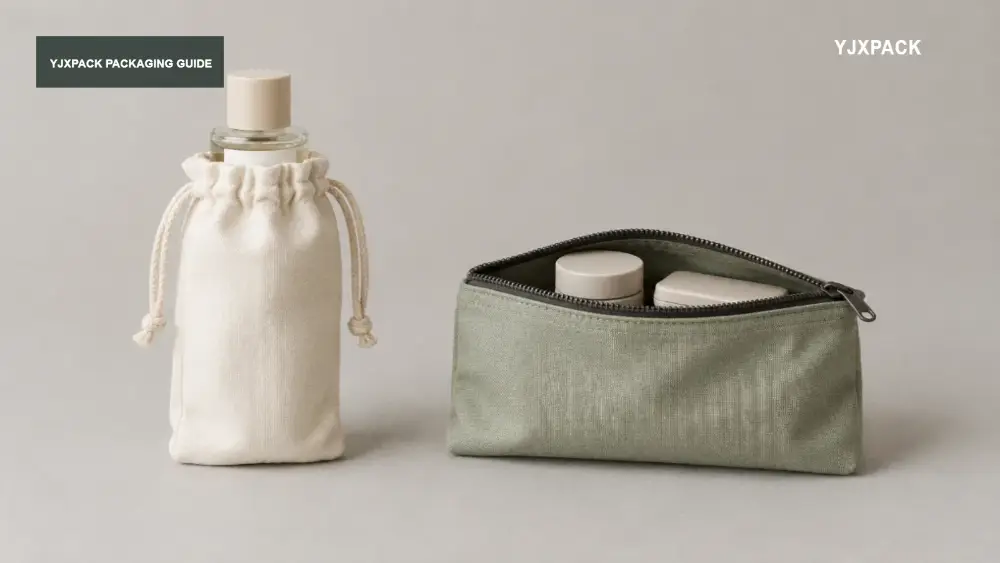
Format matters as much as material. A drawstring pouch may suit rings and earrings, while a flap-closure pouch may better present longer chains or structured items. The preferred format depends on the jewelry dimensions, desired presentation, closure requirements, and the level of protection needed. For a side-by-side comparison of two common formats, the drawstring vs. flap jewelry pouch guide explains the trade-offs.
Cotton and other natural-fiber options may be relevant when a buyer has specific material preferences or requests material-origin information. Environmental characteristics should not be assumed from fiber type alone; they can depend on sourcing, dyeing, finishing, transport, durability, and available documentation. The Textile Exchange publishes information on fiber sourcing that may provide useful context when briefing a factory on material requirements.
Set Sizes, Compartments and Quantity by Design
Pouch size is one of the most common briefing errors. Buyers sometimes specify the pouch they imagine rather than the pouch the jewelry actually needs. A ring pouch that is too large may allow the ring to shift. A necklace pouch that is too narrow may force the chain into a tight fold.
A practical starting point is to measure the jewelry at its widest and longest points, then test the item in a sample pouch or paper mock-up. Account for the following factors:
- Jewelry thickness
- Chain length
- Tags and inserts
- Lining
- Opening width
- Usable space remaining after a drawstring closure is gathered
The final dimensions should be confirmed through sampling rather than treated as a fixed rule.
| Jewelry Type | Size-Brief Considerations |
|---|---|
| Stud earrings | Consider the item, any display card, tags, lining, and the desired presentation. |
| Ring | Consider fit, accessibility, and the amount of movement permitted inside the pouch. |
| Pendant or short necklace | Check chain length, pendant depth, and opening width. |
| Long necklace or bracelet set | Consider whether a flap or envelope format better supports presentation and storage. |
| Watch or bangle | Consider item depth and whether the design needs a firmer base or additional structure. |
Actual finished size may need to change based on the jewelry, pouch shape, seam allowance, lining, closure, and presentation requirements.
Quantity by design is a separate question from total order quantity. If you have multiple colorways or artwork versions of the same pouch, each may need separate color-matching and setup consideration. State the quantity per design clearly, because setup costs for items such as screen frames, foil dies, or embroidery file preparation can vary by design.
Select Logo and Personalization Methods
Logo method is where many OEM buyers underspecify. Saying “print my logo” leaves the supplier to choose the method, which may not match your intended look or the fabric surface.
Each method has a different cost structure, artwork requirement, and finish. Foil stamping may create a sharp metallic appearance on suitable fabrics and may use a metal die, depending on the process and supplier. It is often better suited to simple, bold artwork, although feasibility should be confirmed against the specific fabric and design. Screen printing may handle complex designs and multiple colors, although results can vary on textured or treated surfaces. Embroidery adds a raised, tactile finish and may be more suitable for stable fabrics; its feasibility depends on the fabric, construction, artwork, and stitch route. It may require artwork to be converted into an embroidery stitch file. Debossing can create a recessed, tone-on-tone impression without adding ink or foil color, subject to material and construction suitability.
Artwork requirements vary by method. Vector artwork, such as AI or EPS files, is commonly requested for print and foil work. A vector file is artwork that can be resized without losing clarity. Embroidery may use a stitch file, often in DST or EMB format. Confirm the required artwork format, placement, size, and proofing process with your supplier before submitting the final brief.
Understand the Cost Factors Behind a Custom Pouch Order
Custom jewelry pouch pricing can include unit cost, setup charges, and sampling costs. Understanding this structure helps buyers compare quotes and identify what is included.
Setup costs may cover order-specific items such as foil dies, screen frames, embroidery file preparation, or custom cord colors. These can be one-time charges per design. Unit cost may cover material, labor, and finishing per piece and can change with quantity. Sampling costs may cover pre-production samples and, in some cases, revised samples for approval.
Factors that may affect unit cost include:
- Fabric weight and grade
- Lining presence and material
- Logo method complexity
- Closure hardware
- Whether the pouch needs a firmer insert or base
For example, an aglet is the small finishing tip at the end of a cord. A magnetic snap is closure hardware that may require a different pouch construction.
Color matching can also affect the quote. Matching a color reference on pile velvet may require a different process from matching it on woven or printed material. Some colors may require custom dyeing rather than selection from available fabric colors. If brand color is critical, include a color-approval step in the sampling process and ask the supplier to state the proposed color-comparison method in writing.
Plan Sampling and Quality Control Before Production

Sampling gives OEM buyers an opportunity to clarify materials, color, logo placement, and construction before bulk production. Skipping a pre-production sample may leave fewer opportunities to identify issues before the full order is made.
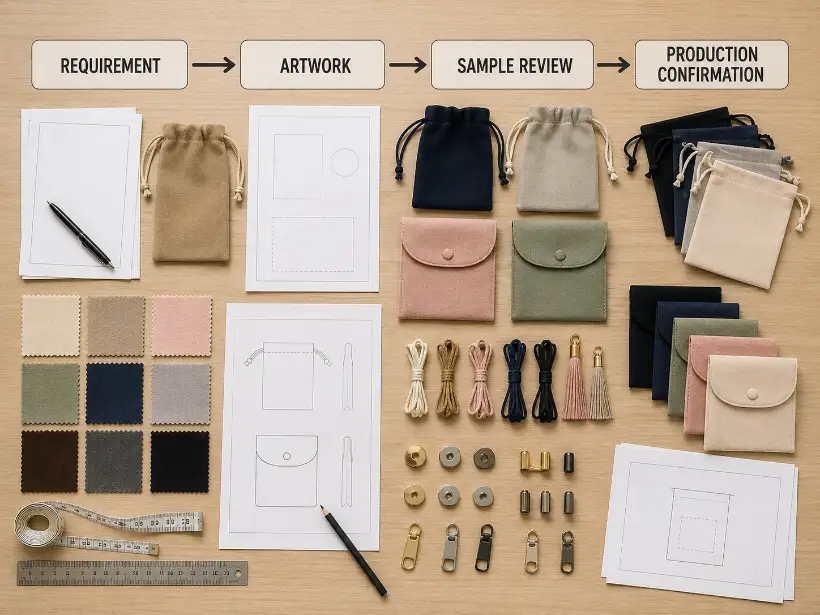
A sampling process may include the following steps:
- Material or color swatch review
- A pre-production sample with logo and construction details
- Buyer approval or revision
- An agreed inspection standard for bulk goods
The exact sequence should be agreed with the supplier because it can vary by material, logo method, construction, and project requirements. When communicating with YJXPACK, provide the available artwork and product information early so the proposed sampling route can be assessed against the actual specification.
Quality-control checkpoints to specify in your brief can include:
- Dimensional tolerance
- Color comparison against the approved sample
- Logo placement and coverage
- Seam condition
- Closure function
- Packaging condition on arrival
If an approved sample will serve as a production reference, document the approval clearly and agree how both buyer and supplier will retain or reference that sample.
Third-party inspection may be relevant for larger orders, particularly if goods are shipping directly to a fulfillment center before you can review them. The ISO 9001 quality management principles describe a quality-management framework, but buyers should still define their own product-specific inspection requirements.
—
Frequently Asked Questions
What is the difference between a personalized jewelry pouch and a custom OEM jewelry pouch?
A personalized pouch typically adds a name, date, or short message to a stock item. The base pouch is standard and only the text changes. A custom OEM pouch is made to a repeatable business specification, including material, color, size, logo method, and closure. Buyers seeking branded packaging for repeat orders should request a custom OEM jewelry pouch rather than a consumer personalization service.
What artwork format do I need to submit for a custom jewelry pouch with logo?
Many suppliers request vector artwork in AI or EPS format for screen printing, foil stamping, and debossing. Embroidery may use a stitch file, such as DST or EMB, which may be created from vector artwork depending on the supplier’s process. Confirm the required format with your supplier before finalizing the brief.
How do I choose the right pouch size for my jewelry?
Measure the jewelry at its widest, longest, and deepest points, then test a sample or mock-up where possible. Consider chain length, tags, inserts, lining, opening width, and the reduced usable opening of a gathered drawstring pouch. The finished size should hold the jewelry securely without forcing it or leaving unnecessary room for movement.
What quality control steps should I require before bulk production?
At minimum, request a pre-production sample that reflects the intended material, color, logo, and construction before bulk production begins. Agree in writing on the inspection points that matter to your order, such as dimensional tolerance, color comparison against the approved sample, logo placement, seam condition, and closure function. For larger orders, consider whether third-party inspection before shipment fits your process.
How does quantity per design affect the cost of custom jewelry pouches?
Setup charges for foil dies, screen frames, or embroidery file preparation may apply per design rather than per total piece count. If you have multiple colorways, each may involve separate setup or color-matching considerations. Ask YJXPACK or another supplier to separate setup charges, sampling charges, and unit costs when providing a quote.
Share This Story, Choose Your Platform!