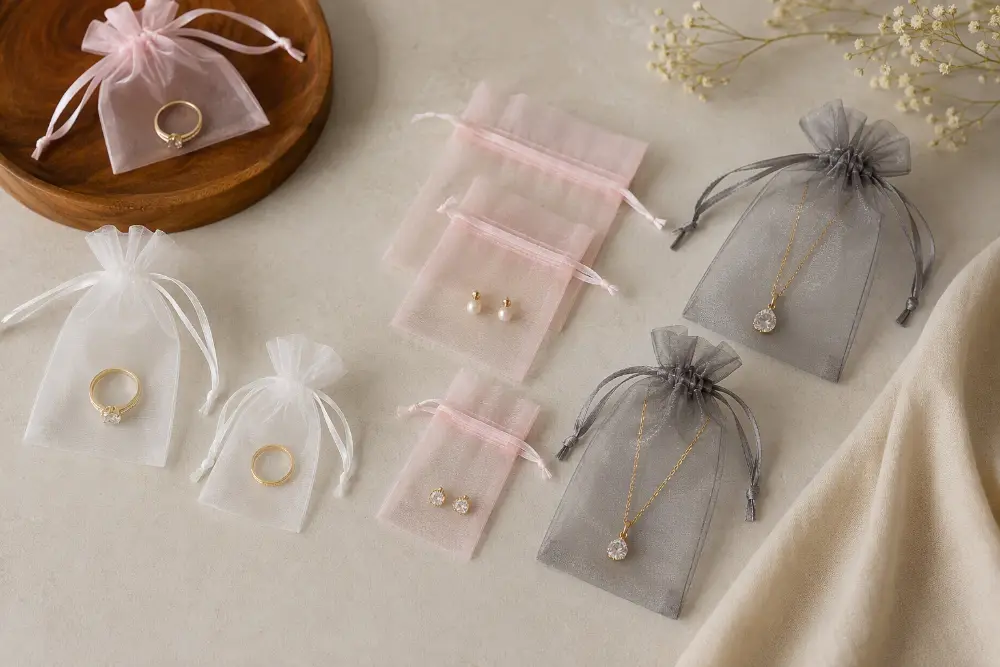
Choosing the wrong size for your organza jewelry pouches is a surprisingly common and costly mistake. A ring rattles around in an oversized pouch, a hoop earring bends against a seam that is too tight, and a necklace chain tangles because the pouch is too narrow to lay it flat. For jewelry brands, retailers, and e-commerce sellers sourcing custom packaging, getting the size right from the start protects the product, strengthens the unboxing experience, and reduces returns. This guide walks through the practical size decisions for rings, earrings, and necklaces, then covers construction, customization, cost, and quality control so you can source with confidence.
Quick Summary
- Ring pouches typically work best in the 5×7 cm to 7×9 cm range; earring pouches vary more widely depending on stud versus hoop styles.
- Necklace pouches need at least 10×12 cm for most pendants and chains, with longer styles requiring 12×15 cm or more.
- Double-layer organza adds opacity and structure without significantly increasing cost, making it the preferred choice for mid-range and premium jewelry brands.
- Drawstring closures suit most jewelry types; satin ribbon ties add a gift-ready feel for retail and seasonal packaging.
- Sampling before bulk production is essential — a 3D mockup or physical pre-production sample catches size and construction issues before they become expensive.
—
Why Organza Pouch Size Matters for Product Protection and Presentation
Size is not just a dimension — it is a functional decision. A pouch that fits the jewelry snugly prevents movement during shipping, which reduces scratching and tangling. One that is too large creates slack, allowing pieces to shift and collide. One that is too small stresses the seams and drawstring channel, shortening the pouch’s usable life.
Beyond protection, size shapes perception. When a customer opens a package and the pouch fits the jewelry with a small, intentional margin, the product feels considered and premium. When the pouch is visibly oversized, the jewelry can feel like an afterthought. For brands selling through e-commerce, where the unboxing moment is often shared on social media, that first impression carries real commercial weight.
Organza jewelry pouches are sheer by nature, which means the jewelry is partially visible through the fabric. This makes size even more important: a well-fitted pouch frames the piece, while a poorly fitted one distorts it. For a deeper look at how pouch style choices affect presentation, the Jewelry Pouch Packaging: Complete Guide for Brands covers the full decision landscape.
Understanding how to measure correctly before you place an order also prevents miscommunication with your factory. The How to Measure a Drawstring Pouch: Size Guide for Brands guide explains width, height, and gusset measurements in plain terms.
—
Best Organza Pouch Sizes for Rings and Small Jewelry
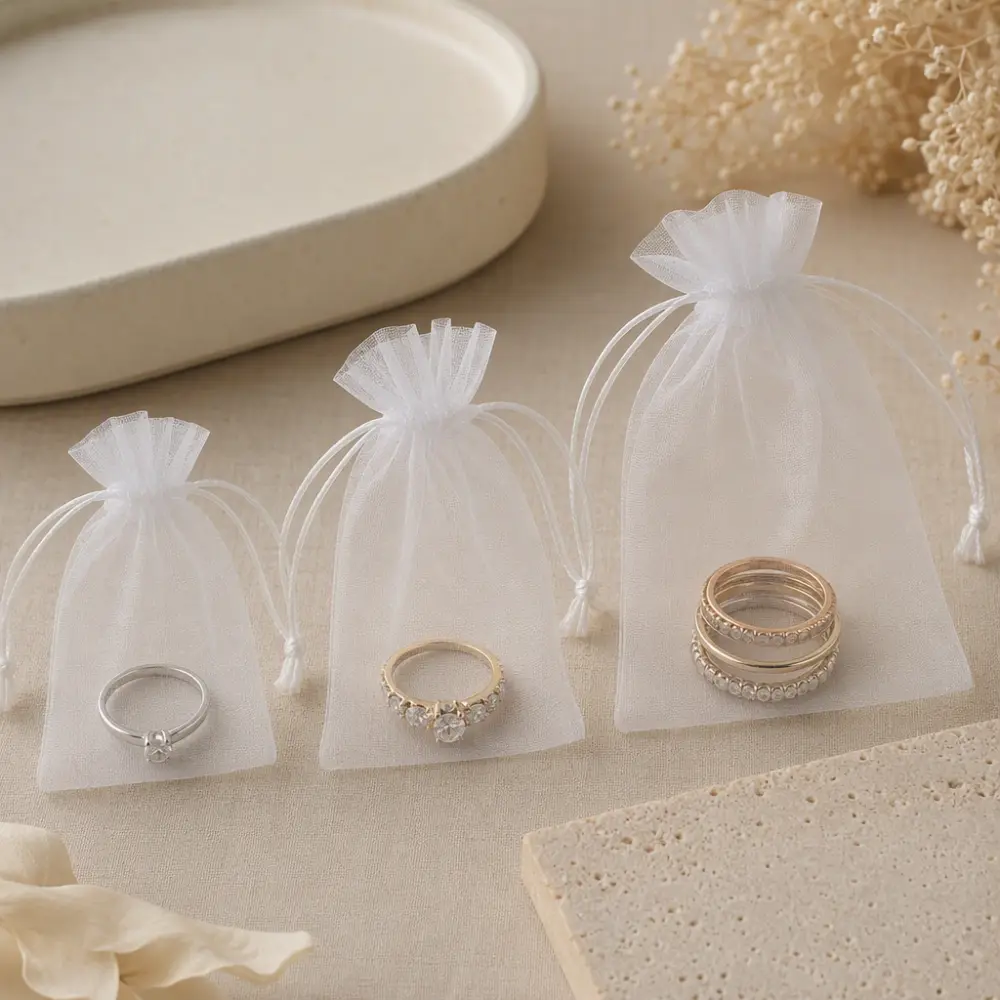
Rings are the smallest category, but they still need a pouch with enough interior space to allow easy insertion and removal without forcing the drawstring open too wide. A pouch that is too narrow makes the ring difficult to retrieve, which frustrates customers and can snag prongs on delicate settings.
For single rings, the most practical range is 6×8 cm to 7×9 cm. This gives enough room for the ring to sit flat or upright without excessive movement. Stacking ring sets or rings with large statement stones benefit from a slightly larger format, typically 8×10 cm, to avoid pressure on the setting.
Small pendants, charms, and loose gemstones follow similar sizing logic. Most fit comfortably in a 6×8 cm or 7×9 cm pouch. If you are packaging a ring alongside a small card or tissue insert, move up one size to maintain a clean, uncrowded interior.
| Jewelry Type | Recommended Pouch Size | Notes |
|---|---|---|
| Single band or plain ring | 6×8 cm | Compact, cost-efficient |
| Ring with large stone or setting | 7×9 cm | Prevents prong snagging |
| Stacking ring set (3–5 pieces) | 8×10 cm | Allows flat lay without pressure |
| Small pendant or charm | 6×8 cm | Works for most chain lengths under 40 cm |
| Loose gemstone or small bead | 5×7 cm | Minimum practical size for organza |
—
Choosing Earring Pouch Sizes for Studs, Hoops, and Sets
Earrings present the widest size variation of any jewelry category. A pair of 6 mm diamond studs and a pair of 60 mm gold hoops are both earrings, but they need completely different pouches. Getting this wrong is one of the most common sourcing errors buyers make when ordering organza jewelry pouches in bulk.
For an independent reference on relevant standards terminology, consult the ISO standards catalogue .
Stud earrings are small and relatively flat. A 6×8 cm pouch handles most stud styles comfortably. If the studs have large decorative backs or are sold on a card, a 7×9 cm pouch gives the extra clearance needed.
Hoop earrings are the challenging category. Small hoops (under 30 mm diameter) fit in a 7×9 cm pouch. Medium hoops (30–50 mm) need at least 9×12 cm to lie flat without bending. Large statement hoops (50 mm and above) require 10×12 cm or larger. Forcing a hoop into an undersized pouch risks deforming the shape, particularly for thin gold-filled or silver styles.
Drop earrings and chandelier styles depend on length. Most drops under 5 cm fit in a 7×9 cm pouch. Longer chandelier earrings need a 9×12 cm or 10×14 cm format to hang straight without folding.
| Earring Style | Recommended Pouch Size | Key Consideration |
|---|---|---|
| Studs (standard) | 6×8 cm | Most cost-effective size |
| Studs on card backing | 7×9 cm | Card adds width |
| Small hoops (under 30 mm) | 7×9 cm | Fits flat |
| Medium hoops (30–50 mm) | 9×12 cm | Prevents bending |
| Large hoops (50 mm+) | 10×12 cm | Shape protection critical |
| Drop earrings (under 5 cm) | 7×9 cm | Length is the limiting factor |
| Chandelier / long drops | 10×14 cm | Prevents folding |
| Earring sets (multiple pairs) | 10×12 cm | Shared pouch for gift sets |
When sourcing earring organza pouches for a product line with multiple styles, consider standardizing on two sizes — one for studs and small hoops, one for medium and large styles — rather than ordering a separate size for every SKU. This simplifies inventory and often reduces unit cost through higher quantities per size.
—
Organza Pouch Size Guide for Necklaces and Longer Jewelry
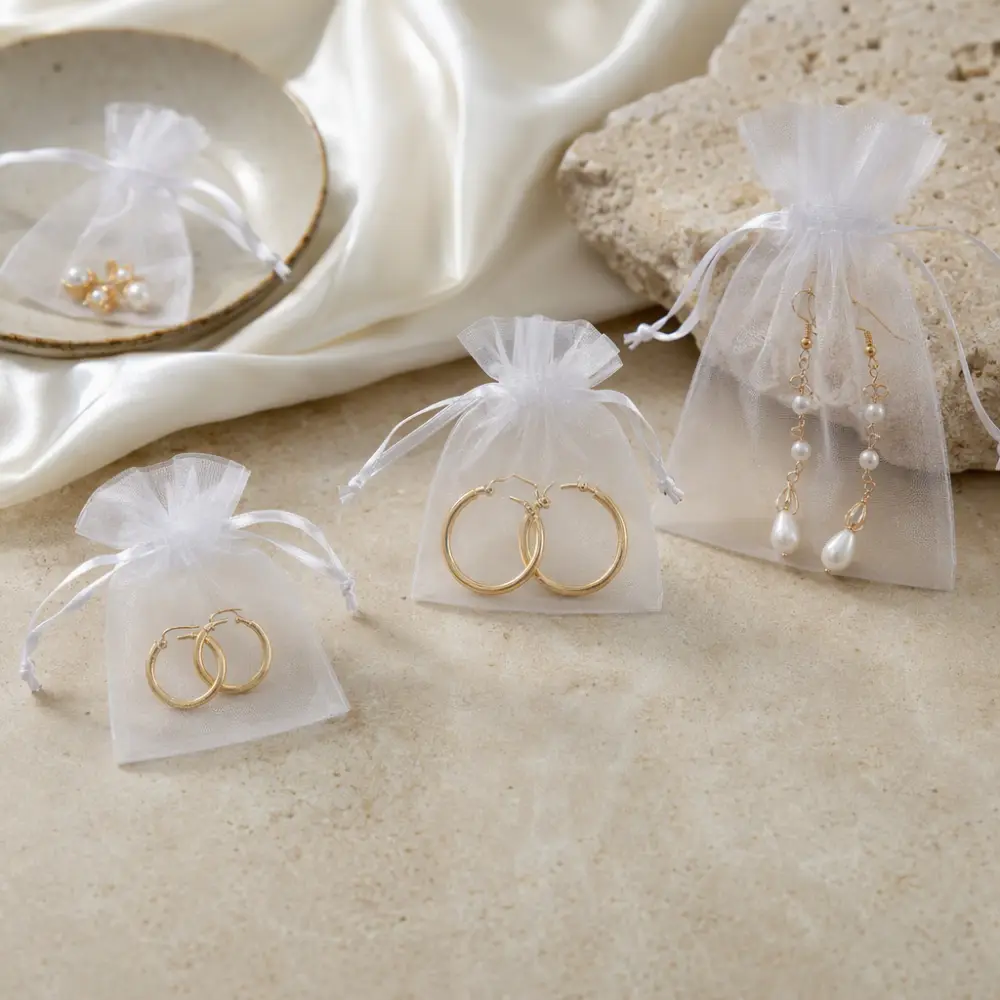
Necklaces are the most size-sensitive jewelry category for packaging. A chain that cannot lie flat inside the pouch will tangle, and a pendant that is pressed against the seam can scratch or deform. The pouch width must accommodate the pendant’s widest point, and the height must allow the chain to fold naturally without kinking.
For most standard necklaces with pendants up to 3 cm wide, a 10×12 cm pouch is the practical minimum. Chains alone — without a pendant — can fold into a 8×10 cm pouch, but the extra space in a 10×12 cm format makes insertion and removal much easier for the end customer.
Longer necklaces (60 cm and above) and layered chain sets need a 12×15 cm pouch. Statement necklaces with wide bib-style designs or multiple strands may require 14×18 cm or a custom size. When in doubt, measure the pendant at its widest point and add at least 2 cm on each side for the pouch width.
Bracelets and bangles follow similar logic to medium hoops. A standard bracelet fits in a 8×10 cm pouch; a wide cuff or bangle set needs 10×12 cm.
For a comprehensive reference across all jewelry types, the Complete Jewelry Pouch Size Guide for Rings, Necklaces, Bracelets & More covers standard dimensions in detail.
—
Single-Layer vs. Double-Layer Organza for Jewelry Packaging
Standard organza is a single-layer sheer fabric. It is lightweight, cost-effective, and gives the jewelry full visibility through the pouch. For many applications — wedding favors, promotional gifts, and budget retail packaging — single-layer organza is entirely appropriate.
Double-layer organza uses two layers of fabric sewn together, which adds opacity, body, and a more substantial feel. The jewelry is still partially visible, but the sheer effect is softened. Double-layer construction also reinforces the seams and drawstring channel, which matters for heavier pieces like chunky chains or multi-strand bracelets.
For mid-range and premium jewelry brands, double-layer organza is usually the better choice. The cost difference per unit is modest, but the perceived quality improvement is significant. Customers handling a double-layer pouch feel the difference immediately.
The fabric weight of the organza itself also matters. Lighter organza (around 30–40 gsm) is more delicate and sheer. Heavier organza (50–60 gsm) holds its shape better and resists snagging. YJXPACK works with both weights depending on the application, and the choice should match the jewelry’s weight and the brand’s positioning.
—
Customization Choices: Closures, Edging, Materials, and Logo Placement
Once you have the size and construction sorted, customization decisions shape the final brand experience. The main variables are closure type, edging finish, material color, and logo method.
Closures fall into two practical categories. Drawstring closures — either single-cord or double-cord — are the most common for organza jewelry pouches. They are easy to open and close, work well for all jewelry types, and allow the pouch to be reused by the customer. Satin ribbon ties add a more gift-ready aesthetic and are popular for retail packaging and seasonal collections. The Drawstring Cord Guide covers cord materials, aglet options, and custom details worth considering.
Edging options include plain cut edges, satin-stitched edges, and heat-sealed edges. Satin-stitched edges (also called rolled or overlock edges) give a cleaner finish and prevent fraying over time. For premium packaging, a contrasting satin edge in a brand color adds a visible detail that elevates the pouch without significant cost.
Logo placement on organza is more limited than on opaque fabrics because the sheer surface makes some printing methods impractical. Silk screen printing works on organza when the ink is applied carefully, but coverage can be uneven on very sheer weights. Heat transfer and woven labels are more reliable for consistent logo reproduction. Embroidery adds texture and permanence but increases cost and is better suited to heavier organza weights. For a full comparison of logo methods and their cost implications, see Silk Screen vs Heat Transfer vs Embroidery: Which Printing Method Is Best?
YJXPACK handles all three logo methods and can advise on which works best for a given organza weight and design complexity during the sampling stage.
—
Cost, Sampling, MOQ, and Quality Control Questions for Buyers
Cost factors for custom organza jewelry pouches include fabric weight, layer count, pouch size, closure type, edging finish, logo method, and order quantity. Larger orders reduce unit cost through economies of scale in cutting, sewing, and printing. Double-layer construction adds a small premium over single-layer. Logo methods vary significantly in setup cost: silk screen has a plate fee but low per-unit cost at volume; embroidery has a digitizing fee and higher per-unit cost regardless of quantity.
MOQ (minimum order quantity) varies by factory and by the complexity of the customization. Standard sizes with no logo typically carry lower minimums than fully custom sizes with embroidered logos. If you are launching a new product line and need to test multiple sizes, ordering samples of each size before committing to bulk production is the most cost-effective approach. YJXPACK offers pre-production samples and 3D mockups, which allow buyers to verify size, construction, and logo placement before the bulk run begins.
Sampling is not optional for first-time orders or new size specifications. A physical sample reveals issues that a spec sheet cannot: whether the drawstring channel is wide enough for the cord, whether the seam allowance reduces the usable interior, and whether the logo placement looks balanced on the actual fabric. Request a sample that matches the bulk production fabric weight and color, not a generic stock sample.
Quality control checkpoints for organza pouches should cover seam integrity (no skipped stitches or loose threads), drawstring function (smooth pull, no jamming), logo registration (centered, correct color), and size consistency (measure at least 10 pieces from a production run). For buyers sourcing from China, understanding factory audit standards is useful context — the How to Verify a BSCI-Compliant Packaging Factory in China article explains what to look for and how to verify compliance without an in-person visit.
—
Ready to confirm your size specifications and see how your logo looks on organza? Get a Free 3D Mockup from YJXPACK and review your custom jewelry pouch design before committing to production.
—
Frequently Asked Questions
What is the most common organza pouch size for jewelry packaging?
The 7×9 cm and 9×12 cm sizes cover the majority of jewelry applications. The 7×9 cm works for rings, studs, small pendants, and small hoops. The 9×12 cm handles medium hoops, drop earrings, and standard necklaces. Most jewelry brands standardize on two or three sizes to cover their full product range.
Can organza pouches be printed with a logo?
Yes, but the method matters. Silk screen printing, heat transfer, and woven labels all work on organza. Embroidery is possible on heavier organza weights. Very sheer single-layer organza can make ink coverage uneven with silk screen, so heat transfer or a woven label is often more reliable for fine detail logos.
What is the difference between single-layer and double-layer organza pouches?
Single-layer organza is fully sheer and lightweight, making the jewelry clearly visible through the fabric. Double-layer organza uses two fabric layers, adding opacity, body, and a more substantial feel. Double-layer is generally preferred for mid-range and premium jewelry brands because it feels more substantial and reinforces the seams.
How do I choose between a drawstring and a ribbon tie closure?
Drawstrings are more practical for everyday use — they open and close quickly and hold securely. Ribbon ties create a more gift-ready presentation and are popular for retail packaging, seasonal collections, and wedding favors. If your customers are likely to reuse the pouch, a drawstring is the better functional choice. If the pouch is primarily a presentation piece, a ribbon tie adds visual appeal.
What should I check when reviewing organza pouch samples before bulk production?
Check the interior dimensions against your jewelry pieces directly — not just against the spec sheet. Pull the drawstring fully open and insert the largest piece you plan to package. Inspect the seam stitching for consistency and check that the logo is centered and the color matches your approved artwork. Measure at least three samples to confirm size consistency, since small variations in cutting can affect fit across a bulk run.
Share This Story, Choose Your Platform!